| If you ask which is the hardest event in athletics, most answers will point to the pole vault. It is highly technical, extremely gruelling, and dangerous at the same time. One small mistake can lead to an injury that lasts a lifetime.
In recent years, the world has witnessed outstanding performances in the event, with Mondo Duplantis redefining excellence by creating multiple world records. In India, however, pole vault remained stalled, slightly unknown for a long time. Not many athletes at the domestic level took up the event due to its risky nature and unpredictability.
As a result, despite India dominating several disciplines at the Asian Games, no Indian male pole vaulter has ever officially qualified for or competed in the pole vault event at the Asian Games.
Beyond the technical challenges of the sport, travelling with poles itself is a major hurdle that athletes face while competing across the country.
At the recently concluded All India Inter-University Athletics Championships 2026, held from January 12–16, around 4,288 athletes from 312 universities competed across events. While athletes from most disciplines returned home after the competition with a sense of relief, the real struggle began for the pole vaulters.
After competing on the final day in the pole vault final, they were left figuring out how to transport their equipment back to their training bases.
Among them were two of India’s finest pole vaulters — Kuldeep Yadav and India’s current national record holder Dev Meena, both training at the DSWY Academy in Bhopal, Madhya Pradesh.
Kuldeep, who broke the meet record by clearing 5.10m to win gold at the championships, faced an even more challenging situation while travelling back with the same poles.
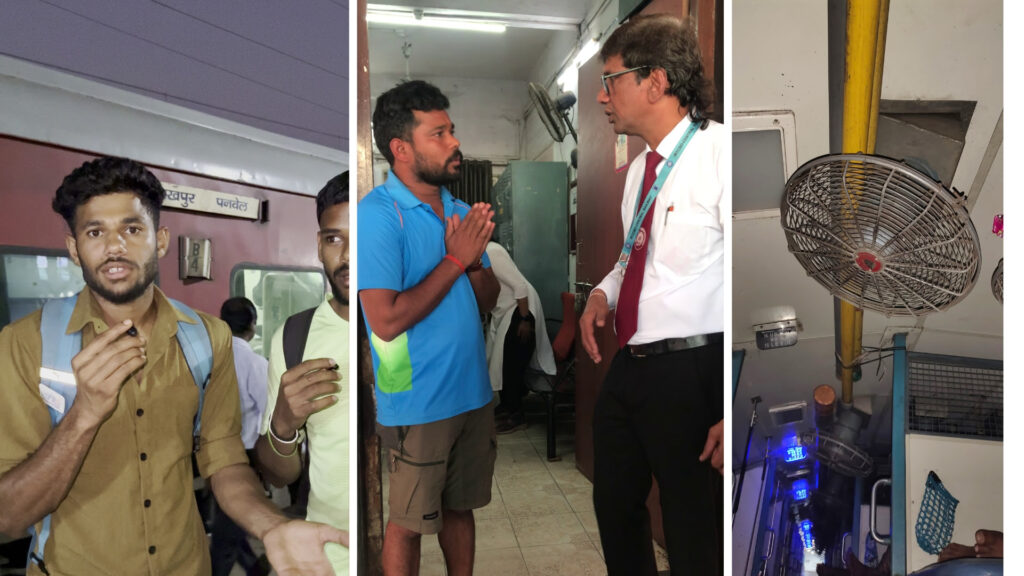
While travelling from Mangaluru to Bhopal, the group had to change trains at Panvel Railway Station. However, the entire group was stopped from boarding by the Travelling Ticket Examiner (TTE), who stated that they were not allowed to travel with the poles.
When the athletes tried to resolve the issue and requested permission to board the train, railway officials refused to listen, which ultimately led to them missing their train.
They were then forced to wait for more than five hours at the station. Even after requesting to speak to senior officials and offering to pay a fine, they were still not allowed to continue their journey.
“We are currently at Panvel Railway Station in Maharashtra, where the senior TT saw our poles and stopped us from boarding the train, because of which we missed it. We were travelling back to Bhopal after competing at the All-India Inter-University Championships. They made us wait for more than five hours and harassed us,” Dev Meena said in a video sent from the station.
“If we are facing these problems, how are we supposed to motivate junior athletes to take up pole vault for their future?” added the 21-year-old, who bettered India’s national record three times in 2025.
“I request Indian Railways to do something for athletes so that our sports equipment can travel without disturbance. Even if we need to pay extra charges, we are ready for it. This equipment’s are extremely expensive — a single pole costs around ₹2 lakh,” Dev added.
Dev Meena, the son of a farmer from Madhya Pradesh, is no ordinary athlete. He is the youngest ever national record holder in the men’s pole vault, with a best of 5.40m.
Last season, he rewrote the national record not once, not twice, but three times, improving it from 5.31m to 5.40m.
The Asian Games 2026 qualifying standard for men’s pole vault stands at 5.45m, a mark Dev is confident of achieving.
As India takes confident steps toward becoming a global sporting power, these seemingly small yet impactful logistical issues need urgent attention. Addressing them can significantly boost motivation and ensure that young athletes are not discouraged from choosing sport as a career. |


 Emergingsports
February 12, 2026
Emergingsports
February 12, 2026