
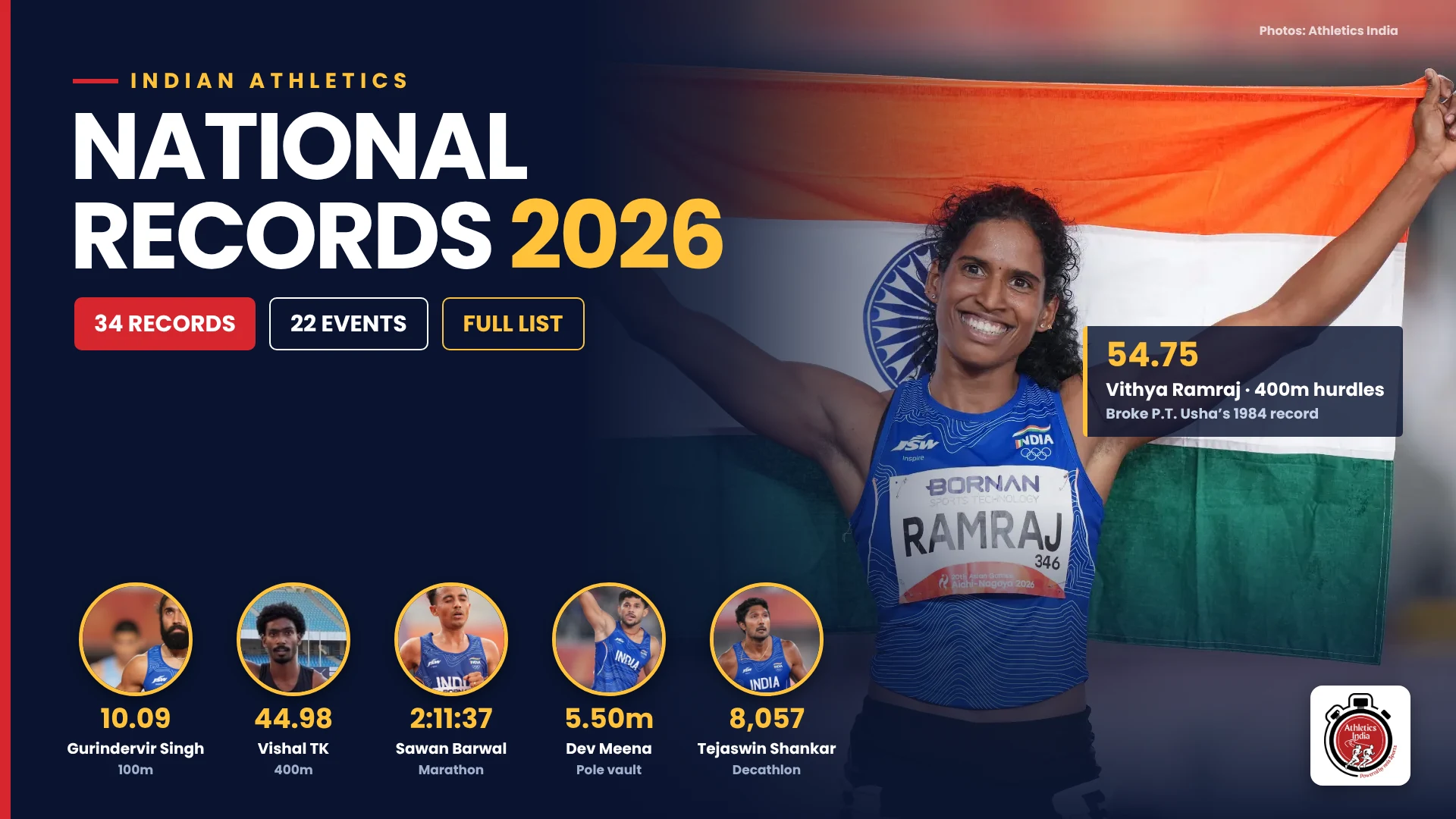
Indian national records 2026 tell the story of a record year: marks fell 34 times, across 22 events. Gurindervir Singh ran 10.09 in the 100m. Vishal TK became the first Indian under 45 seconds in the 400m. And Vithya Ramraj broke P.T. Usha’s 42-year-old 400m hurdles record at the Asian Games.
This page lists every senior national record set this year. It runs from January to the Asian Games and the Indian Athletics Series Final in September. In other words, it updates our mid-season list of 26 records from July. Below, therefore, you will find the current record in each event and the events where it fell more than once. You will also find the oldest marks that fell and the four records from Nagoya.
Jump to: Full list Broken more than once Oldest records Asian Games records New race walk records What comes next
Indian national records 2026: the full list
The table shows the current national record in each event and the meet where the athlete set it. In addition, the last column shows the record it replaced.
| Event | Athlete | Record | Where | Previous record |
|---|---|---|---|---|
| Men’s 100m | Gurindervir Singh | 10.09 | Federation Cup, Ranchi (final), May | 10.15 (Animesh Kujur) |
| Men’s 60m (indoor) | Gurindervir Singh | 6.60 | National Indoor Championships, Bhubaneswar, March | 6.67 (V.K. Elakkiyadasan, 2018) |
| Men’s 400m | Vishal TK | 44.98 | Federation Cup, Ranchi, May | 45.12 (Vishal TK) |
| Men’s 110m hurdles | Tejas Shirse | 13.27 | Indian Athletics Series 9, June | 13.41 (Tejas Shirse) |
| Men’s 5000m | Gulveer Singh | 13:03.93 | LA Track Fest, Los Angeles, May | 13:11.82 (Gulveer Singh) |
| Women’s 5000m | Parul Chaudhary | 15:04.26 | Meeting Nikaïa, Nice, June | 15:10.35 (Parul Chaudhary, 2023) |
| Women’s 3000m steeplechase | Parul Chaudhary | 9:08.67 | Asian Games, Aichi-Nagoya, September | 9:12.46 (Parul Chaudhary) |
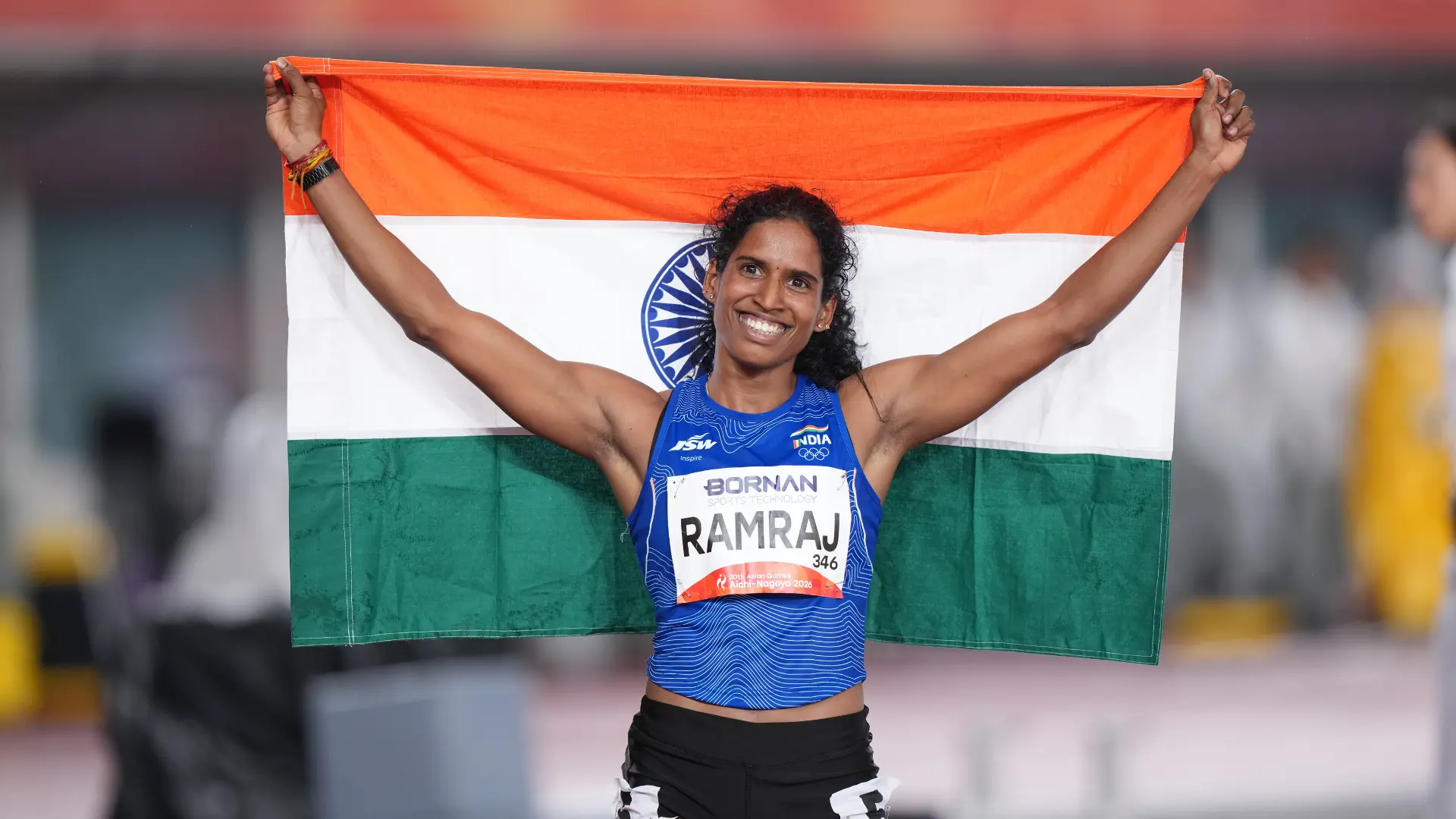
| Women’s 400m hurdles | Vithya Ramraj | 54.75 | Asian Games, Aichi-Nagoya, September | 55.42 (P.T. Usha, 1984) |
| Mixed 4x100m relay | India (Gurindervir, Sneha, Animesh, Harita) | 41.06* | Asian Games, Aichi-Nagoya, September | 41.35 (World Relays) |
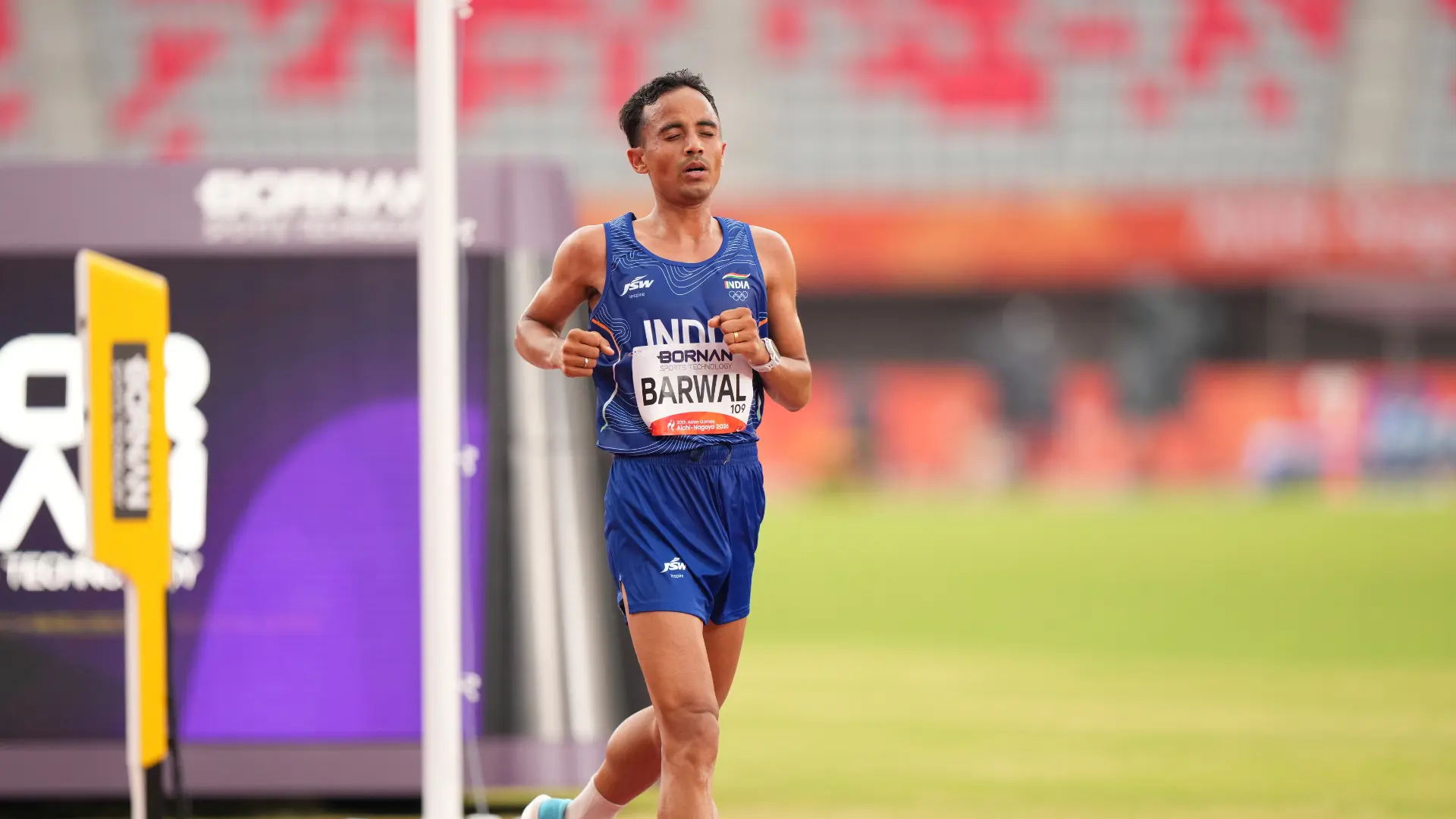
| Men’s marathon | Sawan Barwal | 2:11:37 | Asian Games, Aichi-Nagoya, September | 2:11:58 (Sawan Barwal) |
| Men’s marathon race walk | Ram Baboo | 3:09:16 | Indian Open Race Walking Competition, Chandigarh | New event |
| Women’s marathon race walk | Manju Rani | 3:33:24 | Indian Open Race Walking Competition, Chandigarh | New event |
| Men’s half marathon race walk | Sahil | 1:25:48 | Indian Open Race Walking Competition, Chandigarh | New event |
| Women’s half marathon race walk | Ravina | 1:39:14 | Indian Open Race Walking Competition, Chandigarh | New event |
| Men’s high jump | Sarvesh Kushare | 2.31m | Inter-State Championships, June | 2.29m (Tejaswin Shankar) |
| Women’s high jump | Pooja | 1.93m | Asian U20 Championships | 1.92m (Sahana Kumari) |
| Men’s pole vault | Dev Meena | 5.50m | Asian Games, Aichi-Nagoya, September | 5.46m (Dev Meena) |
| Women’s pole vault | Sindhushree G | 4.25m | Inter-State Championships, June | 4.23m (Baranica Elangovan) |
| Women’s long jump | Ancy Sojan | 6.88m | Inter-State Championships, Bhubaneswar, June | 6.83m (Anju Bobby George, 2004) |
| Women’s hammer throw | Tanya Chaudhary | 68.35m | Indian Athletics Series Final, New Delhi, September | 67.02m (Anushka Yadav) |
| Men’s hammer throw | Nirbhay Choudhary | 71.02m | Indian Athletics Series Final, New Delhi, September | 70.73m (Neeraj Kumar, 2016) |
| Decathlon | Tejaswin Shankar | 8,057 pts | Federation Cup, May | 7,826 pts (Tejaswin Shankar) |
* DD News reported the mixed relay’s 41.06 in Nagoya as a national record; it improves on the 41.35 from the World Relays. We list all records on this page as reported at the time. However, the Athletics Federation of India (AFI) ratifies national records separately.
Records broken more than once in 2026
In six events, the record fell two or more times. Above all, the men’s pole vault led the way: Kuldeep Kumar and Dev Meena pushed each other from 5.41m to 5.50m in one season.
| Event | How the record moved in 2026 |
|---|---|
| Men’s 100m | 10.17 (Gurindervir Singh) → 10.15 (Animesh Kujur) → 10.09 (Gurindervir Singh) |
| Mixed 4x100m relay | 42.30 (India B) → 41.35 (India) → 41.06* (India) |
| Men’s marathon | 2:11:58 (Sawan Barwal) → 2:11:37 (Sawan Barwal) |
| Men’s pole vault | 5.41m (Kuldeep Kumar) → 5.42m (Dev Meena) → 5.45m (Kuldeep Kumar and Dev Meena) → 5.46m (Dev Meena) → 5.50m (Dev Meena) |
| Women’s pole vault | 4.22m (Baranica Elangovan) → 4.23m (Baranica Elangovan) → 4.25m (Sindhushree G) |
| Women’s hammer throw | 67.02m (Anushka Yadav) → 68.35m (Tanya Chaudhary) |
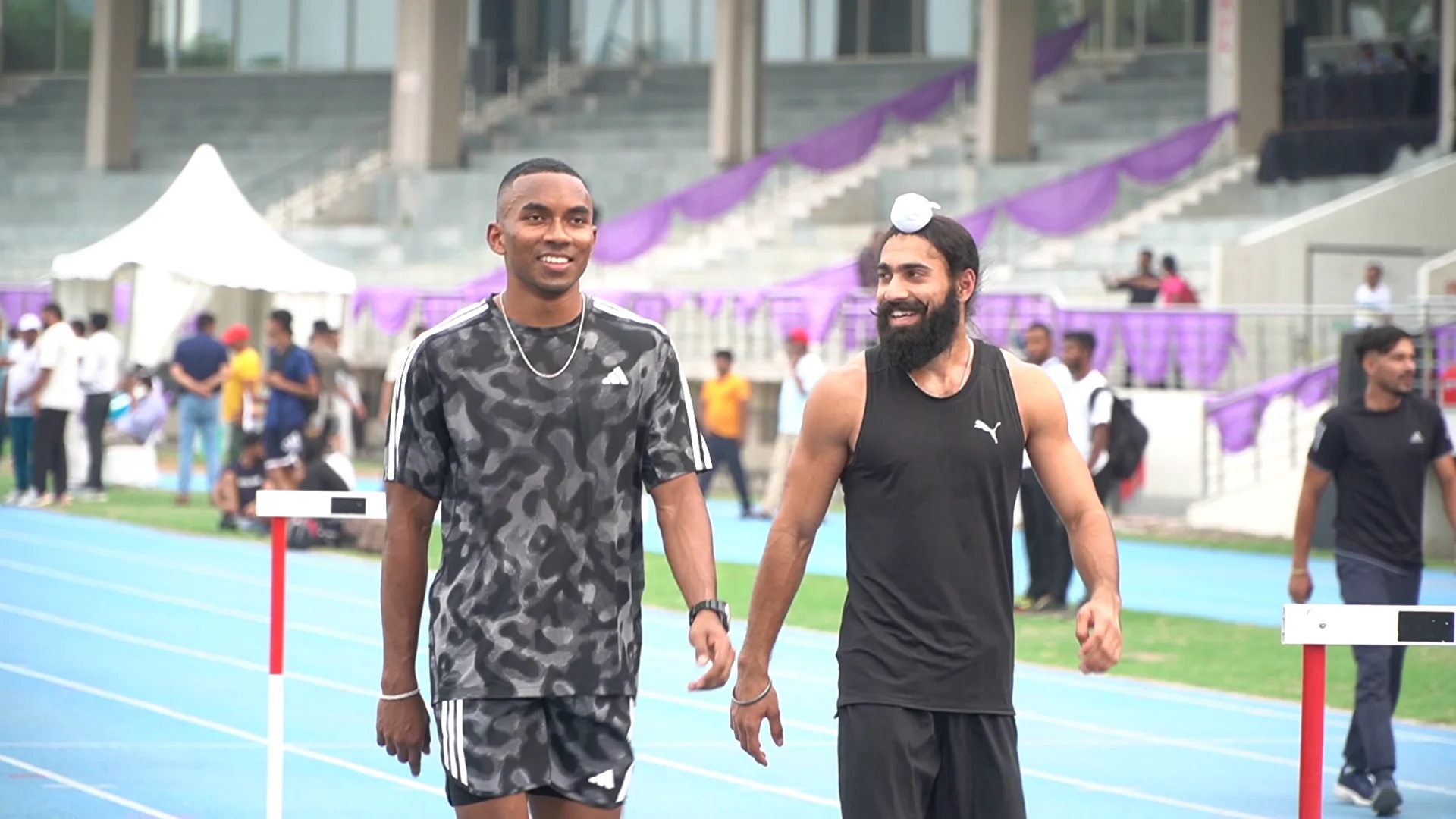
Similarly, the 100m record changed hands three times in one meet. First, Gurindervir ran 10.17 in his semi-final; then Animesh Kujur replied with 10.15. Finally, in the final, Gurindervir took it back with 10.09, as The Tribune reported.
The oldest Indian national records that fell in 2026
Moreover, several of this year’s new records replaced marks that had lasted for decades. As a result, fans will remember 2026 as the year Indian athletics finally moved past some of its most famous names.
| Record broken | Old mark | New mark | Years it stood |
|---|---|---|---|
| Men’s marathon | Shivnath Singh (1978) | Sawan Barwal, 2:11:58, then 2:11:37 | 48 |
| Women’s 400m hurdles | P.T. Usha, 55.42 (1984) | Vithya Ramraj, 54.75 | 42 |
| Women’s long jump | Anju Bobby George, 6.83m (2004) | Ancy Sojan, 6.88m | 22 |
| Men’s hammer throw | Neeraj Kumar, 70.73m (2016) | Nirbhay Choudhary, 71.02m | 10 |
Four national records at the Asian Games 2026
Meanwhile, India set four national records at the Asian Games 2026 in Aichi-Nagoya, and, notably, three of them came with medals.
| Athlete | Event | Record | Result |
|---|---|---|---|
| Sawan Barwal | Men’s marathon | 2:11:37 | Silver |
| Vithya Ramraj | Women’s 400m hurdles | 54.75 | Bronze |
| Parul Chaudhary | Women’s 3000m steeplechase | 9:08.67 | Bronze |
| Dev Meena | Men’s pole vault | 5.50m | 7th |
The first national records in the new race walk events
From 2026, the half marathon and marathon race walks replaced the 20km and 35km at major championships. Consequently, India needed new national records. The first ones came at the Indian Open Race Walking Competition in Chandigarh. In the marathon race walk, Ram Baboo set 3:09:16 and Manju Rani 3:33:24. In the half marathon race walk, Sahil clocked 1:25:48 and Ravina 1:39:14.
What comes next for Indian national records
The senior season is nearly over; still, records can fall before the end of the year, so we will add any new mark to this page. Meanwhile, the full results from every meet are on our Indian athletics results page.
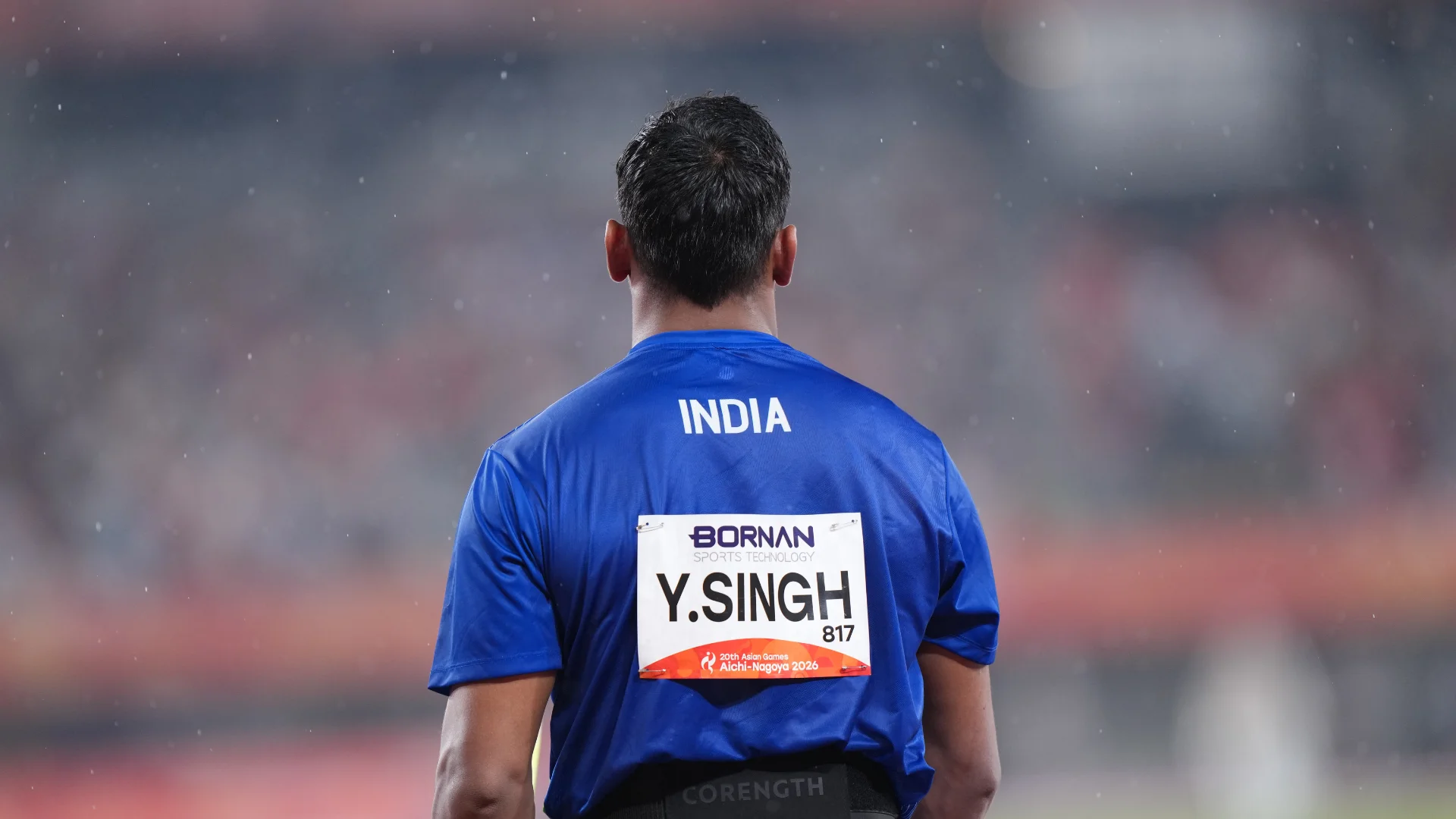
Who is Yashvir Singh? He is the 24-year-old javelin thrower from Haryana who won silver at the Asian Games 2026 in Nagoya with a personal best of 85.72m. Two months earlier, Yashvir Singh won bronze at the Commonwealth Games in Glasgow, his first international medal.
He only reached Nagoya because he replaced the injured Neeraj Chopra. This page therefore tells his whole story so far: his medals, his personal bests, his 2026 season throw by throw, and the father who taught him the event.
Yashvir Singh at a glance
- Born: 22 October 2001, Devsar village, Bhiwani (Haryana)
- Age: 24
- State: Born in Haryana, competes for Rajasthan
- Event: Javelin throw
- Personal best: 85.72m (Asian Games, September 2026)
- 2026 medals: Asian Games silver and Commonwealth Games bronze
- Coach: his father, Rai Singh, a former national-level javelin thrower
- Off the track: trained at Sawai Mansingh Stadium, Jaipur, and started on a bamboo javelin
Jump to: Who is he Asian Games silver CWG bronze 2026 season Personal bests His story Beyond the track
Who is Yashvir Singh? The short answer
Yashvir Singh is an Indian javelin thrower, also written as Yash Vir Singh. He was born on 22 October 2001, according to World Athletics, and he competes for Rajasthan at national level.
His 2026 season was the breakout year of his career. He improved his personal best four times, won Commonwealth Games bronze and then won Asian Games silver. Meanwhile, he shared both podiums with fellow Indians: Neeraj Chopra in Glasgow and Rohit Yadav in Nagoya.
Asian Games 2026: javelin silver with his last throw
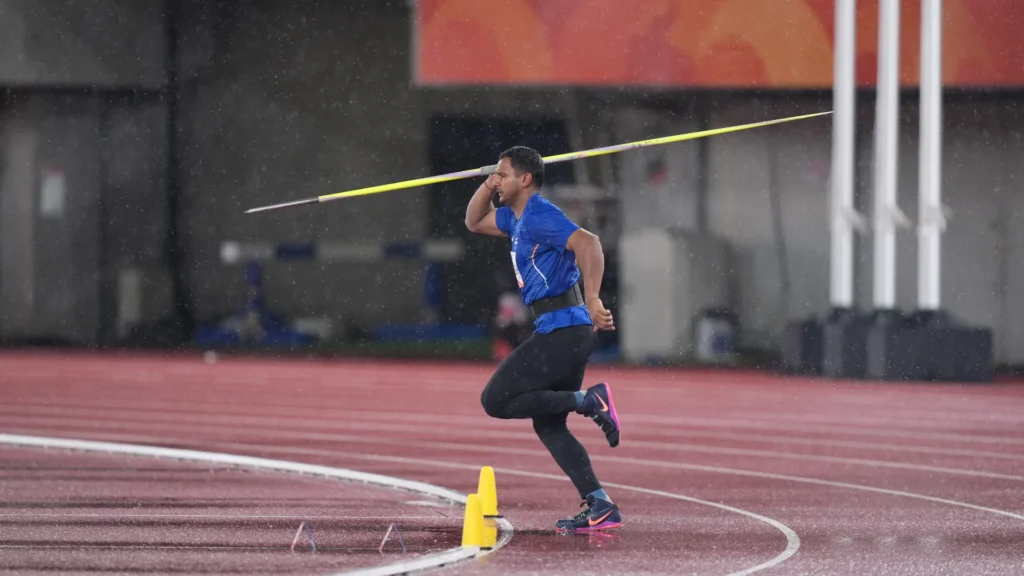
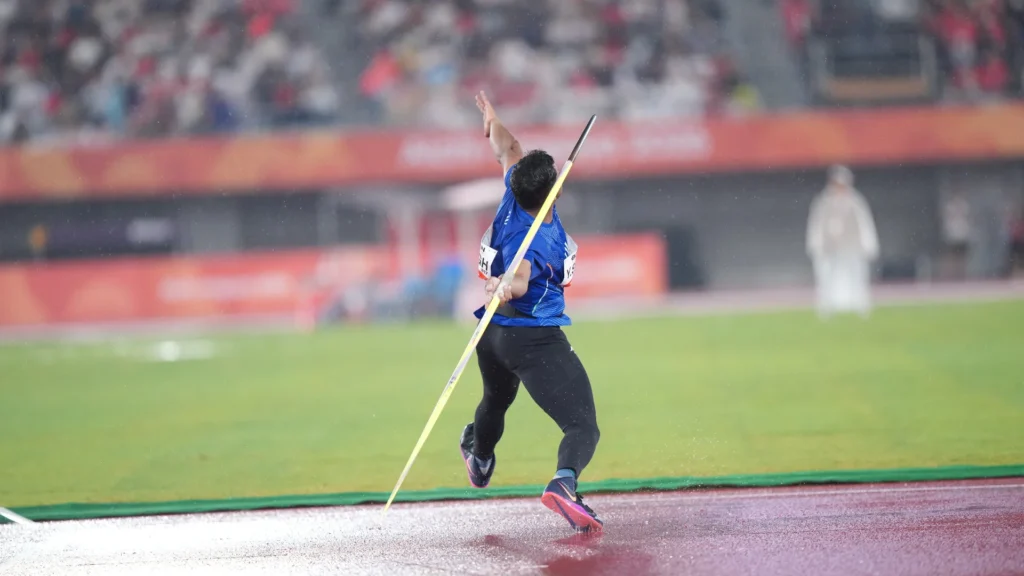
The men’s javelin final took place in Nagoya on Monday 28 September. Yashvir opened with 83.56m to take the early lead. He then threw 84.31m and 85.14m in rounds four and five. Finally, on his sixth attempt, he launched a personal best of 85.72m to move past Rohit Yadav into second place.
Sri Lanka’s Rumesh Pathirage won gold with 88.55m, also on his final throw. As a result, India finished with silver and bronze, and Pakistan’s Olympic champion Arshad Nadeem finished fourth. Full marks are on our Asian Games 2026 javelin results page.
| Place | Athlete | Country | Mark |
|---|---|---|---|
| 1 | Rumesh Pathirage | Sri Lanka | 88.55m |
| 2 | Yashvir Singh | India | 85.72m |
| 3 | Rohit Yadav | India | 84.35m |
| 4 | Arshad Nadeem | Pakistan | 80.29m |
The medal also came after a late call-up. Yashvir was not on India’s original long list, but the AFI named him in place of the injured Chopra on 3 September, PTI reported. In addition, AFI president Bahadur Singh Sagoo said the federation picked him because he was a Commonwealth Games medallist.
Commonwealth Games 2026: bronze on his last attempt
In Glasgow, Yashvir only scraped into the final. Strong headwinds hit the qualifying round on 30 July, and he finished 10th with 78.36m. As a result, India had three throwers in a Commonwealth Games javelin final for the first time.
The final came a day later, on 31 July. Yashvir sat seventh after five rounds, with a best of 81.33m. Then, with his last throw, he hit a personal best of 85.41m and jumped to bronze, PTI reported. Anderson Peters and Douw Smit still had final throws left, but neither could pass him.
| Place | Athlete | Country | Mark |
|---|---|---|---|
| 1 | Rumesh Pathirage | Sri Lanka | 89.75m |
| 2 | Neeraj Chopra | India | 85.83m |
| 3 | Yashvir Singh | India | 85.41m |
| 4 | Anderson Peters | Grenada | 83.88m |
| 7 | Rohit Yadav | India | 81.56m |
The bronze put him in rare company. He became only the third Indian man to win a Commonwealth Games javelin medal, after Kashinath Naik in 2010 and Chopra, Outlook reported. Every Indian result from Glasgow is on our CWG 2026 page.
Download PDF: CWG 2026 complete results
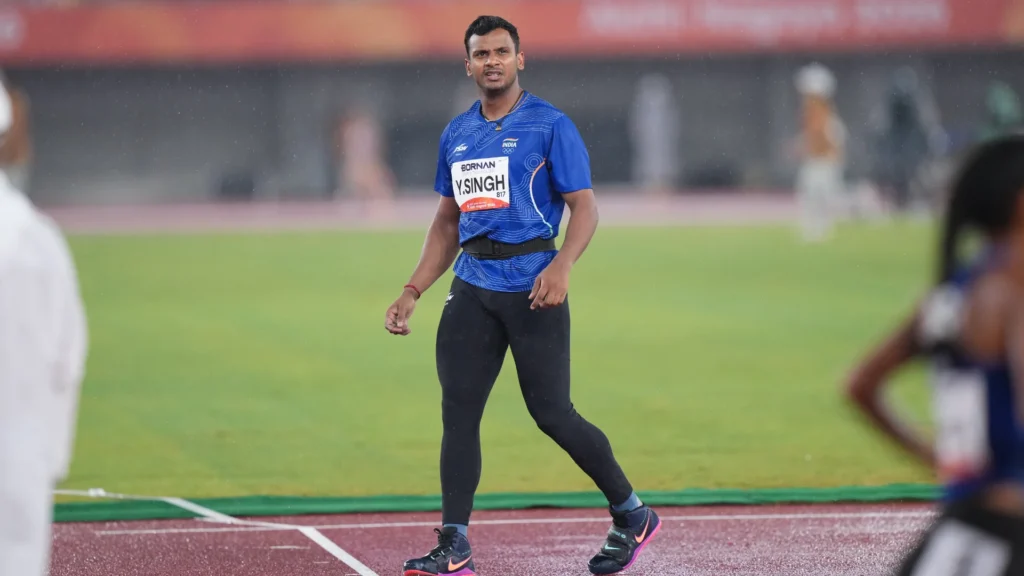
Yashvir Singh’s 2026 season, throw by throw
His rise came in steps. For example, his best went from 82.57m in 2025 to 82.93m in Ludhiana and 83.72m in Bhubaneswar in June. Then, at the two biggest meets of the year, he added almost two more metres.
| When | Meet | Event | Result |
|---|---|---|---|
| 11 April | Indian Athletics Series-3, New Delhi | Javelin | 81.61m, third |
| 25 May | Federation Cup, Ranchi | Javelin | 80.80m, second |
| 13 June | Indian Athletics Series-9, Ludhiana | Javelin | 82.93m, second, personal best then and CWG mark |
| 28 June | Inter-State Championships, Bhubaneswar | Javelin | 83.72m, silver, personal best then |
| 30 July | Commonwealth Games qualifying, Glasgow | Javelin | 78.36m, 10th, reached final |
| 31 July | Commonwealth Games final, Glasgow | Javelin | 85.41m, bronze |
| 22 August | World Athletics Continental Tour meet, Bhubaneswar | Javelin | 82.94m, second |
| September | Indian Athletics Final Series, New Delhi | Javelin | 80.40m, third |
| 28 September | Asian Games final, Nagoya | Javelin | 85.72m, silver |
At the Inter-State Championships, his 83.72m also cleared the Asian Games mark of 77.87m. However, Rohit Yadav won that day with 87.05m, and Yashvir did not make the first Asian Games list. Results from all of India’s javelin throwers are on our men’s javelin page.
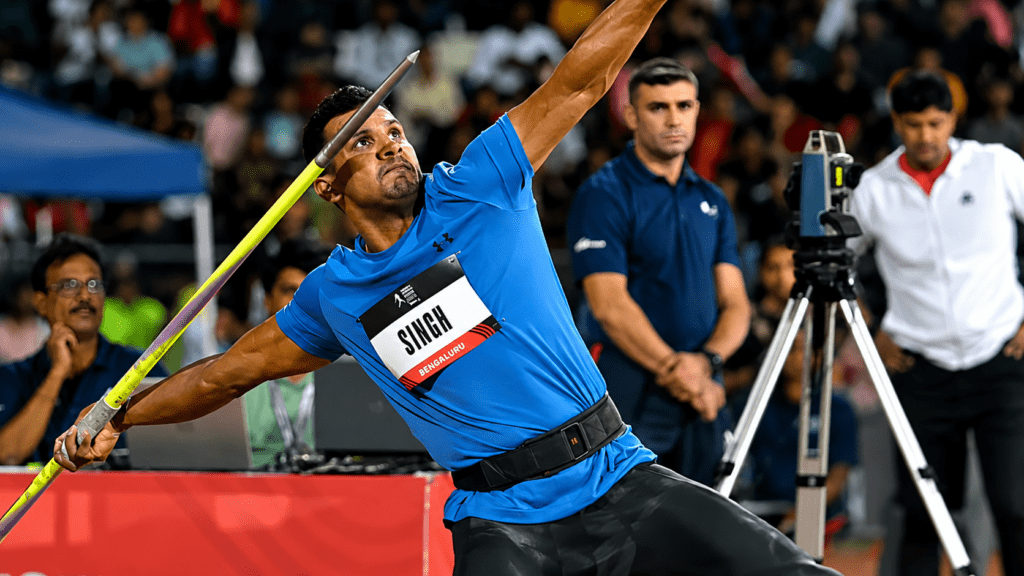
Yashvir Singh personal bests
All of his best senior throws came in 2026. The marks below are from his World Athletics profile and our race reports.
| Event | Mark | Where | Date |
|---|---|---|---|
| Javelin (800g) | 85.72m | Asian Games, Mizuho Park Athletic Stadium, Nagoya | 28 September 2026 |
| Javelin, previous best | 85.41m | Commonwealth Games, Scotstoun Stadium, Glasgow | 31 July 2026 |
| Javelin, best before 2026 | 82.57m | Asian Championships, Gumi Civic Stadium (Korea) | 31 May 2025 |
| Javelin (700g, youth) | 75.63m | Ranchi | 2 November 2018 |
His 85.72m is more than three metres beyond his 2025 best. In addition, he threw past 85m twice in two months, both times with his sixth and final throw. Meanwhile, his first 80m throw came back in 2022, when his 82.13m made him only the 12th Indian over 80m, the AFI reported.
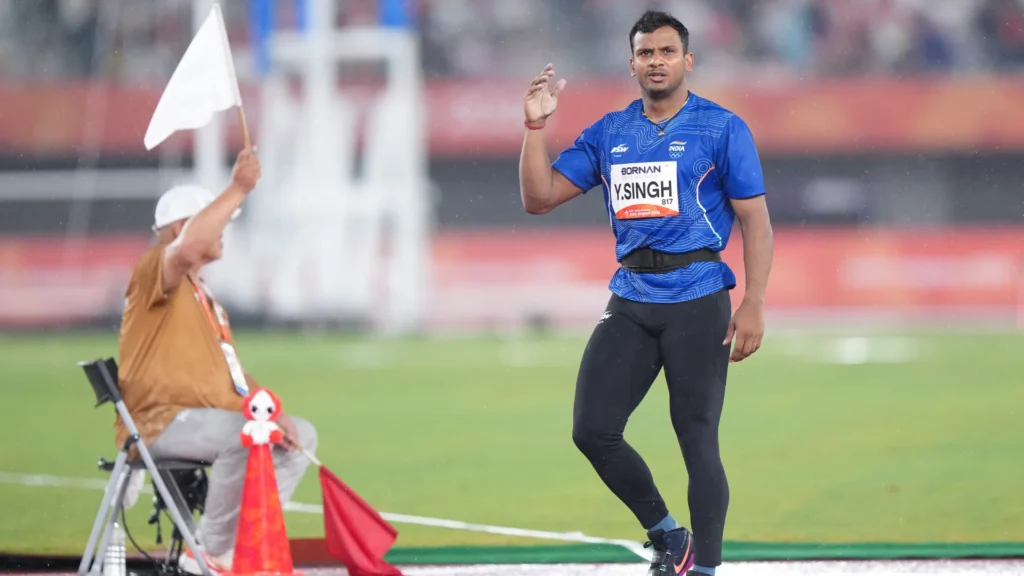
Who is Yashvir Singh’s coach? From Bhiwani to Nagoya
Yashvir grew up in Devsar village near Bhiwani. His father, Rai Singh, was a national-level javelin thrower and a Railways champion who later became a coach. He began coaching his son in 2015, so that Yashvir would not repeat the mistakes he made without a coach.
However, javelin was not his first sport. He liked basketball first, and he started throwing with a bamboo javelin before he moved to proper equipment. He then won national U18 titles in 2017 and 2018 and junior national silver in 2019.
In January 2021, at the U20 Federation Cup in Bhopal, he threw 78.68m and broke Chopra’s meet record of 76.91m. Then, in 2025, he won the Indian Open in Chennai and the Arzumanov Memorial in Tashkent. He also finished fifth at the Asian Championships in Gumi with 82.57m and made his World Championships debut in Tokyo.
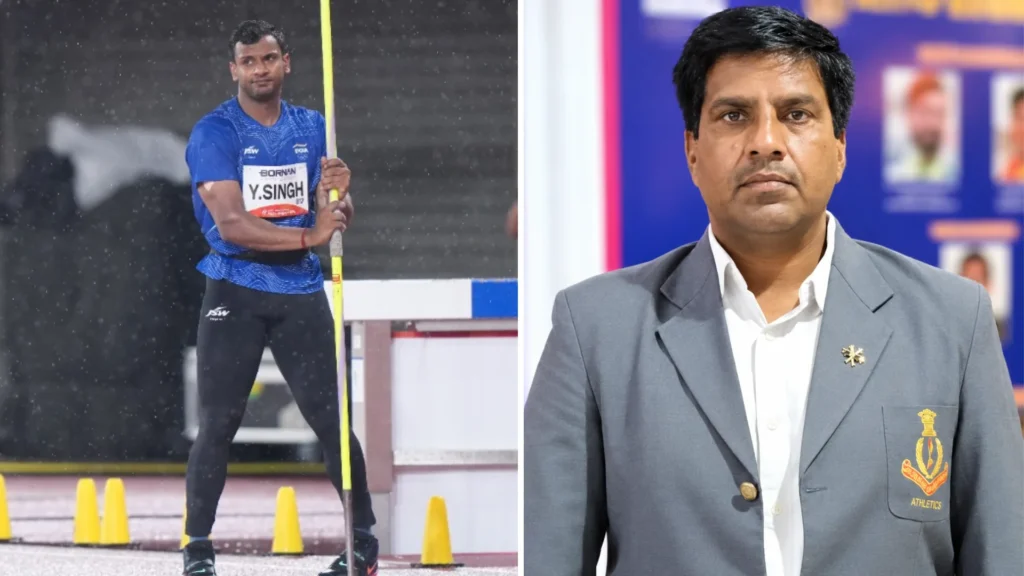
Yashvir Singh began throwing in 2015 under his father, Rai Singh, a former national-level javelin thrower.
Who is Yashvir Singh beyond the track? Family, Jaipur and sacrifice
Although he was born in Haryana, Yashvir built his career in Rajasthan. He trained regularly at the Sawai Mansingh Stadium in Jaipur. In addition, he has said a real javelin was too expensive at first, so he practised with a bamboo one and sometimes got hurt.
After Glasgow, he called the bronze the result of years of work and family sacrifice. “This is my first international medal, and I am overjoyed,” he told ANI. He also urged young athletes in Rajasthan to stay disciplined, follow their diet and listen to their coaches.
Meanwhile, the man he replaced in Nagoya is one of his biggest supporters. Chopra praised him after Glasgow and pointed to his 85m throw as proof of India’s javelin depth.
Follow Yashvir Singh on Athletics India
His full stats and results are on Yashvir Singh’s athlete profile. In addition, every Indian result from Nagoya is on our Asian Games 2026 hub.
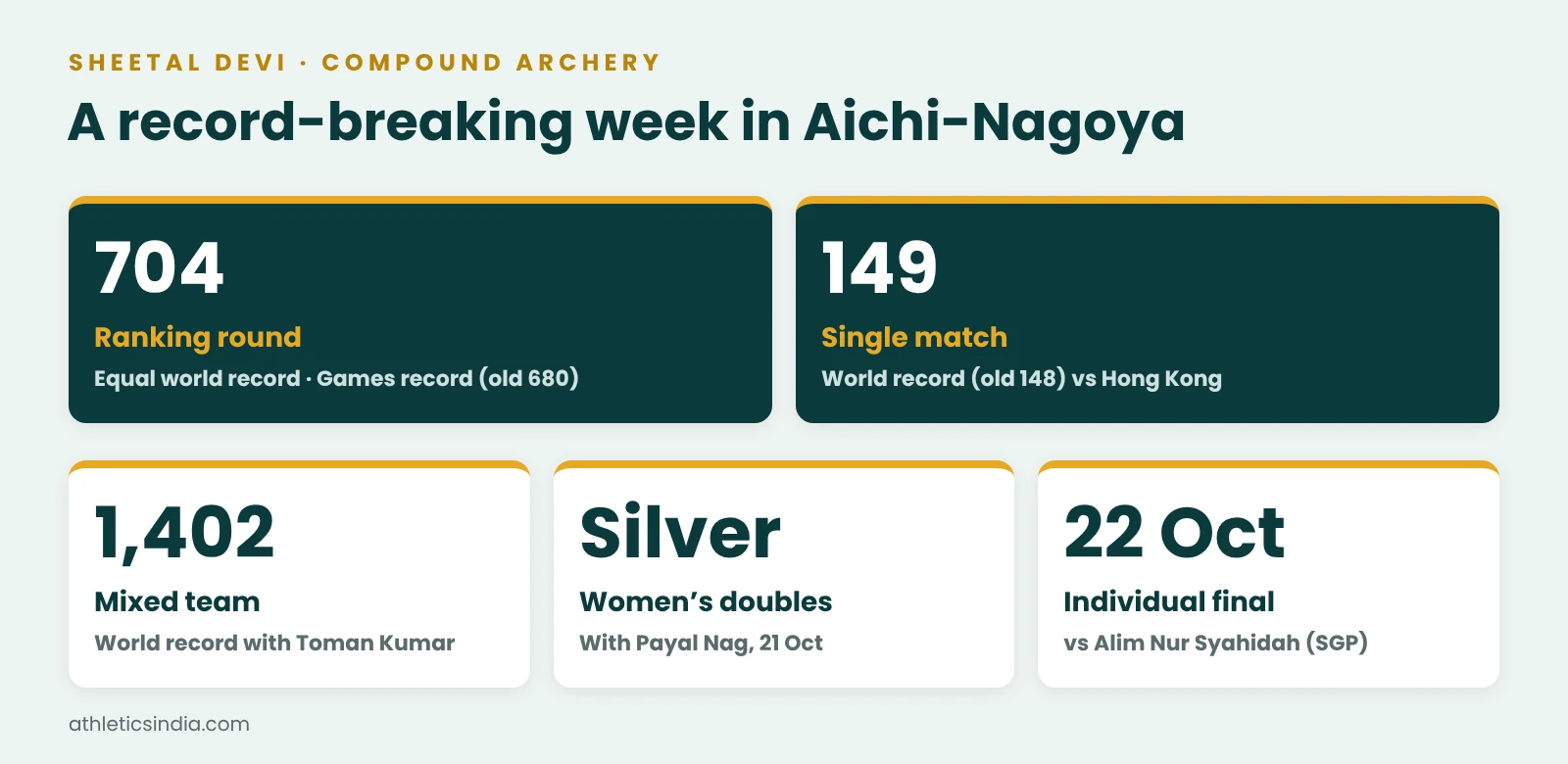
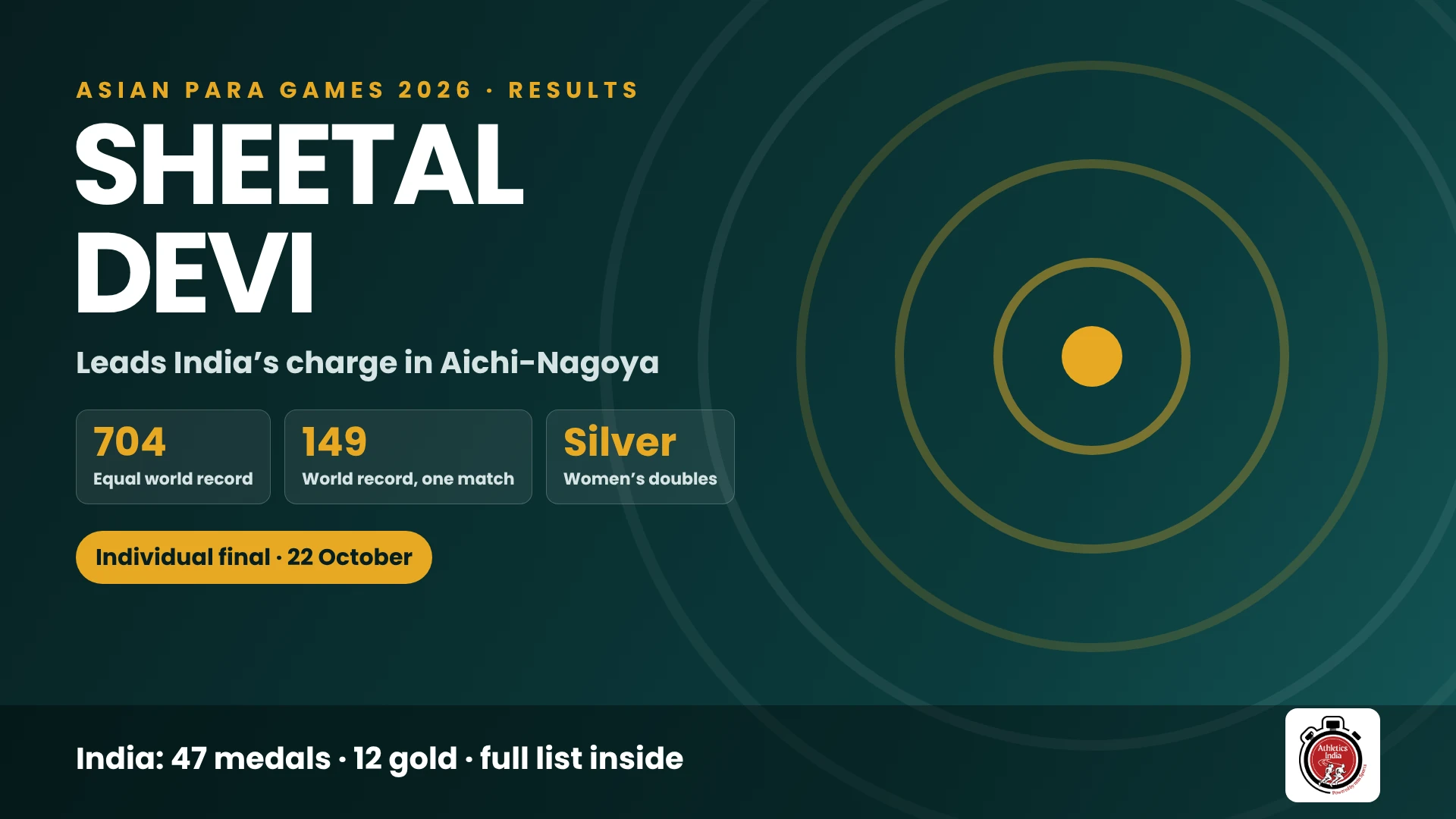
Sheetal Devi is the headline of India’s Asian Para Games 2026 results. The armless archer from Jammu and Kashmir has equalled the world record, broken two more world records, won silver in the women’s doubles and reached the individual compound final, which she shoots on 22 October.
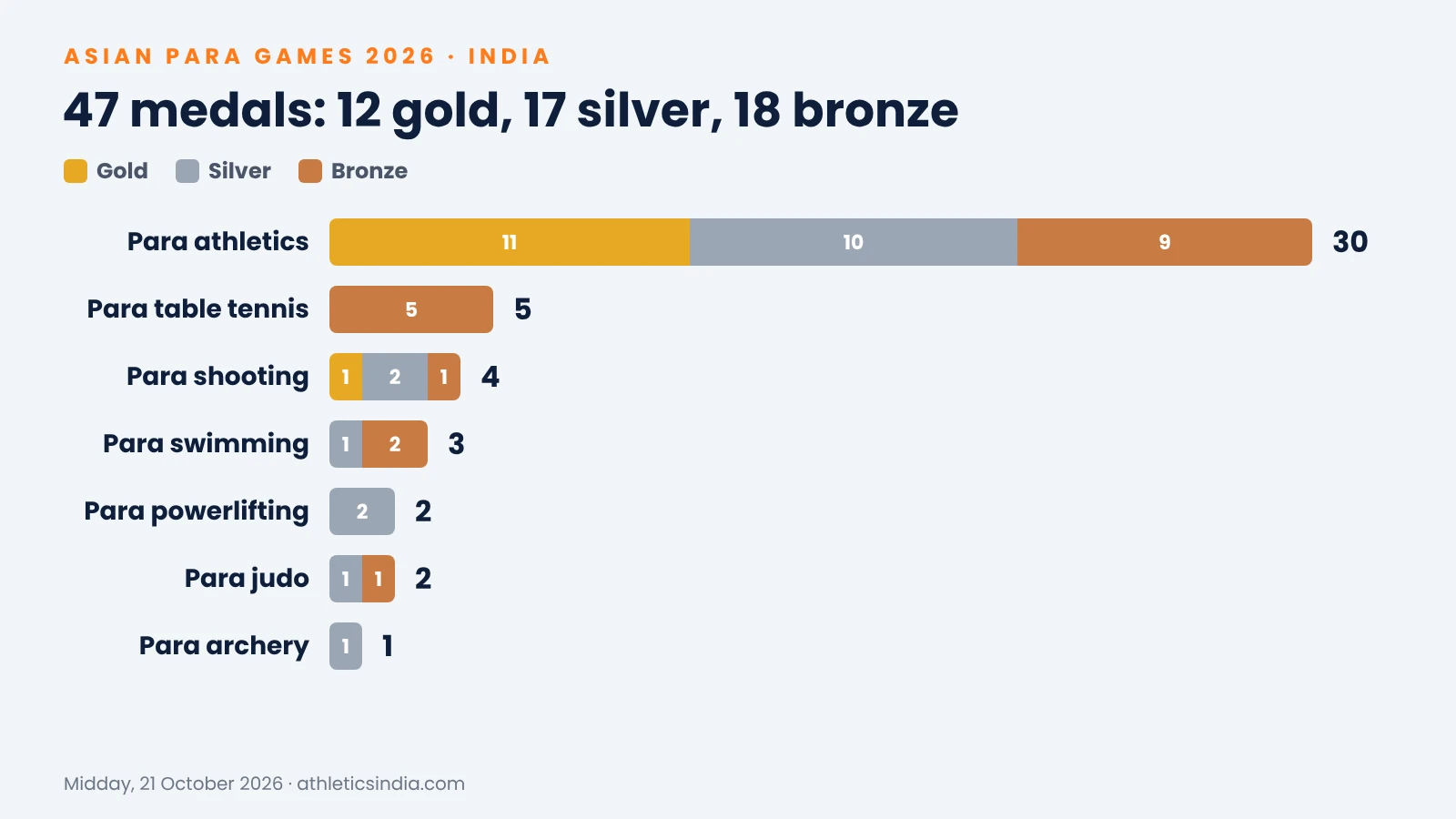
Overall, India has won 47 medals (12 gold, 17 silver, 18 bronze) at the Games in Aichi-Nagoya, Japan, as of midday on 21 October. Para athletics leads the way with 30 medals. Below are Sheetal’s results, India’s medal tally by sport and every Indian athletics medal, day by day.
Asian Para Games 2026 results: India at a glance
- Sheetal Devi: 704 in the ranking round (equal world record), world-record 149 in a match, women’s doubles silver, individual final on 22 October
- India’s medals (all sports): 47 (12 gold, 17 silver, 18 bronze) at midday on 21 October
- Para athletics: 30 medals (11 gold, 10 silver, 9 bronze)
- Games records in athletics: Deepthi Jeevanji, Simran Sharma, Nishad Kumar, Praveen Kumar, Sachin Khilari
- Games: 18 to 24 October 2026, Aichi-Nagoya, Japan
Sheetal Devi leads the Asian Para Games 2026 results
Sheetal arrived in Aichi-Nagoya as the defending champion and world No. 1 in women’s compound. Even so, her first three days were remarkable. In the ranking round, she scored 704 out of 720, equalling the world record held jointly with Turkey’s Oznur Cure. That score also raised the Asian Para Games record from 680 to 704.
| Round | Event | Result | Note |
|---|---|---|---|
| Ranking round | Women’s compound individual | 704, ranked 1st | Equal world record; Asian Para Games record (old 680) |
| Ranking round | Women’s doubles (with Payal Nag) | 1,379, ranked 1st | Asian and Games records |
| Ranking round | Mixed team (with Toman Kumar) | 1,402 | World record (old 1,400, Sheetal and Rakesh Kumar) |
| Pre-quarter-final | Individual | Beat Chan Yuen Wah (Hong Kong) 149-134 | World record (old 148, Jessica Stretton) |
| Quarter-final | Individual | Beat Agustina Bantiloc (Philippines) 147-135 | – |
| Semi-final | Individual | Beat Aya Shinohara (Japan) 145-137 | Medal assured |
| Final, 21 Oct | Women’s doubles (with Payal Nag) | 🥈 Silver, lost 141-150 | To China’s Xu Xueqing and Zhao Jing |
| Final, 22 Oct | Individual | vs Alim Nur Syahidah (Singapore) | Gold-medal match |
Silver in the doubles with Payal Nag
In the women’s doubles, Sheetal teamed up with 18-year-old Payal Nag from Balangir, Odisha. Payal lost all four limbs in an electrocution accident as a child, and she took up archery after being inspired by Sheetal. Together, they topped the ranking round with Asian and Games records. However, in the final on 21 October, China’s Xu Xueqing and Zhao Jing won 150-141, so the Indian pair took silver.
Other Indian archers
Swati Chaudhary reached the women’s W1 final by beating South Korea’s Lee Eunhee 6-2. Meanwhile, Toman Kumar lost his men’s compound semi-final 144-149 to China’s Ai Xin Liang and goes for bronze.
Who is Sheetal Devi?
Sheetal Devi was born on 10 January 2007 in Loidhar village in the Kishtwar district of Jammu and Kashmir. She was born with phocomelia, a rare condition that left her without arms, so she shoots with her legs and feet. In fact, she is the first female para archer without arms to become a world champion.
Around 2020, the Indian Army’s Rashtriya Rifles noticed her through Operation Sadbhavana and supported her education and medical care. Later, at the Shri Mata Vaishno Devi Shrine Board Sports Complex, coaches Abhilasha Chaudhary and Kuldeep Baidwan began training her. Within 11 months, she was competing at the Asian Para Games.
| Year | Competition | Result |
|---|---|---|
| 2023 | Asian Para Games, Hangzhou (2022 edition) | 🥇 Individual gold, 🥇 mixed team gold, 🥈 doubles silver |
| 2023 | World Championships, Plzeň | 🥈 Individual silver |
| 2024 | Paralympic Games, Paris | 🥉 Mixed team bronze with Rakesh Kumar, at 17 the youngest Indian Paralympic medallist |
| 2025 | World Championships, Gwangju | 🥇 Individual gold (beat Oznur Cure 146-143), 🥈 doubles silver, 🥉 mixed team bronze |
| 2026 | Asian Para Games, Aichi-Nagoya | 🥈 Doubles silver; individual final on 22 October |
Sheetal received the Arjuna Award for 2023 and was named World Archery’s Para Archer of the Year for 2025.
India’s Asian Para Games 2026 medal tally by sport
Para athletics has won 30 of India’s 47 medals so far. In addition, para shooting has given India a gold through Mona Agarwal in the women’s 10m air rifle SH1.
| Sport | Gold | Silver | Bronze | Total |
|---|---|---|---|---|
| Para athletics | 11 | 10 | 9 | 30 |
| Para shooting | 1 | 2 | 1 | 4 |
| Para archery | 0 | 1 | 0 | 1 |
| Para swimming | 0 | 1 | 2 | 3 |
| Para powerlifting | 0 | 2 | 0 | 2 |
| Para judo | 0 | 1 | 1 | 2 |
| Para table tennis | 0 | 0 | 5 | 5 |
| Total | 12 | 17 | 18 | 47 |
Para athletics results: 19 October
India opened with six athletics medals. Nishad Kumar won the long jump T47, and then Rinku Hooda and Ajeet Singh Yadav finished one-two in the javelin F46, just nine centimetres apart. Later, Soumya and Radha Venkatesh did the same in the women’s 1500m T12/T13.
| Athlete | Event | Medal | Mark | Note |
|---|---|---|---|---|
| Nishad Kumar | Men’s long jump T47 | 🥇 Gold | 7.11m | – |
| Rinku Hooda | Men’s javelin F46 | 🥇 Gold | 65.11m | – |
| Soumya | Women’s 1500m T12/T13 | 🥇 Gold | 5:12.39 | – |
| Ajeet Singh Yadav | Men’s javelin F46 | 🥈 Silver | 65.02m | – |
| Radha Venkatesh | Women’s 1500m T12/T13 | 🥈 Silver | 5:30.90 | – |
| Ravanni Valasanaini | Women’s 1500m T11 | 🥉 Bronze | 5:41.85 | Guide: Rahul Balakrishna |
Para athletics results: 20 October
Day 2 brought 14 athletics medals. Above all, Deepthi Jeevanji defended her 400m T20 title in a Games record of 56.36, and Simran Sharma won the 200m T12 in 24.80, also a Games record. Nishad Kumar then added a second gold in the high jump with a Games record of 2.04m.
| Athlete | Event | Medal | Mark | Note |
|---|---|---|---|---|
| Deepthi Jeevanji | Women’s 400m T20 | 🥇 Gold | 56.36 | Games record |
| Simran Sharma | Women’s 200m T12 | 🥇 Gold | 24.80 | Games record |
| Nishad Kumar | Men’s high jump T47 | 🥇 Gold | 2.04m | Games record |
| Pranav Soorma | Men’s discus F51–53 | 🥇 Gold | 11.66m | Asian record |
| Devender Kumar | Men’s discus F43/44/62/64 | 🥇 Gold | 49.71m | – |
| Ram Ratan Singh | Men’s discus F51–53 | 🥈 Silver | 10.35m | – |
| Rakesh | Men’s discus F43/44/62/64 | 🥈 Silver | 49.35m | – |
| Pradeep Kumar | Men’s javelin F53/54 | 🥈 Silver | 27.45m | Personal best |
| Preethi Pal | Women’s 200m T35 | 🥈 Silver | 29.53 | – |
| Tejalben Damor | Women’s 200m T12 | 🥉 Bronze | 25.23 | Personal best |
| Pardeep Kumar | Men’s discus F43/44/62/64 | 🥉 Bronze | 51.15m | Personal best |
| Ayush Verma | Men’s javelin F53/54 | 🥉 Bronze | 17.88m | Personal best |
| Praveen Sharma | Men’s shot put F11 | 🥉 Bronze | 13.86m | Personal best |
| Hokato Hotozhe Sema | Men’s shot put F57 | 🥉 Bronze | 14.65m | – |
Para athletics results: 21 October
On Wednesday, Paris Paralympic champion Praveen Kumar won the high jump T64 with a Games record of 2.05m. Then India swept the shot put F46, led by Sachin Khilari’s Games record of 15.87m. Later, Anubhav Choudhary and Rakeshbhai Bhatt both ran personal bests for 100m bronze.
| Athlete | Event | Medal | Mark | Note |
|---|---|---|---|---|
| Praveen Kumar | Men’s high jump T64 | 🥇 Gold | 2.05m | Games record |
| Sachin Khilari | Men’s shot put F46 | 🥇 Gold | 15.87m | Games record |
| Ayush Verma | Men’s shot put F53 | 🥇 Gold | 8.16m | – |
| Banti | Men’s high jump T64 | 🥈 Silver | 1.92m | Personal best |
| Mohd Yasser | Men’s shot put F46 | 🥈 Silver | 15.06m | – |
| Manjeet | Men’s javelin F12/F13 | 🥈 Silver | 61.03m | Personal best |
| Bhagyashri Jadhav | Women’s shot put F34 | 🥈 Silver | – | – |
| Parveen | Men’s shot put F46 | 🥉 Bronze | 14.94m | – |
| Anubhav Choudhary | Men’s 100m T35 | 🥉 Bronze | 12.72 | Personal best |
| Rakeshbhai Bhatt | Men’s 100m T37 | 🥉 Bronze | 11.50 | Personal best |
Results for 21 October are as of midday. We add every new Indian medal to this page as soon as it is confirmed.
Records set by Indian athletes at the Asian Para Games 2026
| Athlete | Sport and event | Mark | Record |
|---|---|---|---|
| Sheetal Devi | Archery, compound ranking round | 704 | Equal world record; Games record |
| Sheetal Devi | Archery, compound match | 149 | World record |
| Sheetal Devi and Toman Kumar | Archery, mixed team ranking round | 1,402 | World record |
| Pranav Soorma | Athletics, discus F51–53 | 11.66m | Asian record |
| Deepthi Jeevanji | Athletics, 400m T20 | 56.36 | Games record |
| Simran Sharma | Athletics, 200m T12 | 24.80 | Games record |
| Nishad Kumar | Athletics, high jump T47 | 2.04m | Games record |
| Praveen Kumar | Athletics, high jump T64 | 2.05m | Games record |
| Sachin Khilari | Athletics, shot put F46 | 15.87m | Games record (old 15.67m) |
What to watch next
On 22 October, Sheetal Devi shoots for her second straight Asian Para Games individual gold against Singapore’s Alim Nur Syahidah. Meanwhile, the athletics programme continues until the Games end on 24 October, and India’s squad still includes two-time Paralympic javelin champion Sumit Antil. For the full athletics squad, see our Asian Para Games 2026 guide.
This page is updated with every Indian medal until 24 October.
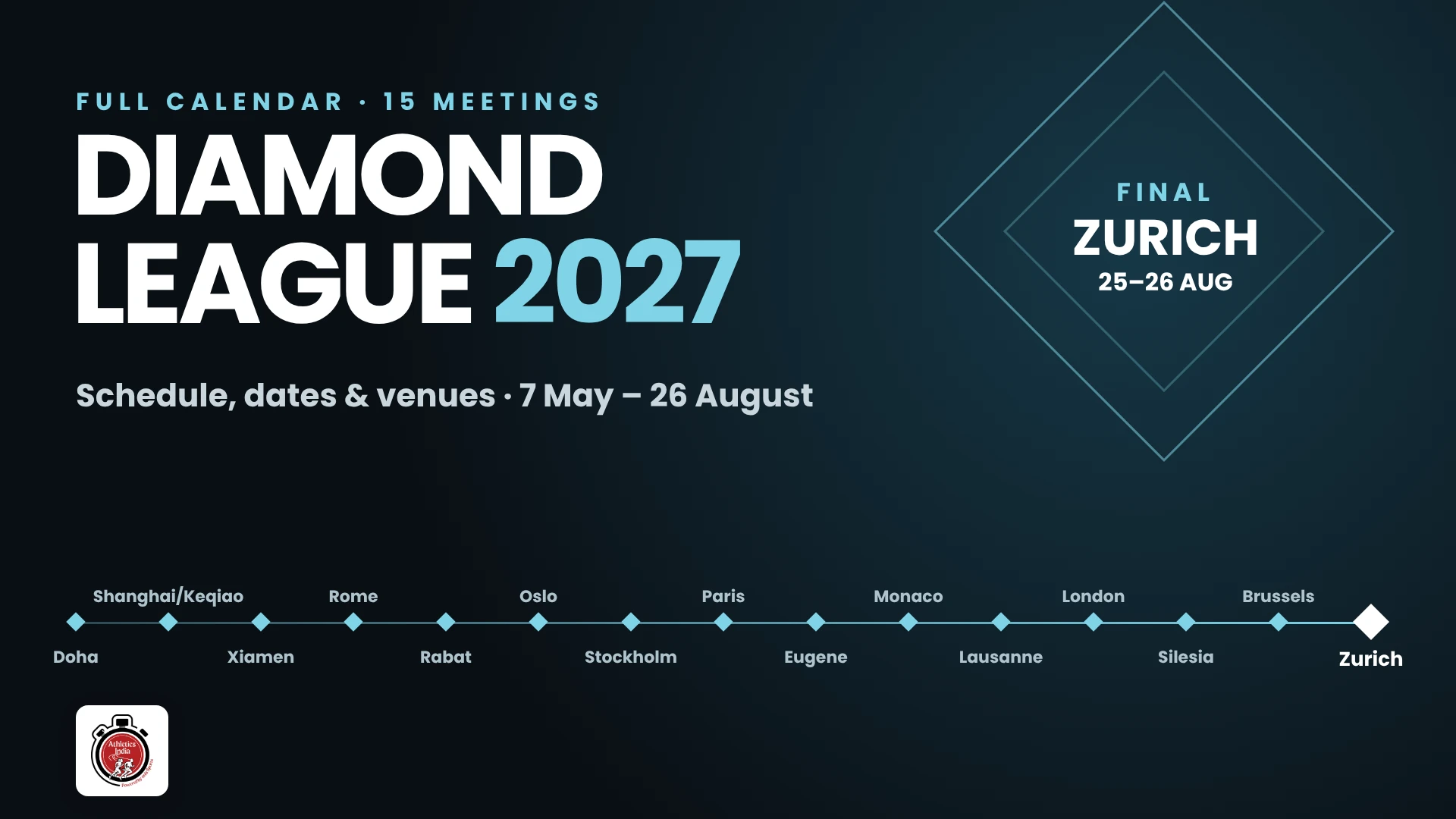
The Diamond League 2027 schedule has 15 meetings, starting in Doha on 7 May and ending with a two-day Final in Zurich on 25 and 26 August 2027. World Athletics announced the calendar on 13 October 2026, and it will therefore be the 18th season of the Wanda Diamond League.
In total, the series visits 15 cities on four continents. Moreover, it ends about a month before the World Championships in Beijing in September 2027, so every meeting also matters for World Championships qualification. Below, you will find the full Diamond League 2027 schedule, how the league works and what it means for Indian athletes such as Neeraj Chopra.
Diamond League 2027 at a glance
- Season: 18th Wanda Diamond League season
- Meetings: 15 (14 series meetings and the Final)
- First meeting: Doha, Qatar, 7 May 2027
- Final: Zurich, Switzerland, 25–26 August 2027 (two days)
- Continents: Asia, Europe, Africa and North America
- Next big event: World Athletics Championships, Beijing, September 2027
Diamond League 2027 schedule: full calendar
The table below lists the full Diamond League 2027 schedule in date order. In addition, the Final in Zurich is highlighted.
| # | Date (2027) | City | Country | Continent |
|---|---|---|---|---|
| 1 | Friday 7 May | Doha | Qatar | Asia |
| 2 | Saturday 15 May | Shanghai/Keqiao | China | Asia |
| 3 | Saturday 22 May | Xiamen | China | Asia |
| 4 | Thursday 27 May | Rome | Italy | Europe |
| 5 | Sunday 30 May | Rabat | Morocco | Africa |
| 6 | Thursday 3 June | Oslo | Norway | Europe |
| 7 | Sunday 6 June | Stockholm | Sweden | Europe |
| 8 | Friday 25 June | Paris | France | Europe |
| 9 | Saturday 3 July | Eugene | USA | North America |
| 10 | Friday 9 July | Monaco | Monaco | Europe |
| 11 | Tuesday 13 July | Lausanne | Switzerland | Europe |
| 12 | Saturday 17 July | London | Great Britain | Europe |
| 13 | Sunday 15 August | Silesia | Poland | Europe |
| 14 | Friday 20 August | Brussels | Belgium | Europe |
| 15 | Wednesday 25 – Thursday 26 August | Zurich (Final) | Switzerland | Europe |

The 2027 season month by month
Overall, the calendar falls into four clear blocks. First, the season opens with three meetings in Asia in May. After that, it moves to Europe and Africa, crosses to the United States in early July and returns to Europe for the run-in to the Final.
May: the Asian swing and Rome
Doha, Shanghai/Keqiao and Xiamen make up the Asian leg, which is also the best time zone for Indian fans. After that come Rome on 27 May and Rabat, the only African meeting, on 30 May.
June and July: the heart of the season
Next, June brings Oslo, Stockholm and Paris. Then, in July, the league visits Eugene in the United States before three meetings in quick succession: Monaco, Lausanne and London, all within eight days of each other.
August: the run-in
After a four-week break, the season resumes in Silesia on 15 August and Brussels on 20 August. Notably, Brussels hosted the 2026 Final, and Silesia also staged a meeting in 2026; read our Silesia Diamond League 2026 report.
Diamond League Final 2027 in Zurich
The 2027 Final will be held over two days, 25 and 26 August, in Zurich. As always, the winner of each discipline is crowned Diamond League champion. For example, at the 2026 Final in Brussels, Australia’s Cameron Myers won the 1500m in 3:30.14.
The Final moves from Brussels (2026) to Zurich (2027). Brussels stays on the calendar as the last series meeting before the Final.
How the Diamond League works
Each series meeting stages only some of the disciplines. Then, in every discipline, the top eight athletes score points: 8 for first, 7 for second and so on down to 1 for eighth. Therefore, athletes need several good results across the season to qualify.
India and the Diamond League 2027
Neeraj Chopra is India’s biggest name in the Diamond League. In 2022, he became the first Indian to win the Diamond League title, in Zurich, the same city that hosts the 2027 Final. In 2026, he threw a season-best 88.05m in Lausanne, finishing nine centimetres behind Rumesh Pathirage.
However, an ankle ligament tear ended his 2026 season in late August, so he missed the Final in Brussels. As a result, the 2027 Diamond League will be a key test of his comeback, with the World Championships in Beijing only weeks after the Final.
Diamond League 2027 and the road to Beijing
Diamond League meetings are among the highest-ranked competitions in the world rankings. That matters, because the rankings decide most World Championship places under the Beijing 2027 qualification system. Consequently, Indian athletes who cannot hit the entry standards will want as many Diamond League starts as possible.
We will add the discipline list for each meeting once it is announced, and update this page if any date changes.
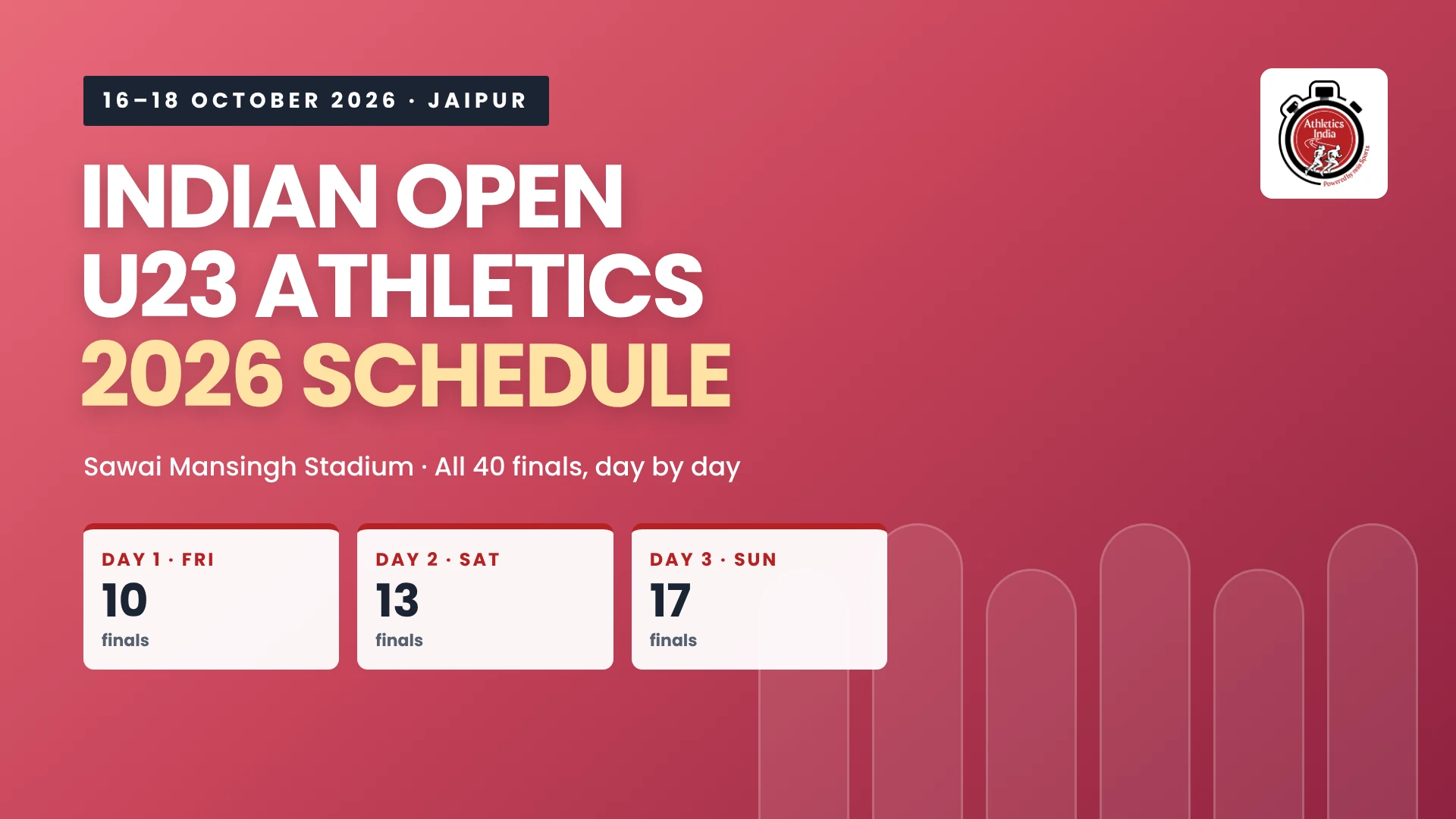
The Indian Open U23 Athletics 2026 competition takes place from 16 to 18 October at the Sawai Mansingh Stadium in Jaipur. The Athletics Federation of India (AFI) has published the full schedule: 40 finals over three days, including the decathlon, the heptathlon and two half marathon race walks.
This is the sixth edition of the meet for athletes in the Under 23 age group. Below, therefore, you will find the day-by-day timetable of every final, the warm-up rounds worth watching, last year’s winners and where to follow the results. In addition, we will update this page with the medal winners each evening.
Indian Open U23 Athletics 2026 at a glance
- Competition: 6th Indian Open U23 Athletics Competition 2026
- Dates: Friday 16 to Sunday 18 October 2026
- Venue: Sawai Mansingh Stadium, Jaipur, Rajasthan
- Organiser: Athletics Federation of India
- Finals: 40, including the men’s decathlon and the women’s heptathlon
- First final: men’s 10,000m, 6:00 AM on 16 October
- Last final: women’s 3000m steeplechase, 6:10 PM on 18 October
- Last year: Warangal, Telangana, 16 to 18 October 2025
Indian Open U23 Athletics 2026 dates and venue
The competition runs from Friday 16 to Sunday 18 October 2026 at the Sawai Mansingh Stadium in Jaipur. AFI announced the schedule on its official website, and it is version 1.1, dated 29 September. As AFI notes, the organisers may still change it.
Each day starts at 6:00 AM with a distance race or a race walk. Most finals, meanwhile, are in the evening session, between 2:20 PM and 6:10 PM.
The Under 23 events use senior equipment: a 7.26kg shot and hammer, a 2kg discus and an 800g javelin for men, and senior hurdle heights (1.067m in the 110m hurdles). As a result, marks from Jaipur compare directly with senior performances.
Day 1 schedule: Friday 16 October
Ten finals take place on the opening day. The 100m finals close the day, with the women at 5:20 PM and the men at 5:30 PM. Before that, the 100m and 400m heats and semi-finals fill the morning and afternoon.
| Time (IST) | Final |
|---|---|
| 6:00 AM | Men’s 10,000m |
| 6:40 AM | Women’s 10,000m |
| 8:00 AM | Women’s shot put |
| 8:25 AM | Women’s high jump |
| 10:00 AM | Women’s discus throw |
| 12:10 PM | Men’s hammer throw |
| 2:30 PM | Men’s pole vault |
| 4:00 PM | Women’s long jump |
| 5:20 PM | Women’s 100m |
| 5:30 PM | Men’s 100m |
The men’s decathlon also starts on Day 1 with the 100m, long jump, shot put, high jump and 400m. In addition, the 1500m heats for men and women end the evening.
Day 2 schedule: Saturday 17 October
Day 2 is the busiest, with 13 finals. It opens with the men’s half marathon race walk at 6:00 AM. The 1500m finals follow in the late morning, and the hurdles and 400m finals come in quick succession after lunch.
| Time (IST) | Final |
|---|---|
| 6:00 AM | Men’s half marathon race walk |
| 11:15 AM | Men’s 1500m |
| 11:25 AM | Women’s 1500m |
| 2:20 PM | Men’s discus throw |
| 2:25 PM | Women’s pole vault |
| 2:30 PM | Men’s high jump |
| 3:00 PM | Women’s 100m hurdles |
| 3:20 PM | Men’s 110m hurdles |
| 3:40 PM | Women’s 400m |
| 3:50 PM | Men’s 400m |
| 4:00 PM | Men’s shot put |
| 4:10 PM | Men’s long jump |
| 5:40 PM | Men’s decathlon (last event, 1500m) |
The decathlon ends with the 1500m at 5:40 PM. Meanwhile, the women’s heptathlon covers its first four events: the 100m hurdles, high jump, shot put and 200m.
Day 3 schedule: Sunday 18 October
The final day has 17 finals. Because of the field size, the men’s 5000m is run in three races and the men’s steeplechase in two. Places are decided on time across all the races.
| Time (IST) | Final |
|---|---|
| 6:00 AM | Women’s half marathon race walk |
| 8:00 AM | Men’s 5000m (Races A, B and C) |
| 9:00 AM | Women’s 5000m |
| 11:15 AM | Women’s hammer throw |
| 2:30 PM | Men’s javelin throw |
| 2:40 PM | Women’s triple jump |
| 3:30 PM | Men’s 400m hurdles |
| 3:45 PM | Women’s 400m hurdles |
| 4:00 PM | Women’s javelin throw |
| 4:10 PM | Women’s 200m |
| 4:20 PM | Men’s 200m |
| 4:30 PM | Men’s triple jump |
| 4:40 PM | Men’s 800m |
| 4:50 PM | Women’s 800m |
| 5:00 PM | Women’s heptathlon (last event, 800m) |
| 5:20 PM | Men’s 3000m steeplechase (Races A and B) |
| 6:10 PM | Women’s 3000m steeplechase |
The 200m, 800m and both 400m hurdles finals all fall between 3:30 PM and 4:50 PM. Then the heptathlon ends with the 800m, and the women’s steeplechase closes the competition at 6:10 PM.
Indian Open U23 2025: last year’s winners
The 5th edition took place in Warangal, Telangana, from 16 to 18 October 2025. These are the winners of ten finals, as listed on the World Athletics results page.
| Event | Winner | Mark |
|---|---|---|
| Men’s 100m | Mrutyam Jayaram Dondapati | 10.49 |
| Women’s 100m | Sudeshna Shivankar | 11.66 |
| Men’s 10,000m | Rijwan | 29:48.91 |
| Women’s 10,000m | Latika Talwar | 36:47.22 |
| Women’s 1500m | Vinita Gurjar | 4:31.85 |
| Men’s pole vault | Kuldeep Kumar | 5.10m |
| Women’s high jump | Seema Kumari | 1.68m |
| Women’s long jump | Mubassina Mohammed | 6.36m |
| Women’s shot put | Simranjeet Kaur | 13.99m |
| Men’s hammer throw | S. Dinesh | 58.54m |
Two of those champions have since moved up to the senior stage. Sudeshna Shivankar ran in India’s women’s 4x100m relay final at the Asian Games 2026 in Nagoya. Mubassina Mohammed, meanwhile, won the long jump at the National Open Athletics Championships in New Delhi this month with 6.38m.
Why the Indian Open U23 Athletics 2026 meet matters
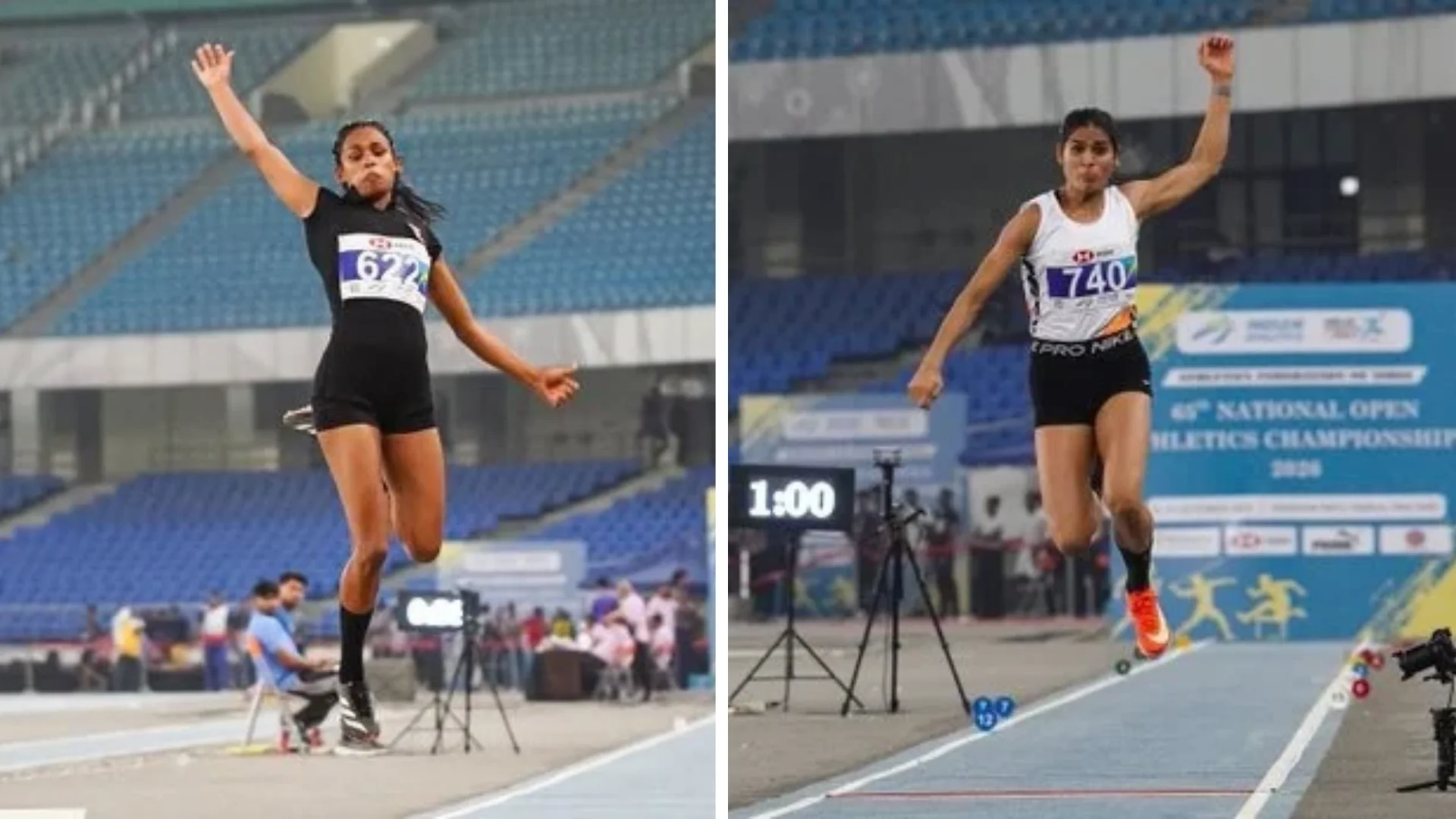
For many junior champions, the Under 23 years decide whether they make the jump to senior level. This meet, therefore, gives them a national final of their own, away from the senior stars. It also matters more this year, because Asia now has an Under 23 championship. At the inaugural Asian U23 Athletics Championships in Ordos, China, in July, India finished fourth with 16 medals (3 gold, 4 silver, 9 bronze).
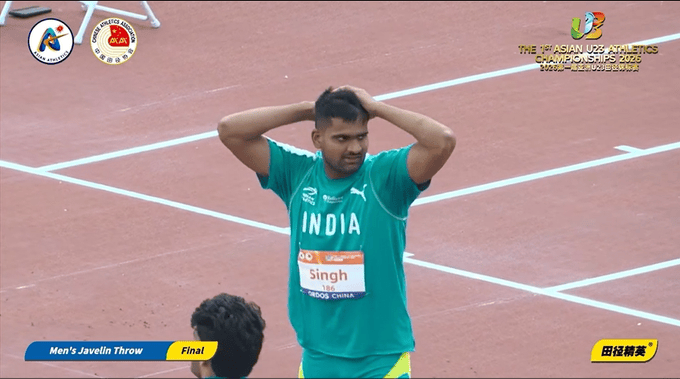
Javelin thrower Anand Singh won gold in Ordos with a personal best of 80.57m. India also won the mixed and women’s 4x400m relays there. Results in Jaipur will show which young athletes can build on that.
Indian Open U23 Athletics 2026 results
We will add the winners of every final to this page each evening, from 16 to 18 October. AFI also publishes the official results on its website.
After Jaipur, the junior season continues with the National Junior Athletics Championships 2026 in Chennai from 23 to 27 October. Results from the zone championships, such as the West Zone athletics 2026 results, are also on our site.
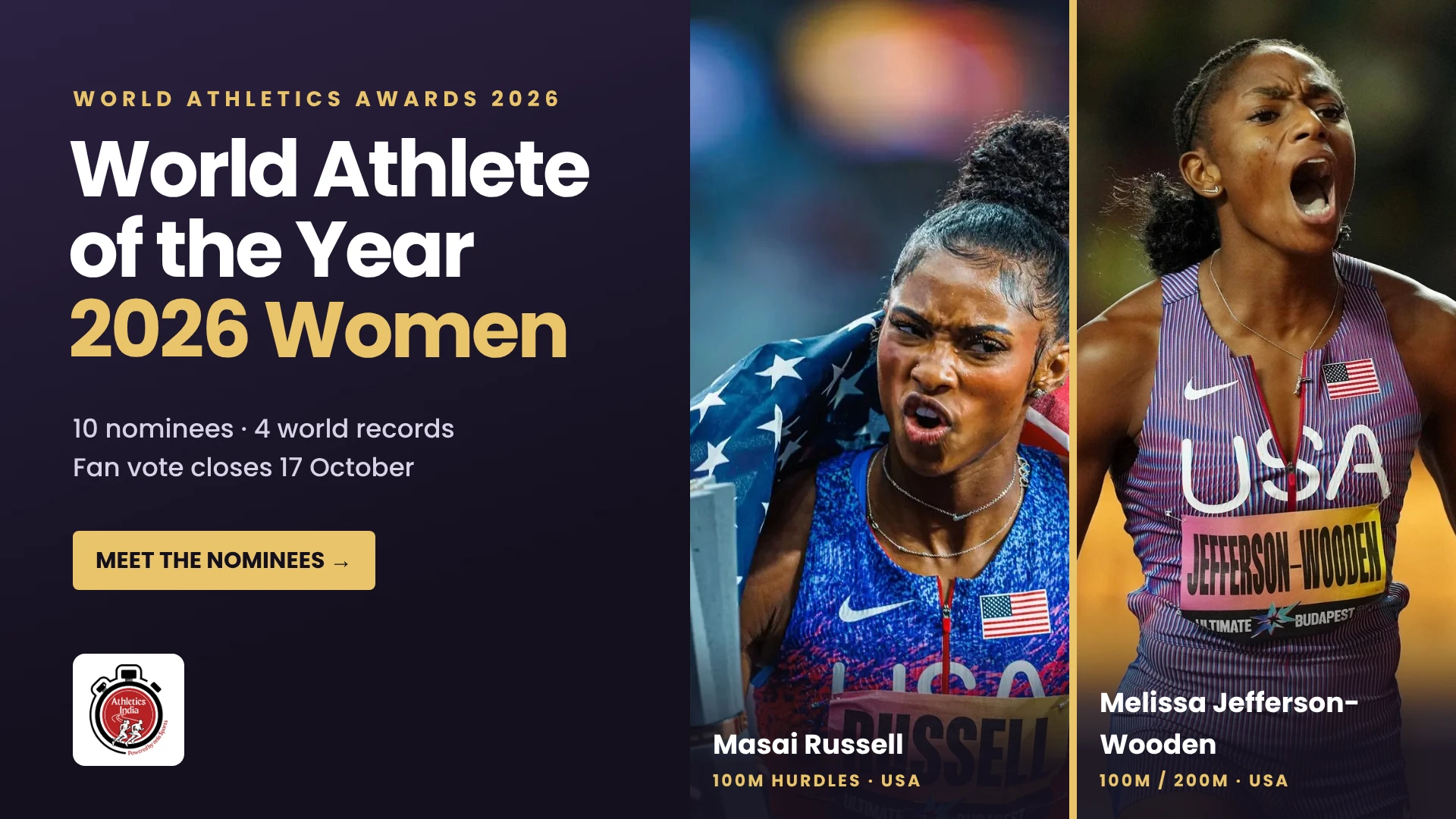
World Athletics has named 10 women for the World Athlete of the Year 2026 award, and fans can vote until midnight CEST on Saturday 17 October. The list includes four world record setters, four Ultimate Championship winners and China’s Yan Ziyi, the Asian Games javelin champion.
The nominees were announced on 6 October, together with the 10 men’s nominees. This page therefore covers every woman on the list and her 2026 season, how the vote works, how to vote and what happens next. In addition, every achievement below comes from the World Athletics announcement.
World Athlete of the Year 2026 women at a glance
- Nominees: 10 women, announced on 6 October 2026
- Voting closes: midnight CEST on Saturday 17 October (early on Sunday 18 October in India)
- Who votes: fans, athletes, media and the World Athletics Family, 25% each
- Finalists: three women, announced on 10 and 11 November
- Winner: announced live at the World Athletics Awards in Monaco on 29 November
- 2025 winner: Sydney McLaughlin-Levrone (USA)
World Athlete of the Year 2026: all 10 women nominees
A panel of eight statisticians picked the nominees: two from World Athletics and one from each of the six continental associations. As a result, the World Athlete of the Year 2026 women’s list covers sprints, hurdles, middle distance, road running, race walking and three throwing events.
| Athlete | Country | Event | 2026 highlight |
|---|---|---|---|
| Tigst Assefa | Ethiopia | Marathon | Won Berlin in 2:11:04 (third-fastest ever) and London in a women-only world record of 2:15:41 |
| Chase Jackson | USA | Shot put | North American records of 21.02m and 21.14m; world indoor champion |
| Melissa Jefferson-Wooden | USA | 100m / 200m | Ultimate Championship sprint double; world leads of 10.62 and 21.47 |
| Agnes Ngetich | Kenya | Road / cross-country | World half marathon champion in a women-only world record of 1:05:15; world cross-country champion |
| Marileidy Paulino | Dominican Republic | 400m | Ultimate and Diamond League champion; unbeaten, with a world-leading 48.48 |
| María Pérez | Spain | Race walk | Inaugural world record of 1:30:06 for the half marathon race walk; European champion |
| Camryn Rogers | Canada | Hammer throw | North American record of 81.13m; Commonwealth Games champion |
| Masai Russell | USA | 100m hurdles | World record of 12.09; unbeaten season with Ultimate and Diamond League titles |
| Audrey Werro | Switzerland | 800m | Ultimate, Diamond League and European champion; world lead of 1:53.70 |
| Yan Ziyi | China | Javelin throw | Asian and world U20 record of 71.74m; Asian Games and Diamond League champion |
The seasons behind the World Athlete of the Year 2026 women nominees
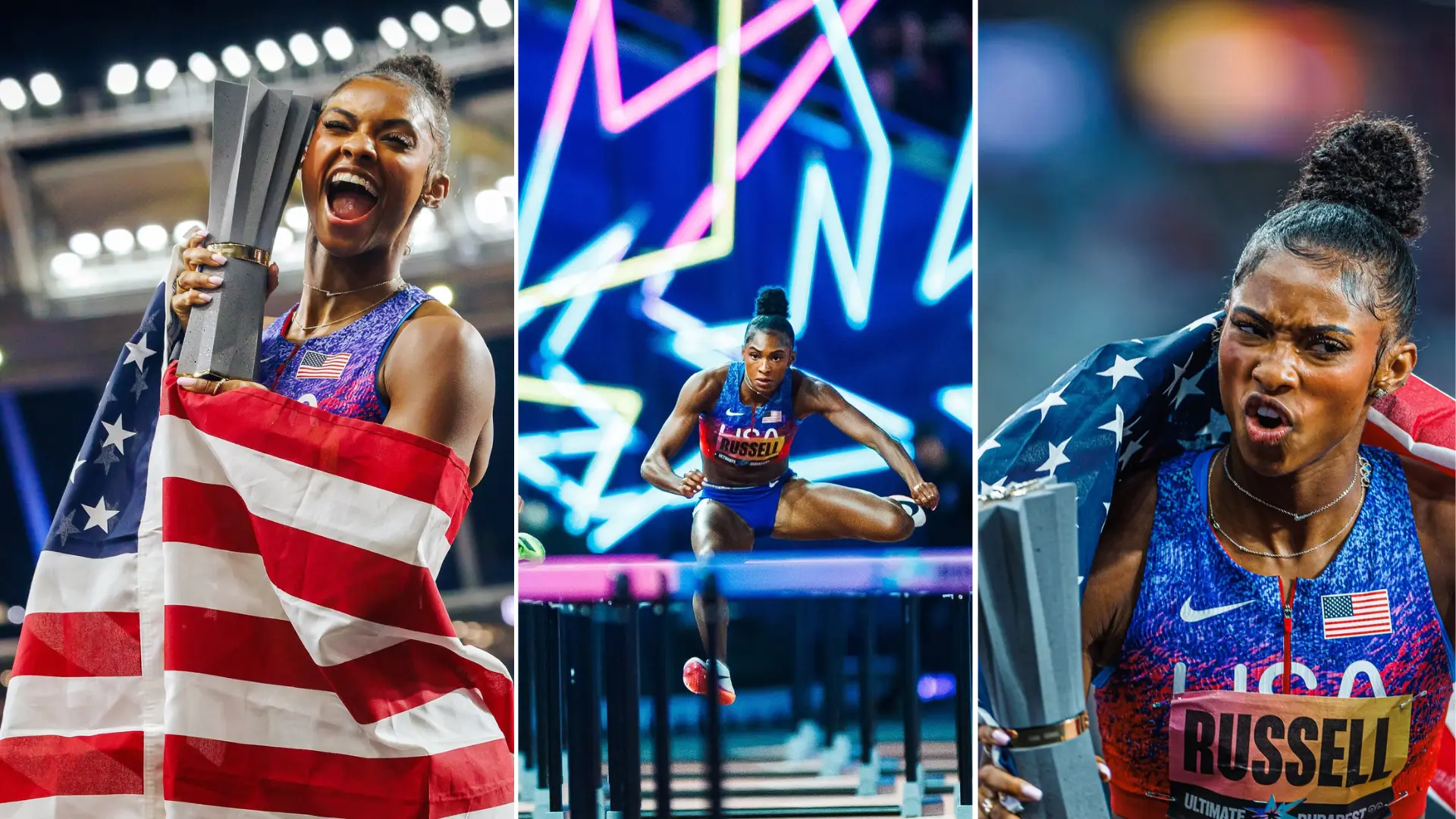
Masai Russell (USA), 100m hurdles
Russell set a world record of 12.09 and ran nine of the ten fastest times of the season. In addition, she was unbeaten in the 100m hurdles, and she won the Ultimate Championship title in Budapest as well as the Diamond League title.
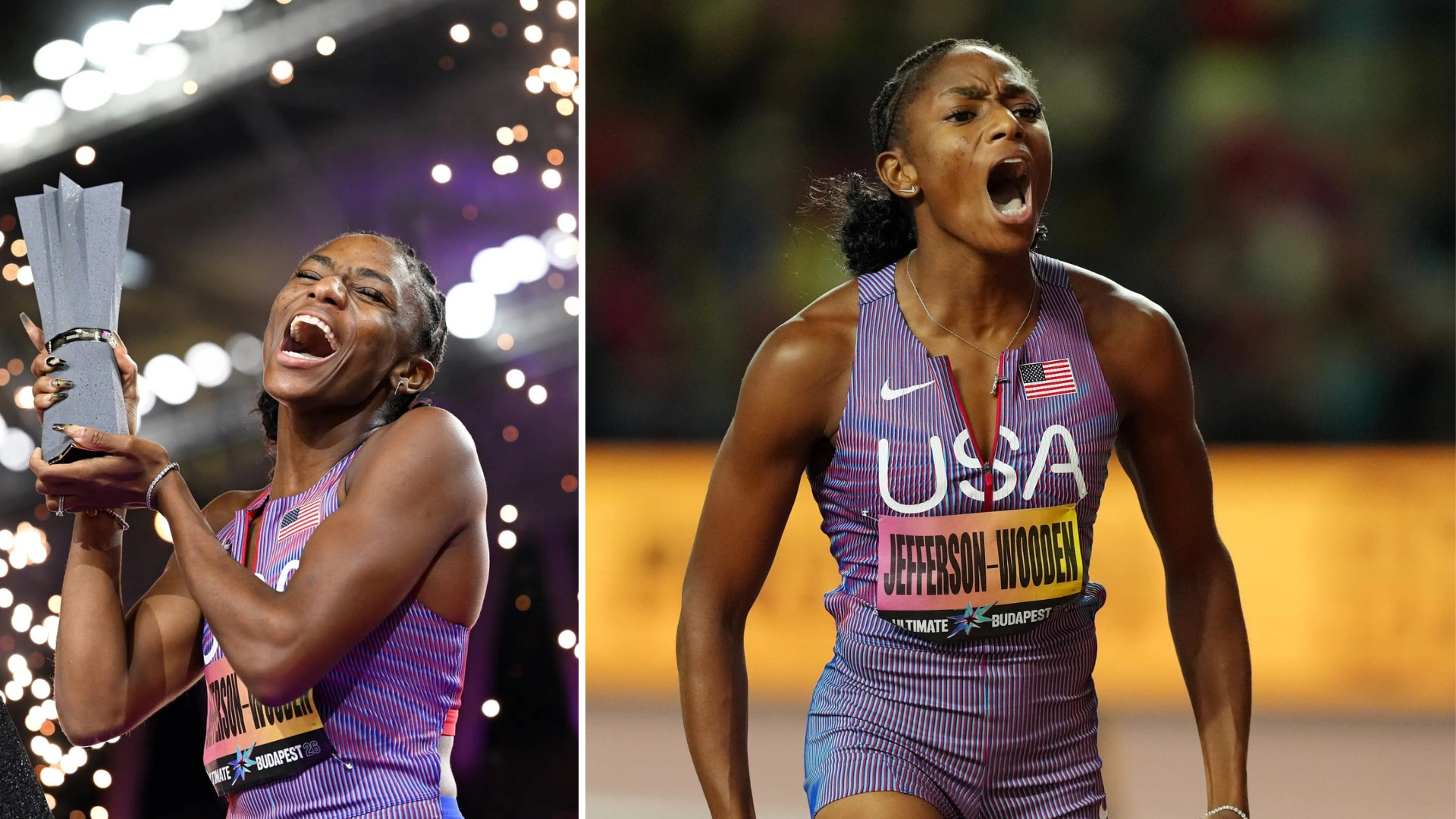
Melissa Jefferson-Wooden (USA), 100m and 200m
Jefferson-Wooden won a sprint double at the Ultimate Championship, taking the 100m and the 200m. Moreover, her world-leading 21.47 in the 200m put her third on the world all-time list, and she ran a world-leading 10.62 in the 100m.
Marileidy Paulino (Dominican Republic), 400m
Paulino won the Ultimate 400m title and regained the Diamond League title. Furthermore, she was unbeaten and ran under 49 seconds in eight races, and set a world lead and Diamond League record of 48.48.
Audrey Werro (Switzerland), 800m
Werro won the Ultimate, Diamond League and European 800m titles. On top of that, she broke the Diamond League record three times, and her world-leading 1:53.70 puts her third on the world all-time list.
Tigst Assefa (Ethiopia), marathon
First, Assefa won the London Marathon in a women-only world record of 2:15:41. Later, she won the Berlin Marathon in 2:11:04, the third-fastest time in history.
Agnes Ngetich (Kenya), road and cross-country
Ngetich won the world half marathon title by 50 seconds in a women-only world record of 1:05:15. Besides that, she won the world cross-country title by 42 seconds and ran world leads for 3000m (8:08.95) and 10km (28:58).
María Pérez (Spain), race walk
Pérez set the inaugural world record for the half marathon race walk, 1:30:06. Remarkably, she did it while winning the European title by 58 seconds.
Chase Jackson (USA), shot put
First of all, Jackson improved the North American shot put record twice, to 21.02m and then 21.14m. In addition, she won the world indoor title and set a Diamond League record to regain the Diamond Trophy.
Camryn Rogers (Canada), hammer throw
Above all, Rogers improved her own North American record to 81.13m, which keeps her second on the world all-time list. In fact, she also had the five best throws in the world this year and retained her Commonwealth Games title.
Yan Ziyi: the only Asian among the World Athlete of the Year 2026 women
Yan Ziyi of China is the only Asian woman on the list. To begin with, she opened her season with 71.74m, an Asian and world U20 record that puts her second on the world all-time javelin list. Then, in Nagoya, she won the Asian Games javelin title with 70.46m, an Asian Games record, at the age of 18.
Asia, in fact, has a javelin champion on both lists. Sri Lanka’s Rumesh Tharanga Pathirage, who won the men’s javelin gold in Nagoya, is among the men’s nominees. You can read more about the Chinese athletics team at the Asian Games on our site.
How to vote for World Athlete of the Year 2026 (women and men)
The vote decides the final ranking of all ten World Athlete of the Year 2026 women nominees, from first to tenth. In total, four groups vote, and each one counts for 25% of the result:
| Voting group | Who is in it | Share |
|---|---|---|
| Fans | Anyone, through the World Athletics online survey | 25% |
| Athletes | Athletes who competed at World Athletics Series events in 2026 | 25% |
| Media | Commentators, journalists and content creators accredited at World Athletics Series events in 2026 | 25% |
| World Athletics Family | Council and commission members, meeting directors, member federation presidents, partners and staff | 25% |
What happens after the World Athlete of the Year 2026 women and men vote
After that, the six finalists are invited to the World Athletics Awards in Monaco, where each winner is announced on stage. For comparison, last year Sydney McLaughlin-Levrone of the USA won the women’s award and Mondo Duplantis of Sweden the men’s, as World Track reported.
The West Zone athletics 2026 results are now official. The Athletics Federation of India (AFI) has published the result sheets of the 37th West Zone Junior Athletics Championships, held at the Atal Athletics Stadium in Bambolim, Goa, from 27 to 29 September.
This page therefore lists the gold, silver and bronze medallists in 84 finals, from Under 20 down to Under 14. In addition, you will find the standout marks, the sprint doubles and a medal count by state. Every result below comes from the official AFI result sheets.
West Zone Junior Athletics Championships 2026 at a glance
- Meet: 37th West Zone Junior Athletics Championships 2026
- Dates: 27 to 29 September 2026
- Venue: Atal Athletics Stadium, Bambolim, Goa
- Teams: Maharashtra, Gujarat, Rajasthan, Madhya Pradesh, Chhattisgarh, Goa, Dadra and Nagar Haveli, and Daman and Diu
- Athletes: 650, according to the AFI result page
- Most golds in the finals listed here: Maharashtra, 31
- Overall team standings: not published with the result sheets
Jump to: Highlights Under 20 men Under 20 women Under 18 Under 16 and Under 14 Medal count National Junior standards What comes next
West Zone athletics 2026 results: the highlights
Maharashtra dominated the meet in Goa. Its athletes won 31 of the 84 titles listed here, and 55 medals in all. Gujarat also won 55 medals, but only 15 of them were gold.
The fastest men: Tilak Barsel, Arnav Kadam and Raj Chauhan
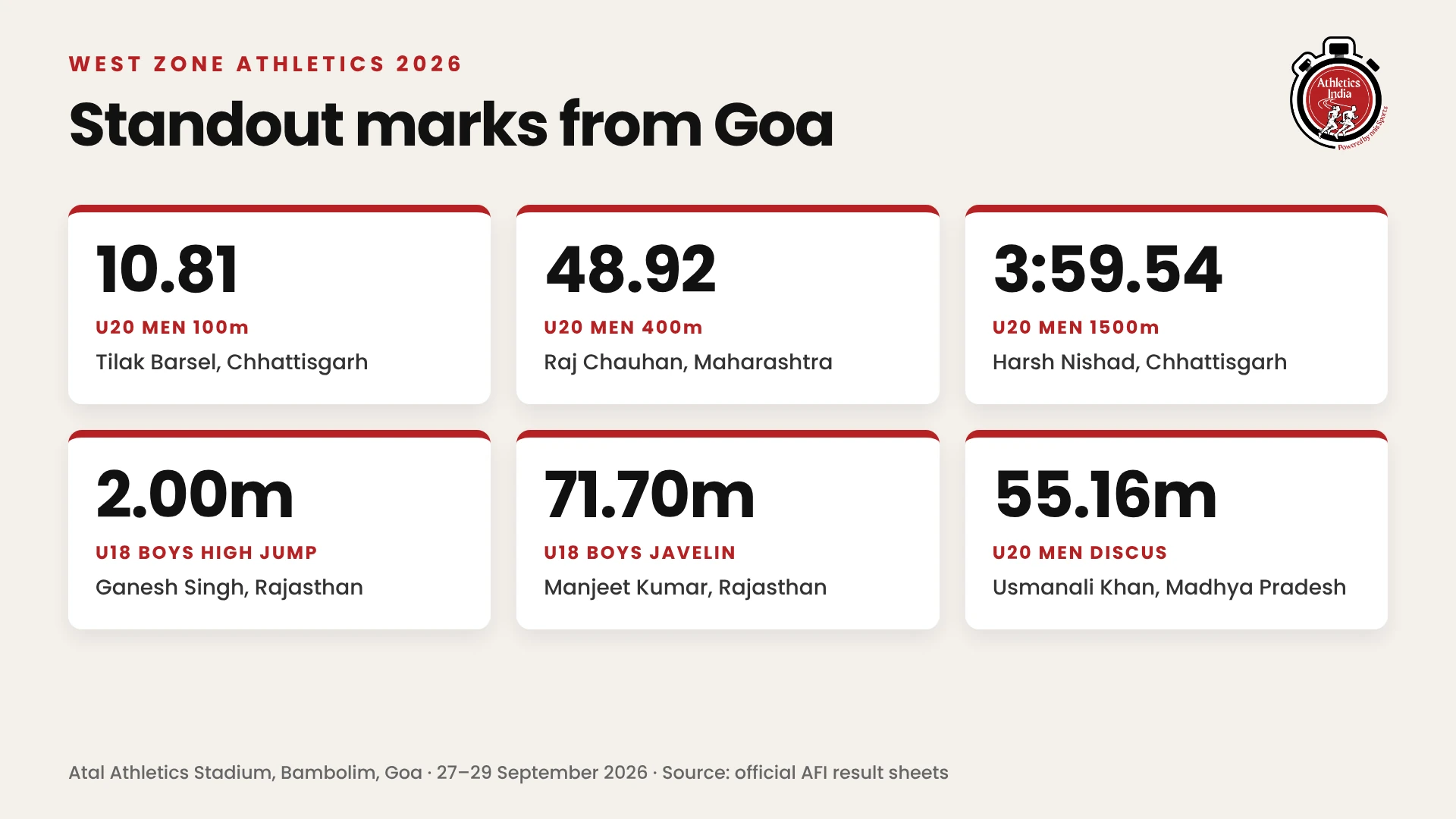
Tilak Barsel of Chhattisgarh won the Under 20 men’s 100m in 10.81 seconds. Arnav Kadam of Maharashtra then took the 200m in 21.92, while his teammate Raj Chauhan won the 400m in 48.92. In addition, Harsh Nishad of Chhattisgarh broke four minutes in the 1500m with 3:59.54.
Three sprint doubles
Three athletes won both the 100m and the 200m in their age group:
| Athlete | State | Age group | 100m | 200m |
|---|---|---|---|---|
| Vala Roshanba Vikramsinh | Gujarat | Under 20 women | 12.01 | 25.63 |
| Abhishek Naruka | Rajasthan | Under 18 boys | 10.91 | 22.09 |
| Thakor Rinkal Jayantiji | Gujarat | Under 18 girls | 12.77 | 26.60 |
Javelin gold by 13 centimetres
The Under 18 boys’ javelin was the closest field final of the meet. Manjeet Kumar of Rajasthan threw 71.70m, while Shourya Agrawal of Chhattisgarh replied with 71.57m. As a result, just 13 centimetres decided the gold.
The other throws were strong as well. For example, Usmanali Khan of Madhya Pradesh won the Under 20 discus with 55.16m, and Divyanshu Saharan of Rajasthan threw 64.18m in the Under 16 javelin. Meanwhile, Ganesh Singh of Rajasthan cleared 2.00m to win the Under 18 high jump.
Under 20 men: West Zone athletics 2026 results
Here are the medallists in 20 Under 20 men’s finals. Times are in minutes and seconds, while field marks are in metres.
On a phone, swipe the table sideways to see silver and bronze.
| Event | Gold | Silver | Bronze |
|---|---|---|---|
| 100m | Tilak Barsel Chhattisgarh · 10.81 |
Granth Mahlawat Rajasthan · 10.85 |
Gourav Yadav Rajasthan · 10.89 |
| 200m | Arnav Kadam Maharashtra · 21.92 |
Granth Mahlawat Rajasthan · 22.49 |
Devanand Sahu Chhattisgarh · 22.68 |
| 400m | Raj Chauhan Maharashtra · 48.92 |
B Ganesh Chhattisgarh · 49.78 |
Abhishek Kumar Jade Chhattisgarh · 50.42 |
| 800m | Aditya Chhattisgarh · 1:54.89 |
Yasheer Rajasthan · 1:56.31 |
Raiyankhan Pathan Gujarat · 1:57.84 |
| 1500m | Harsh Nishad Chhattisgarh · 3:59.54 |
Zuber Shaikh Gujarat · 4:05.19 |
Pranjal Yadav Chhattisgarh · 4:05.80 |
| 3000m | Lalit Poonia Rajasthan · 9:10.01 |
Tilokchand Patel Chhattisgarh · 9:46.71 |
Rahul Bishnoi Goa · 9:47.82 |
| 5000m | Sonu Kumar Goa · 17:21.38 |
Sushant Gaonkar Goa · 17:22.71 |
Tilokchand Patel Chhattisgarh · 17:22.88 |
| 110m hurdles | Shreyash Jadhav Maharashtra · 14.38 |
Nakul Rajasthan · 14.50 |
Dheeraj Kumar Kushwah Madhya Pradesh · 15.67 |
| 400m hurdles | Vikas Yadav Maharashtra · 54.93 |
Darshan Tiwade Maharashtra · 55.74 |
Vivekkumar Chudasama Gujarat · 55.92 |
| 3000m steeplechase | Zuber Shaikh Gujarat · 10:03.69 |
Himanshu Choudhary Rajasthan · 10:34.33 |
Rakesh Singh Chhattisgarh · 11:55.28 |
| High jump | Ankit Kumar Rajasthan · 1.95m |
Sulaksh Pandor Rajasthan · 1.93m |
Rohaan Khan Goa · 1.75m |
| Long jump | Vedant More Maharashtra · 6.99m |
Tilak Barsel Chhattisgarh · 6.87m |
Rohaan Khan Goa · 6.78m |
| Triple jump | Bhavishy Singh Rajasthan · 14.69m |
Satyajitsih Chovhan Gujarat · 13.78m |
Kachela Om Rajeshbhai Gujarat · 13.23m |
| Shot put | Aryan Satpute Maharashtra · 17.25m |
Abhimanyu Kushwaha Maharashtra · 16.99m |
Kundan Kumar Gurjar Rajasthan · 15.33m |
| Discus throw | Usmanali Khan Madhya Pradesh · 55.16m |
Hansraj Dhayal Rajasthan · 52.50m |
Virendra Poonia Rajasthan · 49.27m |
| Hammer throw | Dinesh Kumar Gurjar Rajasthan · 58.39m |
Vinit Khandeparkar Goa · 41.72m |
Ashutosh Trivedi Madhya Pradesh · 37.85m |
| Javelin throw | Manoj S Chavan Maharashtra · 63.06m |
Abhishek Sharma Madhya Pradesh · 51.35m |
Kuldipsinh Parmar Gujarat · 49.89m |
| 5000m race walk | Dinkar Verma Chhattisgarh · 22:34.62 |
Shyam Ji Dubey Chhattisgarh · 22:34.99 |
– |
| 4x100m relay | Gujarat 43.70 |
Maharashtra 45.15 |
Goa 45.25 |
| 4x400m relay | Chhattisgarh 3:20.49 |
Gujarat 3:25.40 |
Goa 3:35.58 |
Note: the Under 20 men’s pole vault produced no valid mark, and the 5000m race walk had two finishers.
Under 20 women: West Zone 2026 results and medal winners
Maharashtra won the most Under 20 women’s titles, 10 of 20. Some fields were small, so a few events have fewer than three medallists. Here are the 20 finals.
On a phone, swipe the table sideways to see silver and bronze.
| Event | Gold | Silver | Bronze |
|---|---|---|---|
| 100m | Vala Roshanba Vikramsinh Gujarat · 12.01 |
Darshnika Mishra Chhattisgarh · 12.26 |
Mahi Kuntal Rajasthan · 12.84 |
| 200m | Vala Roshanba Vikramsinh Gujarat · 25.63 |
Darshnika Mishra Chhattisgarh · 25.67 |
Kashish Bhagat Maharashtra · 26.23 |
| 400m | Kashish Bhagat Maharashtra · 57.45 |
Taniya Kewat Chhattisgarh · 58.84 |
Sherin Vargish Goa · 1:08.90 |
| 800m | Taniya Kewat Chhattisgarh · 2:22.89 |
Harsha Sahu Chhattisgarh · 2:23.74 |
Patel Vidhyakum Prakashbhai Gujarat · 2:33.53 |
| 1500m | Kajalben Manjib Jambucha Gujarat · 5:05.46 |
Avantikaben Lalabhai Dabhi Gujarat · 5:08.47 |
Rushala Gawander Goa · 5:53.48 |
| 3000m | Sandhya R Gohil Gujarat · 11:52.62 |
Jashuben Lakhamanbhai Gujarat · 11:53.38 |
Disha Velip Goa · 13:42.04 |
| 5000m | Jashuben Lakhamanbhai Gujarat · 20:46.88 |
– | – |
| 100m hurdles | Abhilasha Waghmare Maharashtra · 14.98 |
Riddhi Sawant Goa · 16.58 |
Yukta Salkar Goa · 24.12 |
| 400m hurdles | Pooja Goswami Rajasthan · 1:08.25 |
Komal Rajasthan · 1:12.20 |
Riddhi Sawant Goa · 1:12.55 |
| Pole vault | Yogita Samant Maharashtra · 2.50m |
Monika Madavi Maharashtra · 2.50m |
– |
| High jump | Sanchita Malewar Maharashtra · 1.45m |
Monika Madavi Maharashtra · 1.40m |
– |
| Long jump | Shrestha Shetty Maharashtra · 5.44m |
Priya Margaj Maharashtra · 5.10m |
Ankita Rajasthan · 4.85m |
| Triple jump | Janhavi Waghmare Maharashtra · 11.35m |
Rajput Mahavirsinh Gujarat · 10.06m |
Saisha Gawas Goa · 9.11m |
| Shot put | Anvesha Rahate Maharashtra · 11.25m |
Manisha Choudhari Maharashtra · 10.64m |
Bhumi Chaudhhary Rajasthan · 9.88m |
| Discus throw | Vedika Jagatap Maharashtra · 39.43m |
Lobi Muskan Dilipbhai Gujarat · 38.43m |
Modhvadiya Kanabhai Gujarat · 36.27m |
| Hammer throw | Vidhi Sawant Maharashtra · 39.93m |
Chotiyara Tabsu Hasanbhai Gujarat · 36.47m |
Rasika Patil Goa · 26.27m |
| Javelin throw | Urvasikumari Gamit Gujarat · 28.99m |
Rasika Patil Goa · 24.55m |
Tejasvini Rajput Madhya Pradesh · 22.52m |
| 5000m race walk | Manisha Rajasthan · 23:16.56 |
Jalpaben Gohil Gujarat · 27:59.18 |
Payal Markandey Chhattisgarh · 28:26.75 |
| 4x100m relay | Maharashtra 54.06 |
– | – |
| 4x400m relay | Goa 4:28.38 |
Gujarat 4:37.45 |
– |
West Zone Under 18 results: boys and girls
Boys: Under 18 medal winners
On a phone, swipe the table sideways to see silver and bronze.
| Event | Gold | Silver | Bronze |
|---|---|---|---|
| 100m | Abhishek Naruka Rajasthan · 10.91 |
Mohit Gupta Gujarat · 11.08 |
Darshan M Nirmal Gujarat · 11.20 |
| 200m | Abhishek Naruka Rajasthan · 22.09 |
Darshan M Nirmal Gujarat · 22.88 |
Chandan Ghosh Goa · 22.93 |
| 400m | Ambe Rugved Maharashtra · 49.96 |
Purabiya Tushar Prakashbhai Gujarat · 51.41 |
Modi Aaryan Altab Gujarat · 51.67 |
| 1000m | Shivam Rathore Madhya Pradesh · 2:29.55 |
Pushpendra Parasawar Madhya Pradesh · 2:33.12 |
Alok Kumar Sagar Chhattisgarh · 2:35.36 |
| 110m hurdles | Karthik Prajapati Rajasthan · 14.71 |
Yogendra Singh Chhattisgarh · 15.10 |
Tirth Butani Gujarat · 15.75 |
| High jump | Ganesh Singh Rajasthan · 2.00m |
Atharv Satpute Maharashtra · 1.91m |
Aman Vanzara Gujarat · 1.87m |
| Long jump | Mukund Verma Chhattisgarh · 6.45m |
Tarun Yadav Madhya Pradesh · 6.34m |
Savanbhai Patel Gujarat · 6.09m |
| Shot put | Anshul Thorat Maharashtra · 16.50m |
Siddharth Nagesh Chhattisgarh · 16.01m |
Anant Kumar Saw Chhattisgarh · 12.02m |
| Discus throw | Pradyumn Rajasthan · 44.99m |
Divyanshu Yadav Gujarat · 41.61m |
Vishal Satish Phad Maharashtra · 41.09m |
| Javelin throw | Manjeet Kumar Rajasthan · 71.70m |
Shourya Agrawal Chhattisgarh · 71.57m |
Aalok Choudhary Rajasthan · 64.64m |
| 5000m race walk | Anurag Ekka Chhattisgarh · 23:57.05 |
Sumit Kumar Sahu Chhattisgarh · 24:49.37 |
Aarman Ashapak Shaikh Maharashtra · 26:12.25 |
| Medley relay | Gujarat 2:02.01 |
Chhattisgarh 2:02.57 |
Goa 2:05.04 |
| Heptathlon | Parveen Rajasthan · 4102 pts |
Sohil Khan Rajasthan · 4025 pts |
Sandeep Singh Porte Chhattisgarh · 4002 pts |
Girls: Under 18 medal winners
On a phone, swipe the table sideways to see silver and bronze.
| Event | Gold | Silver | Bronze |
|---|---|---|---|
| 100m | Thakor Rinkal Jayantiji Gujarat · 12.77 |
Kiran Dhruw Chhattisgarh · 13.10 |
Charmi Dholakiya Gujarat · 13.14 |
| 200m | Thakor Rinkal Jayantiji Gujarat · 26.60 |
Charmi Dholakiya Gujarat · 27.00 |
Ananya Swami Madhya Pradesh · 27.42 |
| 400m | Margiben Nakum Gujarat · 1:01.32 |
Cindrella Pawar Goa · 1:03.43 |
Ranu Bhogami Chhattisgarh · 1:06.73 |
| 1000m | Patel Arunaben Kantibhai Gujarat · 3:08.21 |
Divyanshi Kaith Verma Madhya Pradesh · 3:12.90 |
Ravinaben Sevra Gujarat · 3:18.34 |
| 100m hurdles | Saiesha Pawar Maharashtra · 14.94 |
Mahera Khan Madhya Pradesh · 16.58 |
Bhumika Dodiyar Madhya Pradesh · 17.18 |
| High jump | Xanelle Evanca Lacerda Goa · 1.49m |
Janya Ajithkumar Maharashtra · 1.46m |
Alana Da Gama Goa · 1.35m |
| Long jump | Shraddha Bhamre Maharashtra · 5.18m |
Pantrod Khushbu Shamalbhai Gujarat · 5.03m |
Kiran Dhruw Chhattisgarh · 4.95m |
| Shot put | Anushka Gutte Maharashtra · 14.41m |
Srushti Doifode Maharashtra · 13.87m |
Shradhdha Kathad Gujarat · 10.89m |
| Discus throw | Aishwarya Ghule Maharashtra · 41.05m |
Janvi Tarone Maharashtra · 33.47m |
Resham Kotadiya Gujarat · 32.02m |
| Javelin throw | Durva Shewale Maharashtra · 46.61m |
Poonam Makhan Singh Chhattisgarh · 38.95m |
Rinaben Kantariya Gujarat · 36.78m |
| 3000m race walk | Antara Gaonkar Maharashtra · 17:50.56 |
Meghnaben Chaudhari Gujarat · 18:23.59 |
Hingora Havaben R. Gujarat · 19:25.00 |
| Medley relay | Maharashtra 2:27.86 |
Chhattisgarh 2:34.57 |
Goa 2:36.17 |
Under 16 and Under 14 West Zone results
The Under 16 events are shorter. For example, the sprint is over 60m and the middle-distance race is over 600m.
Boys: Under 16 medal winners
On a phone, swipe the table sideways to see silver and bronze.
| Event | Gold | Silver | Bronze |
|---|---|---|---|
| 60m | Samarth Neugi Goa · 7.35 |
David Lemos Godinho Goa · 7.47 |
Reshla Rathwa Gujarat · 7.47 |
| 600m | Divyanshu Rajasthan · 1:19.46 |
Aniruddha Namboodri Maharashtra · 1:22.65 |
Bhavesh Sharma Rajasthan · 1:23.24 |
| 80m hurdles | Ghanshyam Jat Rajasthan · 11.01 |
Tanishq Jondhale Maharashtra · 11.07 |
Rathod Rahulbha Ishverbhai Gujarat · 11.24 |
| High jump | Manish Kumar Rajasthan · 1.70m |
Parv Thakur Maharashtra · 1.70m |
Rupesh Kamti Maharashtra · 1.68m |
| Long jump | Yash Kumar Fageriya Rajasthan · 4.28m |
Raviranjan Sharma Goa · 4.26m |
Sachin Saran Rajasthan · 4.20m |
| Shot put | Varadraaj Jagtap Maharashtra · 15.59m |
Anil Suthapa Gujarat · 13.68m |
Ram Mishra Madhya Pradesh · 13.52m |
| Javelin throw | Divyanshu Saharan Rajasthan · 64.18m |
Arjun Saini Rajasthan · 61.43m |
Jivitesh Bhawarkar Madhya Pradesh · 57.50m |
| Medley relay | Maharashtra 2:05.79 |
Chhattisgarh 2:09.59 |
Gujarat 2:10.98 |
Girls: Under 16 medal winners
On a phone, swipe the table sideways to see silver and bronze.
| Event | Gold | Silver | Bronze |
|---|---|---|---|
| 60m | Jansi Kewat Madhya Pradesh · 7.88 |
Avisha Choudhary Rajasthan · 8.26 |
Archi Katkar Goa · 8.28 |
| 600m | Sakshi Naik Goa · 1:42.98 |
Aanora Xaviera Gracias Goa · 1:43.89 |
Danteshwari Nishad Chhattisgarh · 1:44.39 |
| 80m hurdles | Shreya Bandal Maharashtra · 12.11 |
Neeva Naik Goa · 13.17 |
Shyla Naik Goa · 13.35 |
| High jump | Manyata Sahu Chhattisgarh · 1.47m |
Sonam Kanwar Rajasthan · 1.45m |
Naisha Raghav Maharashtra · 1.43m |
| Long jump | Laxmi Matang Gujarat · 3.99m |
Risa Fernandes Maharashtra · 3.94m |
Sonam Kanwar Rajasthan · 3.93m |
| Shot put | Monika Bishnoi Rajasthan · 11.65m |
Payal Gavali Maharashtra · 11.05m |
Mamta Ashokbhai Kareniya Gujarat · 8.96m |
| Javelin throw | Rahi Chavan Maharashtra · 45.02m |
Parghi Ravinabe Babubhai Gujarat · 34.57m |
Anushree Urmaliya Madhya Pradesh · 26.65m |
| Medley relay | Goa 2:29.66 |
Chhattisgarh 2:35.55 |
– |
Kids javelin and mixed relay
On a phone, swipe the table sideways to see silver and bronze.
| Event | Gold | Silver | Bronze |
|---|---|---|---|
| Kids javelin (boys) | Nitesh Kumar Midyam Chhattisgarh · 43.72m |
Mankuram Murami Chhattisgarh · 40.98m |
Kayaan Chauhan Maharashtra · 39.25m |
| Kids javelin (girls) | Mysha Patel Maharashtra · 34.11m |
Aarya Pagare Maharashtra · 25.25m |
Chrisel Soares Goa · 22.54m |
| 4x100m mixed relay | Gujarat 47.06 |
Maharashtra 47.57 |
Goa 58.12 |
Not in these tables: the decathlon, the Under 20 women’s and Under 18 girls’ heptathlons, the Under 16 pentathlons and the Under 14 triathlons. Those results are in the official results PDF. For example, Archi Katkar of Goa won the Under 16 girls’ pentathlon, The Goan reported.
West Zone 2026 medal count by state
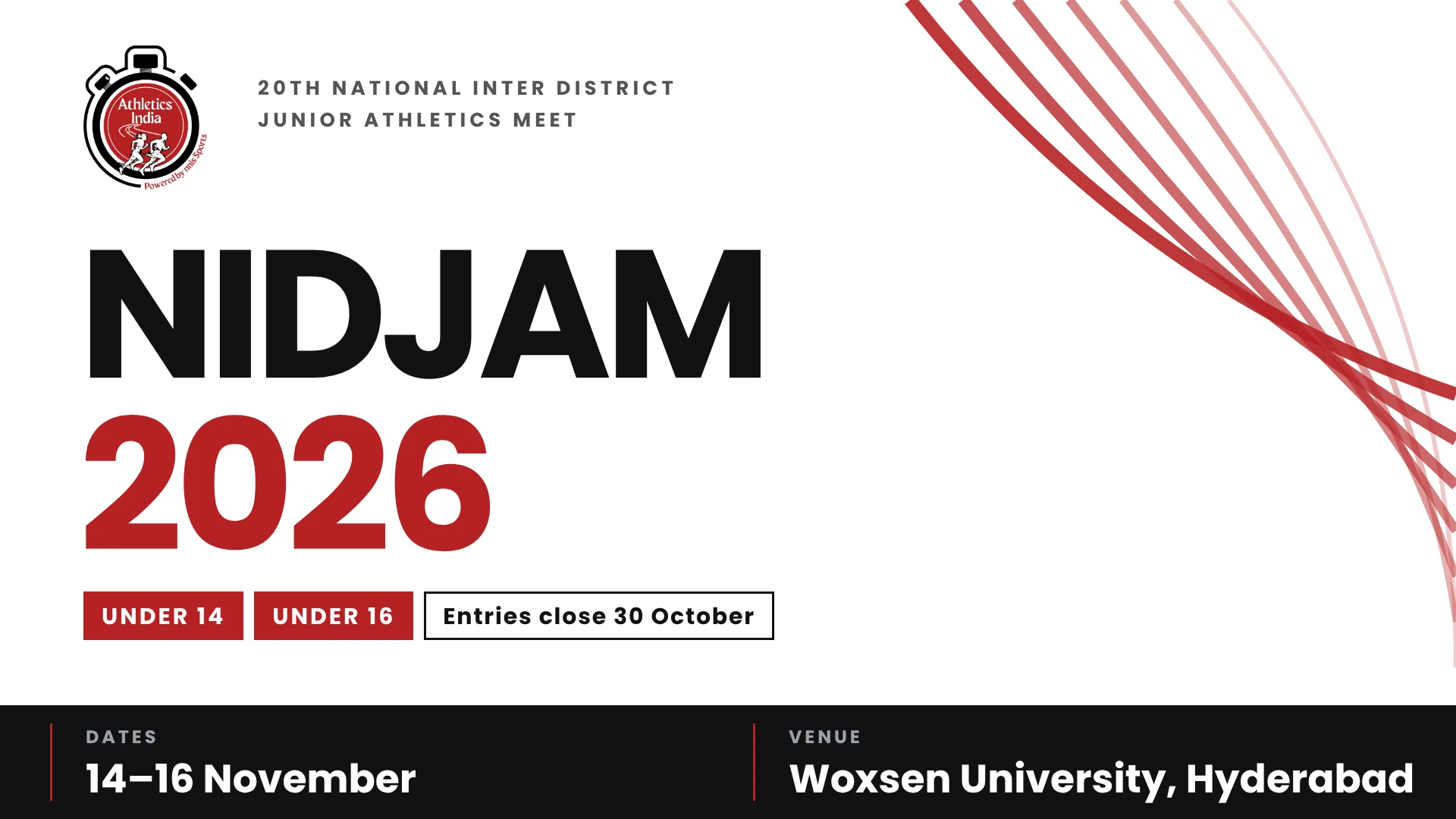
AFI’s result sheets do not include a team points table. So we counted the medals in the 84 finals listed above. Some events had fewer than three finishers, which is why there are 82 silver and 77 bronze medals.
| State | Gold | Silver | Bronze | Total |
|---|---|---|---|---|
| Maharashtra | 31 | 18 | 6 | 55 |
| Rajasthan | 19 | 12 | 10 | 41 |
| Gujarat | 15 | 19 | 21 | 55 |
| Chhattisgarh | 10 | 19 | 12 | 41 |
| Goa | 6 | 9 | 20 | 35 |
| Madhya Pradesh | 3 | 5 | 8 | 16 |
However, this is our count and not the official standings. It also leaves out the combined events named in the note above. We will add the official team standings here as soon as AFI publishes them.
West Zone winners against the National Junior entry standards
The next stop for many of these athletes is the National Junior Athletics Championships 2026 in Chennai. Therefore, we compared ten Under 20 winning marks from Goa with the AFI entry standards for that meet.
| Under 20 event | Entry standard | West Zone winner | Winning mark | Against the standard |
|---|---|---|---|---|
| Men 100m | 10.90 | Tilak Barsel | 10.81 | Inside |
| Men 400m | 50.00 | Raj Chauhan | 48.92 | Inside |
| Men 800m | 1:55.00 | Aditya | 1:54.89 | Inside |
| Men 1500m | 4:00.00 | Harsh Nishad | 3:59.54 | Inside |
| Men shot put | 15.50m | Aryan Satpute | 17.25m | Inside |
| Men hammer throw | 60.00m | Dinesh Kumar Gurjar | 58.39m | Outside |
| Men javelin throw | 65.00m | Manoj S Chavan | 63.06m | Outside |
| Women 100m | 12.75 | Vala Roshanba Vikramsinh | 12.01 | Inside |
| Women 400m | 58.50 | Kashish Bhagat | 57.45 | Inside |
| Women 800m | 2:20.00 | Taniya Kewat | 2:22.89 | Outside |
Seven of the ten winners were inside the standard. Above all, Aditya and Harsh Nishad of Chhattisgarh only just made it, by 0.11 and 0.46 seconds. However, the hammer, javelin and women’s 800m champions were outside the mark.
West Zone championships in recent years
Jodhpur hosted the 34th edition in October 2023. Rajasthan topped the men’s points table with 273, while Gujarat led the women’s table with 143, according to the AFI points sheet. Then Nagpur staged the 35th edition from 4 to 6 October 2024; its results are on our site (PDF).
However, the 36th edition, due in Shivpuri in September 2025, did not go ahead as planned. AFI postponed it a few days before the start, and its notice gave no new dates.
After the West Zone athletics 2026 meet: what comes next
The 41st National Junior Athletics Championships will take place at the JN Stadium in Chennai from 23 to 27 October. After that, the 20th NIDJAM follows in Hyderabad from 14 to 16 November for Under 14 and Under 16 athletes.
Meanwhile, results from the other zones are on our East Zone athletics 2026 results and South Zone athletics 2026 results pages, and in the North Zone 2026 results (PDF).
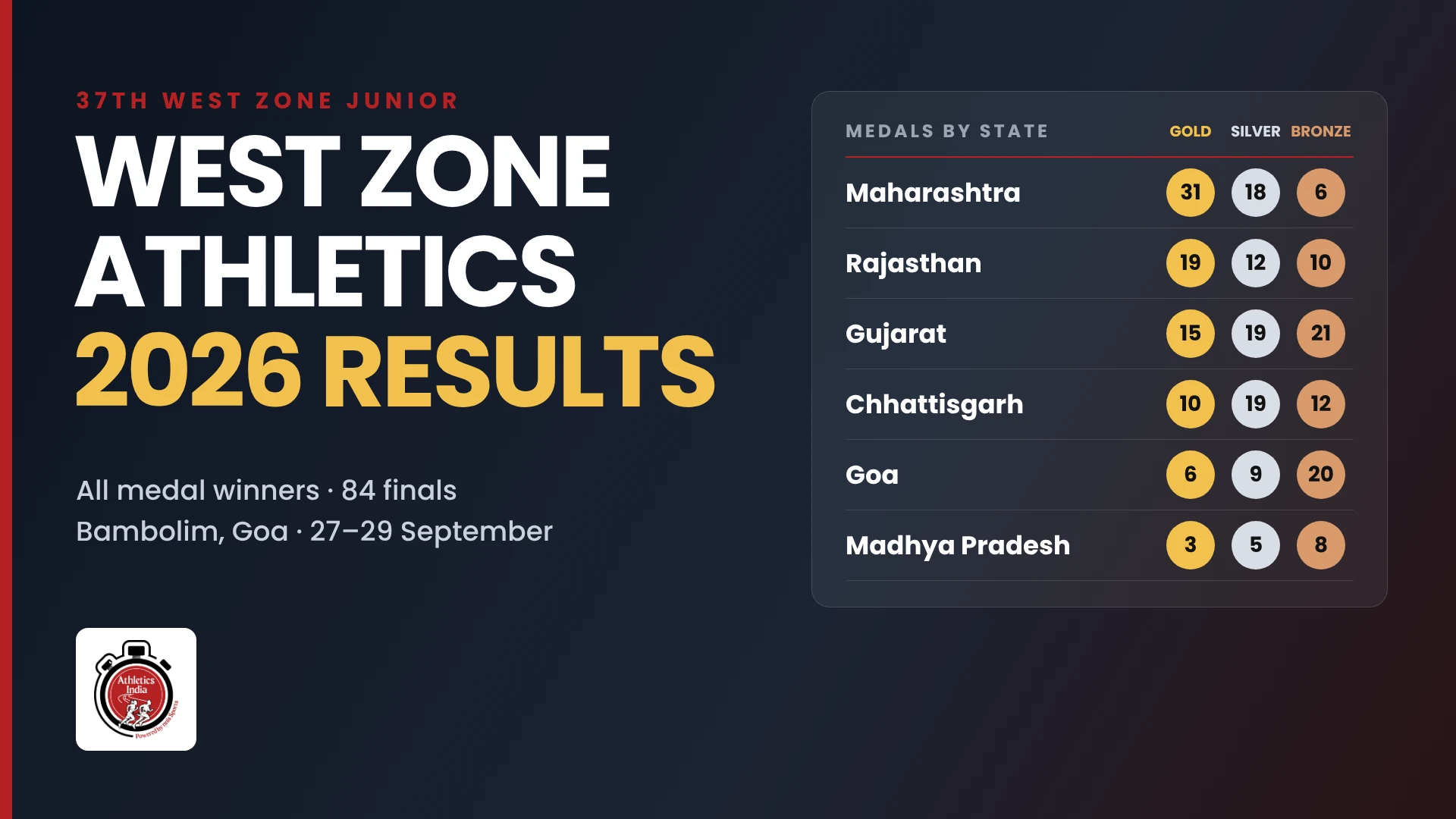
NIDJAM 2026, the 20th National Inter District Junior Athletics Meet, will take place at Woxsen University in Hyderabad from 14 to 16 November. It is the Athletics Federation of India’s biggest talent hunt for Under 14 and Under 16 athletes, and every entry comes through a district athletics association.
Online entries open on 15 October and close on 30 October. This guide therefore covers everything from the AFI circular: the age limits, the events, how many athletes a district can send, the entry steps and the documents to carry.
NIDJAM 2026 at a glance
- Full name: 20th National Inter District Junior Athletics Meet 2026
- Dates: 14 to 16 November 2026
- Venue: Woxsen University, Kamkole, Sadasivpet, Hyderabad, Telangana
- Organisers: Athletics Federation of India with the Government of Telangana
- Age groups: Under 14 and Under 16, boys and girls
- Entries: online only, through district units, 15 to 30 October 2026
- Age verification: 13 November 2026, at the venue
Jump to: What is NIDJAM Age groups Events District quota How to enter Documents Food and travel Last edition
What is NIDJAM?
NIDJAM is AFI’s national meet for district champions. AFI first launched it in 2003, and its aim is to find young talent early and give it a national stage.
The meet has grown with every edition. For example, the 2018 meet in Tirupati drew more than 4,500 athletes from over 420 districts. Then the 2023 edition in Patna had 5,482 athletes from 599 districts, according to The Bridge.
NIDJAM 2026 age groups: who is eligible
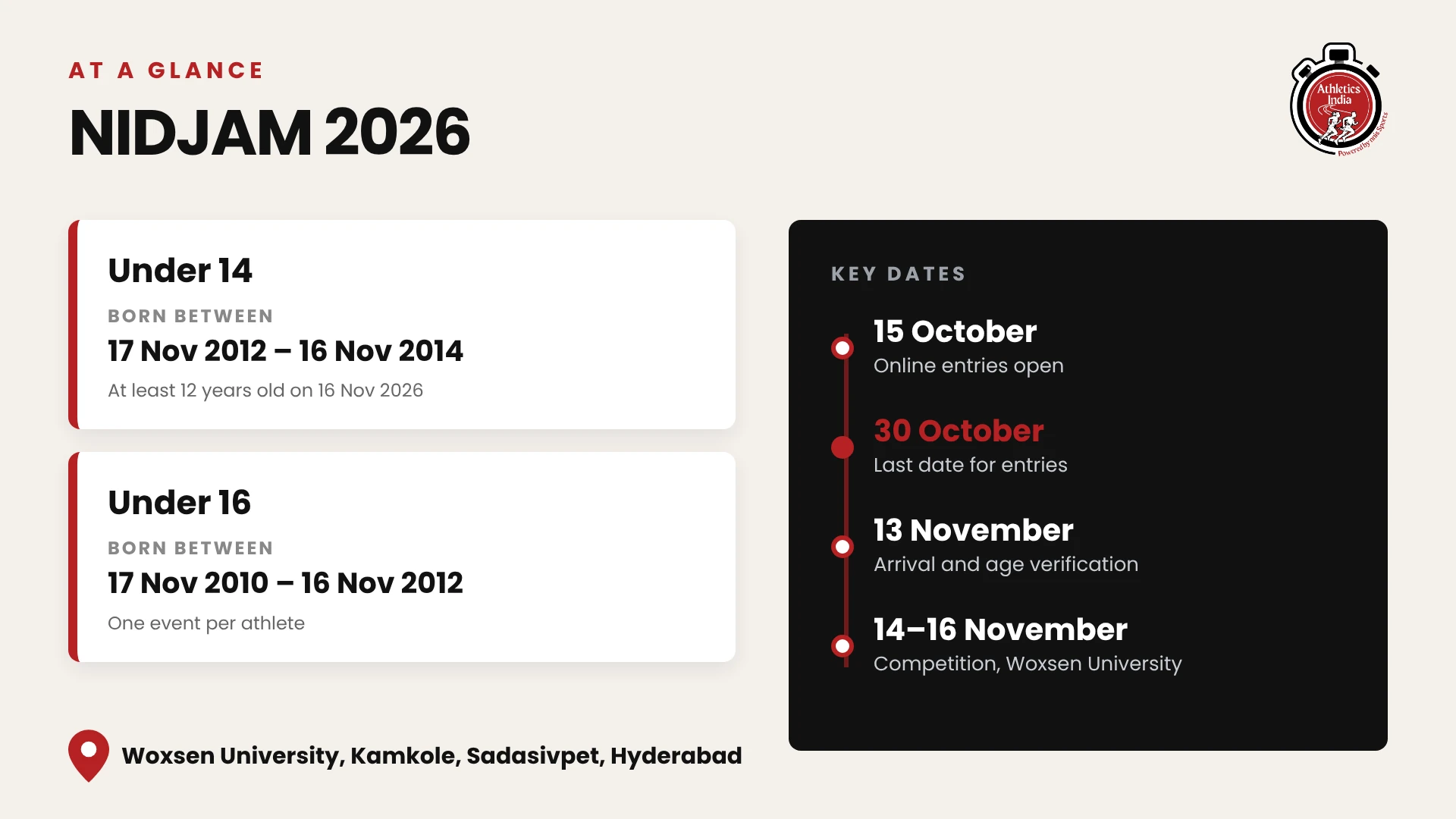
There are only two age groups, and the date of birth decides the group. In addition, an athlete must be at least 12 years old on 16 November 2026.
| Age group | Date of birth | Minimum age |
|---|---|---|
| Under 14 | 17 November 2012 to 16 November 2014 | 12 years on 16 November 2026 |
| Under 16 | 17 November 2010 to 16 November 2012 | – |
For example, a child born on 20 December 2012 is in the Under 14 group. However, a child born on 1 November 2012 falls in the Under 16 group.
NIDJAM 2026 events for Under 14 and Under 16
Under 14: triathlons and kids javelin
Under 14 athletes do not enter single events. Instead, each athlete chooses one triathlon group. Every Under 14 athlete must also take part in the kids javelin throw.
| Under 14 event | What it includes |
|---|---|
| Triathlon A | 60m, long jump (5m approach) and high jump (scissor) |
| Triathlon B | 60m, long jump (5m approach) and back throw (1kg shot) |
| Triathlon C | 60m, long jump (5m approach) and 600m |
| Kids javelin throw | Five-metre runway; compulsory for all Under 14 athletes |
Under 16: single events with lighter implements
The Under 16 events use shorter runways and lighter implements than senior athletics. For example, the shot put is a standing throw, and the high jump is scissor style only.
| Event | Boys | Girls |
|---|---|---|
| 60m | Yes | Yes |
| 80m hurdles | 0.838m hurdles | 0.762m hurdles |
| 600m | Yes | Yes |
| High jump | Scissor style only | Scissor style only |
| Long jump | 5m approach | 5m approach |
| Shot put (standing) | 4kg | 3kg |
| Javelin throw (10m approach) | 600g | 500g |
The circular also lists a pentathlon of 60m, 80m hurdles, long jump, standing shot put and 600m. However, its table does not make clear which group runs it, so check with your district unit before you enter.
How many athletes can a district send to NIDJAM 2026?
The quota is small, so district selection matters. Each district can send:
District quota for NIDJAM 2026
- Under 14: a maximum of four athletes, boys and girls together
- Under 16: one event per athlete, and a maximum of two athletes per event
- Free boarding and lodging: up to 13 athletes and 2 officials per district
Above all, only districts that have held a district meet under AFI guidelines can enter. The district association also has to send the district meet results, press cuttings and photographs with its entry, and it needs a valid PAN in its own name.
How to enter NIDJAM 2026
Athletes cannot enter on their own. Instead, the district athletics association enters them online. Here are the steps:
Important: AFI accepts online entries only. Entries sent by WhatsApp or email are not accepted.
NIDJAM 2026 age verification and documents
Age verification takes place on 13 November, at the venue, as soon as the teams arrive. An AFI committee, which includes doctors, checks every athlete, and managers or coaches have to present their athletes in person.
So bring the original proof of date of birth. AFI accepts either a birth certificate from the Birth and Death Registration Office (municipal corporation, nagar palika or district) or a Class 10 certificate. As a result, an athlete who does not clear verification cannot compete.
Food, stay and travel at NIDJAM 2026
AFI provides food from 13 to 17 November. It also gives free boarding and lodging to up to 13 athletes and 2 officials from each district.
In addition, AFI pays back the rail fare after the meet. It checks the original tickets and the athlete’s actual participation, and then it pays the money into the district association’s bank account. However, overage athletes get no travel allowance, food or accommodation.
Last edition: the 19th NIDJAM in Ahmedabad
The 19th NIDJAM took place at Gujarat University in Ahmedabad from 16 to 18 February 2024. You can see the 19th NIDJAM results (PDF) on our site.
Where else Under 14 and Under 16 athletes compete this season
The Under 14 and Under 16 groups also race at the National Junior Athletics Championships 2026 in Chennai from 23 to 27 October. Meanwhile, the zone results show the current level: see the Under 16 tables in our East Zone athletics 2026 results.
The East Zone athletics 2026 results are now official. The Athletics Federation of India (AFI) has published the result sheets of the 37th East Zone Junior Athletics Championships, which took place in Patna from 22 to 24 September.
This page therefore lists the gold, silver and bronze medallists in 84 finals, age group by age group. In addition, you will find the closest finishes, the athletes who won two golds and a medal count by state. Every result below comes from the official AFI result sheets.
East Zone Junior Athletics Championships 2026 at a glance
- Meet: 37th East Zone Junior Athletics Championships 2026
- Dates: 22 to 24 September 2026
- Venue: Patliputra Sports Complex, Kankarbagh, Patna, Bihar
- Age groups: Under 14, Under 16, Under 18 and Under 20
- Athletes: 553, according to the AFI result page
- Most golds in the finals listed here: Bihar 22, Odisha 21
- Overall team standings: not published with the result sheets
Jump to: Highlights Under 20 men Under 20 women Under 18 Under 16 and Under 14 Medal count National Junior standards What comes next
East Zone athletics 2026 results: the highlights
Bihar, the hosts, and Odisha shared the spotlight in Patna. Both states won 59 medals in the 84 finals listed here. However, Bihar finished with 22 golds, while Odisha had 21.
Prince Kumar wins the 100m, Koushik Gogoi takes the 200m
Prince Kumar of Bihar won the Under 20 men’s 100m in 10.76 seconds. Behind him, Pratik Maharana of Odisha and Koushik Gogoi of Assam both clocked 10.84. Gogoi then returned to win the 200m in 22.51, while Maharana took silver again.
Five athletes with two individual golds
In addition, five athletes won two individual titles in the events listed here.
| Athlete | State | Age group | Gold medals |
|---|---|---|---|
| Lusan Khamari | Odisha | Under 20 men | 400m (49.44) and 400m hurdles (53.38) |
| Ommkar Prasad Nanda | Odisha | Under 20 men | Shot put (16.91m) and hammer throw (57.64m) |
| Pahi Keot | Assam | Under 20 women | 1500m (4:49.77) and 5000m (18:07.21) |
| Dipti Rajbanshi | West Bengal | Under 18 girls | Shot put (13.13m) and discus throw (29.31m) |
| Longjam Tomcrus Singh | Manipur | Under 16 boys | High jump (1.74m) and long jump (4.90m) |
The closest finals in Patna
The Under 20 men’s 4x100m relay was the tightest race of the meet. Bihar won in 43.04, Odisha followed in 43.06 and Assam finished in 43.08. As a result, only four hundredths of a second separated the three medal teams.
Similarly, the photo-finish camera decided two individual medals. In the Under 20 men’s 800m, Rahul Oraon and Vikas Singh both clocked 1:57.86, but Oraon took silver by four thousandths of a second. In the Under 18 boys’ 100m, Ayushman Mahapatra won bronze in 11.17, because he was five thousandths ahead of Rishu Raj.
Prem Raj wins the long jump again
Prem Raj of Bihar won the Under 18 boys’ long jump with 7.33m. Earlier this season, he also broke the meet record at the Youth Nationals with 7.58m.
Big throws and golds for the smaller teams
The throws also produced strong marks. Subham Das of Odisha won the Under 20 men’s javelin with 68.44m, while Ayush Raj of Bihar threw 68.09m for the Under 18 title. In addition, Dev Raj of Bihar won the Under 18 discus with 52.17m.
The smaller teams also reached the top of the podium. For example, Phurba Hissey Sherpa and Sabina Rai won golds for Sikkim, in the Under 20 men’s 1500m and the women’s 3000m steeplechase. Meanwhile, Tusame Marak of Meghalaya won the Under 18 girls’ high jump, and Yanu Mane of Arunachal Pradesh took the Under 20 women’s 800m.
Under 20 men: East Zone athletics 2026 results
The table below has the medallists in 21 Under 20 men’s finals. Times are in minutes and seconds, while field marks are in metres.
On a phone, swipe the table sideways to see silver and bronze.
| Event | Gold | Silver | Bronze |
|---|---|---|---|
| 100m | Prince Kumar Bihar · 10.76 |
Pratik Maharana Odisha · 10.84 |
Koushik Gogoi Assam · 10.84 |
| 200m | Koushik Gogoi Assam · 22.51 |
Pratik Maharana Odisha · 22.56 |
Yiarmanwill Rymbai Meghalaya · 22.92 |
| 400m | Lusan Khamari Odisha · 49.44 |
Bishnu Kant Jha West Bengal · 49.78 |
Abhijeet Kujur Jharkhand · 50.23 |
| 800m | Rudrajit Karmakar West Bengal · 1:57.70 |
Rahul Oraon Jharkhand · 1:57.86 |
Vikas Singh Bihar · 1:57.86 |
| 1500m | Phurba Hissey Sherpa Sikkim · 4:02.85 |
Rahul Oraon Jharkhand · 4:04.42 |
Ayush Kumar Bihar · 4:04.55 |
| 3000m | Deepak Kumar Mahto Jharkhand · 8:46.24 |
Dolamani Chirgun Odisha · 8:51.05 |
Phurba Hissey Sherpa Sikkim · 8:55.46 |
| 5000m | Dolamani Chirgun Odisha · 15:41.74 |
Wankyrmen L Mawphlang Meghalaya · 15:42.94 |
Hitesh Baro Assam · 15:57.54 |
| 110m hurdles | Sayan Mondal West Bengal · 14.83 |
Sanjeev Kumar Bharti Jharkhand · 15.12 |
Biswajit Das Odisha · 15.17 |
| 400m hurdles | Lusan Khamari Odisha · 53.38 |
Sayan Mondal West Bengal · 53.67 |
Roshan Khadia Odisha · 54.74 |
| 3000m steeplechase | Ayush Kumar Bihar · 9:37.48 |
Biswajit Sau West Bengal · 9:37.67 |
Anchal Rai Sikkim · 9:56.00 |
| High jump | Amar Yadav Odisha · 1.90m |
Soumyajit Mondal West Bengal · 1.90m |
Sagar Ekka Odisha · 1.85m |
| Long jump | Mahendra Hansda Odisha · 7.00m |
Deepak Munda Jharkhand · 6.98m |
Biswajit Das Odisha · 6.97m |
| Triple jump | Rajarshi Barman Assam · 14.44m |
Dular Kerketta Jharkhand · 14.16m |
Vibek Oraon Jharkhand · 13.87m |
| Shot put | Ommkar Prasad Nanda Odisha · 16.91m |
Devanshu Shekhar Bihar · 16.82m |
Partha Protim Buragohain Assam · 15.48m Manoj Roy |
| Discus throw | Priyanshu Sharma Bihar · 46.33m |
Abdul Rajjak West Bengal · 43.79m |
Krishna Raj Bihar · 41.50m |
| Hammer throw | Ommkar Prasad Nanda Odisha · 57.64m |
Md Kadir Bihar · 54.35m |
Suraj Gope Odisha · 51.81m |
| Javelin throw | Subham Das Odisha · 68.44m |
Debasish Adhikary West Bengal · 64.08m |
Virendra Yadav Bihar · 63.63m |
| 5000m race walk | Saurabh Kumar Bihar · 21:36.70 |
Ravi Shankar Kumar Bihar · 21:38.59 |
Thokchom Panan Meitei Manipur · 21:50.96 |
| 4x100m relay | Bihar 43.04 |
Odisha 43.06 |
Assam 43.08 |
| 4x400m relay | Bihar 3:22.97 |
Jharkhand 3:25.17 |
Odisha 3:25.30 |
| Decathlon | Souvik Paul West Bengal · 5400 pts |
Surya Ray Bihar · 4937 pts |
Amit Kumar Bihar · 4402 pts |
Pole vault: the Under 20 men’s pole vault was held as a trial. Ravi Kumar of Bihar cleared 3.90m.
Under 20 women: East Zone 2026 results and medal winners
Odisha and Jharkhand won most of the Under 20 women’s titles. Here are the medallists in 19 finals.
On a phone, swipe the table sideways to see silver and bronze.
| Event | Gold | Silver | Bronze |
|---|---|---|---|
| 100m | Sushree Swagati Samantaray Odisha · 12.72 |
Amisha Tirkey Odisha · 12.77 |
Puja Das West Bengal · 12.96 |
| 200m | Amisha Tirkey Odisha · 25.68 |
Arpita Priyadarsini Odisha · 25.73 |
Punam Kumari Jharkhand · 26.11 |
| 400m | Punam Kumari Jharkhand · 59.07 |
Arpita Priyadarsini Odisha · 59.63 |
Urbashri Saikia Assam · 1:01.47 |
| 800m | Yanu Mane Arunachal Pradesh · 2:24.19 |
Chintamani Tuti Jharkhand · 2:24.35 |
Jaeklin Khess Jharkhand · 2:26.90 |
| 1500m | Pahi Keot Assam · 4:49.77 |
Yanu Mane Arunachal Pradesh · 4:54.70 |
Sapna Khanal Sikkim · 5:09.69 |
| 3000m | Sonam Kumari Jharkhand · 10:33.79 |
Manju Kumari Jharkhand · 10:34.63 |
Sadhana Yadav Bihar · 10:35.35 |
| 5000m | Pahi Keot Assam · 18:07.21 |
Sadhana Yadav Bihar · 18:15.26 |
Manju Kumari Jharkhand · 18:25.30 |
| 100m hurdles | Gurupuja Parida Odisha · 15.39 |
Basanti Majhi Odisha · 16.06 |
Sohini Kundu West Bengal · 16.14 |
| 400m hurdles | Shivani Kumari Jharkhand · 1:02.60 |
Basanti Majhi Odisha · 1:03.48 |
Manisha Lakra Odisha · 1:03.74 |
| 3000m steeplechase | Sabina Rai Sikkim · 11:43.26 |
Sunita Santa Odisha · 11:58.49 |
Doli Kumari Bihar · 13:14.70 |
| High jump | Dipti Ghosh West Bengal · 1.56m |
Moumita Dhar West Bengal · 1.51m |
Anuska Majhong Meghalaya · 1.51m |
| Long jump | Sanju Hantal Odisha · 5.58m |
Moni Kumari Bihar · 5.41m |
Nandita Sarmah Assam · 5.05m |
| Shot put | Shreya Nayak West Bengal · 11.88m |
Sasmita Behera Odisha · 10.31m |
Melibad Kro Meghalaya · 9.86m |
| Discus throw | Purabi Padhi Odisha · 40.74m |
Jagriti Singh Bihar · 39.78m |
Bhumi Kumari Assam · 33.90m |
| Hammer throw | Palak Kumari Bihar · 50.14m |
Ankita Mohapatra Odisha · 49.11m |
Sasmita Behera Odisha · 38.01m |
| Javelin throw | Sabita Murmu Jharkhand · 43.71m |
Anupriya Roy West Bengal · 41.50m |
Sumitra Pangi Odisha · 35.76m |
| 5000m race walk | Sunita Kumari Bihar · 27:11.52 |
Sanchita Ram West Bengal · 30:32.38 |
Alish Ekka Odisha · 31:01.35 |
| 4x100m relay | Odisha 49.23 |
Jharkhand 50.10 |
Bihar 50.96 |
| 4x400m relay | Jharkhand 3:56.20 |
Odisha 3:57.27 |
Bihar 4:26.01 |
Trials: the Under 20 women’s pole vault and triple jump were listed as trials, and neither produced a valid mark.
East Zone Under 18 results: boys and girls
Boys: Under 18 medal winners
On a phone, swipe the table sideways to see silver and bronze.
| Event | Gold | Silver | Bronze |
|---|---|---|---|
| 100m | Subhashu Kumar Bihar · 11.06 |
Himanshu Behera Odisha · 11.10 |
Ayushman Mahapatra Odisha · 11.17 |
| 200m | Himanshu Behera Odisha · 22.49 |
Ayushman Mahapatra Odisha · 22.53 |
Rishu Raj Jharkhand · 23.00 |
| 400m | Prince Kumar Jharkhand · 49.78 |
Devendra Kumar Bihar · 50.38 |
Waikhom Sidharth Singh Manipur · 50.57 |
| 1000m | Santosh Kumar Jharkhand · 2:40.31 |
Piyush Keshri Bihar · 2:40.95 |
Raj Sinha Bihar · 2:42.13 |
| 110m hurdles | Md Sajid Jharkhand · 14.38 |
Bhargab Boro Assam · 14.48 |
Nirmal Kumar Bihar · 14.96 |
| Long jump | Prem Raj Bihar · 7.33m |
Sanoyaj Mondal West Bengal · 7.12m |
Kamlesh Oraon Jharkhand · 6.80m |
| High jump | Swadhin Behera Odisha · 1.97m |
Kingshuk Paul West Bengal · 1.97m |
Zubin Gohain Assam · 1.95m Himanshu Kumar Singh |
| Shot put | Shubham Raj Bihar · 16.10m |
Snigdho Protim Konwar Assam · 15.95m |
Dev Raj Bihar · 15.70m |
| Discus throw | Dev Raj Bihar · 52.17m |
Amrit Raj Singh Bihar · 50.12m |
Mainak Ghosh West Bengal · 48.96m |
| Javelin throw | Ayush Raj Bihar · 68.09m |
Apurba Paul West Bengal · 63.76m |
Deb Rup Barman West Bengal · 60.34m |
| 5000m race walk | Firdous Alam Assam · 23:20.15 |
Alok Kumar Bihar · 23:36.37 |
Abhra Mondal West Bengal · 24:23.92 |
| Medley relay | Bihar 1:57.97 |
Assam 1:59.27 |
Jharkhand 2:00.56 |
| Heptathlon | Akash Ashvini Bihar · 4735 pts |
Deb Mondal West Bengal · 4202 pts |
Meghadri Saha West Bengal · 4106 pts |
Girls: Under 18 medal winners
On a phone, swipe the table sideways to see silver and bronze.
| Event | Gold | Silver | Bronze |
|---|---|---|---|
| 100m | Mamta Marry Murmu Jharkhand · 12.48 |
Hiya Baruah Assam · 12.71 |
Rutuparna Biswa Odisha · 12.71 |
| 200m | Dhritima Deka Assam · 25.79 |
Mamta Marry Murmu Jharkhand · 25.93 |
Brishti Gogoi Assam · 26.44 |
| 400m | Laxmipriya Nath Odisha · 59.16 |
Dhritima Deka Assam · 59.99 |
Aashika Kumari Bihar · 1:00.56 |
| 1000m | Khushi Kumari Bihar · 3:03.43 |
Rivana Sultana West Bengal · 3:04.87 |
Barsha Pramanik West Bengal · 3:05.45 |
| 100m hurdles | Sonali Jana West Bengal · 14.56 |
Diptimayee Das Odisha · 14.61 |
Urmila Bharasag Odisha · 15.09 |
| Long jump | Magheli Buragohain Assam · 5.55m |
Parbati Hansdah Odisha · 5.32m |
Prithvi Oraon Jharkhand · 5.30m |
| High jump | Tusame Marak Meghalaya · 1.51m |
Maya Basumatary Assam · 1.48m |
Pushkarini Barman West Bengal · 1.45m |
| Shot put | Dipti Rajbanshi West Bengal · 13.13m |
Ipsita Borah Assam · 10.70m |
Suhani Singh Jharkhand · 9.91m |
| Discus throw | Dipti Rajbanshi West Bengal · 29.31m |
Goma Purti Jharkhand · 28.60m |
Rupsha Mondal West Bengal · 28.58m |
| Javelin throw | Shilpa Kumari Jharkhand · 43.11m |
Rajkumari Yadav Jharkhand · 36.36m |
Tusame Marak Meghalaya · 32.78m |
| 3000m race walk | Suporna Das Assam · 16:08.85 |
Tannu Kumari Bihar · 16:23.87 |
Richa Kumari Bihar · 16:53.12 |
| Medley relay | Odisha 2:20.27 |
Assam 2:23.17 |
West Bengal 2:27.89 |
Under 16 and Under 14 East Zone results
The Under 16 events are shorter. For example, the sprint is over 60m and the middle-distance race is over 600m.
Boys: Under 16 medal winners
On a phone, swipe the table sideways to see silver and bronze.
| Event | Gold | Silver | Bronze |
|---|---|---|---|
| 60m | Sandeep Yadav Bihar · 7.04 |
Sai Pritam Sahu Odisha · 7.17 |
Bhargav Boruah Assam · 7.17 |
| 600m | Abhirup Roy West Bengal · 1:21.11 |
Subhash Oraon Jharkhand · 1:21.17 |
Ashok Kumar Bihar · 1:23.30 |
| 80m hurdles | Rohit Raj Bihar · 10.38 |
Amanuel Kisku Jharkhand · 10.42 |
Swayamsiddha Sahoo Odisha · 10.43 |
| High jump | Longjam Tomcrus Singh Manipur · 1.74m |
Soumik Ghosh West Bengal · 1.74m |
Dilip Mallick Odisha · 1.74m |
| Long jump | Longjam Tomcrus Singh Manipur · 4.90m |
Rohit Raj Bihar · 4.84m |
Satavik Ghorui West Bengal · 4.73m |
| Shot put | Aditya Chauhan Bihar · 13.89m |
Abhijit Barman West Bengal · 13.39m |
Aakash Kumar Bihar · 13.33m |
| Javelin throw | Kishu Singh Bihar · 66.18m |
Mugdha Poran Borah Assam · 65.78m |
Gourab Bouri West Bengal · 54.62m |
| Medley relay | Bihar 1:59.69 |
Odisha 2:02.59 |
West Bengal 2:07.00 |
| Pentathlon | Parma Hansda Jharkhand · 3852 pts |
Mithlesh Kumar Bihar · 3783 pts |
Nikhil Kumar Bihar · 3691 pts |
Girls: Under 16 medal winners
On a phone, swipe the table sideways to see silver and bronze.
| Event | Gold | Silver | Bronze |
|---|---|---|---|
| 60m | Sohana Akter West Bengal · 8.10 |
Samikshya Smaranika Odisha · 8.16 |
Priti Kumari Bihar · 8.27 |
| 600m | Piya Dutta West Bengal · 1:38.93 |
Abhilasha Dutta Assam · 1:39.78 |
Naina Singh Jharkhand · 1:41.31 |
| 80m hurdles | Naina Singh Jharkhand · 12.76 |
Jeena Majhi Odisha · 12.83 |
Archana Sarkar West Bengal · 12.90 |
| High jump | Resma Behera Odisha · 1.48m |
Yasmin Parween Bihar · 1.48m |
Ananya Khandayatray Odisha · 1.46m |
| Long jump | Samikshya Smaranika Odisha · 3.99m |
Nidhi Shaw West Bengal · 3.84m |
Soni Kumari Jharkhand · 3.81m |
| Shot put | Ananya Roy West Bengal · 11.17m |
Debojani Bora Assam · 10.84m |
Radha Rani Bihar · 10.74m |
| Javelin throw | Monika Baidya West Bengal · 44.27m |
Kajal Kumari Jharkhand · 29.92m |
Puja Sonowal Assam · 29.35m |
| Medley relay | Jharkhand 2:27.29 |
West Bengal 2:29.27 |
Bihar 2:30.14 |
Kids javelin: Under 14 medal winners
On a phone, swipe the table sideways to see silver and bronze.
| Event | Gold | Silver | Bronze |
|---|---|---|---|
| Boys | Rahul Kumar Bihar · 56.75m |
Hari Om Bihar · 54.68m |
Shibam Bala West Bengal · 53.50m |
| Girls | Kuni Rajgond Odisha · 36.44m |
Soumya Kumari Bihar · 32.55m |
Bharati Gundua Odisha · 26.31m |
Not in these tables: the women’s and girls’ combined events, the Under 14 triathlons and the mixed relays. Those results are in the official results PDF.
East Zone 2026 medal count by state
AFI’s result sheets do not include a team points table. So we counted the medals in the 84 finals listed above. Two events had a tie for bronze, which is why the bronze column adds up to 86.
| State | Gold | Silver | Bronze | Total |
|---|---|---|---|---|
| Bihar | 22 | 17 | 20 | 59 |
| Odisha | 21 | 21 | 17 | 59 |
| Jharkhand | 14 | 15 | 13 | 42 |
| West Bengal | 13 | 18 | 16 | 47 |
| Assam | 8 | 11 | 11 | 30 |
| Sikkim | 2 | 0 | 3 | 5 |
| Manipur | 2 | 0 | 2 | 4 |
| Meghalaya | 1 | 1 | 4 | 6 |
| Arunachal Pradesh | 1 | 1 | 0 | 2 |
However, this is our count and not the official standings. It also leaves out the events named in the note above, so the final order can still change. We will add the official team standings here as soon as AFI publishes them.
East Zone winners against the National Junior entry standards
The next stop for many of these athletes is the National Junior Athletics Championships 2026 in Chennai. Therefore, we compared nine winning marks in Patna with the AFI entry standards for that meet.
| Event | Entry standard | East Zone winner | Winning mark | Against the standard |
|---|---|---|---|---|
| Men U20 100m | 10.90 | Prince Kumar | 10.76 | Inside |
| Men U20 400m | 50.00 | Lusan Khamari | 49.44 | Inside |
| Men U20 800m | 1:55.00 | Rudrajit Karmakar | 1:57.70 | Outside |
| Men U20 javelin throw | 65.00m | Subham Das | 68.44m | Inside |
| Men U20 hammer throw | 60.00m | Ommkar Prasad Nanda | 57.64m | Outside |
| Women U20 100m | 12.75 | Sushree Swagati Samantaray | 12.72 | Inside |
| Women U20 400m | 58.50 | Punam Kumari | 59.07 | Outside |
| Women U20 1500m | 4:50.00 | Pahi Keot | 4:49.77 | Inside |
| Women U20 javelin throw | 38.50m | Sabita Murmu | 43.71m | Inside |
Six of the nine winners were inside the standard. However, the other three winning marks were outside it. So an East Zone gold does not guarantee the entry mark on its own.
Last year: Jharkhand won the title in Ranchi
Ranchi hosted the 36th edition from 22 to 24 September 2025 at the Morabadi football stadium. Jharkhand won the overall title with 172 points, while Bihar finished second with 168, according to ETV Bharat. You can also compare this year’s marks with the East Zone 2025 results (PDF).
After the East Zone athletics 2026 meet: what comes next
The 41st National Junior Athletics Championships will take place at the JN Stadium in Chennai from 23 to 27 October. After that, the 20th NIDJAM follows in Hyderabad from 14 to 16 November for Under 14 and Under 16 athletes.
Meanwhile, results from the other zones are on our South Zone athletics 2026 results page and in the North Zone 2026 results (PDF). Results from every other meet this season are also on the Indian athletics results page.
The 41st National Junior Athletics Championships 2026 will take place from 23 to 27 October at the JN Stadium in Chennai, and online entries close on Friday 9 October. The meet also covers four age groups, from Under 14 to Under 20.
This guide puts everything in one place for athletes, parents and coaches. You will find the entry standards for every age group, as well as the entry fee, the age rules and the documents you need for age verification. In addition, we explain how hard the standards really are, with results from this season.
National Junior Athletics Championships 2026 at a glance
- Dates: Friday 23 October to Tuesday 27 October 2026
- Venue: JN Stadium, Chennai, Tamil Nadu
- Organiser: Athletics Federation of India (AFI)
- Age groups: Under 14, Under 16, Under 18 and Under 20, for boys and girls
- Last date for entries: Friday 9 October 2026, online only, through your state association
- Entry fee: ₹250 per event, per athlete
- Age verification: from Wednesday 21 October at the stadium
Jump to: Key dates Age groups How to enter U20 standards U18 standards U16 standards Documents Schedule and results
National Junior Athletics Championships 2026: key dates
Four dates matter. Above all, do not miss the first one, because entries close that day.
Entries opened on 19 September, so only a few days remain. After that, the next step is age verification in Chennai.
Age groups: which category are you in?
Your date of birth decides your age group. For example, an athlete born on 15 March 2009 competes in the Under 18 group.
| Age group | Born between |
|---|---|
| Under 14 | 28 October 2012 and 27 October 2014 |
| Under 16 | 28 October 2010 and 27 October 2012 |
| Under 18 | 28 October 2008 and 27 October 2010 |
| Under 20 | 28 October 2006 and 27 October 2008 |
How to enter the National Junior Athletics Championships 2026
Athletes cannot enter on their own. Instead, the state or union territory association sends every entry online. So if you have the standard, contact your state association before 9 October.
| Rule | Under 20, Under 18 and Under 16 | Under 14 |
|---|---|---|
| Entries per state | Two athletes per event | One athlete per event |
| Events per athlete | Two individual events and one relay | One triathlon group, plus the kids javelin throw |
National Junior Athletics Championships 2026 entry standards: Under 20
These are the marks from the AFI circular. Times are in minutes and seconds, while field marks are in metres.
| Event | Men U20 | Women U20 |
|---|---|---|
| 100m | 10.90 | 12.75 |
| 200m | 23.00 | 26.50 |
| 400m | 50.00 | 58.50 |
| 800m | 1:55.00 | 2:20.00 |
| 1500m | 4:00.00 | 4:50.00 |
| 3000m | 9:14.00 | 11:40.00 |
| 5000m | 15:10.00 | 18:50.00 |
| 110m / 100m hurdles | 15.00 | 16.00 |
| 400m hurdles | 55.00 | 1:07.00 |
| 3000m steeplechase | 10:10.00 | 13:30.00 |
| 5000m race walk | 26:00.00 | 30:00.00 |
| High jump | 1.90m | 1.55m |
| Pole vault | 3.80m | 2.80m |
| Long jump | 6.80m | 5.30m |
| Triple jump | 14.50m | 11.60m |
| Shot put | 15.50m | 11.00m |
| Discus throw | 45.00m | 35.00m |
| Hammer throw | 60.00m | 39.00m |
| Javelin throw | 65.00m | 38.50m |
| Decathlon / Heptathlon | 5000 points | 3250 points |
| 4x100m relay | 44.00 | 52.00 |
| 4x400m relay | 3:24.00 | 4:05.00 |
The Under 20 programme also has 4x100m and 4x400m mixed relays. However, the circular does not list an entry standard for them.
Entry standards: Under 18
| Event | Boys U18 | Girls U18 |
|---|---|---|
| 100m | 11.50 | 13.00 |
| 200m | 23.60 | 27.00 |
| 400m | 51.70 | 1:03.00 |
| 1000m | 2:50.00 | 3:10.00 |
| 110m / 100m hurdles | 15.40 | 16.00 |
| High jump | 1.80m | 1.45m |
| Long jump | 6.50m | 5.00m |
| Shot put | 14.50m | 11.50m |
| Discus throw | 46.00m | 33.00m |
| Javelin throw | 58.00m | 35.00m |
| Heptathlon | 4000 points | 3000 points |
| Medley relay | 1:56.00 | 2:20.00 |
| 5000m race walk | 28:00.00 | Not listed |
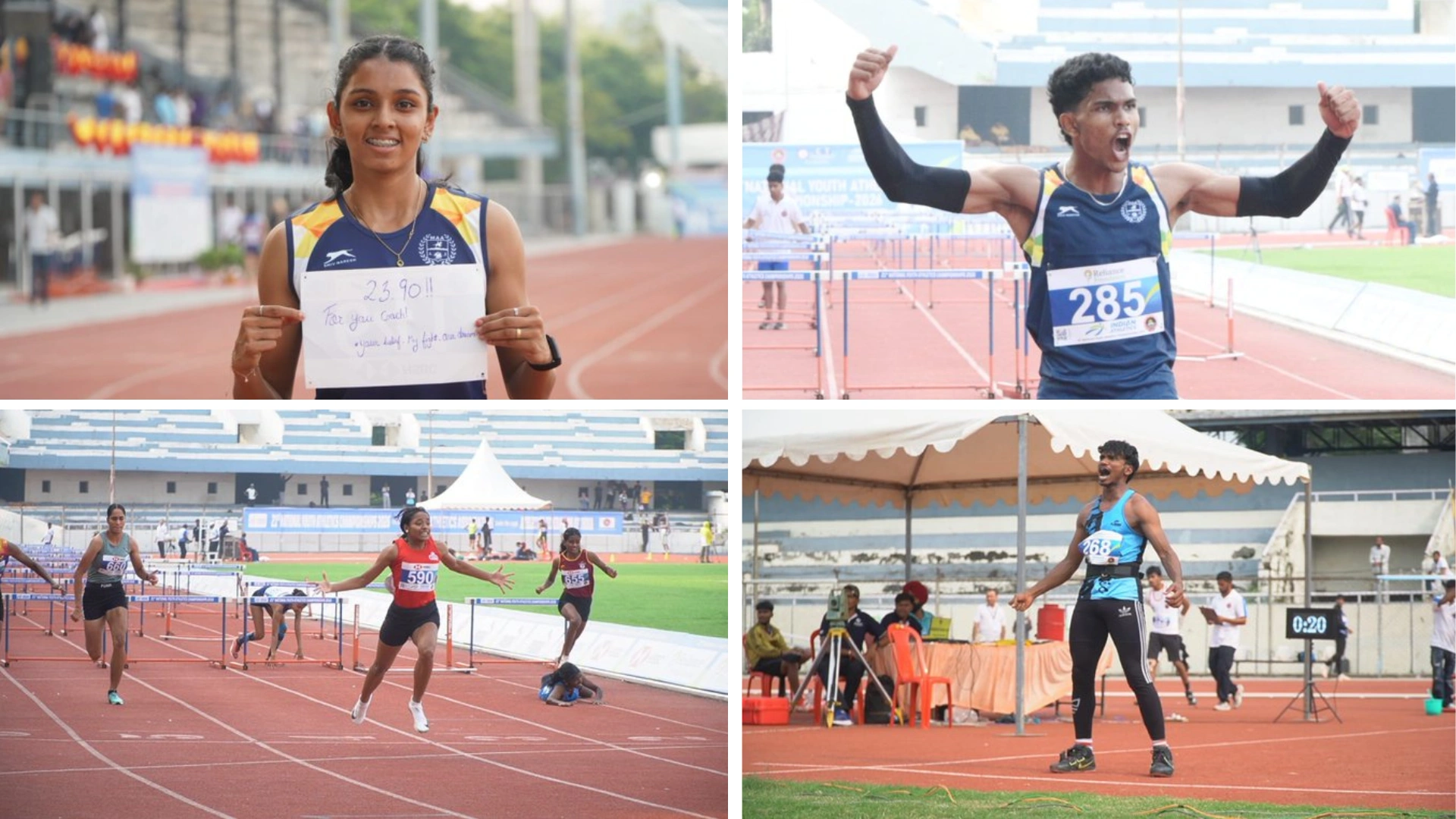
Entry standards: Under 16 and Under 14
The Under 16 events are shorter and simpler. For example, the high jump is scissor style only, and the long jump uses a five-metre runway.
| Event | Boys U16 | Girls U16 |
|---|---|---|
| 60m | 8.00 | 9.50 |
| 600m | 1:30.00 | 1:45.00 |
| 80m hurdles | 12.00 | 13.50 |
| High jump (scissor) | 1.55m | 1.30m |
| Long jump (5m runway) | 4.20m | 3.50m |
| Shot put (standing throw) | 10.00m | 8.00m |
| Javelin throw (10m approach) | 38.00m | 30.00m |
| Pentathlon | 2800 points | 1800 points |
Under 14: no entry standards
However, the circular lists no entry standards for the Under 14 group. Instead, each athlete picks one triathlon group, and every Under 14 athlete also takes part in the kids javelin throw.
| Under 14 event | What it includes |
|---|---|
| Triathlon A | 60m, long jump (5m approach) and high jump (scissor) |
| Triathlon B | 60m, long jump (5m approach) and back throw (1kg shot) |
| Triathlon C | 60m, long jump (5m approach) and 600m |
| Kids javelin throw | Five-metre runway; compulsory for all Under 14 athletes |
How hard are the entry standards?
The standard is the minimum, not a medal mark. In order to show the gap, we compared the Under 20 standards with the winning marks at the North Zone Junior Championships in September.
| Event | Entry standard | North Zone 2026 winner | Winning mark |
|---|---|---|---|
| Men U20 100m | 10.90 | Sagar Baliyan (Uttar Pradesh) | 10.78 |
| Men U20 400m | 50.00 | Harmandeep Singh (Chandigarh) | 46.43 |
| Men U20 800m | 1:55.00 | Deepender (Haryana) | 1:52.68 |
| Men U20 1500m | 4:00.00 | Brijesh Kumar (Chandigarh) | 3:51.19 |
| Women U20 100m | 12.75 | Mannat (Haryana) | 12.62 |
| Women U20 400m | 58.50 | Harshil (Haryana) | 1:00.90 |
Most zone winners were well inside the standard. However, the last row tells a different story. Harshil won the North Zone Under 20 women’s 400m in 1:00.90, which is outside the 58.50 standard. So a zone gold does not guarantee the mark.
At the top end, however, the level is far higher. For example, Neil Samraj ran 10.46 in September to break the Under 18 100m national record, while the Under 18 entry standard is 11.50.
Similarly, Prem Raj of Bihar jumped 7.58m to win long jump gold at the National Youth Championships in Ludhiana. In comparison, the Under 18 entry standard for Chennai is 6.50m, so he cleared it by more than a metre.
Age verification: documents you must carry
The Age Verification Committee checks every athlete from 21 October at the stadium. No athlete can compete without this check, so carry the original documents.
Proof of age that AFI accepts
- Under 14 and Under 16: a certificate from the Birth and Death Registration Office, or the 10th standard certificate
- Above 16: the 10th standard certificate from a recognised board, or a birth certificate
- Athletes who did not attend school: a birth certificate
- School dropouts: a birth certificate and a school leaving certificate that shows the date of birth
- Certificates in a regional language: add an English or Hindi translation attested by a Gazetted Officer
Other rules at the venue
The National Anti-Doping Agency will conduct dope tests during the championships. In addition, AFI issues participation certificates online, and only to athletes who perform to the entry standard at the meet. Merit certificates also come online, after the dope test reports arrive.
Last year: Tamil Nadu won by two points
Bhubaneswar hosted the 40th edition at the Kalinga Stadium from 10 to 14 October 2025. Tamil Nadu won the overall trophy with 289 points, while Haryana finished second with 287, according to AFI.
Tamil Nadu therefore host the meet as defending champions. In addition, they have just won the overall title at the South Zone Junior Championships 2026.
National Junior Athletics Championships 2026 schedule and results
AFI has not published the day-wise schedule yet. We will add it here as soon as it is out, and then the results after every session from 23 October. Until then, results from every other meet this season are on our Indian athletics results page.