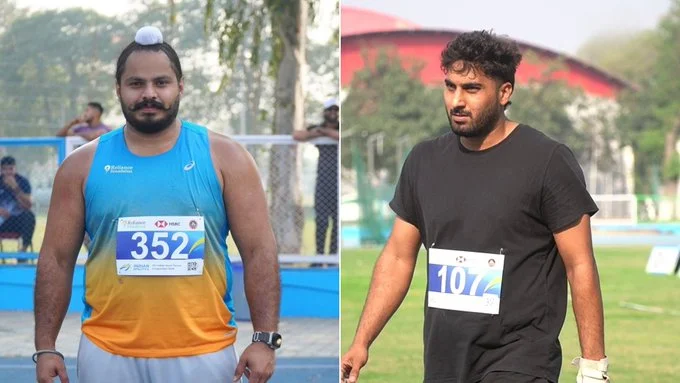

Who is Neeraj Chopra? He is India’s Olympic and world javelin champion, known for winning gold at the Tokyo 2020 Olympics and silver at Paris 2024. Born in Khandra village, Panipat, Haryana, the 28-year-old holds India’s national javelin record of 90.23m, set at the Doha Diamond League in May 2025.
In 2026, Chopra won Commonwealth Games silver in Glasgow with a season-best throw of 85.83m before improving to 88.05m at the Lausanne Diamond League. However, an ankle ligament injury in August brought his season to an early end.
Neeraj Chopra at a glance
- Born: 24 December 1997, Khandra village, Panipat (Haryana)
- Age: 28
- State: Haryana
- Event: Javelin throw
- Personal best: 90.23m, national record (Doha, May 2025)
- Headline results: Olympic gold 2021, Olympic silver 2024, world champion 2023, Commonwealth Games silver 2026
- Job: Honorary Lieutenant Colonel, Territorial Army (joined the Indian Army in 2016)
- Off the track: married to former tennis player Himani Mor; set up his own management firm, Vel Sports
Who is Neeraj Chopra? The short answer
Neeraj Chopra is an Indian javelin thrower and the most decorated athlete in Indian track and field. He was born on 24 December 1997, according to World Athletics, and he grew up in Khandra village near Panipat.
He won India’s first Olympic gold in athletics in Tokyo, and he became India’s first world champion in 2023. However, his 2026 season was short. A back injury delayed his start until June, and an ankle ligament tear ended his year in late August.
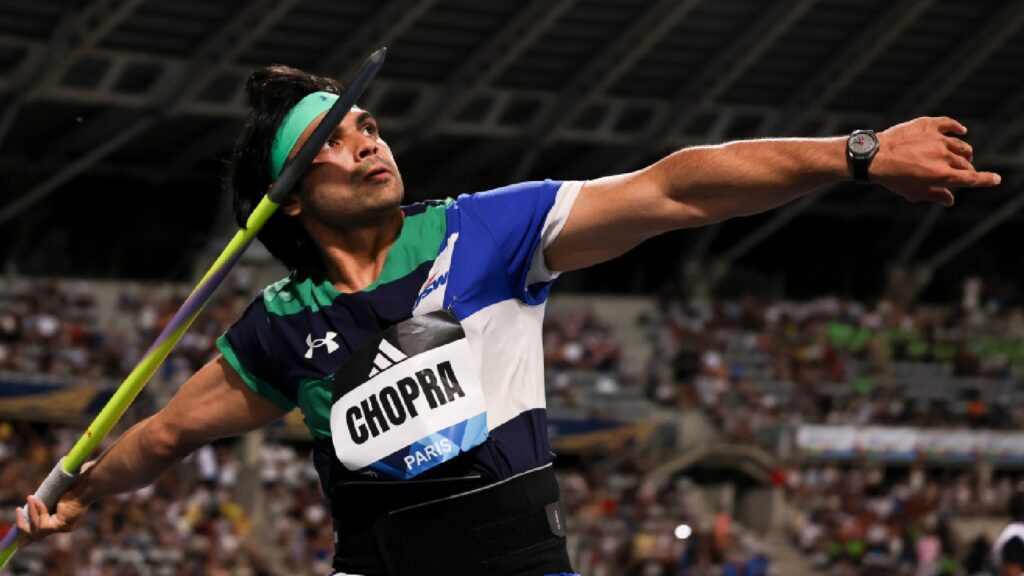 Neeraj Chopra, the 28-year-old javelin thrower from Panipat, is India’s Olympic and world champion.
Commonwealth Games 2026: javelin silver in Glasgow
Neeraj returned to the Commonwealth Games after missing the 2022 edition. In the qualifying round on 30 July, he joined Yashvir Singh and Rohit Yadav as three Indians in a Commonwealth Games javelin final for the first time.
The final followed on Friday 31 July at Scotstoun Stadium. Neeraj opened with 80.97m and then threw a season-best 85.83m in round two to take the lead. However, Sri Lanka’s Rumesh Pathirage replied with 89.75m, and Neeraj finished second.
| Place | Athlete | Country | Mark |
|---|---|---|---|
| 1 | Rumesh Pathirage | Sri Lanka | 89.75m |
| 2 | Neeraj Chopra | India | 85.83m |
| 3 | Yashvir Singh | India | 85.41m |
| 4 | Anderson Peters | Grenada | 83.88m |
| 7 | Rohit Yadav | India | 81.56m |
The silver still made history. Neeraj became the first Indian with two Commonwealth Games javelin medals, after his gold on the Gold Coast in 2018. In addition, Yashvir’s bronze gave India its first double podium in the event. Every Indian result from Glasgow is on our CWG 2026 page.
Download PDF: CWG 2026 complete results
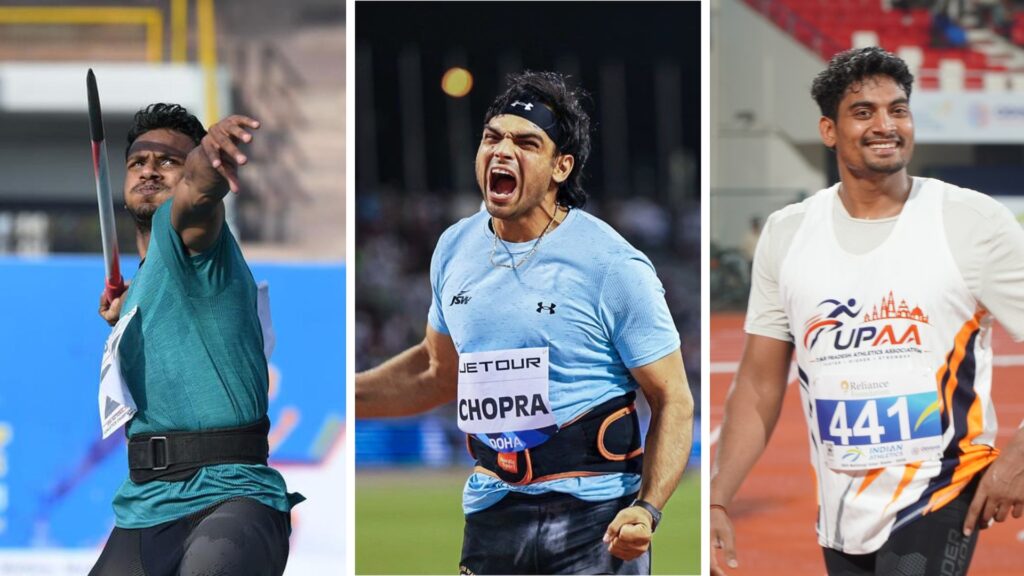
Lausanne Diamond League: 88.05m, just 9cm short
Three weeks after Glasgow, Neeraj competed at the Lausanne Diamond League on 21 August. He opened with 83.54m and then threw a season-best 88.05m in round two. It was his best throw since his 88.16m win at the Paris Diamond League in June 2025.
Pathirage, however, won again with 88.14m, so Neeraj finished second by nine centimetres. Even so, the result lifted him into the Diamond League Final with 12 points from only two meetings.
| Place | Athlete | Country | Mark |
|---|---|---|---|
| 1 | Rumesh Pathirage | Sri Lanka | 88.14m |
| 2 | Neeraj Chopra | India | 88.05m |
| 3 | Anderson Peters | Grenada | 86.69m |
| 4 | Keshorn Walcott | Trinidad and Tobago | 83.71m |
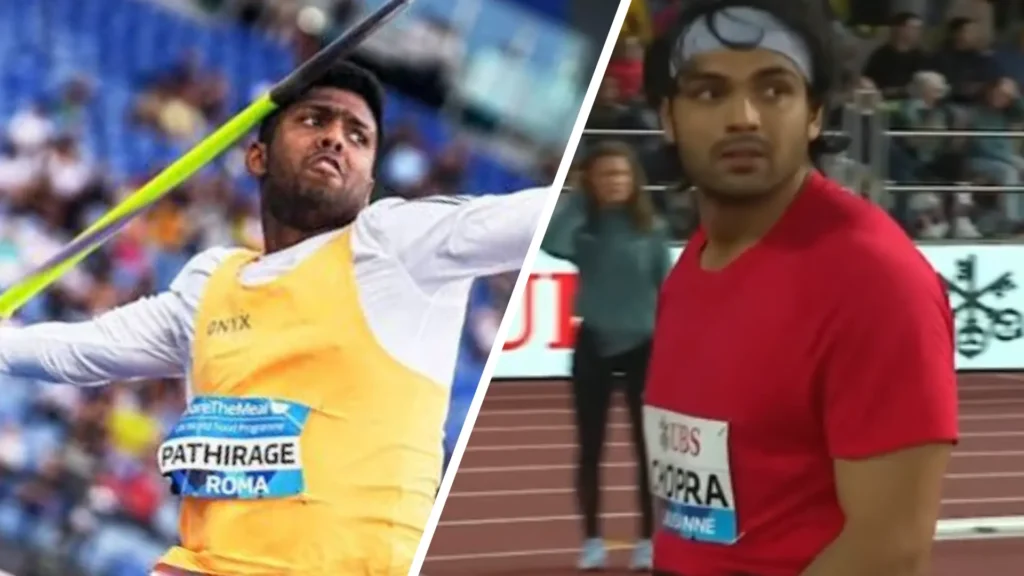 Neeraj Chopra’s 88.05m in Lausanne was his best throw of 2026, nine centimetres behind Rumesh Pathirage.
Neeraj Chopra’s 2026 season, throw by throw
His season started late. A lower-back injury from the 2025 World Championships kept him out for nine months, so his first meet came in June. After that, his best rose from 85.69m to 85.83m and then to 88.05m in just nine weeks.
| When | Meet | Event | Result |
|---|---|---|---|
| 19 June | Doha Diamond League, Qatar | Javelin | 85.69m, fourth, CWG qualification |
| 30 July | Commonwealth Games qualifying, Glasgow | Javelin | Reached final |
| 31 July | Commonwealth Games final, Glasgow | Javelin | 85.83m, silver |
| 21 August | Lausanne Diamond League, Switzerland | Javelin | 88.05m, second, season best |
| 29 August | Season ended | Ankle ligament tear | Missed Diamond League Final, Ultimate Championship and Asian Games |
The Doha meet was also his first under new coach Jai Chaudhary. Then, on 29 August, Neeraj announced that he had torn an ankle ligament in training. As a result, he could not defend his Asian Games title, and India named Yashvir Singh in his place. He also missed the Ultimate Championship in Budapest.
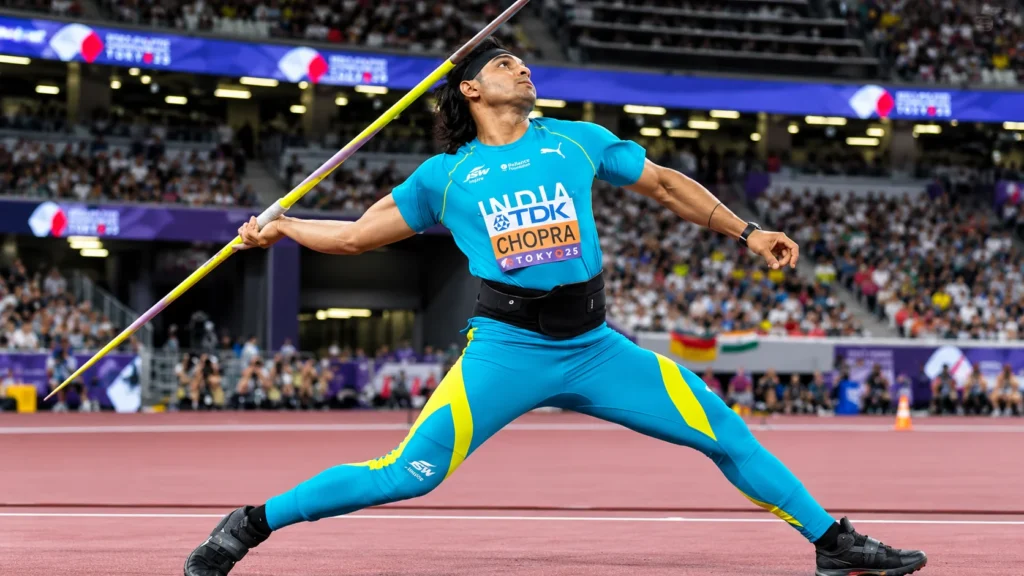 Neeraj Chopra competed only three times in 2026 before an ankle ligament tear ended his season.
Neeraj Chopra personal bests
His best throw came in 2025, under former coach Jan Železný. The marks below are from his World Athletics profile and our race reports.
| Event | Mark | Where | Date |
|---|---|---|---|
| Javelin (800g), national record | 90.23m | Doha Diamond League, Qatar | 16 May 2025 |
| Javelin, previous national record | 89.94m | Stockholm Diamond League, Sweden | 2022 |
| Javelin, 2026 season best | 88.05m | Lausanne Diamond League, Switzerland | 21 August 2026 |
| Javelin, U20 world record | 86.48m | World U20 Championships, Bydgoszcz (Poland) | July 2016 |
His 90.23m made him the first Indian to throw past 90m. Even so, it came in a losing effort, because Germany’s Julian Weber won that night with 91.06m. Meanwhile, his 89.45m silver in Paris remains the second-best throw of his career.
Who is Neeraj Chopra’s coach? From Khandra to the Olympic podium
Neeraj is a farmer’s son from Khandra village near Panipat. He joined the Indian Army as a Naib Subedar in 2016. In the same year, he won the World U20 title with a world U20 record of 86.48m.
After that, the senior medals came quickly. In 2018 he won Commonwealth Games gold and then Asian Games gold with a national record of 88.06m, as Scroll reported. Three years later, his 87.58m in Tokyo gave India its first Olympic gold in athletics.
| Year | Championship | Result | Mark |
|---|---|---|---|
| 2016 | World U20 Championships, Bydgoszcz | Gold | 86.48m |
| 2018 | Commonwealth Games, Gold Coast | Gold | 86.47m |
| 2018 | Asian Games, Jakarta | Gold | 88.06m |
| 2021 | Olympic Games, Tokyo | Gold | 87.58m |
| 2022 | World Championships, Eugene | Silver | – |
| 2022 | Diamond League Final | Winner | 88.44m |
| 2023 | World Championships, Budapest | Gold | 88.17m |
| 2023 | Asian Games, Hangzhou | Gold | 88.88m |
| 2024 | Olympic Games, Paris | Silver | 89.45m |
| 2026 | Commonwealth Games, Glasgow | Silver | 85.83m |
In November 2024, javelin world record holder Jan Železný became his coach, and Neeraj broke 90m under him in May 2025. However, a back injury hurt him at the 2025 World Championships in Tokyo, where he finished eighth with 84.03m. That result ended a run of 26 straight top-two finishes, while Sachin Yadav took fourth.
In January 2026, Neeraj and Železný ended their partnership by mutual agreement. As a result, he now works with Indian coach Jai Chaudhary, a former senior who has known him for more than 15 years.
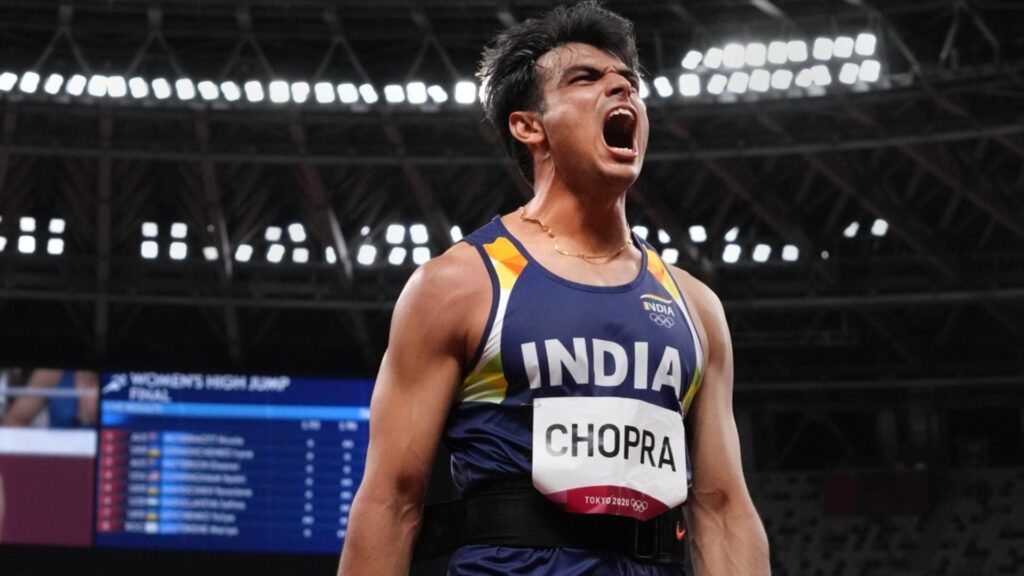 Neeraj Chopra won India’s first Olympic gold in athletics with 87.58m in Tokyo.
Who is Neeraj Chopra beyond the track? Army, family and recovery
Neeraj served with the Rajputana Rifles after joining the Army. Later, the President granted him the honorary rank of Lieutenant Colonel in the Territorial Army from 16 April 2025. Defence Minister Rajnath Singh then gave him the insignia on 22 October 2025.
In January 2025, he married Himani Mor, a former tennis player from Haryana. In addition, he set up his own management firm, Vel Sports, and he won the first edition of the NC Classic, the javelin meet named after him, in Bengaluru in 2025.
For now, recovery comes first. “My focus now is on recovering well and coming back even stronger,” he said after the injury. No return date has been announced. Meanwhile, our essay on how Neeraj reshaped Indian sporting culture explains why his absence was felt so widely.
Follow Neeraj Chopra on Athletics India
His full stats and results are on Neeraj Chopra’s athlete profile. In addition, every Indian javelin story is on our men’s javelin page.
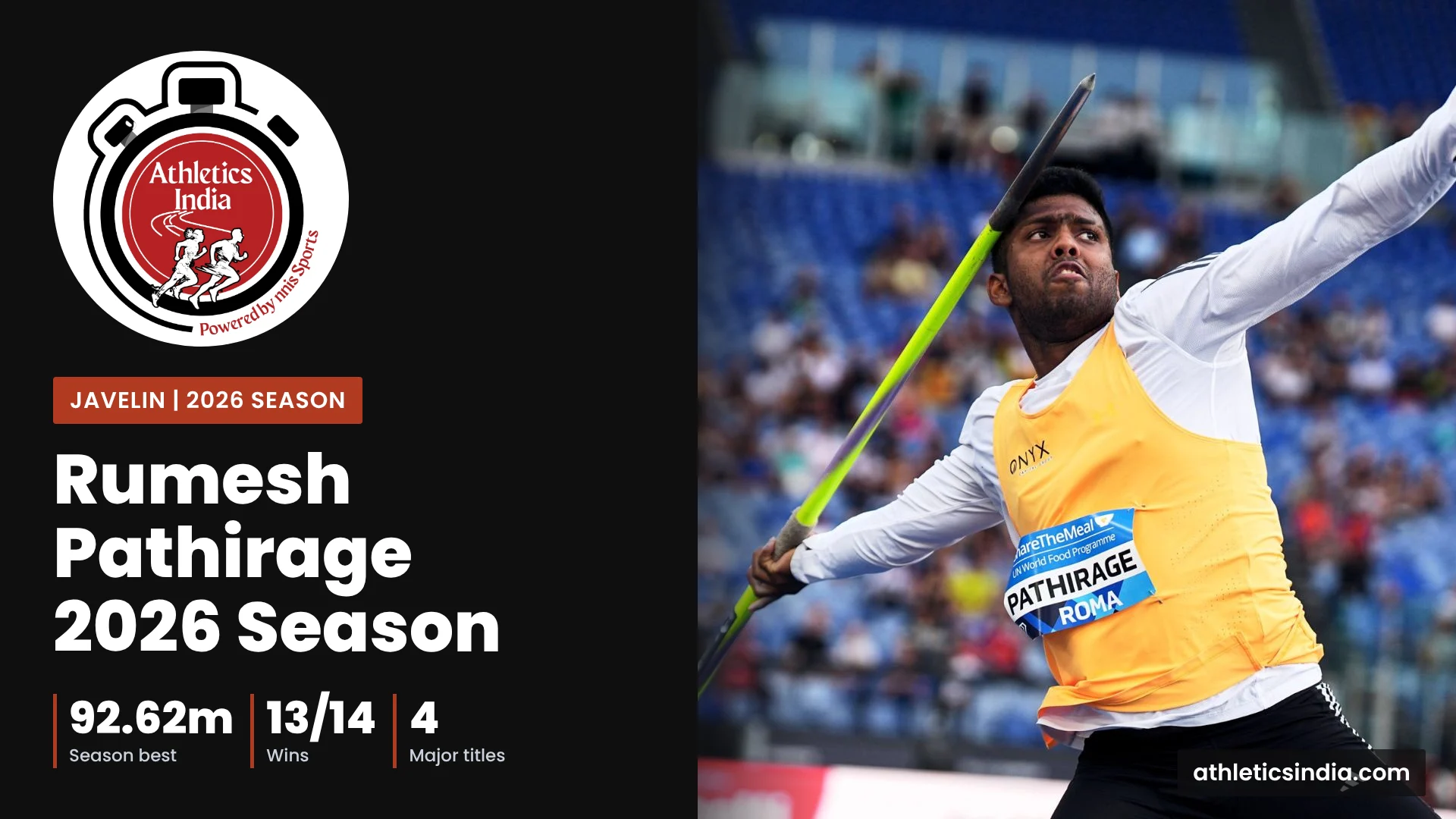
Rumesh Pathirage won 13 of his 14 competitions in 2026. He also set a Sri Lankan record with a throw of 92.62m in Rome on 4 June. However, despite this achievement, World Athletics announced its three finalists for Men’s World Athlete of the Year on 10 November, but he did not make the shortlist. He finished eighth of the ten nominees.
That outcome has puzzled many fans in South Asia. Therefore, this article reviews his entire season using official performance records. It also explains how the award voting process works. Finally, it explores what his rise could mean for Indian javelin throwers.
Rumesh Pathirage in 2026: quick facts
- Season record: 13 wins from 14 competitions
- Best throw: 92.62m, Rome Diamond League, 4 June 2026 (Sri Lankan record)
- Throws over 90m: three: 92.62m (Rome), 92.07m (Zurich), 91.09m (Budapest)
- Titles: Commonwealth Games, Diamond League Final, Ultimate Championship, Asian Games
- Only defeat: second in Rabat on 31 May with 85.97m
- Award result: eighth of ten nominees for Men’s World Athlete of the Year 2026
Jump to: Season results 92.62m in Rome Four titles Why no finalist spot What it means for India Background
Rumesh Pathirage 2026 season results
The table lists his main competitions of 2026, with marks taken from official results and our own reports. In total, he won every meet except one. Moreover, his winning marks rarely dropped below 86 metres.
| Meet | Month | Mark | Place |
|---|---|---|---|
| Champions Track and Field Meet, Diyagama | March | 89.37m (then national record) | 1st |
| Kip Keino Classic, Nairobi | April | 89.28m (meeting record) | 1st |
| Meeting de Rabat (Diamond League) | May | 85.97m | 2nd |
| Golden Gala, Rome (Diamond League) | June | 92.62m (national record) | 1st |
| Golden Spike, Ostrava | June | 86.57m | 1st |
| Doha Diamond League | June | 88.68m | 1st |
| Commonwealth Games, Glasgow | July | 89.75m | Gold |
| Athletissima, Lausanne (Diamond League) | August | 88.14m | 1st |
| Weltklasse Zurich (Diamond League) | August | 92.07m | 1st |
| Diamond League Final, Brussels | September | 89.04m | 1st |
| Ultimate Championship, Budapest | September | 91.09m | Gold |
| Asian Games, Nagoya | September | 88.55m | Gold |
The only defeat came in Rabat on 31 May. There, Anderson Peters of Grenada won with 86.08m, while Pathirage opened with 85.97m and could not improve. Four days later, he answered in Rome.
The 92.62m throw that changed his year
On 4 June, at the Golden Gala in Rome, Pathirage threw 92.62m. It broke his own Sri Lankan record of 89.37m from March. It also made him only the second Asian man past 92 metres. The first was Pakistan’s Arshad Nadeem, who threw 92.97m to win Olympic gold in Paris in 2024.
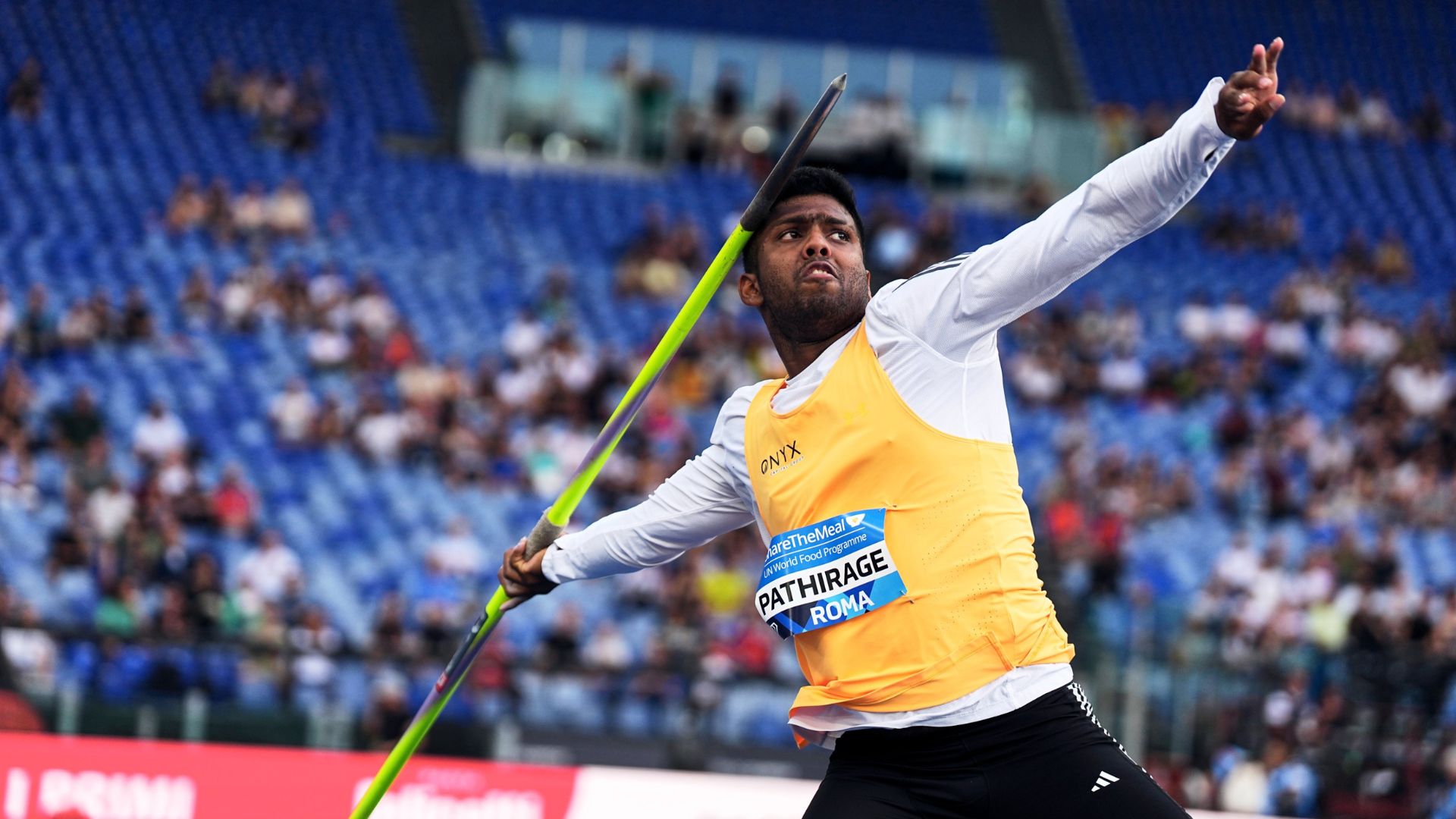
Then, on 27 August in Zurich, he threw 92.07m with his final attempt. As a result, he had two throws beyond 92 metres in a single season. Our Zurich report covers that series in detail.
Four major titles in one season
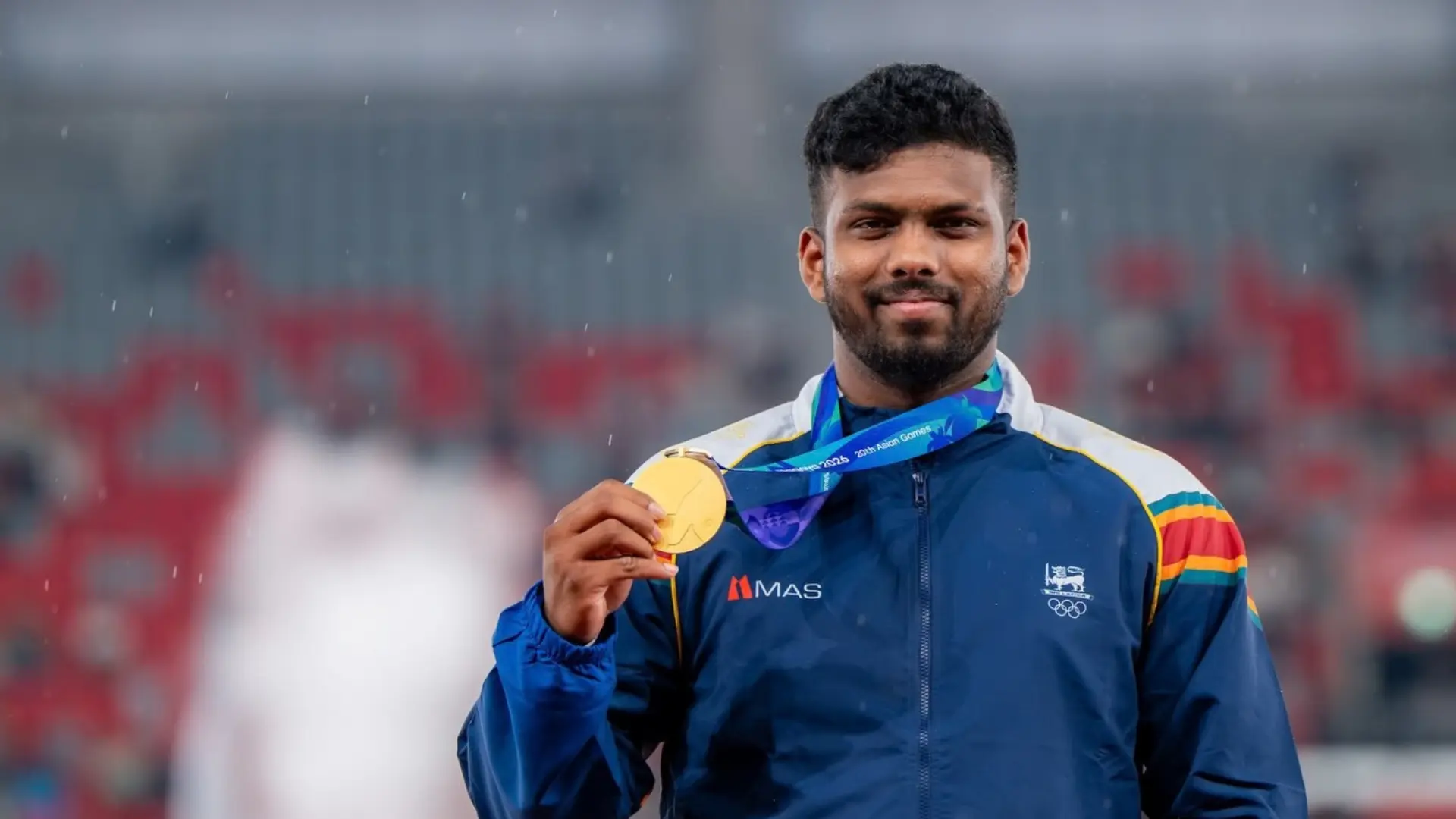
Distance alone did not define the season. In fact, Pathirage also won almost every big final he entered. First, he won Commonwealth Games gold in Glasgow with 89.75m. Neeraj Chopra took silver with 85.83m.
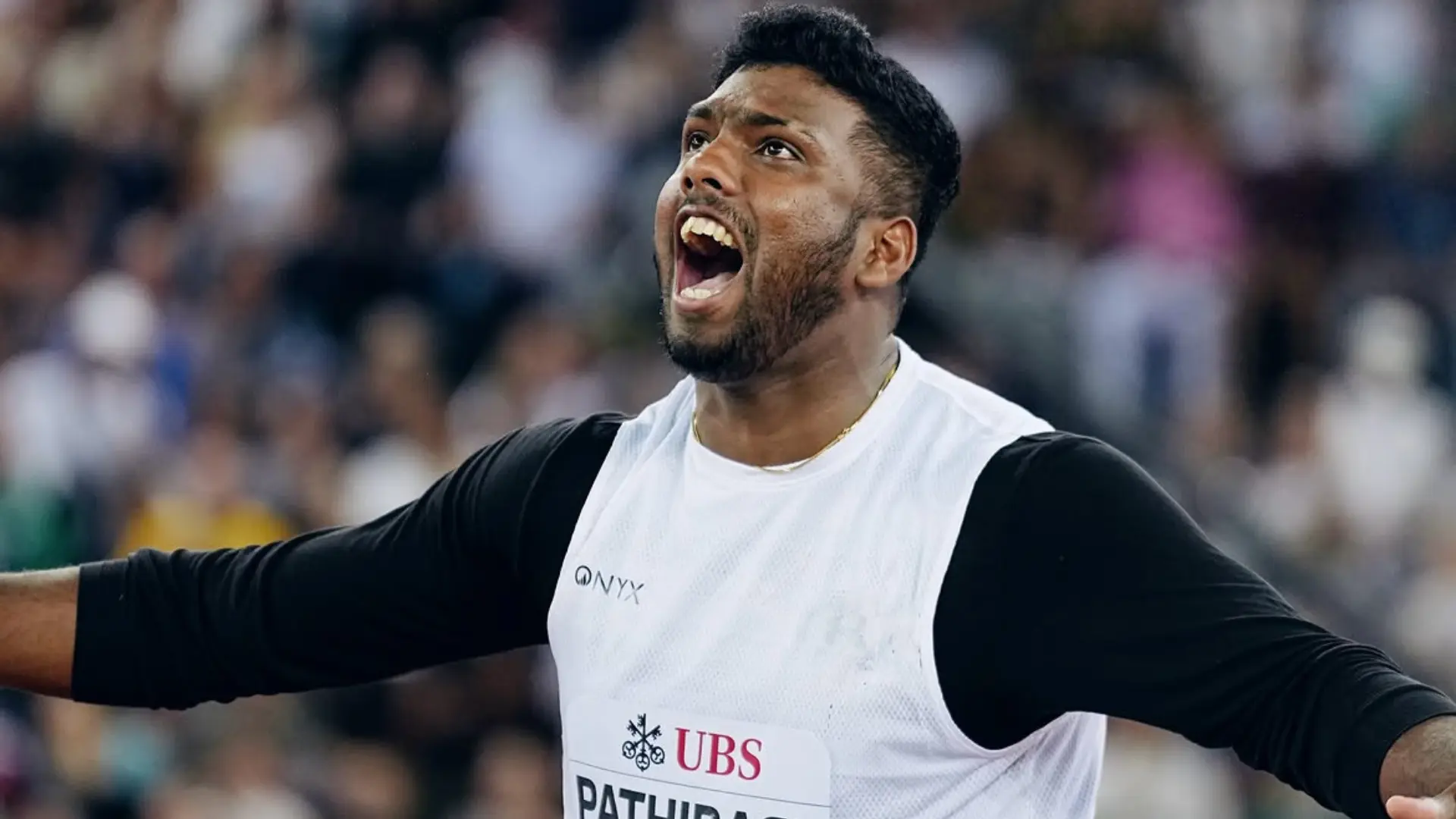
Next, he won the Diamond League Final in Brussels with 89.04m. He became the first Sri Lankan to win a Diamond League title. After that, he won the Ultimate Championship in Budapest on 13 September. He trailed early there, but his final throw of 91.09m settled it.
Finally, he won Asian Games gold in Nagoya on 28 September. On a wet runway, his last throw of 88.55m was the only one beyond 86 metres.
Why Rumesh Pathirage is not a World Athlete of the Year finalist
In October, Pathirage became one of ten men nominated for the award. He was the first Sri Lankan athlete on that list. A panel of experts chose the nominees. After that, a four-way vote by fans, athletes, media and the World Athletics family ranked them.
On 10 November, World Athletics named the top three as finalists. They are Alison dos Santos, Mondo Duplantis and Sabastian Sawe. Pathirage finished eighth. The winner will be announced at the World Athletics Awards in Monaco on 29 November.
| Finalist | Country | Event | 2026 highlight |
|---|---|---|---|
| Alison dos Santos | Brazil | 400m hurdles | World record of 45.80 |
| Mondo Duplantis | Sweden | Pole vault | World record of 6.31m |
| Sabastian Sawe | Kenya | Marathon | World record of 1:59:30 |
The table shows one clear pattern. All three finalists set world records in 2026. By contrast, Pathirage’s 92.62m is a national record, while the javelin world record is 98.48m by Jan Zelezny from 1996. So the vote did not judge his season as weak. Instead, it rewarded a rarer kind of mark.
Rumesh Pathirage and Indian javelin: what his season means
For Indian fans, the rivalry with Neeraj Chopra was the main story. Pathirage beat him in all three of their meetings: Doha, Glasgow and Lausanne. The closest was Lausanne, where the margin was nine centimetres.
Later, an ankle ligament tear ended Chopra’s season before the Asian Games. Even so, India still won two medals in Nagoya. Yashvir Singh took silver with a personal best of 85.72m. Meanwhile, Rohit Yadav won bronze with 84.35m.
The lesson for young Indian throwers is about the standard, not one rival. In 2026, the winning mark at the Commonwealth Games, the Diamond League Final and the Asian Games was above 88 metres every time. Therefore, consistency in the high 80s has become the entry ticket for major medals.
Pathirage himself puts it simply. In an interview with NNIS Sports in April, he said his average throw rose from about 77m to 84 to 86m in a year. “My coach tells me to focus on basics. If you do that, results come automatically,” he told us.
Before 2026: Rumesh Pathirage from fast bowler to javelin
Pathirage comes from Kalutara in Sri Lanka. As a schoolboy at St Peter’s College, Colombo, he was a fast bowler. He then switched schools and moved to athletics, first in the discus and later the javelin. Our exclusive interview tells that story in his own words.
Before 2026, he was already improving fast. Notably, he reached the final at the 2025 World Championships in Tokyo and finished seventh. One year later, he was the man every javelin field had to beat.
Update note: this page reflects results up to 14 November 2026. We will update it after the World Athletics Awards in Monaco on 29 November.
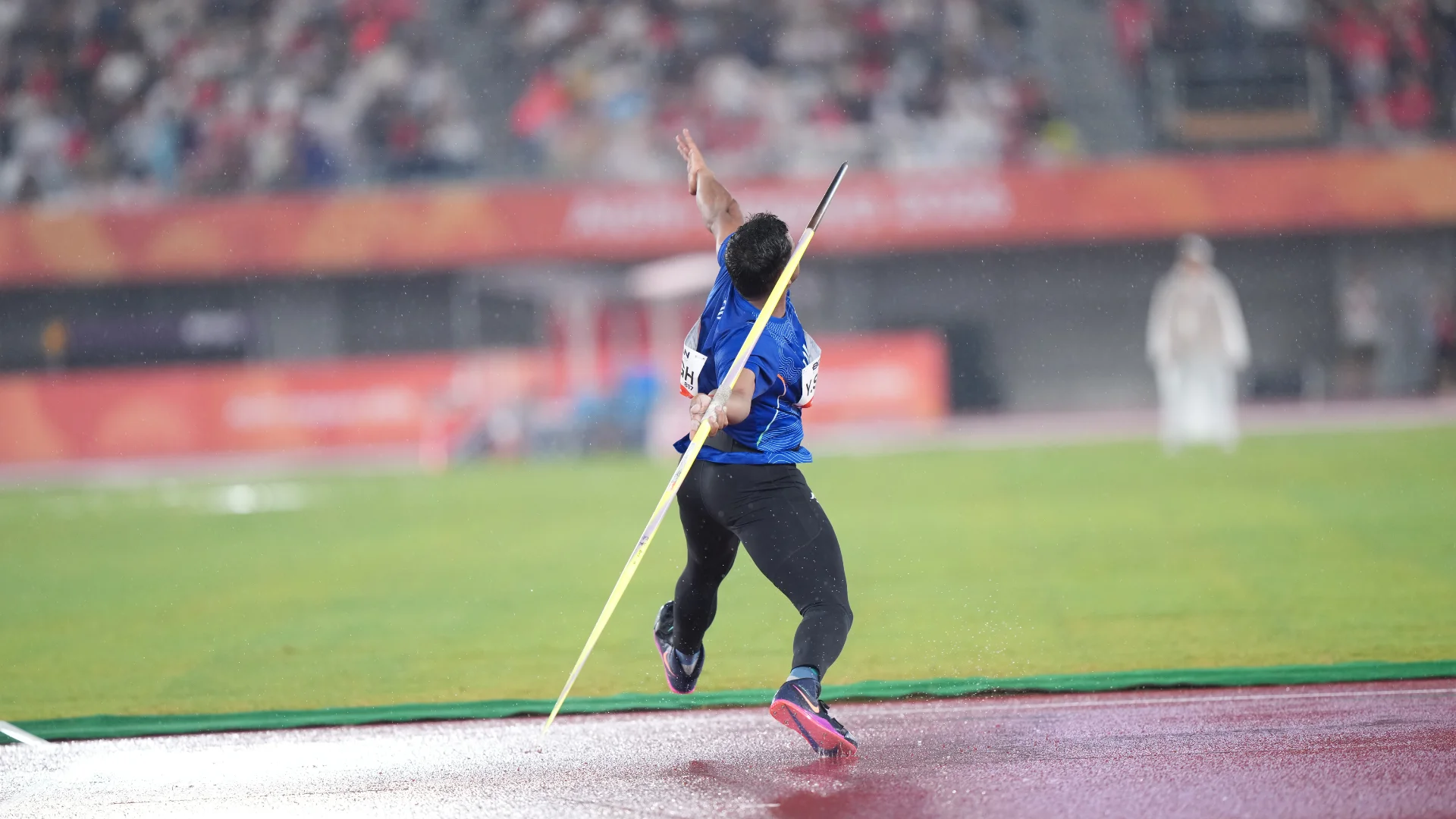
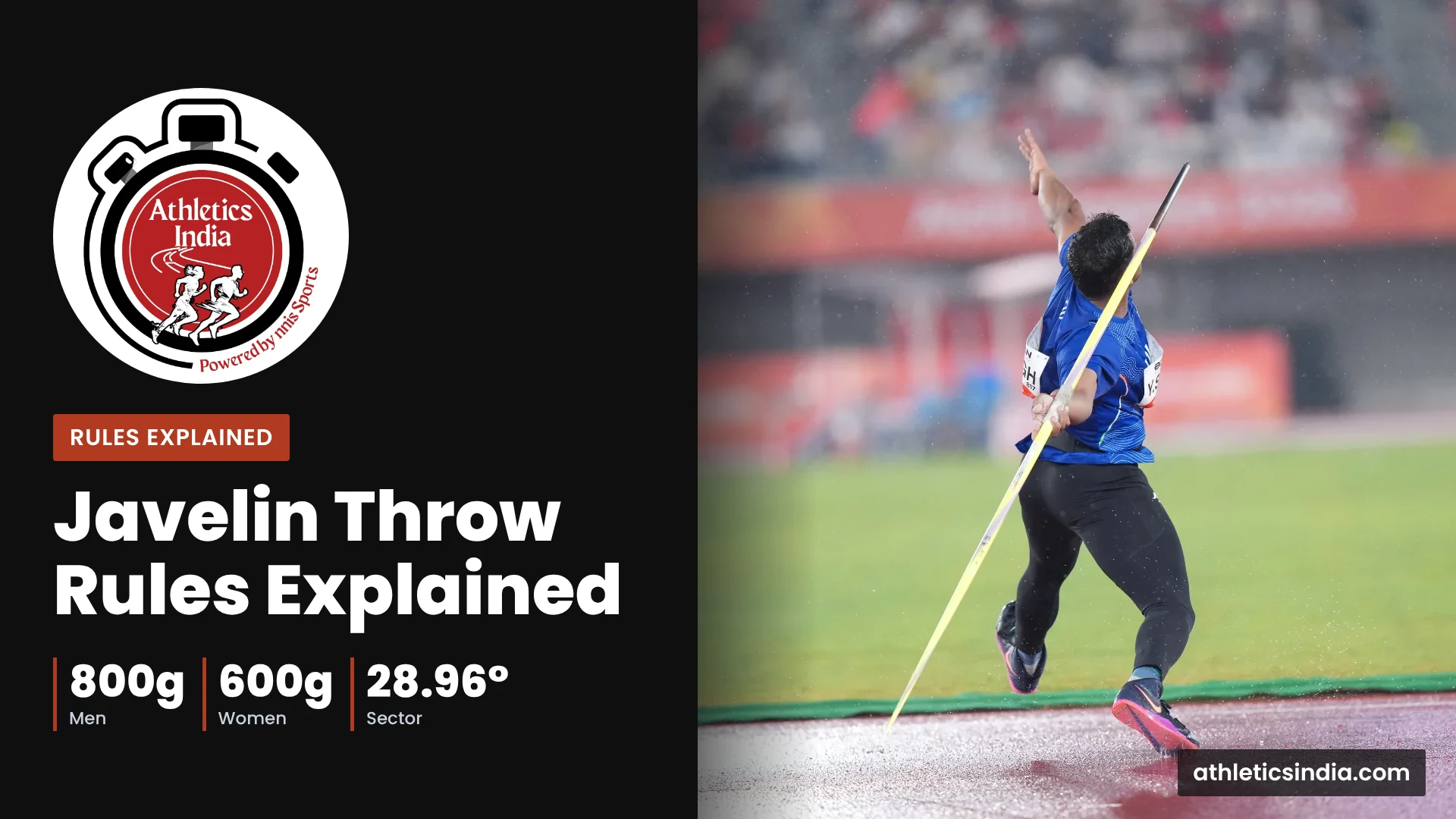
Javelin throw rules ask for three things. The athlete must hold the javelin by its grip and throw it over the shoulder. The metal tip must then land first, inside a 28.96-degree sector. Finally, officials measure from the tip’s first mark back to the inside edge of the arc.
These rules decide medals. For example, at the Asian Games in Nagoya, rain fell all evening and the runway never dried. So this guide explains the rules in plain language. It also covers the javelin weights that Indian athletes use from under-14 to senior level.
Javelin throw rules: quick facts
- Javelin weight: 800g for men, 600g for women
- Runway: at least 30m long and 4m wide
- Throwing arc: curved line with an 8m radius
- Landing sector: 28.96 degrees
- Valid landing: the tip of the metal head must strike the ground first
- Time per attempt: 1 minute
- Attempts: three each, then three more for the top eight
Jump to: How to throw Runway and sector Fouls Measurement Weights by age Attempts and time For young throwers
How a legal throw is made under javelin throw rules
The athlete must hold the javelin at its cord grip with one hand. In addition, the throw must go over the shoulder or the upper part of the throwing arm. The rules also ban slinging, hurling and any non-orthodox style.
There is also a rule about turning. From the start of the run-up until release, the athlete must not turn completely around. In other words, the back cannot face the throwing arc at any point. It stops the spinning technique used in the discus.
The runway, arc and sector
Unlike the shot put or discus, the javelin uses a long runway instead of a circle. The athlete runs between two parallel white lines and throws from behind a curved arc.
| Area | Rule |
|---|---|
| Runway length | At least 30m; 36.5m where conditions allow |
| Runway width | 4m between two 5cm white lines |
| Throwing arc | 7cm wide, with a radius of 8m |
| Sector angle | 28.96 degrees |
| Sector lines | 5cm wide; if extended, they meet at the centre of the arc’s circle |
The odd sector angle has a simple reason. It is the angle at which the sector lines pass through both ends of the arc. As a result, both lines point back to the same centre point, which officials also use for measuring.
When a javelin throw is a foul
Under the javelin throw rules, an attempt is a foul in any of these cases. Officials then raise a red flag, while a valid throw gets a white flag.
| Foul | What it means |
|---|---|
| Tip does not land first | Any part of the javelin touches the ground before the tip of the metal head |
| Outside the sector | The tip lands on a sector line or outside it |
| Touching the lines | The athlete touches the arc, the side lines or the ground beyond them |
| Leaving too early | The athlete leaves the runway before the javelin lands |
| Leaving the wrong way | The athlete does not leave from behind the arc and its end lines |
| Illegal style | The javelin is slung, hurled or thrown with a full turn |
| Time limit | The attempt is not started within the time allowed |
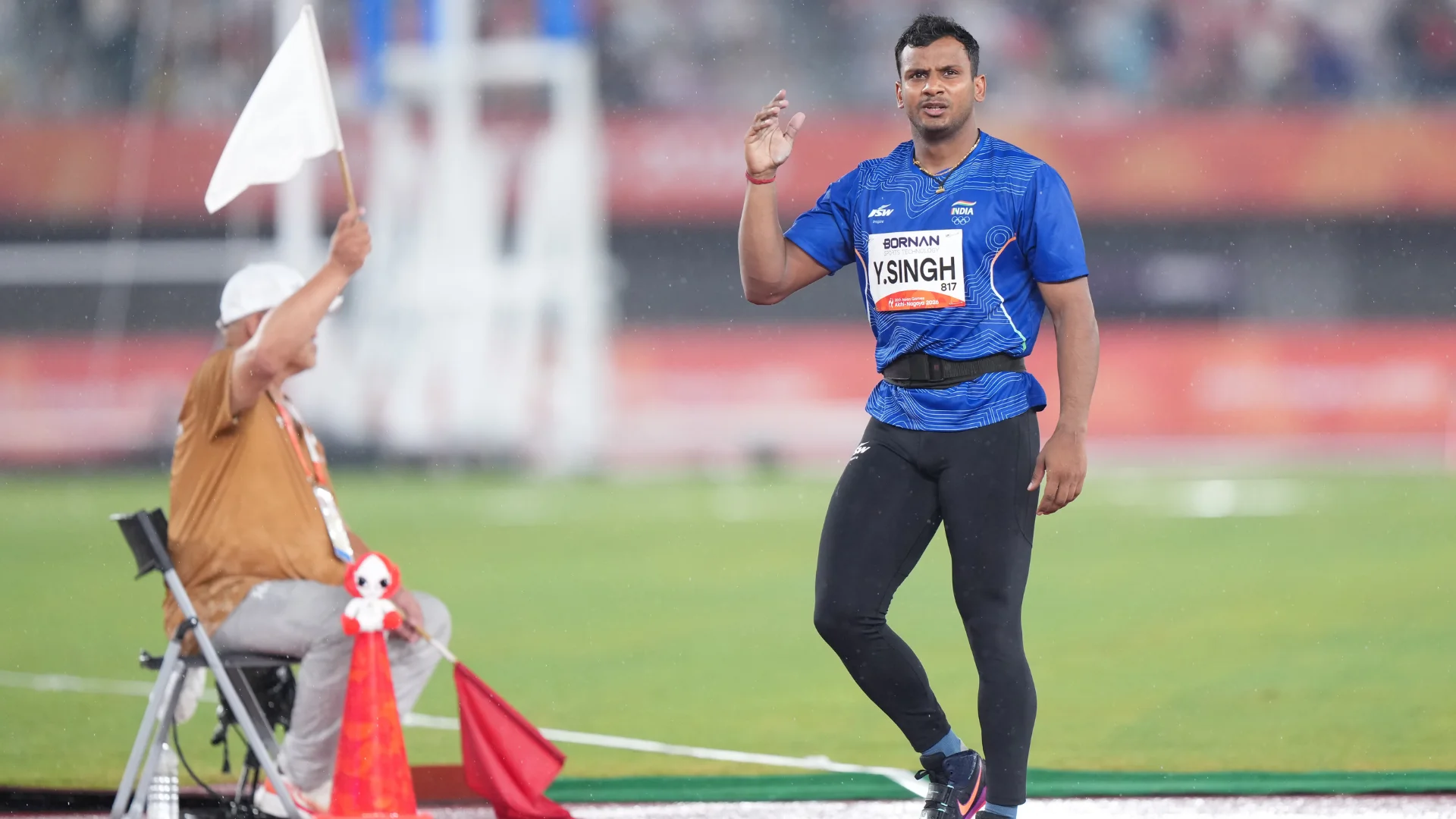
A flat landing is the most common source of debate. The javelin does not have to stick in the ground. However, the tip must strike the ground before the shaft or tail. If the tail lands first, the throw is a foul.
How the javelin throw is measured
Officials measure every valid throw straight away. The tape starts at the mark made by the tip of the metal head. Then it runs to the inside edge of the arc, along a line towards the centre of the arc’s circle. That centre point sits 8m behind the arc.
Measurement uses a steel or fibreglass tape, or an electronic device at major meets. Officials then round the distance down to the nearest centimetre. So a throw of 85.728m becomes 85.72m, never 85.73m.
Javelin throw rules on weight for each age group in India
Javelin throw rules change with age. Younger athletes use lighter javelins, and the youngest use a shorter run-up. The table below follows the Athletics Federation of India (AFI) specifications for its 2025 National Junior Championships.
| Age group | Boys / men | Girls / women | Note |
|---|---|---|---|
| Under-14 | Kids’ javelin | Kids’ javelin | Five-metre runway |
| Under-16 | 600g | 500g | 10m approach |
| Under-18 | 700g | 500g | Full runway |
| Under-20 | 800g | 600g | Same as senior |
| Senior | 800g | 600g | Full runway |
The jumps in weight matter for coaching. For instance, an under-18 boy moves from 700g to 800g at under-20 level. Therefore, distances often dip for a season while the athlete adapts to the heavier javelin.
Number of attempts and time limits
When more than eight athletes compete, each gets three attempts. After that, the best eight get three more. With eight or fewer athletes, everyone gets six attempts. An athlete has one minute to start each attempt. However, when the same athlete throws twice in a row, the limit is two minutes.
To break a tie, officials compare the second-best throw, then the third-best, and so on. Some meetings also use their own formats. At the Doha Diamond League in 2026, for example, only the top three after five rounds got a sixth throw.
What javelin throw rules mean for young Indian throwers
For athletes and families, three rules deserve extra attention. First, the rules ban gloves and taping two or more fingers together. Second, every throw must leave the runway correctly, even after a big release. Third, the shorter approach for under-16 athletes rewards technique over run-up speed.
The standard keeps rising. At the National Junior Championships 2026, Minakshi of Haryana set a girls’ under-16 record of 54.40m. At senior level, Neeraj Chopra holds the men’s national record of 90.23m. Meanwhile, Annu Rani holds the women’s record of 63.82m.
Both marks already meet the LA28 Olympic entry standards. Still, a record means nothing if the throw is a foul. Clean technique within the rules comes first.
Update note: this guide reflects World Athletics Technical Rules as applied in AFI competitions, checked on 14 November 2026. We will update it if the rules or AFI age-group weights change.
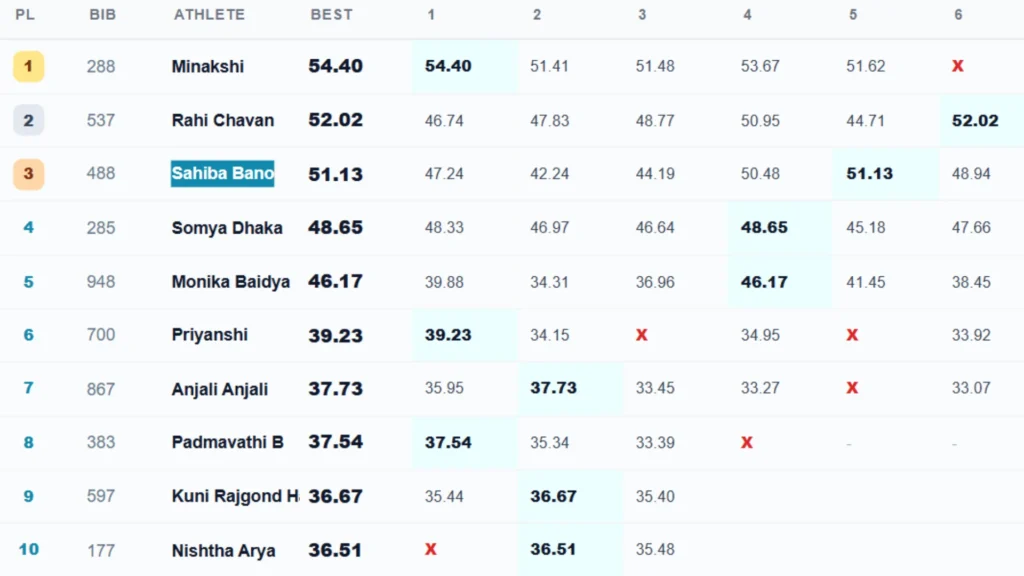
Haryana’s Minakshi produces a stunning 54.40m throw as four athletes surpass the previous national record in an extraordinary girls’ U16 javelin competition.
Haryana’s teenage javelin sensation Minakshi delivered one of the standout performances of the 41st National Junior Athletics Championships 2026, smashing the girls’ U16 national record with a massive throw of 54.40 metres, improving the previous mark by an astonishing 7.53 metres.
The previous national record of 46.87m was held by Haryana’s Muskan. Minakshi not only erased that mark but also produced a remarkable series in which all five of her valid throws travelled beyond 50 metres.
But this was not merely a story of one outstanding athlete. In an extraordinary display of emerging Indian javelin talent, the top four finishers all surpassed the previous national record.
Maharashtra’s Rahi Chavan claimed silver with a personal best of 52.02m, while Sahiba Bano took bronze with 51.13m. Somya Dhaka finished fourth with another personal best of 48.65m.
Five Throws Beyond 50 Metres
Minakshi’s winning throw came in the opening round, when she sent the javelin soaring to 54.40m.
She followed it with throws of 51.41m, 51.48m, 53.67m and 51.62m before recording a foul in her final attempt.
The consistency was almost as impressive as the record itself.
Even her fifth-best legal throw would have comfortably beaten the previous national record.
Her performance was especially significant because she had never crossed 50m in official competition before this championship.
From U14 Record-Holder to U16 Champion
Minakshi’s rise has been anything but sudden.
At the 38th National Junior Athletics Championships in Coimbatore in November 2023, she won the girls’ U14 Kids Javelin gold with a national record throw of 44.05m.
She continued her dominance at the 39th National Junior Championships in Bhubaneswar in December 2024, winning another U14 gold with 46.81m.
In October 2025, competing in the higher U16 age category, Minakshi secured gold at the 40th National Junior Athletics Championships in Bhubaneswar with a throw of 44.97m, defeating Delhi’s Yogita Baisla, who finished second with 44.41m.
Her latest 54.40m performance marks a major breakthrough in her U16 career.
The progression also reflects the work of her grassroots training group in Bangaon village in Haryana’s Fatehabad district.
Minakshi is associated with the Bangaon Javelin Team, where coach Hanuman Singh has helped develop several promising female throwers.
The training programme, which began in 2012, has produced national-level medallists across multiple age categories despite limited infrastructure.
Rahi Chavan: Another Rising Javelin Talent
Silver medallist Rahi Chavan has also built an impressive junior record.
Representing Maharashtra, Rahi won the girls’ U14 Kids Javelin silver medal at the 39th National Junior Athletics Championships in 2024 with a throw of 38.54m, finishing behind Minakshi.
She subsequently moved into the U16 category, finishing fourth at the 2025 Junior Nationals with 42.22m.
More recently, Rahi won gold at the 37th West Zone Junior Athletics Championships, held in Bambolim, Goa, from September 27 to 29, 2026.
Her winning distance of 45.02m was recorded as a meet record.
She has also enjoyed success in school athletics, winning a CBSE National Athletics Championship title in the U17 girls’ javelin event.
Rahi trains at Shree Elite Sports Academy in Pune, Maharashtra, under coaches Lakhwinder Singh and Akshay Singh.
Her leap to 52.02m at the 2026 Junior Nationals represents a significant improvement over her previous competitive bests.
A Remarkable New Generation
What made the girls’ U16 final particularly encouraging was the depth of performance.
For four athletes to surpass the existing national record in the same competition is an exceptional result.
Minakshi and Rahi, both born in 2011, have already competed against each other at successive national junior championships, progressing from the U14 Kids Javelin category to U16 competition.
Their continued improvement offers encouragement for Indian women’s javelin, particularly at the grassroots level.
However, junior success is only the beginning. As these athletes move into older age groups, maintaining technical development, managing training loads and preventing injuries will become increasingly important.
For now, Minakshi’s 54.40m national record and the remarkable performances behind her mark an exciting moment for India’s next generation of female javelin throwers.
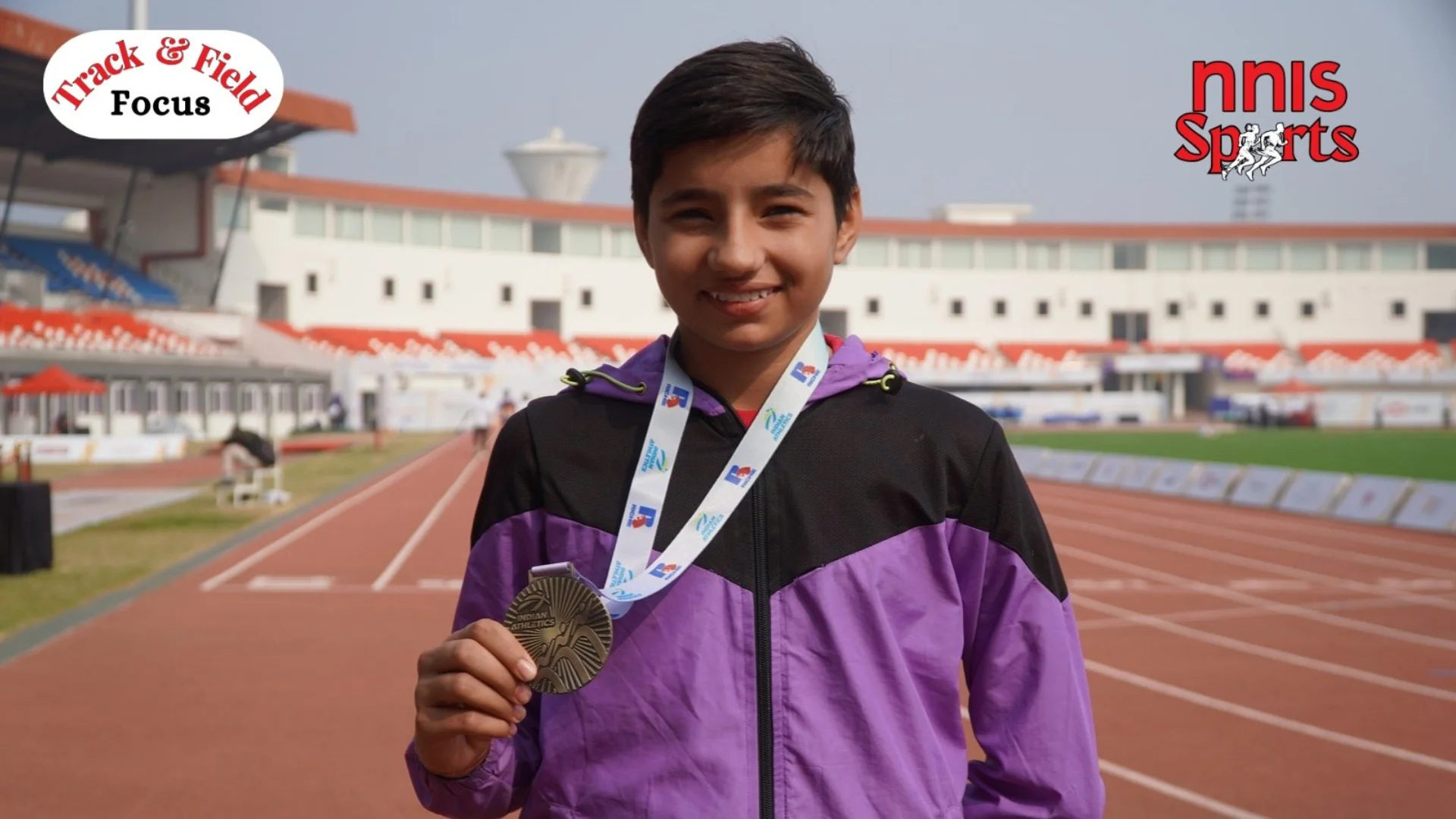
Who is Yashvir Singh? He is the 24-year-old javelin thrower from Haryana who won silver at the Asian Games 2026 in Nagoya with a personal best of 85.72m. Two months earlier, Yashvir Singh won bronze at the Commonwealth Games in Glasgow, his first international medal.
He only reached Nagoya because he replaced the injured Neeraj Chopra. This page therefore tells his whole story so far: his medals, his personal bests, his 2026 season throw by throw, and the father who taught him the event.
Yashvir Singh at a glance
- Born: 22 October 2001, Devsar village, Bhiwani (Haryana)
- Age: 24
- State: Born in Haryana, competes for Rajasthan
- Event: Javelin throw
- Personal best: 85.72m (Asian Games, September 2026)
- 2026 medals: Asian Games silver and Commonwealth Games bronze
- Coach: his father, Rai Singh, a former national-level javelin thrower
- Off the track: trained at Sawai Mansingh Stadium, Jaipur, and started on a bamboo javelin
Jump to: Who is he Asian Games silver CWG bronze 2026 season Personal bests His story Beyond the track
Who is Yashvir Singh? The short answer
Yashvir Singh is an Indian javelin thrower, also written as Yash Vir Singh. He was born on 22 October 2001, according to World Athletics, and he competes for Rajasthan at national level.
His 2026 season was the breakout year of his career. He improved his personal best four times, won Commonwealth Games bronze and then won Asian Games silver. Meanwhile, he shared both podiums with fellow Indians: Neeraj Chopra in Glasgow and Rohit Yadav in Nagoya.
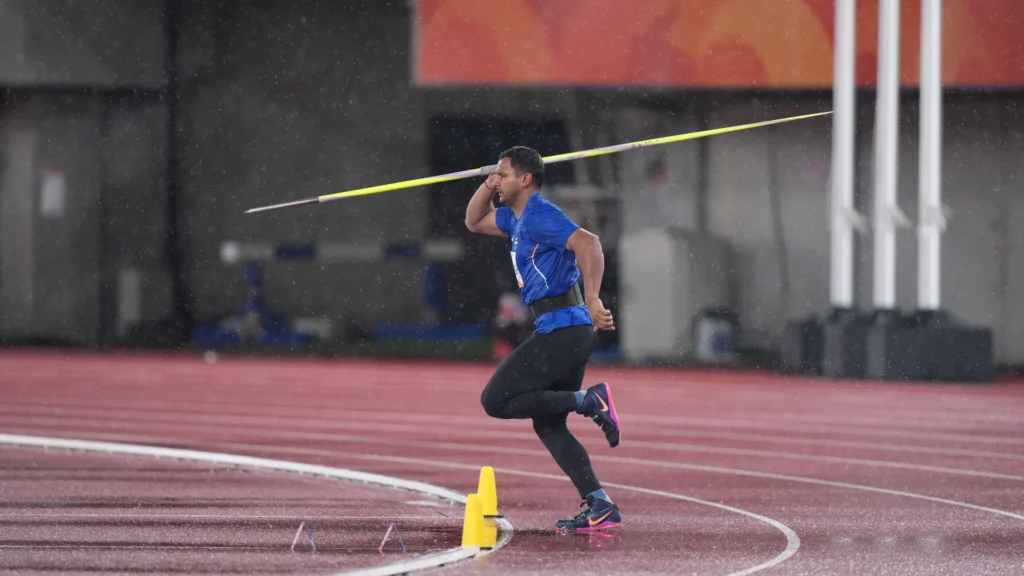
Asian Games 2026: javelin silver with his last throw
The men’s javelin final took place in Nagoya on Monday 28 September. Yashvir opened with 83.56m to take the early lead. He then threw 84.31m and 85.14m in rounds four and five. Finally, on his sixth attempt, he launched a personal best of 85.72m to move past Rohit Yadav into second place.
Sri Lanka’s Rumesh Pathirage won gold with 88.55m, also on his final throw. As a result, India finished with silver and bronze, and Pakistan’s Olympic champion Arshad Nadeem finished fourth. Full marks are on our Asian Games 2026 javelin results page.
| Place | Athlete | Country | Mark |
|---|---|---|---|
| 1 | Rumesh Pathirage | Sri Lanka | 88.55m |
| 2 | Yashvir Singh | India | 85.72m |
| 3 | Rohit Yadav | India | 84.35m |
| 4 | Arshad Nadeem | Pakistan | 80.29m |
The medal also came after a late call-up. Yashvir was not on India’s original long list, but the AFI named him in place of the injured Chopra on 3 September. In addition, AFI president Bahadur Singh Sagoo said the federation picked him because he was a Commonwealth Games medallist.
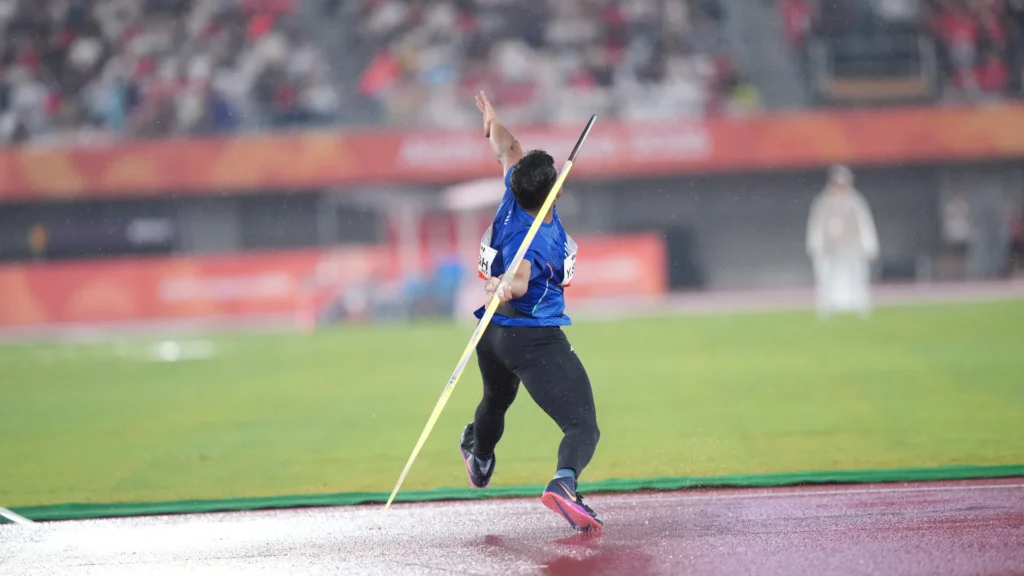
Commonwealth Games 2026: bronze on his last attempt
In Glasgow, Yashvir only scraped into the final. Strong headwinds hit the qualifying round on 30 July, and he finished 10th with 78.36m. As a result, India had three throwers in a Commonwealth Games javelin final for the first time.
The final came a day later, on 31 July. Yashvir sat seventh after five rounds, with a best of 81.33m. Then, with his last throw, he hit a personal best of 85.41m and jumped to bronze. Anderson Peters and Douw Smit still had final throws left, but neither could pass him.
| Place | Athlete | Country | Mark |
|---|---|---|---|
| 1 | Rumesh Pathirage | Sri Lanka | 89.75m |
| 2 | Neeraj Chopra | India | 85.83m |
| 3 | Yashvir Singh | India | 85.41m |
| 4 | Anderson Peters | Grenada | 83.88m |
| 7 | Rohit Yadav | India | 81.56m |
The bronze put him in rare company. He became only the third Indian man to win a Commonwealth Games javelin medal, after Kashinath Naik in 2010 and Chopra. Every Indian result from Glasgow is on our CWG 2026 page.
Download PDF: CWG 2026 complete results
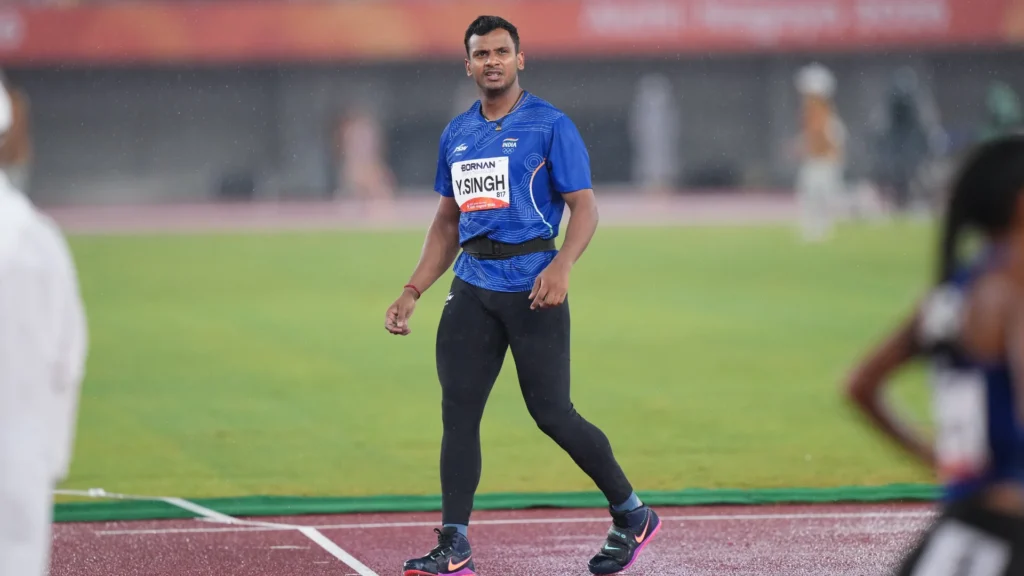
Yashvir Singh’s 2026 season, throw by throw
His rise came in steps. For example, his best went from 82.57m in 2025 to 82.93m in Ludhiana and 83.72m in Bhubaneswar in June. Then, at the two biggest meets of the year, he added almost two more metres.
| When | Meet | Event | Result |
|---|---|---|---|
| 11 April | Indian Athletics Series-3, New Delhi | Javelin | 81.61m, third |
| 25 May | Federation Cup, Ranchi | Javelin | 80.80m, second |
| 13 June | Indian Athletics Series-9, Ludhiana | Javelin | 82.93m, second, personal best then and CWG mark |
| 28 June | Inter-State Championships, Bhubaneswar | Javelin | 83.72m, silver, personal best then |
| 30 July | Commonwealth Games qualifying, Glasgow | Javelin | 78.36m, 10th, reached final |
| 31 July | Commonwealth Games final, Glasgow | Javelin | 85.41m, bronze |
| 22 August | World Athletics Continental Tour meet, Bhubaneswar | Javelin | 82.94m, second |
| September | Indian Athletics Final Series, New Delhi | Javelin | 80.40m, third |
| 28 September | Asian Games final, Nagoya | Javelin | 85.72m, silver |
At the Inter-State Championships, his 83.72m also cleared the Asian Games mark of 77.87m. However, Rohit Yadav won that day with 87.05m, and Yashvir did not make the first Asian Games list. Results from all of India’s javelin throwers are on our men’s javelin page.
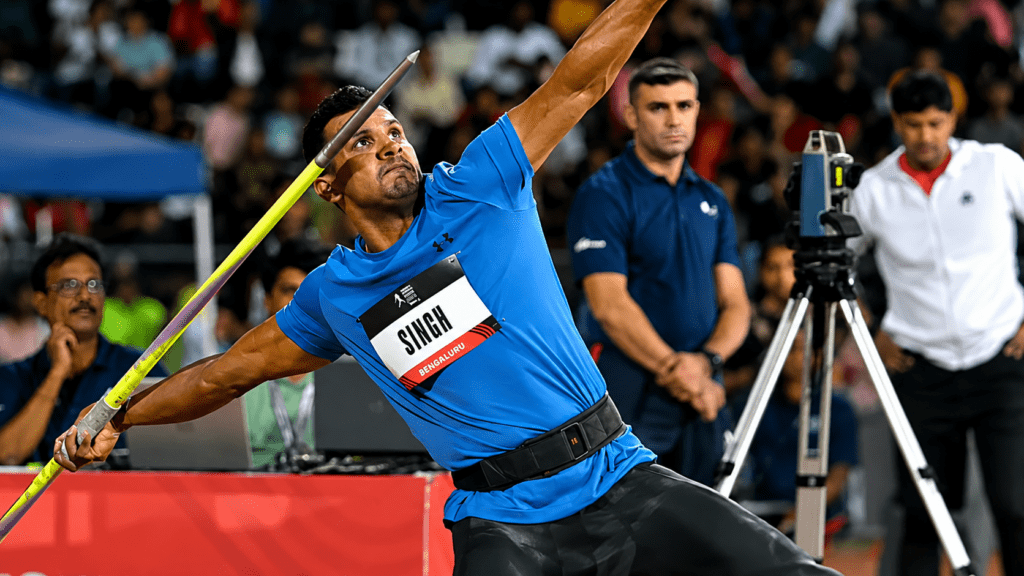
Yashvir Singh personal bests
All of his best senior throws came in 2026. The marks below are from his World Athletics profile and our race reports.
| Event | Mark | Where | Date |
|---|---|---|---|
| Javelin (800g) | 85.72m | Asian Games, Mizuho Park Athletic Stadium, Nagoya | 28 September 2026 |
| Javelin, previous best | 85.41m | Commonwealth Games, Scotstoun Stadium, Glasgow | 31 July 2026 |
| Javelin, best before 2026 | 82.57m | Asian Championships, Gumi Civic Stadium (Korea) | 31 May 2025 |
| Javelin (700g, youth) | 75.63m | Ranchi | 2 November 2018 |
His 85.72m is more than three metres beyond his 2025 best. In addition, he threw past 85m twice in two months, both times with his sixth and final throw. Meanwhile, his first 80m throw came back in 2022, when his 82.13m made him only the 12th Indian over 80m, the AFI reported.
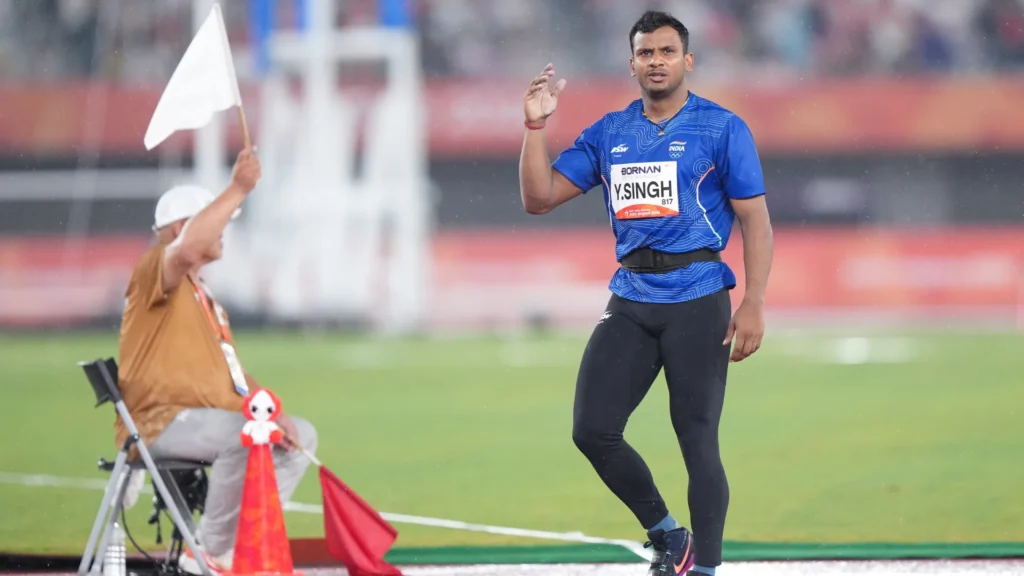
Who is Yashvir Singh’s coach? From Bhiwani to Nagoya
Yashvir grew up in Devsar village near Bhiwani. His father, Rai Singh, was a national-level javelin thrower and a Railways champion who later became a coach. He began coaching his son in 2015, so that Yashvir would not repeat the mistakes he made without a coach.
However, javelin was not his first sport. He liked basketball first, and he started throwing with a bamboo javelin before he moved to proper equipment. He then won national U18 titles in 2017 and 2018 and junior national silver in 2019.
In January 2021, at the U20 Federation Cup in Bhopal, he threw 78.68m and broke Chopra’s meet record of 76.91m. Then, in 2025, he won the Indian Open in Chennai and the Arzumanov Memorial in Tashkent. He also finished fifth at the Asian Championships in Gumi with 82.57m and made his World Championships debut in Tokyo.
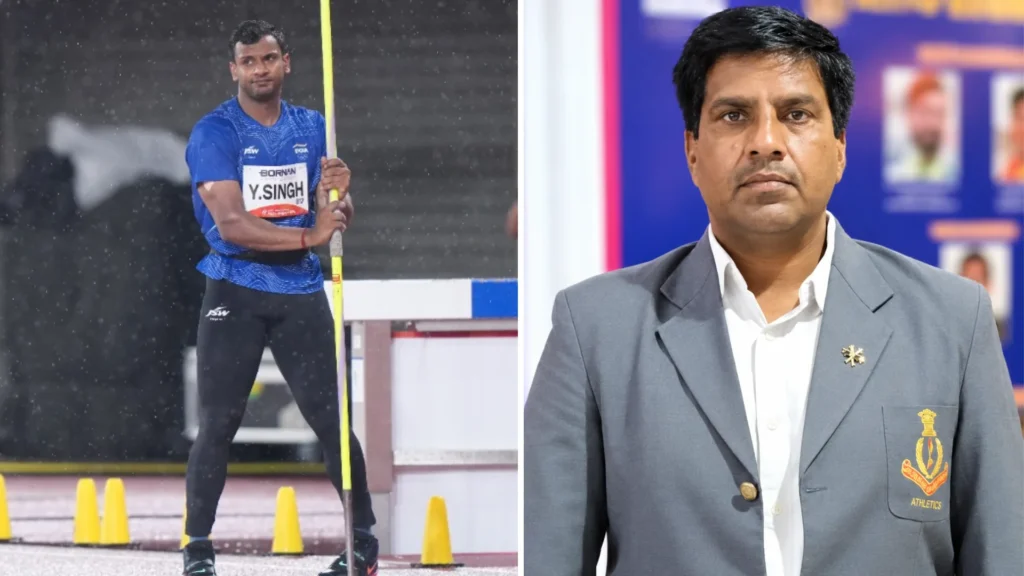 Yashvir Singh began throwing in 2015 under his father, Rai Singh, a former national-level javelin thrower.
Who is Yashvir Singh beyond the track? Family, Jaipur and sacrifice
Although he was born in Haryana, Yashvir built his career in Rajasthan. He trained regularly at the Sawai Mansingh Stadium in Jaipur. In addition, he has said a real javelin was too expensive at first, so he practised with a bamboo one and sometimes got hurt.
After Glasgow, he called the bronze the result of years of work and family sacrifice. “This is my first international medal, and I am overjoyed,” he told NNIS SPORTS. He also urged young athletes in Rajasthan to stay disciplined, follow their diet and listen to their coaches.
Meanwhile, the man he replaced in Nagoya is one of his biggest supporters. Chopra praised him after Glasgow and pointed to his 85m throw as proof of India’s javelin depth.
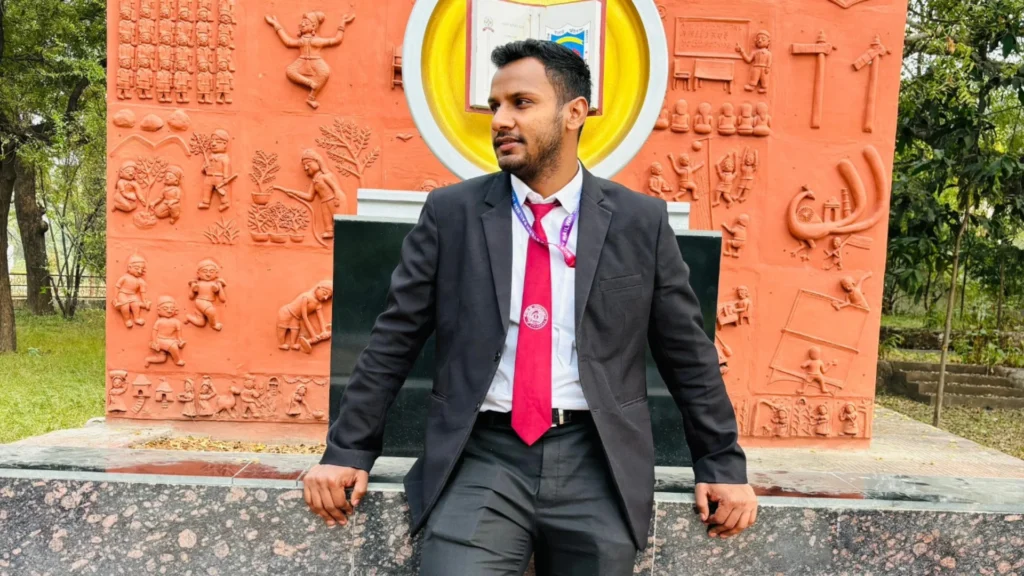
Follow Yashvir Singh on Athletics India
His full stats and results are on Yashvir Singh’s athlete profile. In addition, every Indian result from Nagoya is on our Asian Games 2026 hub.
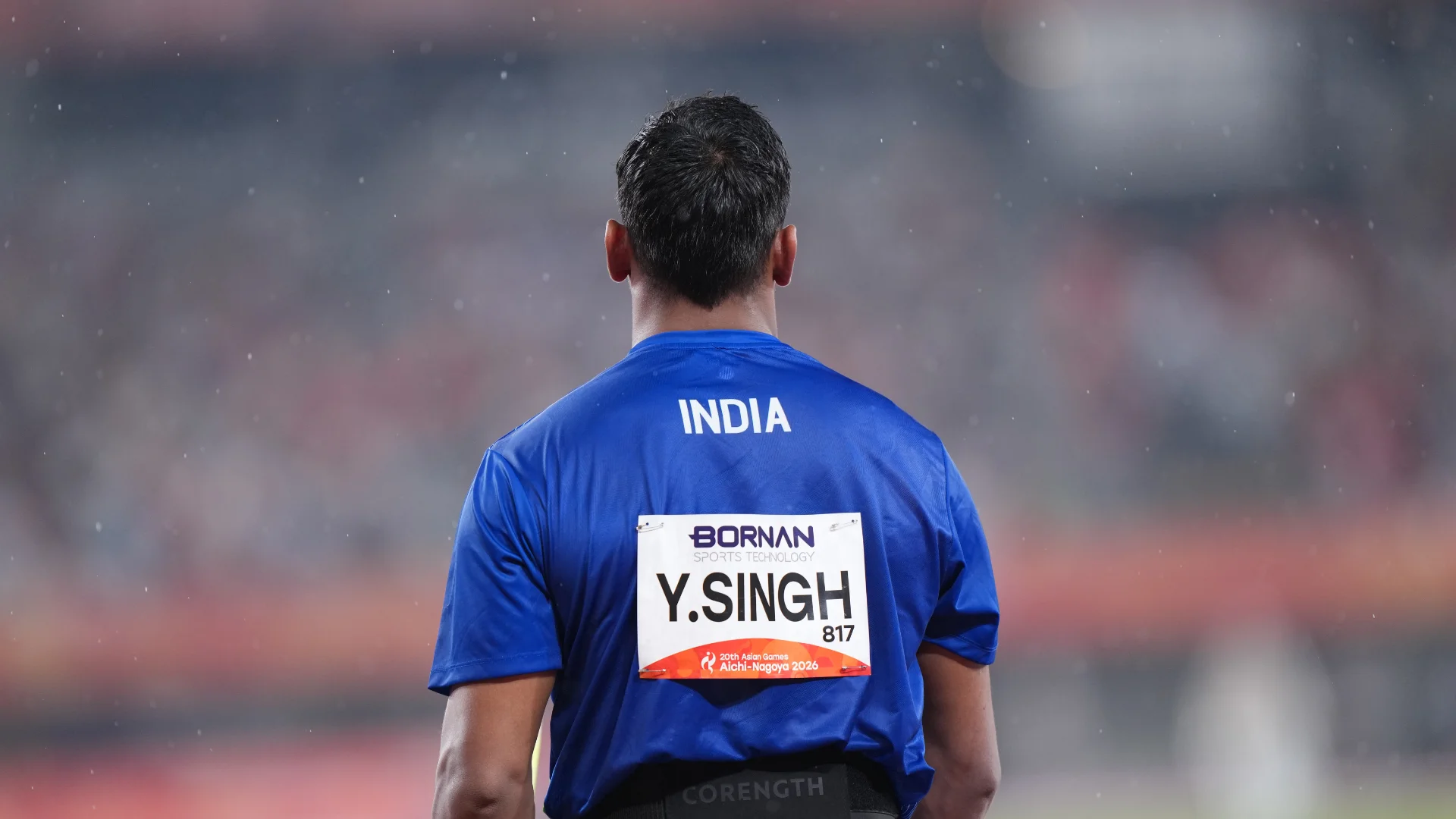
India’s Tanya Chaudhary finished fourth in the women’s hammer throw final at the Asian Games 2026 in Nagoya, setting a new personal best of 65.35m with her final attempt.
Her teammate Anushka Yadav also delivered a strong performance, finishing fifth with a best throw of 64.56m.
The results placed two Indian athletes inside the top five in a competitive continental final.
Tanya Chaudhary Sets Personal Best With Final Throw
Tanya saved her best performance for the final round of the competition.
On her sixth and last attempt, she produced a throw of 65.35m, setting a new personal best.
The effort secured her fourth place and highlighted her ability to deliver under pressure.
Her final-round improvement brought her close to the medal positions, although she ultimately finished outside the podium.
Anushka Yadav Finishes Fifth
India’s Anushka Yadav also produced a consistent performance in the women’s hammer throw final.
She recorded a best mark of 64.56m, securing fifth place.
Her result ensured that India had two athletes among the top five finishers in the event.
Zhang Jiale Wins Gold With Asian Record
China’s Zhang Jiale won the gold medal with an outstanding throw of 78.27m, setting a new Asian record.
Her compatriot Zhao Jie claimed silver with 74.83m, while Joy Iris McArthur secured bronze with 68.42m.
Women’s Hammer Throw Final Results
|
Position |
Athlete |
Country |
Distance |
|---|---|---|---|
|
Gold |
Zhang Jiale |
China |
78.27m (AR) |
|
Silver |
Zhao Jie |
China |
74.83m |
|
Bronze |
Joy Iris McArthur |
— |
68.42m |
|
4th |
Tanya Chaudhary |
India |
65.35m (PB) |
|
5th |
Anushka Yadav |
India |
64.56m |
India Places Two Athletes in the Top Five
Tanya Chaudhary’s personal best and Anushka Yadav’s fifth-place finish marked a strong showing for India in the women’s hammer throw.
Although neither athlete reached the podium, both finished among the top five in a highly competitive field.
Tanya finished fourth with a personal best of 65.35m, while Anushka placed fifth with 64.56m at the Asian Games 2026.
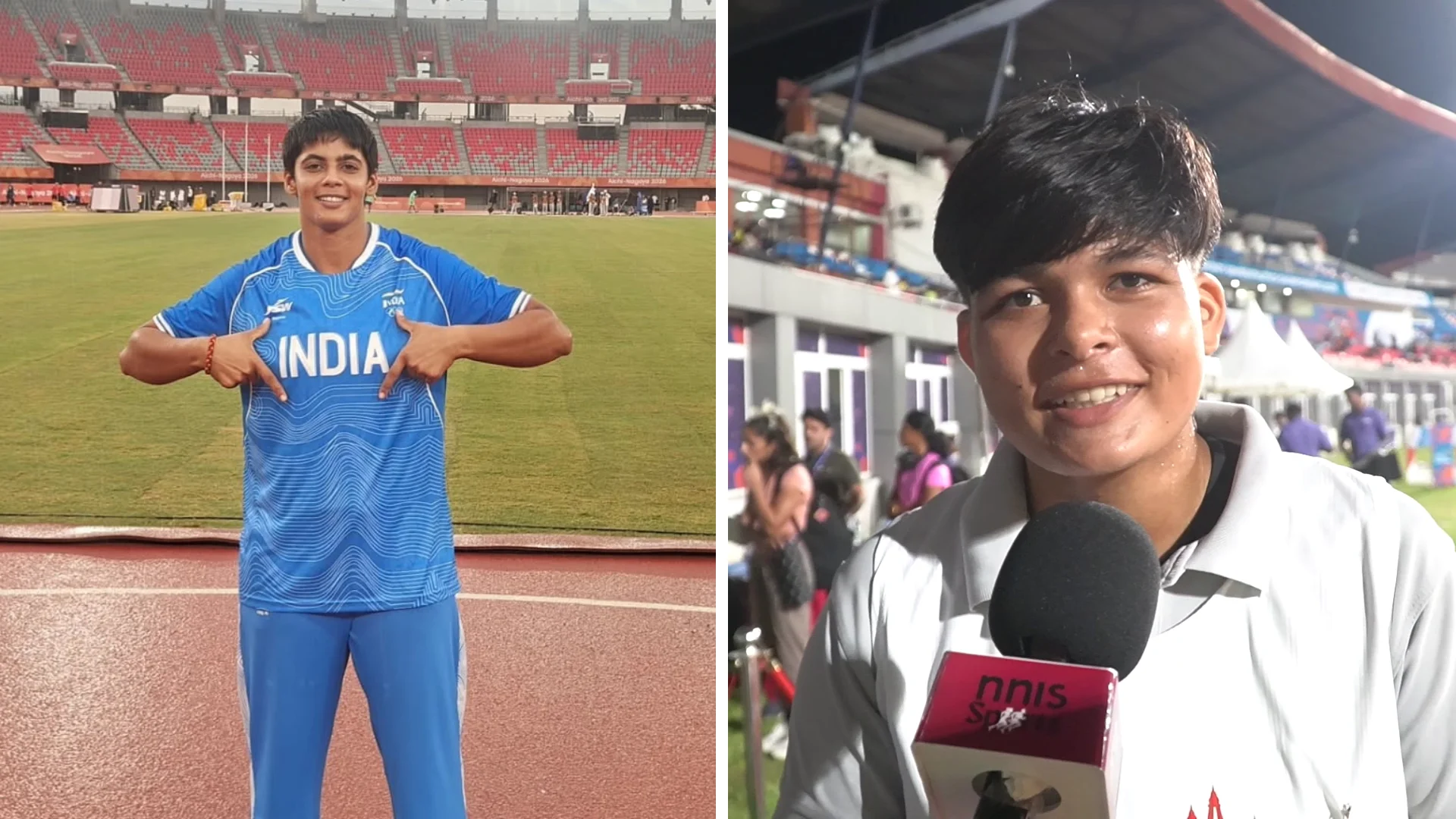
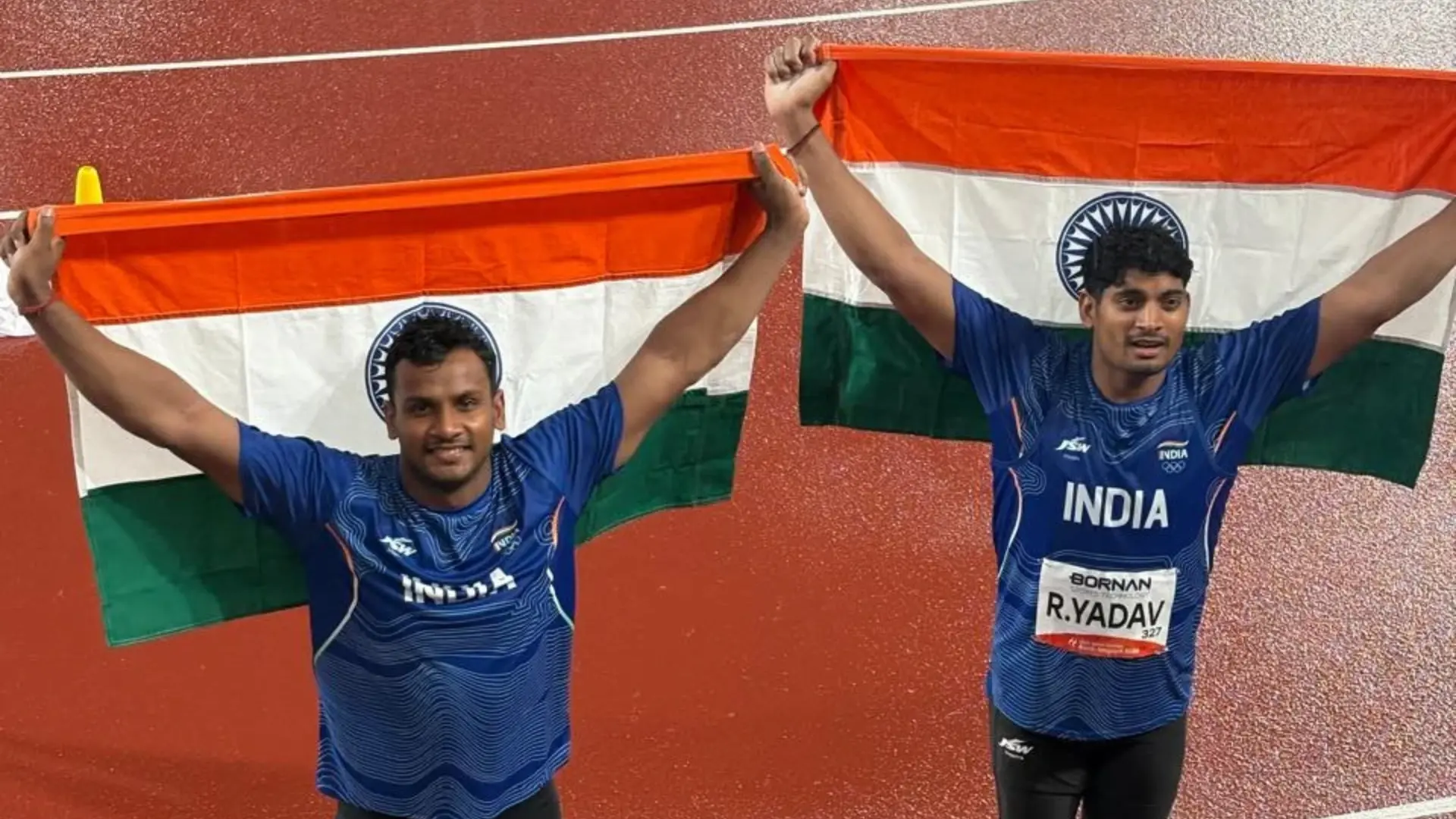
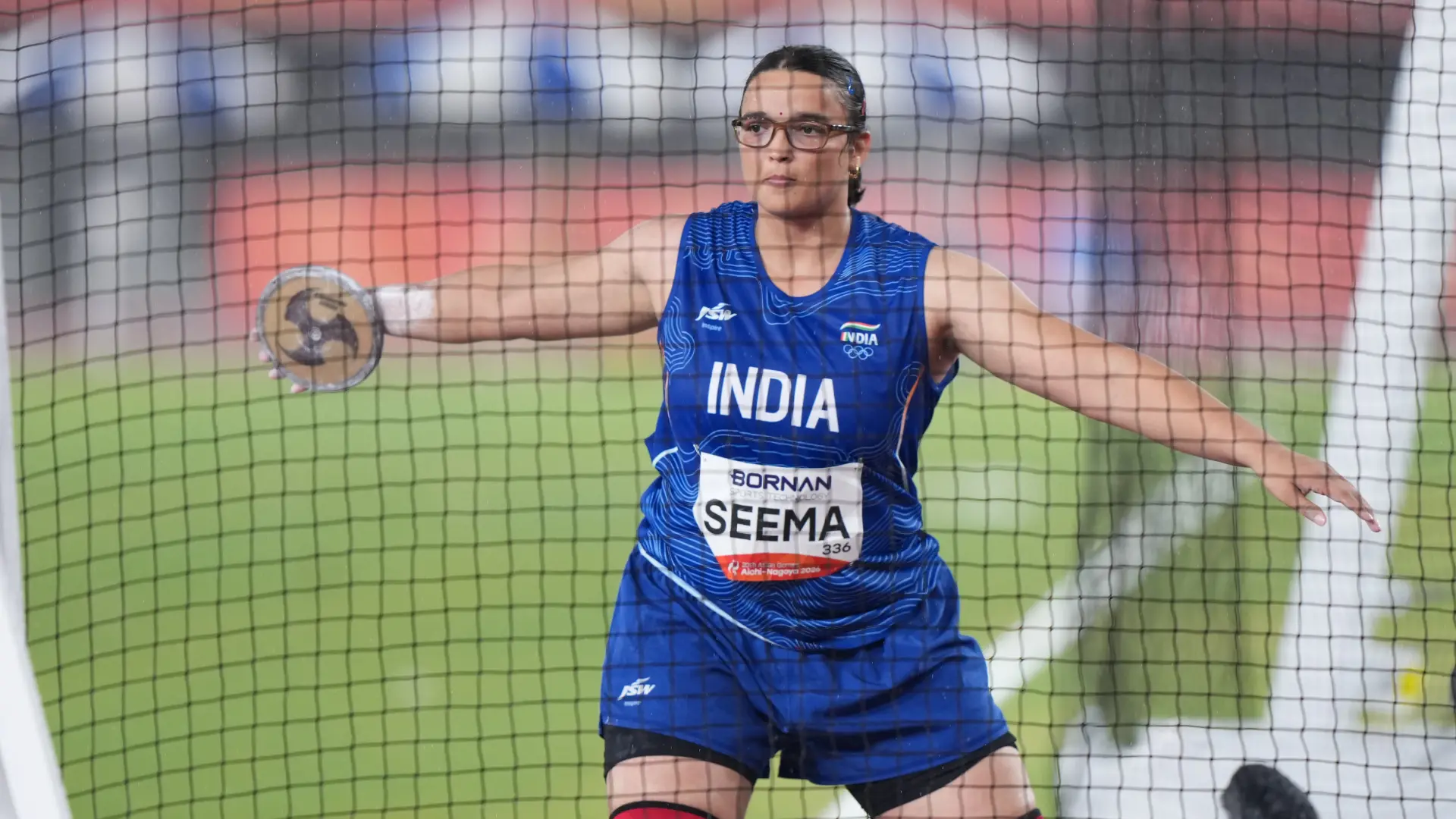
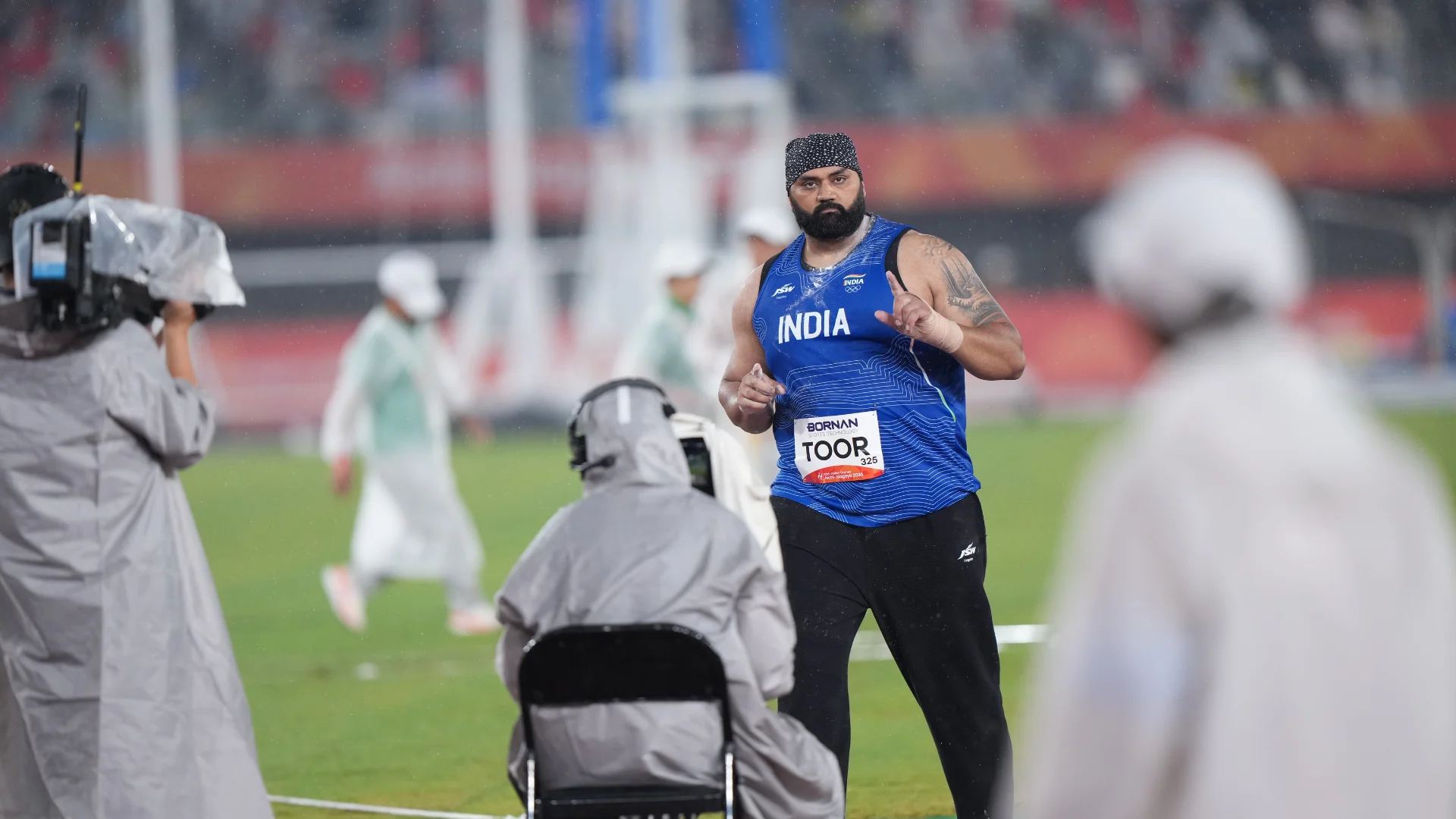
Nagoya: Damneet Singh finished ninth with a best throw of 67.56m, while Praveen Kumar placed 11th with 65.24m in the men’s hammer throw final at the Asian Games. Both Indians were making their debut at the continental Games.
For Damneet, the result marked a disappointing end to a season in which he had demonstrated the ability to compete at a significantly higher level.
Damneet Singh Falls Short of 70m Mark
The 22-year-old produced the biggest breakthrough of his senior career in March at the Indian Open Throws, where he crossed the 70m mark for the first time, recording three throws beyond the distance in the same competition.
He opened with 70.64m, followed by 70.21m on his third attempt and 70.04m on his fifth.
The performance also took him beyond the Asian Games qualification standard of 69.12m, marking a significant milestone for a thrower working to establish himself at the senior level.
However, maintaining that level proved difficult in the months that followed.
Eighth Place at Németh Pál Memorial in Hungary
In August, Damneet competed at the Németh Pál Memorial, a World Athletics Continental Tour Silver-level meeting in Hungary.
He finished eighth in the eight-athlete final with a best throw of 66.67m.
His series included 66.67m, 65.92m, 65.52m and 66.14m, followed by two fouls.
Croatia’s Matija Gregurić won the competition with a throw of 74.85m.
Damneet Finishes Ninth at Asian Games
At the Asian Games, Damneet once again fell short of the 70m mark.
His opening throw of 67.56m remained his best effort, leaving him outside the top eight and ending his competition after three attempts.
Praveen Kumar, who was also making his Asian Games debut, recorded 65.24m to finish 11th.
Both Indians fell short of the performances they would have wanted in the final.
Damneet’s 70m Throws Offer Encouragement
Despite the disappointing result in Nagoya, Damneet’s season includes a significant marker of progress.
His three throws beyond 70m at the Indian Open Throws in March demonstrated that he has the distance required to compete at this level.
The next challenge is consistency.
The Asian Games marked Damneet’s first appearance at a major continental championship. While his ninth-place finish was not the result he would have wanted, his performances earlier in the season showed that the 70m barrier is within his reach.
For now, the men’s hammer throw final in Nagoya ends with 67.56m and ninth place for Damneet Singh, while Praveen Kumar finishes 11th with 65.24m.
Neither performance was enough to reach the top eight, but the experience gives both first-time Asian Games competitors another reference point as they continue to develop.