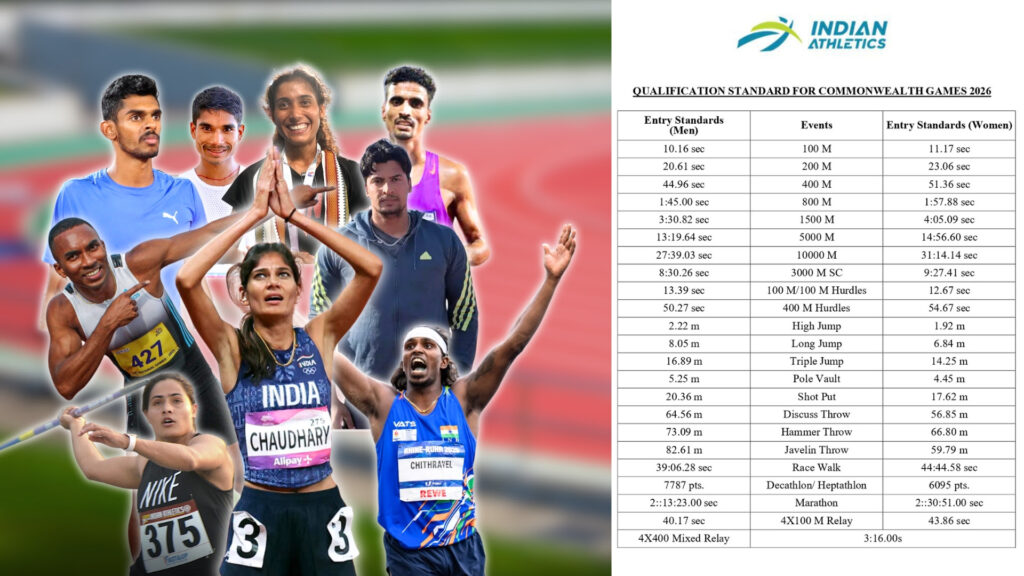

| The Athletics Federation of India revealed the qualifying standards for the 2025 Commonwealth Games on Monday.
While it did come as a distress to the athletics community, just after we posted the qualifying standards, we received calls from many athletes raising concerns, asking whether the standards were too high. Some even questioned if the figures were correct or a mistake at our end.
The main reason for the distress was that in 17 events, athletes have to at least touch the national record mark just to qualify. To be precise, in 15 events, they will have to better the national record, while in two events, women’s 100m and women’s high jump, they will have to equal the national record.
Events like men’s 100m, men’s 400m, women’s 800m, men’s 1500m, women’s 5000m, women’s 10,000m, men’s 110m hurdles, women’s 100m hurdles, women’s 400m hurdles, women’s long jump, women’s triple jump, women’s pole vault, men’s and women’s hammer throw, and the women’s marathon will require performances better than the national record.
Meanwhile, women’s 100m will need Dutee Chand’s 11.17 seconds, and women’s high jump will need Sahana Kumari’s 1.92m to qualify for the Commonwealth Games 2026.
Speaking to the media, Chief Coach Radhakrishnan Nair said the main reason for keeping the qualification standards high is that the federation wants only athletes capable of winning medals at the Commonwealth Games to qualify.
He also added that as per the Commonwealth Games Organising Committee guidelines, the Indian athletics contingent cannot exceed 32 athletes, including a maximum of 16 women.
What is more interesting is that upon further analysis, India’s qualification standards in most events are even better than those of nations like England, New Zealand, and Canada. In some events, they have even exceeded Australia’s qualification marks for the Commonwealth Games 2026.
When NNIS Sports reached out to one coach who did not want to be named, he said:
“This is totally wrong. There is no correlation between the 100m and the 4x100m in both men’s and women’s events. For individual athletes, they have to at least touch the national record, while in relays, it seems pretty easy. This clearly shows the federation does not want individual athletes to qualify but wants the relay teams.”
“The qualification standards of England, Canada, and New Zealand look like they want their athletes to gain exposure, but our federation has made the Commonwealth Games an impossible task. If they show support for athletes at the CWG, then those athletes can dream of competing at the Olympics.”
“The Commonwealth Games should be a priority, not the Asian Games. If we want to be an athletics nation, we should start prioritising the Commonwealth Games. The qualification standards indicate that they have already decided which events they want to send athletes to and which they do not.”
“These standards look biased to me. In many events, you need a national record, but in javelin,n it is only 82.61m. It seems like they want javelin throwers to go but not others,”
“As a federation, your work is to help athletes qualify and perform better, not to stop athletes. This is totally unacceptable,” the coach said in a furious voice.
NNIS Sports also posted a story on its Instagram, asking athletes about their thoughts on the qualification standards. Many reached out to us on the condition that their names should not be revealed.
“If only medal-performance athletes are selected, then how will athletes get exposure?”
“Middle-distance standards are shocking. 1500m at 3:30 compared to the Olympic standard of 3:35.”
“The 400m qualification time is too high for the CWG. Only the 400m seems specifically very high.”
The 29th National Senior Athletics Federation Competition, scheduled to be held from May 22 to 25 in Ranchi, Jharkhand, will act as the final selection trials for the Commonwealth Games 2026, which are scheduled to begin on July 23 in Scotland. |
AFI’s CWG 2026 qualifying standards spark concern across the Athletics community.
 Emergingsports
October 6, 2025
Emergingsports
October 6, 2025