




World Athletics has raised the qualification bar for several events ahead of the Los Angeles 2028 Olympics. A comparison with Paris 2024 and India’s current national records reveals where Indian athletics stands, which records already match the new standards, and where athletes still need significant improvements.
The road to the Los Angeles 2028 Olympic Games has become more demanding for track and field athletes. On November 10, 2026, World Athletics published the official athletics qualification system, outlining the entry standards, qualification windows and selection process for the Games, scheduled from July 15 to 30, 2028.
When comparing the Paris 2024 and LA28 qualification standards, we can see that World Athletics has generally introduced faster track times and higher performance benchmarks in several field events. These changes are particularly noticeable in sprinting, middle-distance running, endurance events and the marathon.
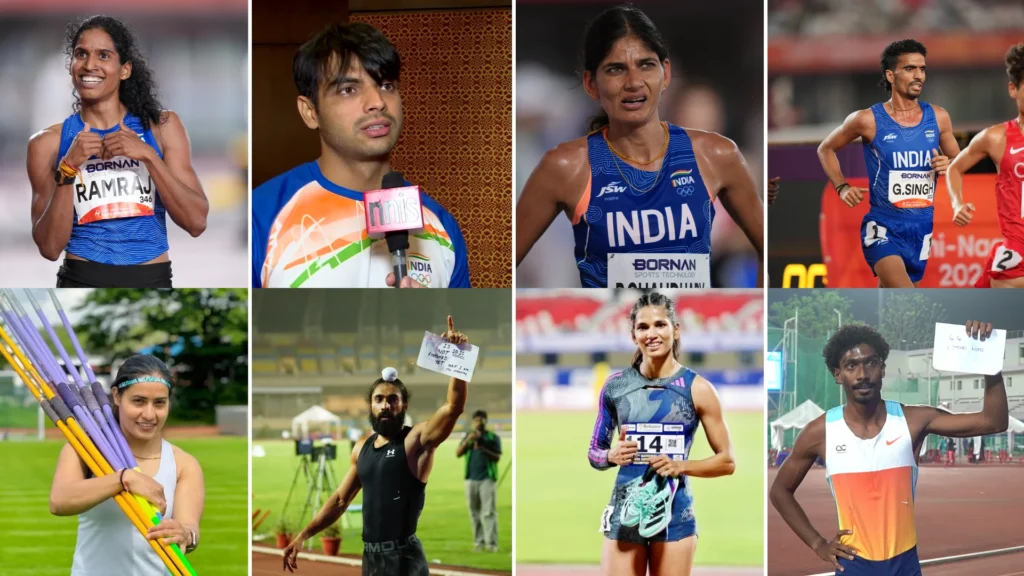
For India, the new standards present an interesting picture. The country has made considerable progress across several events, with athletes breaking national records throughout 2025 and 2026. Recent performances by Gurindervir Singh, Vishal TK, Animesh Kujur, Gulveer Singh, Dev Meena, Ancy Sojan, Vithya Ramraj and others demonstrate this improvement in Indian athletics.
Nevertheless, a comparison of current national records with the LA28 entry standards also highlights the remaining performance gaps.
1. WHAT HAS CHANGED FROM PARIS 2024 TO LA28?
One of the biggest changes concerns the qualification model.
At Paris 2024, the qualification system aimed to have approximately 50% of athletes qualify through entry standards, while World Rankings accounted for the remaining 50%.
However, for LA28, World Athletics has shifted towards a 40:60 model:
- Approximately 40% of athletes are expected to qualify through entry standards.
- Meanwhile, approximately 60% are expected to qualify through World Athletics Rankings.
3. INDIA’S NATIONAL RECORDS VS LA28 QUALIFICATION STANDARDS
100m
Gurindervir Singh’s national record of 10.09 seconds is 0.16 seconds away from the LA28 qualification standard of 9.93 seconds. Similarly, on the women’s side, Dutee Chand’s 11.17-second national record falls 0.21 seconds short of the new 10.96-second benchmark.
200m
Animesh Kujur holds the men’s national record at 20.32 seconds, while Saraswati Saha’s 22.82 seconds remains the women’s national record. Consequently, the respective gaps stand at 0.37 seconds and 0.57 seconds.
400m
Vishal Thennarasu Kayalvizhi made history with his 44.98-second performance, becoming the first Indian to break the 45-second barrier. However, the LA28 qualification standard requires 44.40 seconds, leaving a gap of 0.58 seconds.
Meanwhile, Hima Das holds the women’s national record at 50.79 seconds, which is 0.89 seconds outside the new 49.90-second standard.
800m and 1500m
In the men’s 800m, Mohammed Afsal’s 1:44.93 performance is 1.93 seconds away from the LA28 benchmark. On the women’s side, Tintu Luka’s national record of 1:59.17 falls 2.17 seconds short.
Moving to the 1500m, Jinson Johnson’s 3:35.24 national record is 5.24 seconds outside the men’s standard. Similarly, K.M. Deeksha’s 4:04.78 is 7.28 seconds away from the women’s benchmark.
Long-distance running
India’s long-distance runners have also made progress in recent years. For instance, Gulveer Singh’s outdoor 5000m national record of 13:03.93 is 13.93 seconds outside the LA28 entry standard. Meanwhile, Parul Chaudhary’s women’s 5000m record of 15:04.26 falls 30.26 seconds short.
In the 10,000m, Gulveer Singh’s 27:00.22 national record is even closer to the new standard, with a gap of just 12.22 seconds from the required 26:48.00.
However, the women’s event presents a bigger challenge. Preeja Sreedharan’s national record of 31:50.47 is 1 minute and 20.47 seconds outside the LA28 benchmark.
HURDLES AND STEEPLECHASE: RECENT NATIONAL RECORD IMPROVEMENTS
India has also witnessed encouraging progress in hurdles and steeplechase events.
In the men’s 110m hurdles, Tejas Shirse’s 13.27-second national record is just 0.09 seconds outside the LA28 standard of 13.18 seconds. Similarly, Jyothi Yarraji’s women’s 100m hurdles record of 12.78 seconds falls only 0.20 seconds short of the new 12.58-second benchmark.
The women’s 400m hurdles also witnessed a major breakthrough in 2026. Vithya Ramraj clocked 54.75 seconds at the Asian Games, breaking P.T. Usha’s 42-year-old national record. Even so, she needs to improve by another 0.75 seconds to meet the LA28 qualification standard.
In the men’s 400m hurdles, Ayyasamy Dharun holds the national record at 48.80 seconds. This leaves a gap of 0.80 seconds from the required 48.00 seconds.
Turning to steeplechase, Avinash Sable’s national record of 8:09.91 is 2.41 seconds away from the men’s standard. On the women’s side, Parul Chaudhary’s 9:08.67 record falls 2.67 seconds short of the LA28 benchmark.
FIELD EVENTS: SOME INDIAN RECORDS ALREADY CROSS THE LA28 MARK
India’s field-event performances offer a particularly encouraging picture. In fact, several national records already exceed the newly published LA28 qualification standards.
Events where India’s current national records already meet or exceed the LA28 standards:
- Men’s Long Jump – Jeswin Aldrin: 8.42m against 8.30m.
- Men’s Triple Jump – Praveen Chithravel: 17.37m against 17.35m.
- Men’s Shot Put – Tajinderpal Singh Toor: 21.77m against 21.50m.
- Men’s Javelin Throw – Neeraj Chopra: 90.23m against 85.50m.
- Women’s Discus Throw – Kamalpreet Kaur: 66.59m against 65.00m.
- Women’s Javelin Throw – Annu Rani: 63.82m against 63.80m.
Beyond these events, some Indian athletes have come remarkably close to the new benchmarks. For example, Sarvesh Kushare’s 2.31m high jump national record is just one centimetre short of the men’s standard. Likewise, Ancy Sojan’s 6.88m women’s long jump record is only two centimetres away from the required 6.90m.
However, other field events require more substantial improvements. Dev Meena’s pole vault national record of 5.50m is 40 centimetres short of the new men’s benchmark. Similarly, G. Sindhushree’s women’s record of 4.25m falls 55 centimetres short.
In hammer throw, Nirbhay Choudhary’s 71.02m national record is 7.48m outside the men’s standard. Meanwhile, Tanya Chaudhary’s 68.35m record is 5.65m short of the women’s requirement.
COMBINED EVENTS: A NEW BENCHMARK FOR INDIA
India has made significant progress in combined events as well. In 2026, Tejaswin Shankar produced a historic decathlon performance of 8057 points, taking India beyond the 8,000-point barrier for the first time.
Nevertheless, the LA28 qualification standard stands at 8650 points. Therefore, Shankar needs another 593 points to reach the required benchmark.
In the women’s heptathlon, JJ Shobha holds the national record with 6211 points. However, the new LA28 standard of 6550 points leaves a gap of 339 points.
MARATHON AND RACE WALK: A SIGNIFICANT CHANGE IN FORMAT
The marathon standards have witnessed some of the most substantial changes in the LA28 qualification system.
In the men’s marathon, Sawan Barwal’s national record of 2:11:37 falls 6 minutes and 37 seconds short of the new Olympic standard.
Similarly, in the women’s category, O.P. Jaisha’s national record of 2:34:43 is 12 minutes and 23 seconds outside the LA28 requirement.