




Running fast is not enough to get to the Olympics. An athlete also has to run fast at the right meet, inside the right window, and rank high enough against the rest of the world. Qualification for global championships has changed a lot in recent years, and it is about to get even harder.
This guide explains how athletics qualification works for the three competitions that matter most to Indian athletes: the Olympic Games, the World Athletics Championships and the Asian Games. It covers entry standards, World Rankings, qualification windows and quotas, the confirmed standards for the 2027 World Championships in Beijing, what is known so far about LA 2028, and how AFI selected India’s team for the 2026 Asian Games.
Athletics qualification at a glance
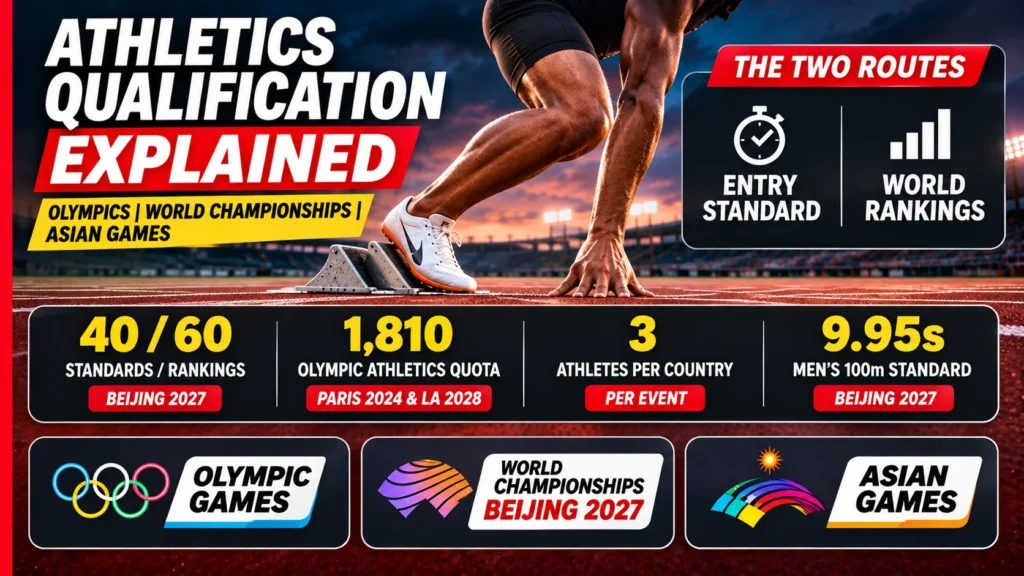
- Two main routes to the Olympics and World Championships: hit the entry standard, or rank high enough in the World Rankings.
- Maximum three athletes per country per individual event at both.
- Beijing 2027: about 40% of places by standard and 60% by ranking, with tougher standards than ever (men’s 100m: 9.95).
- LA 2028: 1,810 athletes in total; most event standards are still to be published.
- Asian Games: no world standards. Each country picks its own team; AFI set Indian standards close to sixth place at the previous Games.
Jump to: The two routes World Rankings Olympics World Championships Asian Games What it means for India Fact check
The two routes: entry standards and World Rankings
For the Olympics and the World Championships, World Athletics sets a target number of athletes for each event: for example, 48 in the 100m and 36 in each field event at Beijing 2027. Those places are filled in two main ways:
- Entry standard: a very tough mark that guarantees a place if you achieve it at an eligible competition inside the qualification window.
- World Rankings: the remaining places go to the highest-ranked athletes who have not already qualified, when the ranking period closes.
- Other routes: depending on the championship, wild cards for title holders, places for area (continental) champions, and top finishes at the biggest road races.
Either way, each country can send at most three athletes per individual event. If four Indians hit the standard, only three can go, and the national federation decides which three.
The balance between the two routes is shifting towards the rankings. Paris 2024 used roughly a 50/50 split. For Beijing 2027, World Athletics expects about 40% of athletes to qualify by standard and 60% by ranking.
How the World Athletics Rankings work
Because most places now come through the rankings, understanding them matters as much as running fast. Each result earns a performance score with two parts:
Performance score = result score + placing score
Result score: your mark converted to points using the World Athletics scoring tables, adjusted for wind and other conditions.
Placing score: extra points for where you finished, depending on how important the meet is.
Your ranking score is the average of your best performance scores over a set period. According to USA Track & Field’s explainer, that is:
- Most events: best 5 results in 12 months
- 3000m steeplechase and 5000m: best 3 in 12 months
- 10,000m, combined events and marathon: best 2 in 18 months
Competitions are graded into categories, from OW (Olympic Games and World Championships) at the top, through the Diamond League (DF and GW) and Gold-level meets (GL), down to A to F. The higher the category, the more placing points: an Olympic win is worth 260 placing points, while winning a small local meet may be worth about 11. That is why where you compete matters almost as much as how fast you run.
How Olympic athletics qualification works
The template: Paris 2024
The Paris 2024 system shows how Olympic qualification is built:
- Quota: 1,810 athletes, 905 men and 905 women.
- Split: about half by entry standard and half by World Ranking.
- Windows: 1 July 2023 to 30 June 2024 for most events; from 31 December 2022 for the 10,000m, combined events, race walks and relays; and 1 November 2022 to 30 April 2024 for the marathon.
- Relays: the top 14 teams at the 2024 World Relays qualified automatically, with the rest picked from the relay performance list.
- Universality places: a country with no qualified man or woman could enter its best-ranked athlete in the 100m, 800m or marathon.
LA 2028: what we know so far
- Quota: the athletics quota stays at 1,810, with a new mixed 4x100m relay added.
- Marathon: the qualification window opens on 1 November 2026 and closes on 30 April 2028. The target field is 70 per race, down from 80 in Paris, with about 40% qualifying by standard or a top-five finish at a Platinum Label marathon and 60% by ranking.
- Race walks: the half-marathon race walk replaces the 20km walk.
Note: as of late October 2026, the LA 2028 entry standards had not been published. Marathon Handbook reports they are expected in December 2026, after approval by the World Athletics Council. The LA 2028 details above come mainly from Marathon Handbook’s reporting, so treat them as provisional until World Athletics publishes the full system.
How World Championships qualification works: Beijing 2027
The World Athletics Council approved the qualification system for the 2027 World Championships in Beijing (11 to 19 September 2027) in May 2026. It is the toughest yet.
Qualification windows
- Marathon: 3 November 2025 to 2 May 2027
- 10,000m, race walks, combined events and relays: 23 February 2026 to 22 August 2027
- All other events: 23 August 2026 to 22 August 2027
Other routes in
- Wild cards: for the 2025 world champions, winners of the 2026 World Athletics Ultimate Championship, winners of the 2026 race walking and combined events tours, leading hammer throwers on the 2026 Continental Tour, and 2027 Diamond League winners.
- Area champions: continental champions qualify, unless another athlete from their area has already qualified in that event.
- Relays: the top 12 teams at the 2026 World Relays in Gaborone have already qualified, and four more come from the performance lists.
- Eligible meets: marks for the entry standard must mainly come from Category C competitions or higher. Lower-level meets still count for the rankings.
Beijing 2027 entry standards
On a phone, swipe the table sideways to see every column.
| Event | Men | Women | Field size |
|---|---|---|---|
| 100m | 9.95 | 10.96 | 48 |
| 200m | 20.07 | 22.45 | 48 |
| 400m | 44.45 | 50.00 | 48 |
| 800m | 1:43.00 | 1:57.50 | 56 |
| 1500m | 3:30.00 | 3:58.00 | 56 |
| 5000m | 12:50.00 | 14:36.00 | 42 |
| 10,000m | 26:48.00 | 30:40.00 | 27 |
| Marathon | 2:06:00 | 2:23:20 | 100 |
| 3000m steeplechase | 8:08.00 | 9:06.50 | 36 |
| 110m / 100m hurdles | 13.18 | 12.60 | 40 |
| 400m hurdles | 48.00 | 54.00 | 40 |
| High jump | 2.30m | 1.96m | 36 |
| Pole vault | 5.90m | 4.75m | 36 |
| Long jump | 8.25m | 6.86m | 36 |
| Triple jump | 17.35m | 14.40m | 36 |
| Shot put | 21.50m | 19.30m | 36 |
| Discus throw | 67.20m | 64.50m | 36 |
| Hammer throw | 78.30m | 74.00m | 36 |
| Javelin throw | 85.50m | 63.40m | 36 |
| Decathlon / heptathlon | 8,620 pts | 6,550 pts | 24 |
| Half marathon race walk | 1:23:00 | 1:33:10 | 50 |
| Marathon race walk | 3:01:00 | 3:28:00 | 50 |
| Relays (all four) | Top 12 at World Relays 2026, plus 4 from performance lists | 16 teams | |
To put these in context: Gurindervir Singh’s Indian 100m record is 10.09, Vishal TK’s 400m record is 44.98, and Tejaswin Shankar’s decathlon record is 8,057. All of them are short of the Beijing standards, so Indian athletes in most events will need the rankings route. See all Indian national records from 2026.
How Asian Games qualification works
The Asian Games work differently. There are no World Athletics entry standards or rankings. Each country’s Olympic committee enters its own team, within the limits set by the Olympic Council of Asia (OCA). In India, the Athletics Federation of India (AFI) sets its own qualifying marks and picks the team, which the government then approves.
How AFI selected India’s team for 2026
- Standards near sixth place: AFI announced its standards in January 2026, based on results at the previous Asian Games. They sat close to a top-six finish at the 2023 Hangzhou Games, not a bronze-medal mark.
- One selection trial: AFI’s May 2026 guidelines named the National Inter-State Senior Championships in Bhubaneswar (24 to 28 June 2026) as the only selection trial. The selection committee could exempt athletes in exceptional cases, such as those competing in the Diamond League, but only with written permission given in advance.
- One per event as standard: ordinarily one athlete who meets the standard was picked per event, with the selection committee free to pick more.
- Relays from AFI centres: relay teams were picked only from athletes at AFI-recognised national camps.
- Other conditions: athletes had to declare their whereabouts, report any injury at once, follow the No Needle Policy, and, for women, submit an SRY gene test from an AFI-approved laboratory.
AFI qualifying standards for the 2026 Asian Games
On a phone, swipe the table sideways to see every column.
| Event | Men | Women |
|---|---|---|
| 100m | 10.16 | 11.54 |
| 200m | 20.88 | 23.70 |
| 400m | 45.97 | 53.72 |
| 800m | 1:48.80 | 2:05.21 |
| 1500m | 3:42.00 | 4:19.45 |
| 5000m | 13:39.18 | 15:36.58 |
| 10,000m | 29:00.00 | 33:50.00 |
| 110m / 100m hurdles | 13.63 | 13.34 |
| 400m hurdles | 49.41 | 57.21 |
| High jump | 2.19m | 1.80m |
| Pole vault | 5.45m | 4.10m |
| Long jump | 7.91m | 6.48m |
| Triple jump | 16.28m | 13.34m |
| Shot put | 19.41m | 16.25m |
| Discus throw | 60.13m | 55.48m |
| Hammer throw | 69.12m | 61.72m |
| Javelin throw | 77.87m | 57.62m |
| Decathlon / heptathlon | 7,250 pts | 5,605 pts |
| Marathon | 2:15:04 | 2:31:52 |
| 4x100m relay | 38.81 | 45.24 |
| 4x400m relay | 3:04.23 | 3:31.23 |
| Mixed 4x400m relay | 3:26.81 | |
Standards as announced in January 2026 and reported by The Bridge. Race walk and mixed 4x100m standards were to be decided later.
Olympics vs Worlds vs Asian Games: qualification compared
On a phone, swipe the table sideways to see every column.
| Olympics | World Championships | Asian Games | |
|---|---|---|---|
| Who sets the rules | World Athletics and IOC | World Athletics | OCA limits; each country picks its team |
| Routes | Standard, ranking, universality | Standard, ranking, wild card, area champion | National trials and standards (AFI for India) |
| Standards vs rankings | About 50/50 in Paris 2024 | About 40/60 for Beijing 2027 | Not used |
| Max per country per event | 3 | 3 (4 with a wild card) | Set by OCA; see note |
| Relays | Top 14 at World Relays (Paris 2024) plus lists | Top 12 at World Relays plus 4 from lists | Chosen by the national federation |
Note: we could not confirm the OCA’s per-event entry limit for athletics at the 2026 Asian Games from an official document. Reports referred to two places per event for India in some disciplines, such as the men’s javelin.
What tougher qualification means for Indian athletes
The move towards rankings, and the rule that entry standards must come from Category C meets or higher, will hit Indian athletes harder than most. Many have qualified in the past with marks from domestic meets such as the Federation Cup and the Inter-State Championships. Under the new rules, they will need:
- More international competition: higher-category meets abroad earn more placing points.
- Better domestic meets: Indian meets need World Athletics categories high enough to count.
- Planning: athletes need a full season of strong results, not one fast day, to rank inside the field.
Stars like Neeraj Chopra will qualify either way. The bigger question is whether India can keep sending large teams to global championships.
Fact check: how we verified this guide
On a phone, swipe the table sideways to see every column.
| Claim | Status | Sources |
|---|---|---|
| Beijing 2027 standards, field sizes, entry limits | Verified | World Athletics qualification document; Citius Mag; India Sports Hub |
| Beijing 2027 40/60 split, windows, wild cards, relays, dates | Verified | World Athletics press release; AFI; Citius Mag |
| World Rankings formula and categories | Verified | World Athletics ranking rules; USATF |
| Number of results counted per event (5, 3, 2) | Single source | USATF explainer (World Athletics’ basics page does not list them) |
| Paris 2024 quota, 50/50 split, windows, relays, universality | Verified | Olympics.com; World Athletics |
| LA 2028 quota, marathon window and field size | Provisional | Marathon Handbook (two reports); standards not yet published |
| AFI 2026 Asian Games selection rules | Verified | AFI qualification guidelines (May 2026) |
| AFI 2026 Asian Games standards and how they were set | Single source | The Bridge (January 2026); other outlets reported the announcement |
| OCA per-event limit for athletics | Not verified | No official document found |