
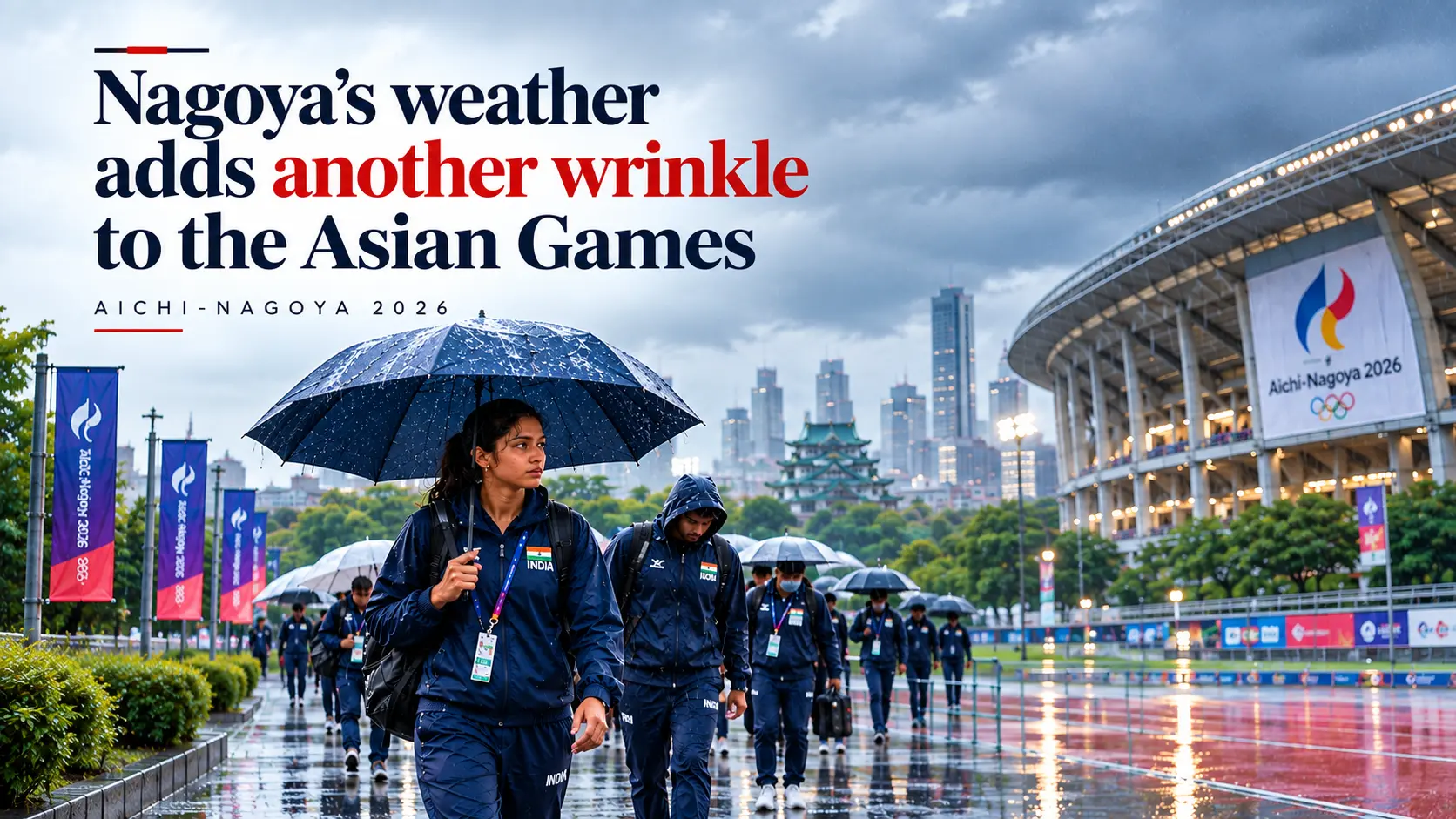
Nagoya has had little time to catch its breath.
Just over a week after torrential rain caused flooding, disrupted transport and briefly forced hundreds of Asian Games athletes and officials to leave their accommodation, the Japanese city is preparing for another weather challenge.
With the Asian Games 2026 officially opening on Saturday, organisers are closely monitoring Tropical Storm Dujuan, which was moving towards central Japan this week. Forecasts indicated that the system could approach the Aichi-Nagoya region around September 21, although its exact path remained uncertain.
The potential storm adds another logistical challenge for organisers after severe flooding hit Nagoya on September 8.
Nagoya Faced Record Rain Earlier This Month
The Japan Meteorological Agency recorded 219.5mm of rain in Nagoya on September 8, making it the city’s third-highest September daily rainfall on record.
The rain was particularly intense. Nagoya recorded 104.5mm in one hour, according to JMA data.
The downpour overwhelmed parts of the city’s drainage and transport networks.
A Level 5 special flood warning was issued for the Shonai River, while authorities urged residents in vulnerable areas to move to safety.
Roads flooded, cars struggled through standing water and subway and bus services faced temporary suspensions. About 3,500 residents reportedly sought refuge at evacuation centres.
Asian Games Athletes Also Forced to Evacuate
The Asian Games were also caught in the downpour.
Around 400 athletes and staff staying in temporary accommodation near Nagoya Port were briefly evacuated to higher ground.
They were able to return after the evacuation order was lifted roughly two hours later.
The accommodation system itself has become an important part of the Games story.
Unlike many major multi-sport events, Aichi-Nagoya 2026 does not have a conventional Athletes’ Village.
Participants are instead spread across hotels, temporary accommodation and the Costa Serena cruise ship, which is being used to house thousands of Games participants.
Heavy Rain Disrupted Games Operations
The heavy rain also reached some competition venues and disrupted movement around the city.
Transport interruptions created further difficulties, while some competitions experienced delays or postponements because of the severe weather.
For athletes already dealing with accommodation and transport arrangements, another disruption could add further pressure.
Tropical Storm Dujuan Now Being Monitored
And now comes Dujuan.
As of Thursday, the storm was off Japan’s Pacific coast and moving towards central Japan. It had maximum sustained winds of around 90kph, with gusts reaching 126kph.
Forecasts remained uncertain, and organisers were monitoring the system closely as the opening ceremony approached.
The latest storm guidance also showed that Dujuan’s projected track could bring the system closer to Japan around September 20-21, although forecast tracks can change.
Nagoya Prepares for the Games
For the thousands of athletes, officials, journalists and volunteers arriving in Nagoya, the situation is not necessarily one of alarm.
The city is functioning, several sports have already begun, and conditions were much calmer on Thursday. However, after last week’s flooding, weather has become another variable in an already complex Games.
Organisers must now balance competition schedules, athlete movement, accommodation and transport while keeping an eye on the changing weather.
Nagoya is preparing to host Asia’s biggest sporting gathering.
For now, it is also keeping a close eye on the sky.
While the global track and field community begins looking ahead to regional showdowns such as the Asian Games following a gruelling summer, the combined events circuit is preparing for one final spectacular curtain call.
After the emotional and physical demands of an Olympic year, the world’s elite multi-event athletes are returning for one last major test. The historic 50th-anniversary edition of Décastar takes centre stage in Talence on Friday and Saturday as the season finale of the World Athletics Combined Events Tour Gold.
The meeting brings together a field featuring Olympic and world champions across the heptathlon and decathlon.
Nafissatou Thiam Headlines Women’s Heptathlon
Belgium’s legendary Nafissatou Thiam headlines the women’s competition as she prepares for her first full heptathlon of the season.
After selective event testing in Ratingen and a high jump appearance at the Wanda Diamond League Final in Brussels, the three-time Olympic champion is ready to build on her brilliant 6880-point performance that secured gold in Paris.
Thiam, however, will face strong competition.
Her compatriot Noor Vidts, the reigning two-time world indoor pentathlon champion, will line up after winning Olympic bronze alongside Thiam in Paris.
The field also includes athletes who have broken the 6300-point barrier this year.
They include Germany’s Vanessa Grimm, Lithuania’s Beatričė Juškevičiūtė, and USA’s Erin Marsh.
Great Britain’s Niamh Emerson will continue her inspiring comeback from injury. She will compete alongside compatriot Ellen Barber, Sweden’s Lovisa Karlsson, and Germany’s Anna-Elisabeth Ehlers.
Markus Rooth Returns for Men’s Decathlon
In the men’s competition, Norway’s Markus Rooth makes his eagerly anticipated return.
Rooth will contest his first decathlon since his stunning gold-medal triumph at the Paris Olympics. The 24-year-old scored 8796 points to claim the Olympic title.
He now returns to Talence for the first time since 2022.
Rooth will be joined by the past two Olympic champions, including Canadian record-holder Damian Warner.
The 2021 Olympic gold medallist is competing in his third decathlon of the season. Warner, who has won four World Championship medals, scored 8497 points in Götzis and secured silver at the Commonwealth Games.
Olympic Champions Lead Deep Decathlon Field
The battle for the top step of the podium promises to be fiercely contested.
Warner’s compatriot Pierce LePage and Rooth’s compatriot Sander Skotheim, the 2025 world indoor heptathlon champion, will also compete.
The deep field features Dutch standout Sven Roosen, who finished fourth at the Olympics and fifth in Götzis.
A resurgent Jeff Tesselaar will also line up, alongside Estonia’s Karel Tilga and France’s Makenson Gletty.
The United States will be represented by Harrison Williams, Hakim McMorris, and Devon Williams.
With Olympic champions, world medallists and emerging multi-event stars assembled in Talence, the 50th anniversary of Décastar promises a fitting finale to the World Athletics Combined Events Tour Gold season.

Ethiopian marathon runner Ruti Aga, one of the leading names on the global women’s marathon circuit in the late 2010s, has been provisionally suspended by the Athletics Integrity Unit (AIU) after an adverse analytical finding for methylprednisolone.
Aga is also facing a separate tampering charge. The AIU’s notice means she is provisionally barred from competition while the case proceeds. It does not, by itself, establish a final anti-doping rule violation.
Ruti Aga Faces AIU Anti-Doping Case
Methylprednisolone is a corticosteroid used medically for conditions involving inflammation, allergic reactions and immune-system disorders.
Its presence in an athlete’s sample can trigger an anti-doping case depending on the circumstances. These include the substance’s route and timing of administration.
The case also includes a tampering allegation, making it more than a straightforward positive test.
The details of the allegations and Aga’s response will be addressed through the relevant anti-doping process. Reuters reported that the Ethiopian Athletics Federation had been contacted for comment.
Aga’s Marathon Career
Aga, 32, has built an impressive career over the marathon distance.
Her current World Athletics profile lists a personal best of 2:18:09, set in Dubai in October 2023 and matched in January 2024. She is also listed as a former World U20 silver medallist and African U20 champion.
Her breakthrough at the highest level came well before that personal best.
In 2016, Aga finished third at the Berlin Marathon. A year later, she returned to the German capital and improved dramatically, running 2:20:41 for second place.
Her 2018 season was even stronger.
Aga finished second at the Tokyo Marathon in 2:21:19 before producing a spectacular 2:18:34 at Berlin.
That performance placed her among the fastest women in marathon history at the time. World Athletics described her as having moved to sixth on the world all-time list following that Berlin performance.
The Berlin race was particularly significant.
Aga finished behind compatriot Gladys Cherono, with Tirunesh Dibaba third, as three women broke 2:19.
Aga’s 2:18:34 remained her personal best until she improved it to 2:18:09 in 2023.
Tokyo Marathon Victory
At the 2019 Tokyo Marathon, Aga finally secured her first World Marathon Majors victory.
She entered the race as one of the fastest women in the field. The conditions were difficult, with cold rain making the roads wet.
A large lead group remained together through halfway.
After 35 kilometres, Aga began to increase the pace. She gradually separated herself from the other contenders and won in 2:20:40, more than 20 seconds clear of fellow Ethiopian Helen Tola.
Shure Demise finished third, completing an Ethiopian sweep of the women’s podium.
It was the first marathon victory of Aga’s career and completed an Ethiopian double in Tokyo, with Birhanu Legese winning the men’s race.
World Athletics ranked Aga among the world’s leading marathoners going into that race.
The Tokyo victory was also significant because Aga had finished runner-up there the previous year.
Her 2018 performance, combined with her Berlin results, had established her as one of the most consistent contenders in the World Marathon Majors.
Aga’s World Marathon Majors Podium Record
Aga’s major-marathon record includes six podium finishes:
| Year | Race | Result |
|---|---|---|
| 2016 | Berlin Marathon | Third |
| 2017 | Berlin Marathon | Second |
| 2018 | Tokyo Marathon | Second |
| 2018 | Berlin Marathon | Second |
| 2019 | Tokyo Marathon | First |
| 2019 | New York City Marathon | Third |
That record places the current anti-doping case against the backdrop of a substantial international marathon career.
From World Junior Track Success to Elite Marathoner
Aga also has a strong background on the track.
She won silver in the women’s 5000 metres at the 2012 World Junior Championships in Barcelona and became African junior champion over the same distance in 2013.
Her early career therefore began on the track before she established herself as an elite road racer.
Her progression into the marathon was rapid.
By 2017, she had already run 2:20:41 in Berlin. By the following year, she had broken 2:19.
Her 2:18:34 in Berlin in 2018 demonstrated that she was capable of competing at the very front of the international marathon field.
What Happens Next?
The latest development puts one of Ethiopia’s prominent marathon names from that era into an anti-doping process that will now have to run its course.
For now, the distinction is important: Aga has been provisionally suspended and faces allegations.
The provisional suspension does not itself establish a final anti-doping violation.
The eventual outcome will depend on the proceedings and evidence considered under the applicable anti-doping rules.

The Indian athletics contingent’s preparations for the Asian Games 2026 in Japan have begun with some logistical teething problems, with accommodation, food and transport emerging as concerns for athletes based around Nagoya and Tsukuba.
A report published by the Times of India on Wednesday said members of the Indian athletics contingent faced difficulties after arriving in Japan. These included a lengthy wait for hotel check-in, breakfast arrangements and transportation to the training facility.
However, conversations by NNIS with several members of the Indian athletics contingent suggest that while there have been problems, athletes said the issues were being handled and that the situation remained manageable.
The picture emerging is therefore more nuanced than the initial headlines.
What Did the Times of India Report?
According to the Times of India, the Indian athletics contingent arrived in Japan on Sunday and faced a wait of more than four hours before completing hotel check-in.
The report said the men’s and women’s teams, along with coaches, were staying in three different hotels. The hotels are located more than four kilometres from the University of Tsukuba training facility.
The report also said members of the men’s contingent were informed that breakfast had not been arranged at their hotel on Monday morning. Some athletes reportedly went out to find food themselves.
Transport was another concern raised in the report. Sources told TOI that a designated bus did not arrive for a training session on Monday evening.
The athletes are in the Tsukuba area as part of their final preparations before the Asian Games competition.
Athletes Tell NNIS: Problems Exist, But They Are Manageable
NNIS spoke to several members of the contingent about the situation on the ground.
One athlete acknowledged that there had been teething problems, particularly around food and transport.
“There have been problems like fruits are not being provided, we have to go out and buy our own fruits,” the athlete told NNIS.
However, the athlete also said that the Indian restaurant being used for lunch and dinner was “good and manageable.”
The bigger challenge, according to the athlete, has been the frequency of transport to the training ground.
The training facility is around 3–4 km from the hotel, but limited bus trips mean athletes have had to organise their training and meal schedules around the available transport.
“The frequency of the bus trips is very less, so we have to schedule our training and eating time accordingly to the bus timings,” the athlete said.
For elite athletes in the final phase of preparation, even relatively short distances can become significant when travel schedules have to fit around training, recovery and meals.
Athletics Chief Coach Rejects Wider Concerns
Radhakrishnan Nair, the Athletics Chief Coach, strongly pushed back against the suggestion that the Indian athletics contingent was facing a wider logistical crisis.
His response was blunt:
“All nonsense.”
Nair acknowledged that there had been an issue at one of the hotels where the male athletes are staying. However, he said there was no issue with transport for training.
He also pointed to Athletics Federation of India social media posts from Monday and Tuesday showing athletes at training.
On food, Nair said breakfast was included at the hotel, while lunch and dinner were being provided at an Indian restaurant.
According to Nair, the restaurant serves rice, chapatti, dal, chicken, mutton, fish, two vegetarian dishes, fruits and milk.
His account therefore differs in some respects from the concerns reported by TOI and the athlete who spoke to NNIS.
Why Athlete Accommodation and Logistics Matter
The issue of Nagoya athlete accommodation is particularly important because athletes competing at the Asian Games need a predictable daily routine.
For track and field athletes, preparation involves much more than simply reaching the stadium. Training sessions, meals, hydration, recovery, sleep and travel all have to work together.
A short distance on a map can also become more complicated when multiple teams are staying at different hotels and transport operates according to fixed schedules.
The Indian athletics contingent is now in the final stretch of its preparations. With competition approaching, the priority for athletes will be to establish a stable routine and focus on performance.
A Bumpy Start, But Not the Whole Story
The reports from Japan point to genuine logistical issues during the opening days of the Indian athletics contingent’s stay.
At the same time, feedback received by NNIS from several members of the contingent suggests that the problems should be viewed as teething issues rather than the complete picture of the athletes’ experience.
There are different accounts on some specifics, particularly breakfast, transport and the availability of food. Those differences are worth noting.
What is clear is that the Indian athletics team has arrived in Japan, training is underway and athletes are working towards the Asian Games 2026.
For the athletes, the logistical details matter.
But once they step onto the track, into the throwing circle or onto the runway, the focus will shift from hotel buses and meal schedules to the competition itself.
The Asian Games are almost here.
And Indian athletics is getting ready.

By Sushant Singh
The National Anti-Doping Agency (NADA) has updated its Provisional Suspensions and Sanctions List, with the latest version dated 8 September 2026.
The updated list includes eight athletes from athletics, among them Prakruthi Roopa Rao, the 2026 National Inter-State Championships bronze medallist in the women’s 200m.
Prakruthi Roopa Rao Provisionally Suspended
Karnataka’s Prakruthi Roopa Rao has been provisionally suspended by NADA in connection with an Anti-Doping Rule Violation involving Stanozolol and Drostanolone.
Prakruthi won bronze in the women’s 200m at the National Inter-State Senior Athletics Championships, clocking 23.58 seconds.
Her time was inside the Asian Games qualifying mark of 23.70 seconds.
The other athletics athletes named in the updated list include Baljit Kaur, the women’s 400m winner at Indian Series 9 Final, and Jujhar Singh, the men’s 3000m steeplechase winner at Indian Series 2 Final.
Athletics Athletes on NADA’s Updated List
Athlete Sport Prohibited Substance(s) Ashu Ashu Athletics Mephentermine Kaushal Kumar Athletics Mephentermine Jujhar Singh Athletics EPO (Erythropoietin) Bhagat Singh Athletics Mephentermine; Morphine Baljit Kaur Athletics Metenolone; Oxandrolone Nabeel Sahi MP Athletics Stanozolol; Drostanolone Ravi Ravi Athletics Mephentermine; Meldonium Prakruthi Roopa Athletics Stanozolol; Drostanolone Vidhi Accepts Three-Year Ban
As per the sanctions list, Vidhi, a trainee at NIS Patiala who was named in India’s U23 Asian Athletics Championships squad but later missed the competition following an Anti-Doping Rule Violation, has accepted the sanction.
Vidhi has received a three-year period of ineligibility, with one year of relief, according to the sanctions list.
Sachin Poswal Handed Four-Year Ineligibility
Sachin Poswal, against whom the Central Bureau of Investigation (CBI) has reportedly registered a case, has also been included in the sanctions list.
It is alleged that Poswa deceived the Athletics Federation of India (AFI) by generating multiple Unique Identification Numbers (UIDs) using fake or forged Aadhaar cards and false credentials.
He has been given a four-year period of ineligibility from 26 December 2028 to 25 December 2032, following the conclusion of an original four-year period of ineligibility that was in force from 31 January 2024.
Seema Punia Handed Two-Year Ban
Seema Punia, a Commonwealth Games and Asian Games discus medallist, has been handed a two-year ban after testing positive for a prohibited substance that she said was used during fertility treatment.
Punia disclosed that she had undergone IVF treatment, but had not completed the required Therapeutic Use Exemption (TUE) paperwork.
Coach Rakesh Kumar Handed Lifetime Ban
Among the cases, athletics coach Rakesh Kumar, reportedly from Bihar, has been handed a lifetime ban by NADA.
According to the sanction, Kumar was found to have violated Article 2.8, which concerns the administration or attempted administration of a prohibited substance or prohibited method to an athlete by an athlete’s support personnel.
The case is significant because it marks a rare and notable instance of an athletics coach receiving a lifetime ban for administering a prohibited substance to an athlete.

By Sports Desk
You can spend four grueling years perfecting your block start, fine-tuning your javelin release angle, or timing your final kick to the millisecond.
But when you step off the plane in Japan for the 2026 Asian Games in Aichi-Nagoya, there are a few non-track skills worth mastering.
Think of the subtle bow, taking off your shoes without hesitation, and resisting the urge to celebrate a personal best at full volume on a commuter train.
For the 79-member Indian athletics squad heading to the Paloma Mizuho Stadium in Nagoya, understanding Japanese etiquette is more than a cultural formality. The athletics team is the largest single sports contingent representing India at these Games.
Knowing how to navigate everyday life outside the Athletes’ Village can be just as important as preparing for competition.
And remember: while gold medals will be awarded for the 3000m steeplechase and 4x400m relay, there is no podium for the deepest bow.
When in Japan, Bow
Bowing, or ojigi, is one of the most recognizable aspects of daily life in Japan.
Athletes will encounter it everywhere. That includes greeting team liaisons, thanking bus drivers, and acknowledging race marshals.
For visitors, a simple and respectful bend from the waist at about a 15-to-30-degree angle is standard practice. Keep your back straight.
Men can keep their hands naturally at their sides, while women can fold them lightly in front.
There is no need to overcomplicate it or turn a simple greeting into an Olympic gymnastics routine. A warm, quiet nod with a polite bow goes a long way.
Shoes Off Means Shoes Off
One of the easiest mistakes for international athletes is walking into a venue or traditional space with their footwear on when custom requires otherwise.
In Japan, some indoor spaces require visitors to remove street shoes. These include traditional ryokan accommodations and dining spaces, along with certain changing areas, training facilities, and medical pods.
These areas are usually marked by a raised floor at the entryway, known as a genkan. Guest slippers are often available there.
The golden rule for every sprinter, thrower, and jumper in the Indian contingent is simple: look down first.
If you see a raised step or a rack of alternative footwear, your shoes come off.
Your spikes belong strictly on the synthetic track of the Mizuho Stadium—not on tatami mats or indoor wooden floors.
Keep It Down: The Art of Public Quiet
Public spaces in Japan, particularly public transit systems such as Nagoya’s Meijo Subway line, follow a collective standard of quiet.
Loud phone calls, blasting music through unsealed headphones, or shouting across train cars can cause discomfort to fellow passengers.
For an athlete who has just shattered a national record or secured a spot in the finals, an outburst of emotion is understandable.
However, doing so at full volume inside a packed subway train alongside local commuters can disturb those around you.
Save the roar for the home straight. Keep team discussions subdued until you return to the hotel or squad quarters.
Queue. And Wait Your Turn.
Whether you are lining up at the dining hall, waiting for transport shuttles, or grabbing a pre-race coffee, orderly queuing, or narabu, is deeply embedded in Japanese society.
Lines are straight. Gaps are respected. Cutting in is virtually non-existent.
Athletes should expect to wait their turn patiently. Avoid pushing, crowding the doors, or attempting creative interpretations of line-forming.
Standing in line quietly is regarded as a sign of respect for those around you.
Forget the Tip
In India and many Western nations, tipping service staff is standard.
In Japan, it is unnecessary and can cause confusion.
Good, attentive service is viewed as a basic standard of professional duty rather than something requiring extra financial compensation.
If a hotel staff member, shuttle driver, or restaurant server goes above and beyond, trying to leave extra cash can create an awkward situation.
A polite “Arigatou gozaimasu” (Thank you very much) with a slight bow is all the appreciation needed.
The Ambassador’s Responsibility
The Asian Games are about elite athletic competition, chasing podium finishes, and breaking records.
But an international sporting spectacle of this scale is also a major exercise in cultural diplomacy.
When Indian athletes step out of the call room, they walk through airports, ride trains, eat in communal spaces, and interact with thousands of local volunteers and fans.
In those moments, every member of the squad serves as an ambassador for Indian sport.
The essential etiquette checklist is simple:
- Bow politely when greeted.
- Take off your shoes when stepping onto raised indoor entrances.
- Keep public transit conversations quiet.
- Queue patiently in single file.
- Leave the tip behind.
When in doubt, take a second, look around, and mirror the local custom.
Winning an Asian Games medal takes years of dedication and relentless training. Avoiding an unnecessary cultural misstep takes only a moment of awareness.