





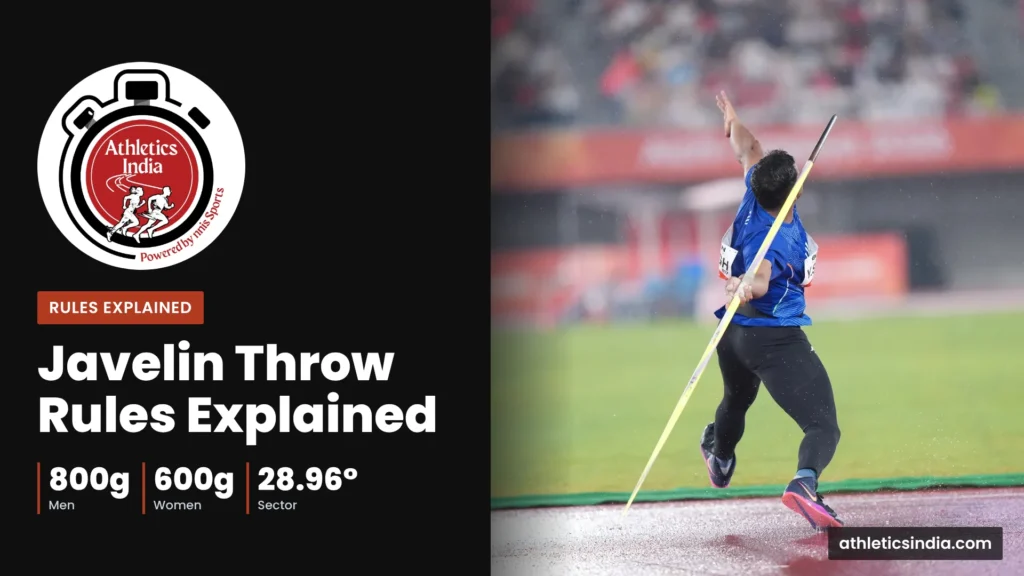
Javelin throw rules ask for three things. The athlete must hold the javelin by its grip and throw it over the shoulder. The metal tip must then land first, inside a 28.96-degree sector. Finally, officials measure from the tip’s first mark back to the inside edge of the arc.
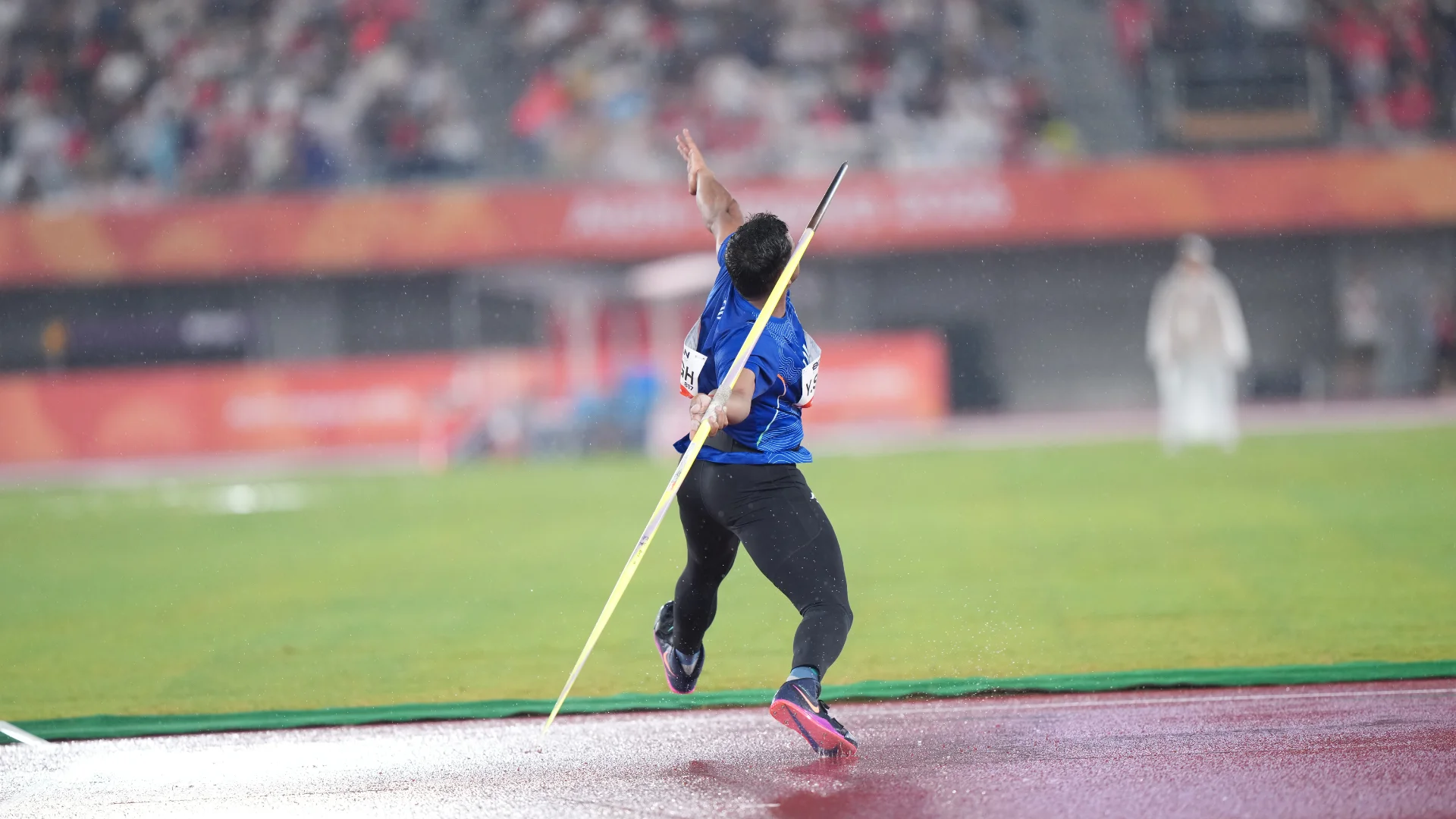
These rules decide medals. For example, at the Asian Games in Nagoya, rain fell all evening and the runway never dried. So this guide explains the rules in plain language. It also covers the javelin weights that Indian athletes use from under-14 to senior level.
Javelin throw rules: quick facts
- Javelin weight: 800g for men, 600g for women
- Runway: at least 30m long and 4m wide
- Throwing arc: curved line with an 8m radius
- Landing sector: 28.96 degrees
- Valid landing: the tip of the metal head must strike the ground first
- Time per attempt: 1 minute
- Attempts: three each, then three more for the top eight
Jump to: How to throw Runway and sector Fouls Measurement Weights by age Attempts and time For young throwers
How a legal throw is made under javelin throw rules
The athlete must hold the javelin at its cord grip with one hand. In addition, the throw must go over the shoulder or the upper part of the throwing arm. The rules also ban slinging, hurling and any non-orthodox style.
There is also a rule about turning. From the start of the run-up until release, the athlete must not turn completely around. In other words, the back cannot face the throwing arc at any point. It stops the spinning technique used in the discus.
The runway, arc and sector
Unlike the shot put or discus, the javelin uses a long runway instead of a circle. The athlete runs between two parallel white lines and throws from behind a curved arc.
| Area | Rule |
|---|---|
| Runway length | At least 30m; 36.5m where conditions allow |
| Runway width | 4m between two 5cm white lines |
| Throwing arc | 7cm wide, with a radius of 8m |
| Sector angle | 28.96 degrees |
| Sector lines | 5cm wide; if extended, they meet at the centre of the arc’s circle |
The odd sector angle has a simple reason. It is the angle at which the sector lines pass through both ends of the arc. As a result, both lines point back to the same centre point, which officials also use for measuring.
When a javelin throw is a foul
Under the javelin throw rules, an attempt is a foul in any of these cases. Officials then raise a red flag, while a valid throw gets a white flag.
| Foul | What it means |
|---|---|
| Tip does not land first | Any part of the javelin touches the ground before the tip of the metal head |
| Outside the sector | The tip lands on a sector line or outside it |
| Touching the lines | The athlete touches the arc, the side lines or the ground beyond them |
| Leaving too early | The athlete leaves the runway before the javelin lands |
| Leaving the wrong way | The athlete does not leave from behind the arc and its end lines |
| Illegal style | The javelin is slung, hurled or thrown with a full turn |
| Time limit | The attempt is not started within the time allowed |
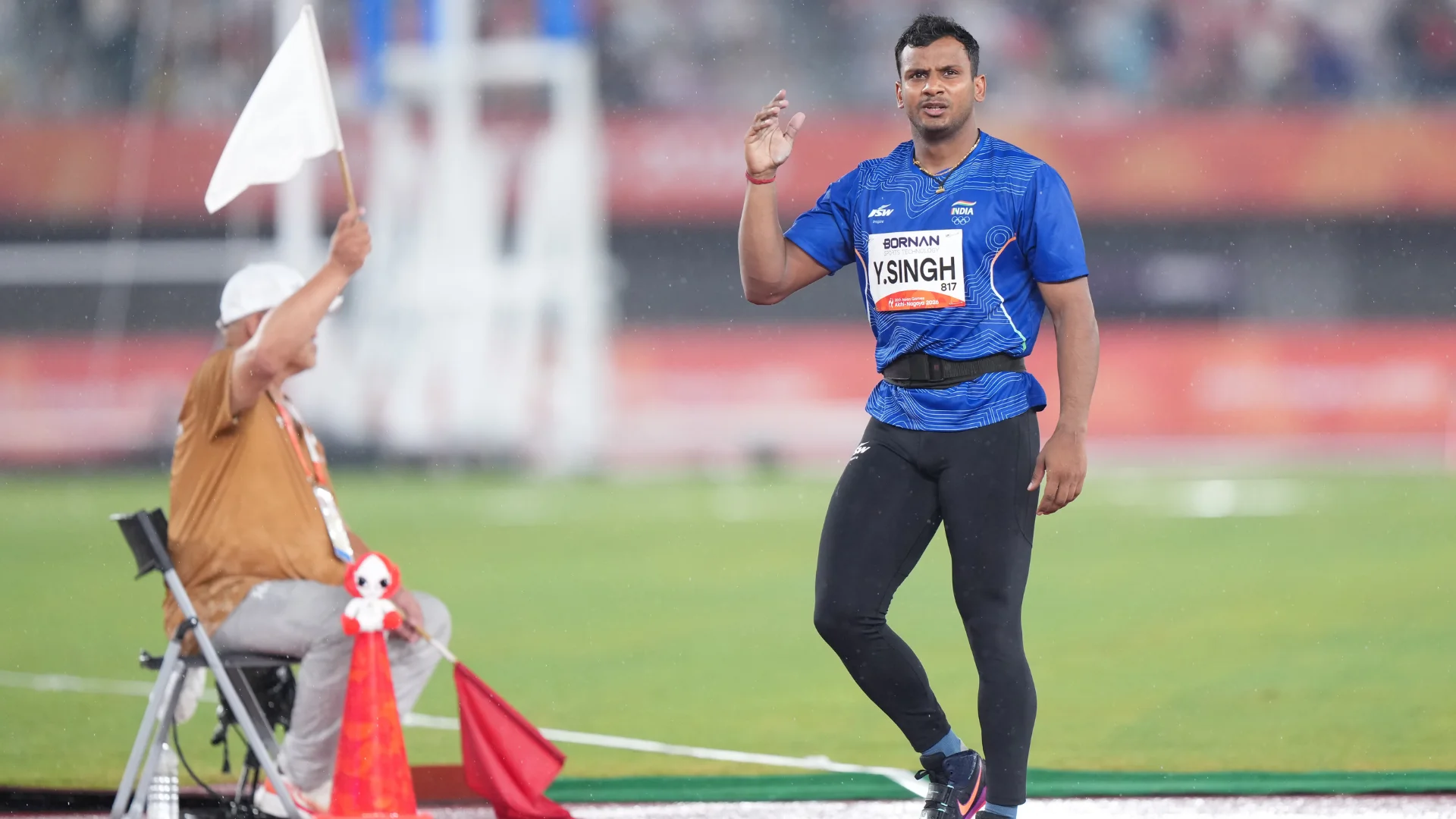
A flat landing is the most common source of debate. The javelin does not have to stick in the ground. However, the tip must strike the ground before the shaft or tail. If the tail lands first, the throw is a foul.
How the javelin throw is measured
Officials measure every valid throw straight away. The tape starts at the mark made by the tip of the metal head. Then it runs to the inside edge of the arc, along a line towards the centre of the arc’s circle. That centre point sits 8m behind the arc.
Measurement uses a steel or fibreglass tape, or an electronic device at major meets. Officials then round the distance down to the nearest centimetre. So a throw of 85.728m becomes 85.72m, never 85.73m.
Javelin throw rules on weight for each age group in India
Javelin throw rules change with age. Younger athletes use lighter javelins, and the youngest use a shorter run-up. The table below follows the Athletics Federation of India (AFI) specifications for its 2025 National Junior Championships.
| Age group | Boys / men | Girls / women | Note |
|---|---|---|---|
| Under-14 | Kids’ javelin | Kids’ javelin | Five-metre runway |
| Under-16 | 600g | 500g | 10m approach |
| Under-18 | 700g | 500g | Full runway |
| Under-20 | 800g | 600g | Same as senior |
| Senior | 800g | 600g | Full runway |
The jumps in weight matter for coaching. For instance, an under-18 boy moves from 700g to 800g at under-20 level. Therefore, distances often dip for a season while the athlete adapts to the heavier javelin.
Number of attempts and time limits
When more than eight athletes compete, each gets three attempts. After that, the best eight get three more. With eight or fewer athletes, everyone gets six attempts. An athlete has one minute to start each attempt. However, when the same athlete throws twice in a row, the limit is two minutes.
To break a tie, officials compare the second-best throw, then the third-best, and so on. Some meetings also use their own formats. At the Doha Diamond League in 2026, for example, only the top three after five rounds got a sixth throw.
What javelin throw rules mean for young Indian throwers
For athletes and families, three rules deserve extra attention. First, the rules ban gloves and taping two or more fingers together. Second, every throw must leave the runway correctly, even after a big release. Third, the shorter approach for under-16 athletes rewards technique over run-up speed.
The standard keeps rising. At the National Junior Championships 2026, Minakshi of Haryana set a girls’ under-16 record of 54.40m. At senior level, Neeraj Chopra holds the men’s national record of 90.23m. Meanwhile, Annu Rani holds the women’s record of 63.82m.
Both marks already meet the LA28 Olympic entry standards. Still, a record means nothing if the throw is a foul. Clean technique within the rules comes first.
Update note: this guide reflects World Athletics Technical Rules as applied in AFI competitions, checked on 14 November 2026. We will update it if the rules or AFI age-group weights change.