




After losing the Sportspersons of Outstanding Merit election, the IOA president has found another route into the electoral college. Documents examined by Athletics India reveal competing claims over ice hockey’s administration, questions about federation membership and the limits of the electoral officer’s decision.
ATHLETICS INDIA | SPECIAL REPORT | NOVEMBER 16, 2026
P.T. Usha’s political survival at the Indian Olympic Association (IOA) has taken an extraordinary turn. The legendary sprinter suffered a major setback after losing the Sportspersons of Outstanding Merit (SOM) election. However, she is now firmly back in contention for another presidential term.
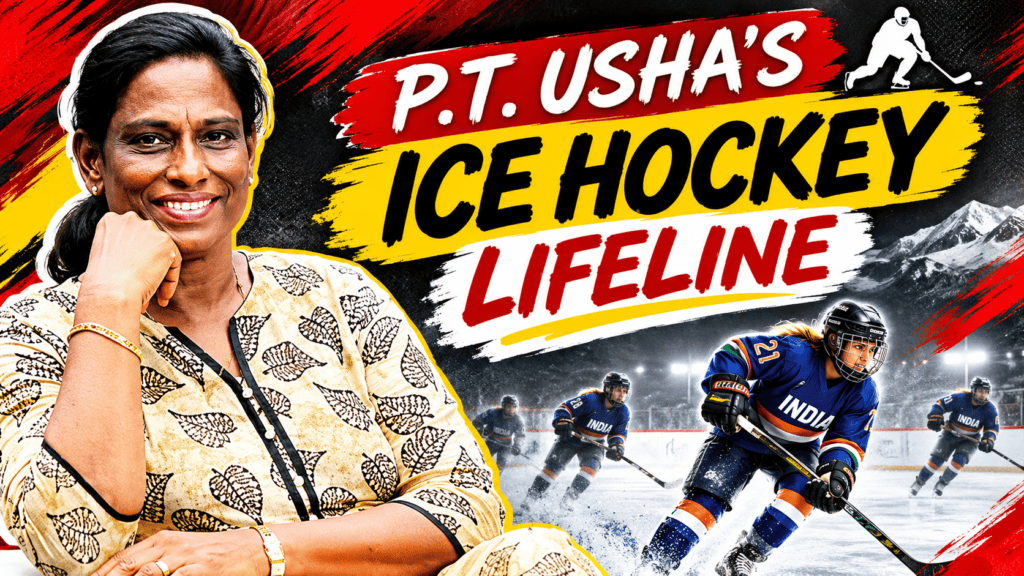
Her route back? Ice hockey.
On November 15, Electoral Officer Sanjay Kumar Srivastava rejected objections to Usha’s nomination. The Ice Hockey Association of India (IHAI) had nominated her as its female representative. The decision clears her path into the final electoral college for the December 5 IOA elections.
The decision marks a significant victory for Usha. However, documents examined by Athletics India reveal a wider controversy. It extends beyond one candidate’s eligibility. The dispute raises questions about national sports federation governance, competing claims of legitimacy and electoral power in Indian sport.
From defeat to an unlikely comeback
The political drama began with Usha’s unexpected defeat in the women’s SOM election.
The IOA planned to elect four women to its General Assembly through the SOM route. Former world championships medallist Anju Bobby George topped the poll with 53 votes. Former hockey captain Rani Rampal followed with 50. Archer Dola Banerjee secured 45, while badminton star Saina Nehwal received 43.
Usha finished fifth with 40 votes.
For a sitting IOA president seeking another term, the result marked a considerable setback. Without a place in the electoral college, her chances of contesting the presidency appeared uncertain.
Then came the Ice Hockey Association of India.
The IHAI nominated Usha as its female representative, alongside secretary general Harjinder Singh. Her name appeared in the provisional electoral roll. This gave her an alternative route into the IOA’s General Assembly.
It was an unusual political manoeuvre. One of India’s most celebrated track-and-field athletes was seeking to retain her Olympic administrative position through a federation governing a winter sport.
The constitutional question
The objections centred on Article 10.4 of the IOA Constitution. It requires representatives nominated by member national sports federations to hold membership in those federations.
A faction of the IHAI challenged Usha’s membership. It argued that she did not qualify to represent the federation. Former IOA president Narinder Batra also raised objections. He sought verification of her membership application, admission date and membership category. He also questioned the constitutional provision under which the federation admitted her.
The Electoral Officer sought clarifications from the IHAI and held a hearing on November 14.
Harjinder Singh and Srinivas Kotni appeared before the election authorities. They submitted records and a notarised affidavit supporting Usha’s membership.
According to the reported decision, the federation maintained that Usha had become a member of the national body after her election as vice-president of its Kerala unit in 2023.
The IOA also clarified that membership of another sports federation did not automatically disqualify an individual from representing a different federation.
The Electoral Officer rejected the objections.
But the distinction matters: the electoral officer has accepted Usha’s eligibility for this election. That decision does not necessarily settle every underlying dispute over the federation’s internal governance.
What the documents reveal
One document submitted for examination is a letter dated December 29, 2023. The Ice Hockey Association (Kerala) sent it to the national federation’s general secretary.
The letter records that the Kerala association held its annual general meeting in Ernakulam on December 27, 2023.
According to the letter, eight of the 14 affiliated district associations attended the meeting. The attendees unanimously elected a nine-member committee.
The letter confirms that the Kerala association reported holding an election. However, the copy examined by Athletics India does not contain the elected office-bearers’ list.
Consequently, this particular document does not independently establish that Usha was elected vice-president of the Kerala unit. The federation reportedly supported that claim in its submissions to the electoral authorities. However, Athletics India has not independently examined the complete membership and election records.
This distinction matters because membership formed the central issue in the objections against her nomination.
Ice hockey’s international standing
Other documents provide stronger evidence of the national federation’s recognition within the Olympic sporting system.
On August 17, 2026, the IOA issued a letter recognising the Ice Hockey Association of India as the national governing body for ice hockey.
IOA Chief Executive Officer Raghuram Iyer signed the letter. It identified Gurpreet Singh Bakshi as president and Harjinder Singh Jindi as secretary general.
The International Ice Hockey Federation (IIHF) sent a second letter on September 23.
IIHF Director General Matti Nurminen confirmed that the Indian association met the international federation’s governance and financial requirements. He also confirmed that it remained in good standing.
Together, these documents establish the association’s recognised position within the IOA and its international federation.
However, they do not independently resolve Usha’s disputed membership. Nor do they establish the validity of every internal election conducted by the association.
IOA or IIHF recognition also does not automatically establish recognition by India’s Sports Ministry. These are separate institutional questions.
The dispute within ice hockey
The documents also point to tensions within Indian ice hockey’s administration.
On July 31, 2026, the Ice Hockey Association, Maharashtra, wrote to the police. It sought permission for a peaceful protest outside Hotel VITS Sharanam in Thane.
The association alleged that the national federation had scheduled a disputed and unauthorised election or meeting for August 2.
Maharashtra association general secretary Suraj Pawar signed the letter. He objected to the proposed proceedings and requested permission for a demonstration.
These allegations indicate that disagreements over the national body’s administration existed months before the controversy surrounding Usha’s IOA nomination.
However, the protest letter records an objection. It does not prove that the proposed election was unlawful or invalid.
Another document contains a declaration linked to a disputed August 2026 electoral process. It raises questions about participation in that process. However, the declaration does not establish wrongdoing or invalidate any election.
The available material therefore cannot resolve the larger governance dispute.
The final electoral roll
The IOA’s November 15 notification confirms that Usha’s nomination survived the scrutiny process.
Her name appears at serial number 28 as the female representative of the Ice Hockey Association of India. Harjinder Singh occupies the federation’s male seat at number 27.
The final electoral college contains 71 members. These include 60 representatives from 30 national sports federations, eight elected SOM representatives, two Athletes’ Commission representatives and IOC member Nita Ambani.
Former AFI president Adille Sumariwalla and Olympic medallist Jyotirmoyee Sikdar represent the Athletics Federation of India.
The roll also includes prominent names such as Gagan Narang, Rahul Bose, Kalyan Chaubey, Rajeev Mehta, Virendra Sachdeva and Anju Bobby George.
Importantly, a place on the electoral roll does not guarantee election as IOA president.
Candidates must still submit their nomination papers between November 22 and 24. The authorities will then conduct scrutiny and allow withdrawals. They will publish the final candidate list before polling on December 5.
A victory for Usha, a question for Indian sport
The immediate political implications are clear.
Usha has survived what appeared to be a potentially fatal setback to her re-election ambitions. She lost the SOM election but retained her place in the electoral college through another recognised federation.
According to reports, her opponents may still challenge the decision in court.
But the larger issue goes beyond Usha.
The IOA Constitution allows national sports federations to nominate their representatives, subject to eligibility requirements. The controversy shows how these provisions can create opportunities for established sporting personalities. They can enter the electoral college through federations outside their primary sports.
That may be constitutionally permissible. However, whether it reflects the intended spirit of athlete representation and sound sporting governance remains a separate question.
For Indian athletics, the symbolism is striking. Usha, one of the country’s greatest track athletes, did not receive a nomination from the Athletics Federation of India. Instead, ice hockey has provided her route to another term at the helm of the Olympic movement.
The electoral officer has answered the immediate question of eligibility. However, a more difficult question remains: Do India’s sporting electoral structures adequately reflect accountability, transparency and genuine representation?
With the IOA elections scheduled for December 5, that debate is unlikely to disappear.