




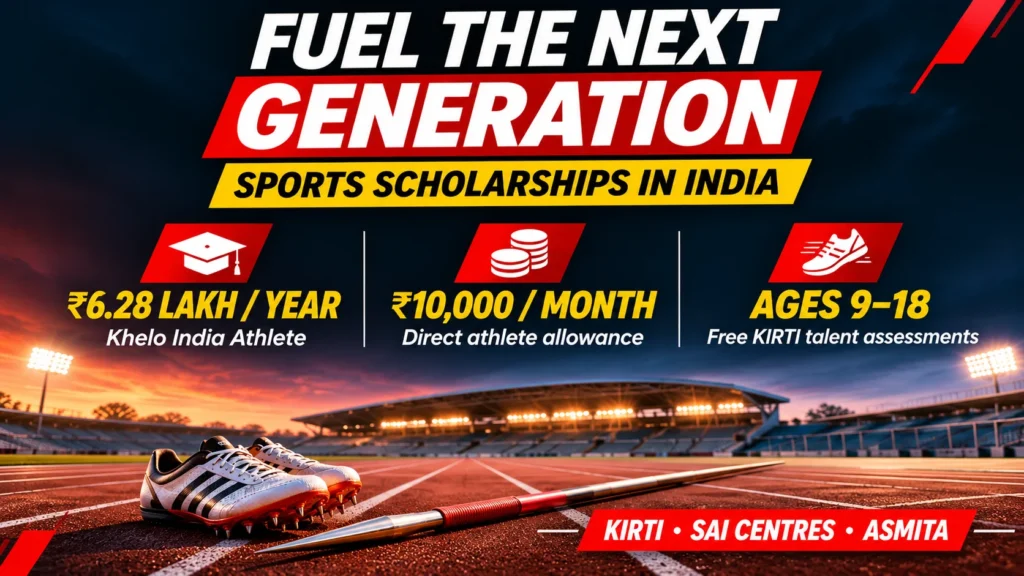
Sports scholarships for children in India are opening new opportunities for young athletes, with government programmes offering free coaching, residential training, talent assessments and financial support. From the Khelo India Athlete scholarship to SAI Training Centres and KIRTI, parents now have several pathways to help their children pursue sports.
This Children’s Day guide explains every major sports scholarship and government scheme open to Indian children: what each one pays, who is eligible and exactly how a child gets in. Every figure has been checked against Ministry of Youth Affairs and Sports (MYAS) and Sports Authority of India (SAI) documents, Parliament answers and PIB publications where possible. Where an amount depends on selection, category or a yearly notification, we say “approx” or “around”. The fact-check table at the end shows the status of each claim.
Sports schemes for children at a glance
- Khelo India Athlete scholarship: around ₹6.28 lakh a year, including ₹10,000 a month to the athlete’s bank account, for up to 8 years (children are scouted, they cannot apply)
- KIRTI talent hunt: free fitness and skill assessments for school children aged 9 to 18
- SAI Training Centres (STC): free boarding, kit, education support and training for juniors aged about 10 to 18, through open trials
- SAI National Centres of Excellence (NCOE): elite residential training for top juniors
- ASMITA leagues: free competitions for girls in Under-13, 13 to 18 and 18+ groups
- Khelo India Youth Games 2026: 11 to 22 December 2026, Telangana
- Later rungs: TOPS (₹25,000 to ₹50,000 a month), ONGC scholarship, GoSports Foundation
Jump to: Neeraj’s start The pathway KIRTI Khelo India scholarship SAI centres ASMITA KIYG 2026 TOPS Other scholarships Parents’ checklist Fact check
How Neeraj Chopra began: a 13-year-old trying to lose weight
India’s most famous athlete did not start with a scholarship. He started on a public ground.
Neeraj Chopra was born on 24 December 1997 in Khandra village, Panipat district, Haryana. By 13 he was overweight and teased for it, so in 2011 his uncle began taking him to Panipat’s Shivaji Stadium, about 15 km from the village, to run and lose weight. He was not interested in running. He saw senior athletes throwing the javelin, wanted to try, and never stopped.
- 2021: Olympic gold at Tokyo 2020, India’s first Olympic gold in athletics.
- 2023: World champion in Budapest with 88.77 m.
- 2024: Olympic silver in Paris.
- May 2025: First throw past 90 m, 90.23 m at the Doha Diamond League.
- September 2025: 8th at the World Championships in Tokyo, ending a long podium streak.
- 2026: Commonwealth Games silver in Glasgow; an ankle ligament tear then ruled him out of the Asian Games.
In his absence, Yash Vir Singh and Rohit Yadav won Asian Games javelin silver and bronze in Nagoya on 28 September 2026. A generation that grew up watching Neeraj is already winning medals. The lesson for parents: a child needs a ground, a coach and a chance. The schemes below are built to provide all three.
How the pathway works: from the school ground to the national camp
There is no single form that gets a child into Indian sport. Every route runs through tests and competition results, and each rung opens the next.
A child can join at any rung, for example going straight to an SAI trial with good district results. The two things that matter at every step are verified age documents and a record of competition results.
KIRTI: the talent hunt for school children aged 9 to 18
KIRTI (Khelo India Rising Talent Identification) is the government’s entry gate for school children. It tests children aged 9 to 18 at notified Talent Assessment Centres and flags those with potential for further training. It was launched on 12 March 2024 in Chandigarh. The first phase covered 50 centres and about 50,000 applicants across 10 sports, including athletics, boxing, wrestling, hockey and football. The target is around 20 lakh assessments a year.
KIRTI costs the family nothing. It is a free assessment, not a cash scholarship. Children who stand out are referred into the training system, such as Khelo India Centres, SAI centres or accredited academies.
- Step 1: Watch for KIRTI notices from your state sports department, district sports officer or nearest SAI regional centre.
- Step 2: Register the child as the notice instructs (through the Khelo India / KIRTI app or the on-site desk).
- Step 3: Carry age proof (birth certificate or Aadhaar), a school ID, and sports clothes and shoes.
- Step 4: Attend on the given date. Results and referrals are communicated by the organisers.
Khelo India Athlete scholarship: around ₹6.28 lakh a year for up to 8 years
This is the biggest scholarship open to young Indian athletes. A child selected as a Khelo India Athlete (KIA) gets a support package of about ₹6.28 lakh a year. Of this, ₹1.20 lakh (₹10,000 a month) goes straight to the athlete’s bank account. The rest pays for training, coaching, food, lodging, education, equipment, medical insurance and competition exposure at the academy where the child trains.
On a phone, swipe the table sideways to see every column.
| What the athlete gets | Amount (approx) |
|---|---|
| Out-of-pocket allowance (OPA), paid by direct benefit transfer | ₹10,000 a month (₹1.20 lakh a year) |
| Training, coaching, boarding, diet, education, kit, insurance (spent through the academy) | around ₹5 lakh a year |
| Total package | around ₹6.28 lakh a year (PIB states ₹6,28,400) |
| Duration | up to 8 years, reviewed on performance |
As of April 2026, 2,905 Khelo India Athletes across 22 disciplines were receiving this package, and 322 academies were accredited to train them.
You cannot apply for it. The official Khelo India guide states that athletes cannot apply directly to become a KIA. A Talent Identification and Development Committee (TIDC) scouts children at the National School Games (run by the School Games Federation of India), National Championships of each sports federation, state and district leagues, and the Khelo India Youth Games and University Games.
- Shortlisting: scouts pick athletes on tournament rank and physical potential, and ask them to fill the Players Basic Information Form (PBIF).
- Assessment camp: skill tests, physical fitness tests, and medical and age-verification tests.
- Final induction: based on the sport’s approved protocol, camp scores and competition results. Selected athletes join a Khelo India Accredited Academy or a SAI National Centre of Excellence.
Do this today: register on NSRS. The National Sports Repository System works as a child’s digital sports resume. Create a profile at nsrs.kheloindia.gov.in to get a unique NSRS ID, then upload age proof (Aadhaar or birth certificate), the sports discipline, and past achievements and certificates.
Older guides often say “₹5 lakh a year”. That figure is the training part only. With the allowance, the package is about ₹6.28 lakh.
SAI Training Centres and National Centres of Excellence
Unlike the Khelo India scholarship, SAI centres hold open selection trials that a child can simply turn up for. Selected trainees get free boarding, lodging and coaching.
On a phone, swipe the table sideways to see every column.
| SAI Training Centre (STC) | National Centre of Excellence (NCOE) | |
|---|---|---|
| Who it is for | Junior athletes scouted from the grassroots | The best juniors and potential national-team athletes |
| Age (approx) | 10 to 18 years, varies by sport and trial | Set per trial, e.g. 16–21 for athletics (2022); U-15 to U-23 for wrestling (2024) |
| How to get in | Open selection trials notified by the centre | Open national trials plus results at nationals |
| What is provided | Boarding, sports kit, stipend, competition exposure, education expenses, medical, insurance | Free boarding and lodging, expert coaches, nutrition, sports science |
| Run by | SAI with the state government | SAI |
Selection is based on age verification, a battery of fitness tests, a skill test in the sport and medical fitness. Most trial notices also say:
- Boarding and lodging are not provided during the trials. Families pay their own travel and stay.
- Children must bring their own equipment, running shoes and tracksuit.
- Report at the stated time; late arrivals may not be tested.
- Carry original age proof and sports achievement certificates, plus education certificates where asked.
Trial dates vary by sport and centre. Recent SAI notices have appeared in January, February, August and October, so check the notices section of sportsauthorityofindia.gov.in, SAI’s social media handles and your nearest SAI regional centre every few weeks.
ASMITA: free leagues that put girls on the scouting map
ASMITA (Achieving Sports Milestone by Inspiring Women Through Action), earlier called the Khelo India Women’s League, runs competitions only for girls and women. It does not pay a stipend. Its value is competition experience and results that scouts can see.
- Age groups: Under-13, 13 to 18, and 18+ (some sports use their own bands, such as U-14 and U-16 in athletics).
- Scale: 852 leagues across 15 sports were planned for 2025–26.
- Biggest single day: a nationwide athletics league on 8 March 2026 at 250 locations, with around 2.5 lakh women expected.
- How to enter: ask your district sports association or district sports officer for the next ASMITA league in your daughter’s sport, and carry age proof.
Khelo India Youth Games 2026: Telangana, 11–22 December
The eighth Khelo India Youth Games (KIYG) open in Telangana on 11 December 2026, less than a month after Children’s Day. This is the single biggest stage where Khelo India scholarship scouts watch young athletes.
- Dates: 11 to 22 December 2026 (12 days)
- Venues: mainly Hyderabad, with events in Hanamkonda, Karimnagar, Nizamabad, Mahabubnagar and Khammam
- Sports: 27 medal sports plus sailing as a demonstration sport
- Athletes: around 6,000, with about 1,800 support staff
- Last edition: Bihar, 3–15 May 2025; Maharashtra topped the table with 58 gold, 47 silver and 53 bronze
There is no open entry. Athletes qualify through their state teams, usually on results at national-level championships or state selection events. Follow your state sports department and your sport’s state association for selection notices.
TOPS: where the ladder leads
The Target Olympic Podium Scheme (TOPS) is not for beginners, but parents should know it is the top of the ladder. It funds athletes the Mission Olympic Cell (MOC) judges capable of Olympic medals. There is no public application form.
On a phone, swipe the table sideways to see every column.
| TOPS group | Monthly allowance | Other support |
|---|---|---|
| Core Group | ₹50,000 | Full cost of the approved training plan: foreign coaches, training abroad, equipment, competitions |
| Development Group | ₹25,000 | Training and competition support for younger prospects |
The wider policy behind all of this is the Khelo Bharat Niti 2025 (National Sports Policy 2025), approved by the Union Cabinet on 1 July 2025. It replaces the 2001 policy and stresses early talent identification at the grassroots.
PSU and private scholarships for teenagers
Once a child has state or national results, a few organisations pay monthly scholarships through open online applications. Amounts and rules change every cycle, so treat these figures as approximate and always read that year’s notification.
ONGC Sports Scholarship: in the 2025–26 cycle it was open to Indian sportspersons aged 15 to 20 (born 1 April 2005 to 1 April 2010), with priority for economically weaker applicants. Monthly amounts were ₹15,000 / ₹20,000 (Sub-Junior, national / international), ₹20,000 / ₹25,000 (Junior) and ₹25,000 / ₹30,000 (Senior). Selection used a points table based on results and rankings. Applications ran from 15 September to 14 October 2025 at sportsscholarship.ongc.co.in, with two age proofs required. Scholarship listing sites report that the 2026–27 cycle was redesigned for older athletes at around ₹40,000 to ₹70,000 a month; we could not confirm this on an ONGC document.
GoSports Foundation: a Bengaluru-based non-profit, set up in 2008, that supports junior Olympic and Paralympic athletes. It says it backs more than 200 athletes. Support is tailored to each athlete rather than a fixed sum. Calls for applications are posted on gosportsfoundation.in.
“National Sports Scholarship Scheme 2026–27”: verify first. Telangana Today reported in July 2026 a scheme for athletes aged 8 to 23 paying around ₹6,000 to ₹20,000 a month, with a 31 July deadline. We could not find a matching MYAS or SAI notification. Confirm on official websites before sharing documents, and never pay a fee to apply for a government sports scholarship.
State schemes: most states run their own sports scholarships and cash awards. Ask your state sports department or district sports officer, and search the myScheme portal for your state.
Parents’ checklist: what to keep ready and what to do next
Documents to keep in one folder
- Birth certificate (the main age proof; age checks at trials are strict)
- Child’s Aadhaar card
- A second age proof where possible: Class 10 certificate or passport
- School bonafide certificate or school ID
- Every sports certificate and result sheet, with dates
- Passport-size photographs
- Bank account in the athlete’s name, linked to Aadhaar
- Medical fitness certificate
- Family income certificate, for scholarships that prioritise lower-income families
- Age 8–12, play and get tested: join the nearest Khelo India Centre, school team or club; take part in KIRTI assessments; girls can enter ASMITA Under-13 leagues.
- Age 10–14, get on record: enter district and state championships and create an NSRS profile with every certificate uploaded.
- Age 12–18, trials and nationals: attend SAI STC trials; aim for School Games and federation sub-junior and junior nationals.
- Age 14–18, the KIYG step: push for your state’s Khelo India Youth Games team, where Khelo India scholarships are often won.
- Age 15–20, add other scholarships: watch for ONGC and similar PSU scholarships and GoSports Foundation calls; check whether a new scholarship requires giving up an existing one.
Red flags: anyone who asks for money to “guarantee” a Khelo India or SAI selection; application links not on a .gov.in, .nic.in or official PSU domain; and age fraud, which age-verification tests are designed to catch and which can end a child’s career.
Fact check: how we verified this guide
On a phone, swipe the table sideways to see every column.
| Claim | Status | Sources |
|---|---|---|
| Khelo India package ₹6.28 lakh/yr incl. ₹1.20 lakh OPA (₹10,000/month) | Verified | Rajya Sabha answer (28 Nov 2024); SAI release; PIB New India Samachar (April 2026) |
| Athletes cannot apply directly; scouted by TIDC; NSRS registration | Verified | Khelo India: “How to become a Khelo India Athlete” |
| 1,067 Khelo India Centres; 322 academies; 2,905 KIAs | Verified | PIB New India Samachar (April 2026) |
| KIRTI ages 9–18; launched 12 March 2024 | Verified | SAI press release; Outlook |
| STC ages 10–18 and facilities; NCOE trial rules | Verified | SAI STC page; SAI trial notices (2022, 2024) |
| TOPS ₹50,000 Core / ₹25,000 Development | Verified | Rajya Sabha answer (13 Feb 2025); PIB New India Samachar |
| KIYG 2026: 11–22 Dec, Telangana, 27 sports | Verified | Telangana Today; MyKhel |
| ASMITA age groups and 852 leagues in 2025–26 | Verified | News On AIR; MyKhel; AIFF |
| ONGC 2025–26 ages and amounts | Verified | ONGC terms and conditions; ONGC letter to Badminton Association of India |
| ONGC 2026–27 redesign (around ₹40,000–70,000/month) | Not confirmed | Scholarship listing sites only |
| National Sports Scholarship Scheme 2026–27 | Single source | Telangana Today (no MYAS/SAI notification found) |
| Neeraj Chopra’s start at 13, Shivaji Stadium, 2011 | Verified | Wikipedia; Hindustan Times; PTI |
| Neeraj’s 2025–26 results and Asian Games injury | Verified | The Bridge; Outlook; Khel Now; World Athletics |
All figures checked on 17 November 2026. Government amounts can be revised; check the official portal before applying. KIA = Khelo India Athlete; OPA = out-of-pocket allowance; TIDC = Talent Identification and Development Committee; NSRS = National Sports Repository System.