





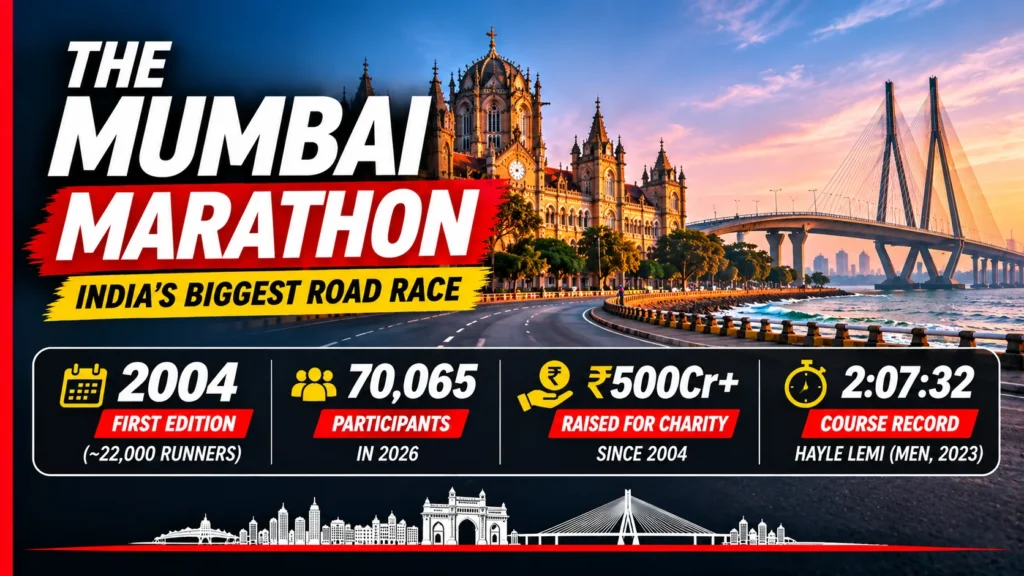
Every January, Mumbai gives its roads to runners. Tens of thousands of people set off from outside Chhatrapati Shivaji Maharaj Terminus, run along Marine Drive and across the Bandra–Worli Sea Link, and turn a working city into a running festival. Since 2004, the Mumbai Marathon has grown into India’s biggest road race and the event that started the country’s running boom.
This is the history of the Mumbai Marathon: how it began, how it grew from about 22,000 runners to more than 69,000, the champions and course records, the Indian runners who made their names on its streets, and its role as India’s biggest charity platform. Every fact has been checked against at least two sources where possible, and the fact-check table at the end shows the status of each claim.
Mumbai Marathon at a glance
- First held: 2004, as the Standard Chartered Mumbai Marathon
- Organiser: Procam International
- Title sponsor: Standard Chartered (2004 to 2017), Tata Group (since 2018)
- Status: World Athletics Gold Label road race
- Course records: Hayle Lemi, 2:07:32 (men); Anchialem Haymanot, 2:24:15 (women), both Ethiopia, 2023
- 2026 edition: 21st edition, 18 January 2026, about 70,000 participants
- Next edition: 22nd edition, 17 January 2027
Jump to: The beginning Timeline The course Course records All winners Indian runners Charity 2026 edition Fact check
How the Mumbai Marathon began
The Mumbai Marathon was created by Procam International, a Mumbai sports management company run by Anil and Vivek Singh. Inspired by the London Marathon, Procam believed Mumbai could support a big-city road race of the same kind. Its founding idea was simple: every great city in the world must have a marathon.
The first edition was held in 2004 as the Standard Chartered Mumbai Marathon, with about 22,000 participants. It raised around ₹1.44 crore for charity in its first year. South Africa’s Hendrick Ramaala won the first men’s race in 2:15:47, and Poland’s Wioletta Uryga won the women’s race in 2:47:53.
Mumbai Marathon timeline: the key moments
- 2004: The first Standard Chartered Mumbai Marathon, with about 22,000 participants.
- 2009 and 2010: The race earned an IAAF (now World Athletics) Silver Label in 2009 and a Gold Label in 2010.
- 2012: Ram Singh Yadav ran 2:16:59 in Mumbai to qualify for the London Olympics.
- 2013: The Gold Label was withdrawn. The same year, Kenya’s Valentine Kipketer ran 2:24:33, at the time the fastest women’s marathon ever run in India.
- 2017: Standard Chartered’s 14th and last year as title sponsor, with about 42,000 runners.
- 2018: The race became the Tata Mumbai Marathon under a 10-year sponsorship deal with Tata Group and Tata Consultancy Services. It regained a Silver Label.
- 2019: The race returned to Gold Label status.
- 2021 and 2022: No race was held, because of the COVID-19 pandemic.
- 2023: Ethiopia’s Hayle Lemi (2:07:32) and Anchialem Haymanot (2:24:15) set the current course records.
- 2024: A record ₹72 crore was raised for charity by 268 NGOs.
- 2026: The 21st edition drew about 70,000 participants, the biggest field in the race’s history.
- 2027: The 22nd edition is scheduled for 17 January 2027.
The Mumbai Marathon course
The marathon starts opposite Chhatrapati Shivaji Maharaj Terminus (CSMT), the UNESCO-listed railway station in south Mumbai. It runs past Flora Fountain, along Marine Drive and Chowpatty, past Haji Ali and Mahim Church, and over the Bandra–Worli Sea Link, before turning back into the city.
Runners say the hardest stretch is Peddar Road, a long climb late in the race. The humidity of a Mumbai morning also makes fast times hard to run. That is why the course records, while quick, are slower than those of the flat, cool marathons of Europe and Asia.
The event also includes a half marathon, a 10K, the Dream Run, a Senior Citizens’ Run and a race for Champions with Disability.
Mumbai Marathon course records
On a phone, swipe the table sideways to see every column.
| Category | Athlete | Time | Year |
|---|---|---|---|
| Men | Hayle Lemi (Ethiopia) | 2:07:32 | 2023 |
| Women | Anchialem Haymanot (Ethiopia) | 2:24:15 | 2023 |
Haymanot’s record broke Valentine Kipketer’s 2:24:33, which had stood since 2013. Hayle Lemi came back to win again in 2024 in 2:07:50, making him one of only two men to win the race twice, along with Kenya’s John Kelai (2007 and 2008).
Every Mumbai Marathon winner (2004 to 2026)
East Africa has dominated the elite races. Ethiopia leads with 23 titles (7 men’s and 16 women’s), and Kenya has 13 (10 men’s and 3 women’s). Ethiopia’s Mulu Seboka is the most successful runner in the race’s history, with three women’s titles.
On a phone, swipe the table sideways to see every column.
| Year | Men’s winner | Women’s winner |
|---|---|---|
| 2004 | Hendrick Ramaala (RSA), 2:15:47 | Wioletta Uryga (POL), 2:47:53 |
| 2005 | Julius Sugut (KEN), 2:13:20 | Mulu Seboka (ETH), 2:35:03 |
| 2006 | Daniel Rono (KEN), 2:12:03 | Mulu Seboka (ETH), 2:33:15 |
| 2007 | John Kelai (KEN), 2:12:27 | Yang Fengxia (CHN), 2:36:16 |
| 2008 | John Kelai (KEN), 2:12:23 | Mulu Seboka (ETH), 2:30:04 |
| 2009 | Kenneth Mugara (KEN), 2:11:51 | Kebebush Haile (ETH), 2:34:08 |
| 2010 | Denis Ndiso (KEN), 2:12:40 | Bizunesh Urgesa (ETH), 2:31:09 |
| 2011 | Girma Assefa (ETH), 2:09:54 | Koren Jelela (ETH), 2:26:56 |
| 2012 | Laban Moiben (KEN), 2:10:48 | Netsanet Achamo (ETH), 2:26:12 |
| 2013 | Jackson Kiprop (UGA), 2:09:32 | Valentine Kipketer (KEN), 2:24:33 |
| 2014 | Evans Rutto (KEN), 2:09:33 | Dinknesh Mekash (ETH), 2:28:08 |
| 2015 | Tesfaye Abera (ETH), 2:09:46 | Dinknesh Mekash (ETH), 2:30:00 |
| 2016 | Gideon Kipketer (KEN), 2:08:35 | Shuko Genemo (ETH), 2:27:50 |
| 2017 | Alphonce Simbu (TAN), 2:09:32 | Bornes Kitur (KEN), 2:29:02 |
| 2018 | Solomon Deksisa (ETH), 2:09:34 | Amane Gobena (ETH), 2:25:49 |
| 2019 | Cosmas Lagat (KEN), 2:09:15 | Worknesh Alemu (ETH), 2:25:45 |
| 2020 | Derara Hurisa (ETH), 2:08:09 | Amane Beriso (ETH), 2:24:51 |
| 2021 and 2022 | Not held (COVID-19) | |
| 2023 | Hayle Lemi (ETH), 2:07:32 (CR) | Anchialem Haymanot (ETH), 2:24:15 (CR) |
| 2024 | Hayle Lemi (ETH), 2:07:50 | Abersh Minsewo (ETH), 2:26:06 |
| 2025 | Berhane Tesfay (ERI), 2:11:44 | Joyce Chepkemoi (KEN), 2:24:56 |
| 2026 | Tadu Abate Deme (ETH), 2:09:55 | Yeshi Kalayu Chekole (ETH), 2:25:13 |
CR = course record. Country codes: ETH Ethiopia, KEN Kenya, RSA South Africa, POL Poland, CHN China, UGA Uganda, TAN Tanzania, ERI Eritrea.
Indian runners at the Mumbai Marathon
The race has a separate Indian elite category with its own prize money, which gives the country’s best distance runners a reason to race at home against a world-class field. In 2026, the top three Indian men and women won ₹5 lakh, ₹4 lakh and ₹3 lakh.
Mumbai has also been a launch pad for Indian Olympians. In 2012, Ram Singh Yadav ran 2:16:59 in Mumbai to qualify for the London Olympics.
The 2026 Indian elite titles went to two surprise winners. Kartik Karkera, an orthopaedic surgeon, won the men’s race in a personal best of 2:19:55, ahead of Anish Thapa (2:20:08) and Pradeep Chaudhary (2:20:49). Sanjivani Jadhav won the women’s race in 2:49:02, just ahead of Nirmaben Thakor (2:49:13) and Sonam (2:49:24).
India’s biggest charity platform
The Mumbai Marathon is not only a race. With United Way Mumbai as its philanthropy partner, it has become India’s largest platform for charity fundraising. Runners raise money for NGOs, and companies enter teams to support causes.
- 2004: about ₹1.44 crore raised in the first year.
- 2017: about ₹32.9 crore raised, with more than ₹190 crore raised across the race’s first 14 years.
- 2024: a record ₹72 crore raised by 268 NGOs.
- 2026: ₹60.68 crore raised for about 309 NGOs, with 13,580 runners fundraising and around 28,000 donors.
- Total: more than ₹500 crore since 2004.
The 2026 Mumbai Marathon: an Ethiopian double
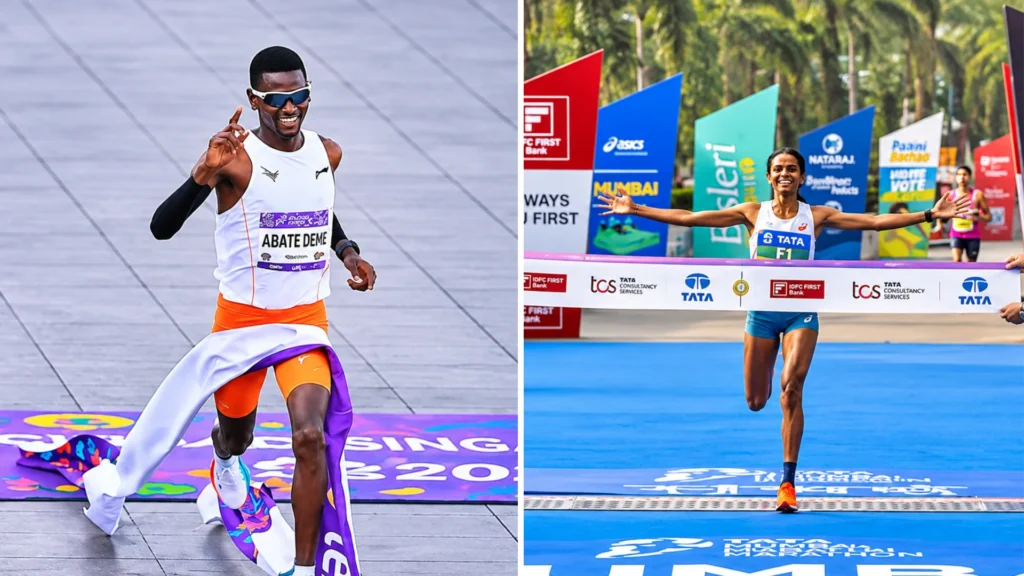 Ethiopia won both elite titles at the 2026 Tata Mumbai Marathon.
The 21st edition, on 18 January 2026, was the biggest yet, with 70,065 participants (65,424 running on the day and 4,641 online). Ethiopia won both elite races, the seventh time in the event’s history that one country has taken both titles.
- Men: Tadu Abate Deme (Ethiopia) won in 2:09:55, ahead of Leonard Kiprotich Langat (Kenya, 2:10:10) and Merhawi Kesete (Eritrea, 2:10:22).
- Women: Yeshi Kalayu Chekole (Ethiopia) won in 2:25:13, the fifth-fastest women’s winning time in the race’s history. Gojjam Tsegaye Enyew (Ethiopia) was third in 2:28:27.
The elite winners each took home $50,000 (about ₹45 lakh). The 22nd edition will be held on 17 January 2027, again starting from CSMT, with a total prize purse of $389,524.
Fact check: how we verified this history
On a phone, swipe the table sideways to see every column.
| Claim | Status | Sources |
|---|---|---|
| Started in 2004 by Procam; Standard Chartered until 2017; Tata from 2018 (10-year deal) | Verified | Wikipedia; Procam; BestMediaInfo; Devdiscourse |
| Course records (Lemi 2:07:32, Haymanot 2:24:15, 2023) | Verified | Wikipedia; Athletics Illustrated |
| 2026 winners, times and podiums | Verified | Watch Athletics; Marathons.com; Wikipedia; Free Press Journal |
| 2026 participants: 70,065 | Sources differ slightly | Marathons.com (70,065); Free Press Journal (“over 69,000”) |
| Charity totals (₹72 crore in 2024; ₹60.68 crore in 2026; ₹500 crore+ overall) | Verified | Procam; Free Press Journal |
| 2004 and 2017 participant and fundraising figures; label history | Single source | Wikipedia (current Gold Label status confirmed by Procam and Watch Athletics) |
| Full list of winners 2004 to 2025 | Single source | Wikipedia (2013, 2019, 2023 and 2024 results also in news reports) |
| Ram Singh Yadav’s 2012 Olympic qualifying run | Single source | Wikipedia |
| 2027 date (17 January) and prize purse | Verified | Devdiscourse; LatestLY (ANI) |