




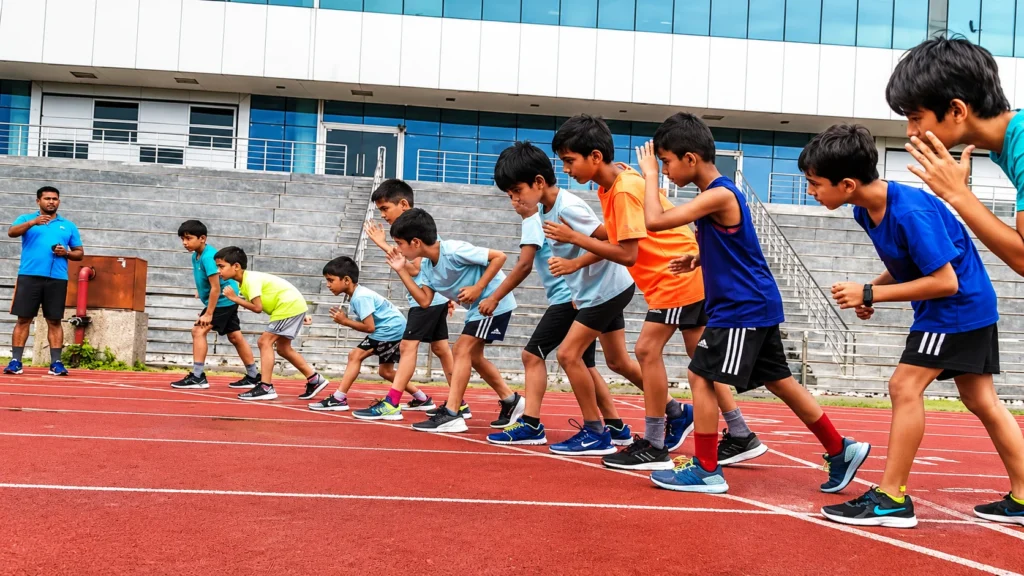
Although India has no shortage of raw sporting talent, identifying promising athletes early and supporting them with structured facilities remains a major hurdle. To address this gap, SAI runs the National Sports Talent Contest (NSTC). Launched in 1985, the scheme scouts children between 8 and 14 years old and provides them with scientific coaching, financial support, and competitive exposure.
Importantly, NSTC follows a straightforward philosophy: young athletes should not have to sacrifice their education to pursue sporting excellence. Therefore, SAI adopts established schools and traditional sporting centres, allowing children to continue their regular studies while training like professionals.
What Is the Objective of the NSTC Scheme?
The primary goal of NSTC is to identify talent at the grassroots level and groom young prospects into future national and international medallists. Instead of focusing only on athletes who have already entered the national circuit, NSTC actively scouts schools, rural pockets, tribal belts, and traditional sporting hubs.
The scheme focuses on three core pillars:
- Early Identification: Scouting promising children aged 8 to 14 years.
- Structured Coaching: Providing scientific training under qualified SAI coaches.
- Competitive Pathways: Offering young athletes match exposure and a stepping stone towards higher-level SAI programmes.
The Three Pillars of NSTC
NSTC operates across three distinct verticals, with each one catering to a specific sporting ecosystem:
1. Regular Schools
SAI adopts schools that already have strong sports infrastructure and a proven track record in competitive sports. As a result, trainees can attend regular classes while receiving daily coaching, sports kits, and institutional support across 10 disciplines:
Sports covered: Athletics, Basketball, Football, Gymnastics, Hockey, Kho-Kho, Swimming, Table Tennis, Volleyball, and Wrestling.
2. Indigenous Games & Martial Arts (IGMA)
Introduced in November 2001, the IGMA vertical promotes traditional Indian sports and martial arts. In particular, it focuses on rural and semi-urban regions where formal sports infrastructure is often scarce.
Through this vertical, SAI adopts schools and institutions to nurture young talent across nine traditional disciplines:
Sports covered: Archery, Gatka, Kabaddi, Kalaripayattu, Mukna, Mallakhamb, Thang-Ta, Silambam, and Khomlainai.
3. Akharas
Recognising the important role traditional wrestling centres play in Indian sport, SAI adopts established Akharas to modernise their training environments. To support this development, SAI provides adopted Akharas with experienced wrestling coaches, wrestling mats, multi-gym setups, sports kits, competition grants, stipends, and accidental insurance.
Eligibility and How SAI Selects Athletes
Although the baseline age bracket is 8 to 14 years, SAI permits age relaxations only in exceptional cases with approval from its Director General. However, age alone does not guarantee admission.
Similarly, children do not necessarily need to win national medals to qualify. Instead, SAI evaluates their existing achievements alongside their raw physical potential:
- Direct Consideration: SAI directly considers state and national-level medal winners, subject to medical fitness.
- Trial-Based Entry: District medallists and state-level participants can qualify by clearing physical fitness benchmarks and sporting potential tests.
- Grassroots Scouting: SAI identifies children from remote, tribal, and coastal areas through specially organised competitions.
The Five-Step Selection Process
SAI follows a five-step selection process to assess each candidate’s sporting potential:
- Past Performance Review: Verification of district, state, or national competition records.
- Age Verification: Official age checks before admission.
- Medical Examination: Mandatory medical clearance.
- Physical Fitness Battery: Standardised tests to measure speed, agility, endurance, and strength.
- Scientific Assessment: A committee of SAI officials, coaches, school/Akhara representatives, and sports scientists conducts sport-specific anthropometric, physiological, and psychological evaluations.
Note for parents and athletes: SAI follows a decentralised schedule for NSTC trials through regional centres, state sports offices, and adopted schools throughout the year. Therefore, aspirants should regularly check notifications on the official SAI portal or contact their nearest SAI Regional Centre or District Sports Office for local trial dates.
Financial Assistance and Facilities Under NSTC
Under NSTC, selected trainees receive annual financial and equipment support. However, the assistance varies according to the vertical under which SAI selects them:
| Support / Facility | Regular Schools | Indigenous Games & Martial Arts (IGMA) | Akharas |
|---|---|---|---|
| Sports Kit (per trainee/year) | ₹2,000 | ₹1,500 | ₹3,000 |
| Stipend | ₹3,000 (for 10 months/year) | ₹3,000 (for 10 months/year) | ₹1,000 per month |
| Competition Exposure (per trainee/year) | ₹2,000 | Covered via ₹25,000 annual school scouting/competition grant | ₹3,000 |
| Accidental Insurance (per trainee/year) | ₹150 | ₹150 | ₹150 |
| Institutional Equipment Grant | ₹20,000/year (to school) | ₹20,000/year (to school) | Wrestling mats & multi-gym |
Residential vs. Non-Residential: How Training Works
Unlike full-time residential academies, NSTC primarily follows a non-residential model. Consequently, selected trainees continue living at home with their families while attending their adopted school or Akhara.
However, SAI makes an exception for only two adopted schools. At these institutions, trainees follow a residential arrangement and receive boarding and lodging instead of a monthly stipend.
Performance Monitoring and Progression
Admission into NSTC depends on performance rather than permanent enrolment. Therefore, SAI conducts half-yearly scientific assessments to monitor every athlete’s development.
Trainees must meet annual performance benchmarks to retain their places in the programme. Otherwise, SAI can remove athletes for failure to progress, age fraud, misconduct, or anti-doping violations.
For standout performers, however, NSTC can serve as a launchpad for bigger opportunities. Exceptionally talented athletes, particularly those excelling under the IGMA vertical, can receive recommendations for admission into higher-tier SAI facilities, including SAI Training Centres (STCs) and SAI Sports Academies, subject to discipline-specific eligibility norms.