





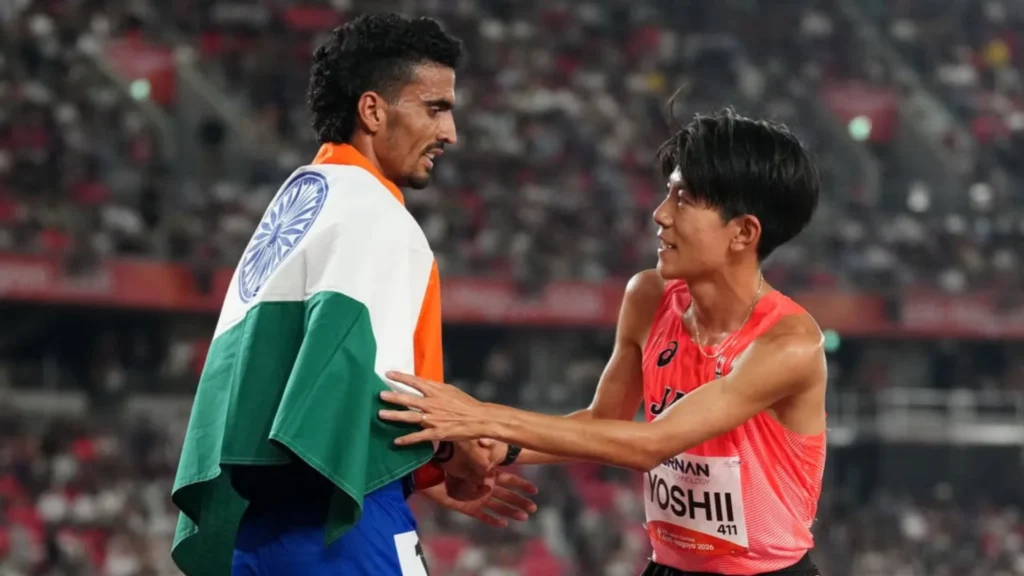
Indian distance runner Gulveer Singh won silver in the men’s 1500m at the Aichi-Nagoya Asian Games 2026. He clocked a career-best 3:36.72, finishing just 0.37 seconds behind Japan’s Kazuto Iizawa.
Iizawa won gold in an Asian Games record of 3:36.35. Gulveer’s performance showcased his speed, endurance and tactical ability. He had also secured silver in the 10,000m earlier in the competition.
Strategic Drafting and Pacing in the 1500m
Middle-distance finals demand careful pacing and well-timed moves. Gulveer had to balance energy conservation with the need to stay close to Japan’s leading runners, Iizawa and Nagiya Mori.
During the middle stages, he maintained a competitive position behind the Japanese athletes. This approach helped him remain in contention without making an early move.
Drafting can reduce air resistance when runners follow closely behind others. It may also help conserve energy for the final stages of a race.
Managing Pace Before the Final Surge
Gulveer maintained his position through much of the race. Rather than responding to every change in pace, he stayed focused on the leading group.
His endurance from the 10,000m also provided valuable championship experience. However, the 1500m demanded a different balance of aerobic fitness, speed and finishing power.
By staying in contention, Gulveer gave himself a chance to challenge for gold in the closing stages.
The Gold Medal Margin
Gulveer finished in 3:36.72, just 0.37 seconds behind Iizawa. The narrow gap highlighted the competitive standard of the men’s 1500m final.
A slightly earlier finishing move might have created another opportunity to challenge for gold. However, the final result confirmed Gulveer’s ability to compete with Asia’s leading middle-distance runners.
Gulveer Singh’s Double-Medal Achievement
Gulveer’s 1500m silver added to his silver medal in the 10,000m. Winning medals in both events demonstrated his versatility across different racing distances.
His performances also strengthened India’s presence in Asian distance running. The combination of endurance and middle-distance speed makes him an important athlete to watch in future competitions.
For official athlete profiles, race results and athletics updates, visit World Athletics.
Gulveer’s double-medal performance in Nagoya marks a significant achievement in his international career.