





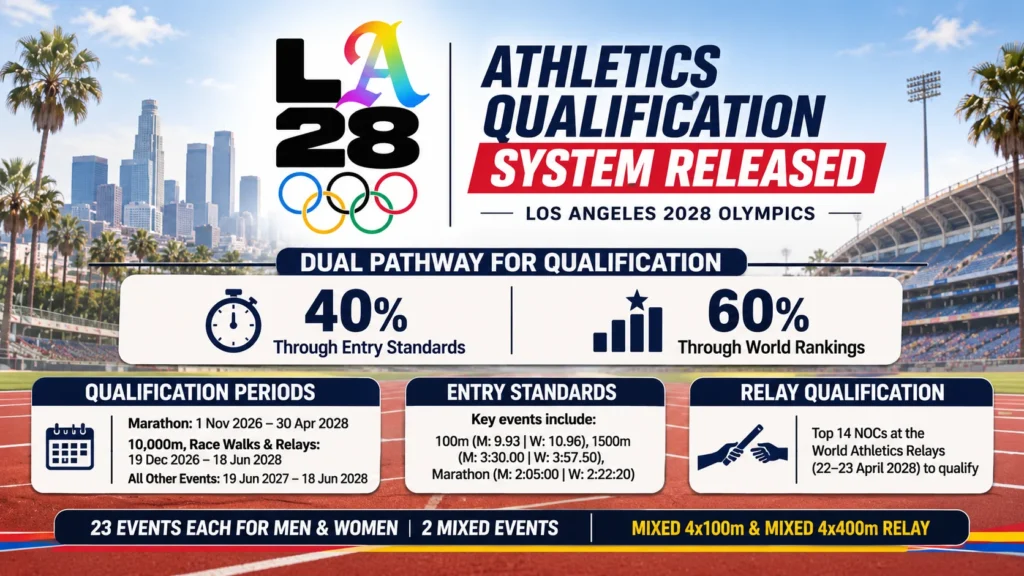
The qualification system for the athletics competition at the Los Angeles 2028 Olympic Games, scheduled to take place from 15 to 30 July 2028, has been published.
The athletics programme will feature 23 events each for men and women, along with two mixed events – the mixed 4x100m relay, which will make its Olympic debut, and the mixed 4x400m relay.
As with recent major outdoor championships, the qualification system will follow a dual pathway. Under the new model, 40% of athletes are expected to qualify through entry standards, while the remaining 60% are expected to secure their places through World Athletics rankings. This replaces the previous 50-50 model.
However, achieving the entry standard does not automatically guarantee an Olympic quota place. If more athletes achieve the standard than the available quota, places will be awarded to those with the best performances during the qualification period, within the event quota. In such cases, no athletes will qualify through world rankings.
Qualification Periods
The qualification and ranking periods will vary depending on the event:
Marathon: 1 November 2026 to 30 April 2028.
10,000m, combined events, race walks and relays: 19 December 2026 to 18 June 2028.
All other events: 19 June 2027 to 18 June 2028.
Results from competitions whose final day falls within the relevant qualification period will count towards qualification.
Results from national senior outdoor championships that begin within the applicable qualification period will also count, provided the performances are achieved no later than Thursday, 22 June.
Entry Standards
| Men’s Event | Men | Women’s Event | Women |
|---|---|---|---|
| 100m | 9.93 | 100m | 10.96 |
| 200m | 19.95 | 200m | 22.25 |
| 400m | 44.40 | 400m | 49.90 |
| 800m | 1:43.00 | 800m | 1:57.00 |
| 1500m | 3:30.00 | 1500m | 3:57.50 |
| 5000m | 12:50.00 | 5000m | 14:34.00 |
| 10,000m | 26:48.00 | 10,000m | 30:30.00 |
| 110m hurdles | 13.18 | 100m hurdles | 12.58 |
| 400m hurdles | 48.00 | 400m hurdles | 54.00 |
| 3000m steeplechase | 8:07.50 | 3000m steeplechase | 9:06.00 |
| High jump | 2.32m | High jump | 1.97m |
| Pole vault | 5.90m | Pole vault | 4.80m |
| Long jump | 8.30m | Long jump | 6.90m |
| Triple jump | 17.35m | Triple jump | 14.50m |
| Shot put | 21.50m | Shot put | 19.30m |
| Discus throw | 67.20m | Discus throw | 65.00m |
| Hammer throw | 78.50m | Hammer throw | 74.00m |
| Javelin throw | 85.50m | Javelin throw | 63.80m |
| Decathlon | 8650 points | Heptathlon | 6550 points |
| Half marathon race walk | WRWTC | Half marathon race walk | WRWTC |
| Marathon | 2:05:00 | Marathon | 2:22:20 |
How Were the Entry Standards Decided?
World Athletics calculated the top lists using the start and end dates of the four qualification periods, considering a maximum of three athletes per country.
The entry standards were determined by analysing performance trends, existing competition levels and expected improvements. The standards also account for events where performances are expected to improve significantly compared to previous championships.
The marathon is one such event. Performance trends indicate that times during an Olympic year are typically 30 to 60 seconds faster than the projected trends.
Relay Qualification
For the relay events, the first 14 National Olympic Committees (NOCs) at the World Athletics Relays, scheduled to take place in The Bahamas on 22–23 April 2028, will automatically qualify for LA28.
Teams will have two opportunities to secure qualification at the World Relays. If a team fails to qualify on the first day, it will get another opportunity on the second day.
The remaining relay places will be allocated based on the World Athletics relay performance lists during the qualification period.