
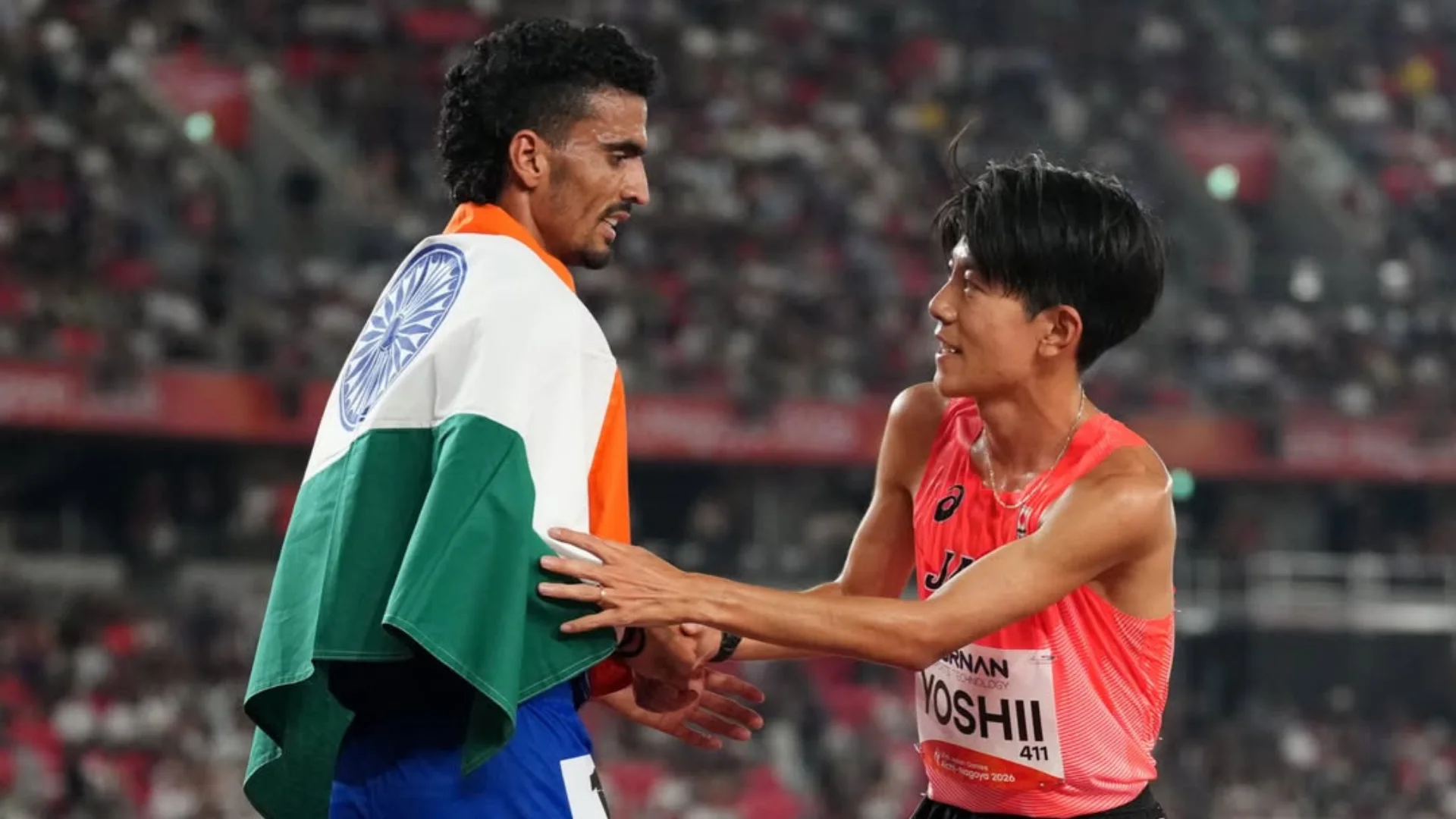
At the Aichi-Nagoya Asian Games 2026, Indian distance runner Gulveer Singh delivered one of the most complete tactical performances in modern Indian track history. Clocking a career-best 3:36.72 to secure the silver medal in the men’s 1500m final, Gulveer missed out on the top step of the podium by a razor-thin 0.37 seconds.
What made the feat remarkable was not merely the raw speed required to force Japanese gold-medallist Kazuto Iizawa into an Asian Games record (3:36.35), but the tactical maturity Gulveer displayed after having already run a grueling, silver-medal-winning 10,000m final just days prior.
Strategic Drafting and Pacing (0–1100m)
In middle-distance racing, championship finals rarely reward early breakaways. Gulveer and his coaching setup executed a precise energy-preservation strategy designed to counter the home advantage of the Japanese duo, Kazuto Iizawa and Nagiya Mori.
Throughout the middle 800 meters, Gulveer committed strictly to an inside-lane position, tucked directly behind Iizawa and Mori. By maintaining this aerodynamic pocket, he effectively reduced wind resistance during the home-straight passes on laps two and three. Aerodynamic drafting in middle-distance events yields significant metabolic savings, reducing oxygen consumption and preserving precious glycogen stores needed for late-stage anaerobic output.
Complementing this positioning was a disciplined split-pacing strategy. Rather than reacting to minor pace accelerations, Gulveer held his splits within a tight, controlled tolerance. Passing the 1100-meter mark without incurring early lactate accumulation allowed his physiological state to shift smoothly from 10k aerobic endurance into peak 1500m speed endurance.
Tactical Masterclass: The Anatomy of Gulveer Singh’s 1500m Silver
At the Aichi-Nagoya Asian Games 2026, Indian distance runner Gulveer Singh delivered one of the most complete tactical performances in modern Indian track history. Clocking a career-best 3:36.72 to secure the silver medal in the men’s 1500m final, Gulveer missed out on the top step of the podium by a razor-thin 0.37 seconds.
What made the feat remarkable was not merely the raw speed required to force Japanese gold-medallist Kazuto Iizawa into an Asian Games record (3:36.35), but the tactical maturity Gulveer displayed after having already run a grueling, silver-medal-winning 10,000m final just days prior.
Strategic Drafting and Pacing (0–1100m)
In middle-distance racing, championship finals rarely reward early breakaways. Gulveer and his coaching setup executed a precise energy-preservation strategy designed to counter the home advantage of the Japanese duo, Kazuto Iizawa and Nagiya Mori.
Throughout the middle 800 meters, Gulveer committed strictly to an inside-lane position, tucked directly behind Iizawa and Mori. By maintaining this aerodynamic pocket, he effectively reduced wind resistance during the home-straight passes on laps two and three. Aerodynamic drafting in middle-distance events yields significant metabolic savings, reducing oxygen consumption and preserving precious glycogen stores needed for late-stage anaerobic output.
Complementing this positioning was a disciplined split-pacing strategy. Rather than reacting to minor pace accelerations, Gulveer held his splits within a tight, controlled tolerance. Passing the 1100-meter mark without incurring early lactate accumulation allowed his physiological state to shift smoothly from 10k aerobic endurance into peak 1500m speed endurance.
The Gold Margin
Gulveer Singh’s 3:36.72 silver stands as a benchmark for Indian distance running. Had his final surge been initiated just 20 to 30 meters earlier on the back straight, he would have been positioned to challenge Iizawa directly for gold. Nevertheless, his double-medal haul in Nagoya confirms his status as one of Asia’s most versatile distance athletes.
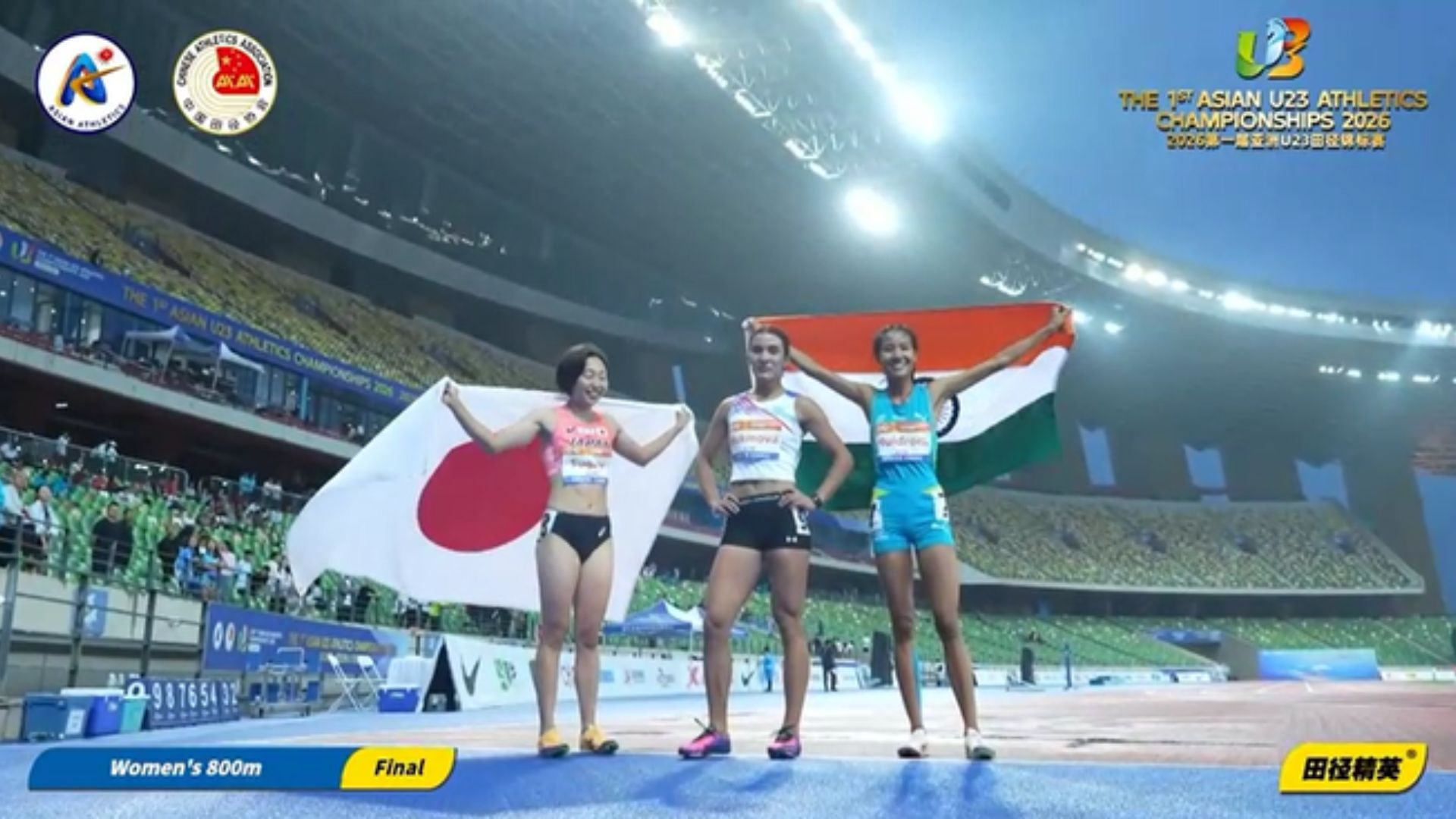
India continued its medal-winning run at the inaugural Asian U23 Athletics Championships 2026 as Bhumeshwory Devi claimed the bronze medal in the women’s 800m in Ordos, China.
Representing India in one of the championships’ most competitive middle-distance events, the athlete from Manipur clocked 2:10.20s to finish third and secure a place on the podium. Bhumeshwory maintained a strong rhythm throughout the two-lap race and produced a determined finish to earn another medal for the Indian contingent.
The gold medal was won by Uzbekistan’s Jonbibi Hukmova, who crossed the finish line in 2:08.41s. Kurumi Sugure of Japan claimed the silver medal with a time of 2:09.42s, while Bhumeshwory completed the podium with her bronze-medal performance.
The result adds another significant achievement to Bhumeshwory’s steadily progressing career. She emerged as the 2025 Interstate champion in the women’s 800m and has continued to establish herself among India’s promising middle-distance runners.
Bhumeshwory currently trains at the National Centre of Excellence (NCOE), Bengaluru, under IndianOil’s Project Shakti, a programme she joined in 2024. The structured training environment has played an important role in her development, and her podium finish at the continental championships reflects the progress she has made over the past two seasons.
The Asian U23 Athletics Championships provide an important stepping stone for emerging athletes aiming to transition successfully to senior international competition. By securing a bronze medal, Bhumeshwory has not only added to India’s medal tally but has also gained valuable experience competing against some of Asia’s best young middle-distance runners.
With another podium finish in Ordos, India continued its encouraging campaign at the inaugural edition of the championships. Bhumeshwory Devi’s bronze medal in the women’s 800m stands as another rewarding achievement for Indian athletics and highlights the growing strength of the country’s emerging talent in middle-distance running.
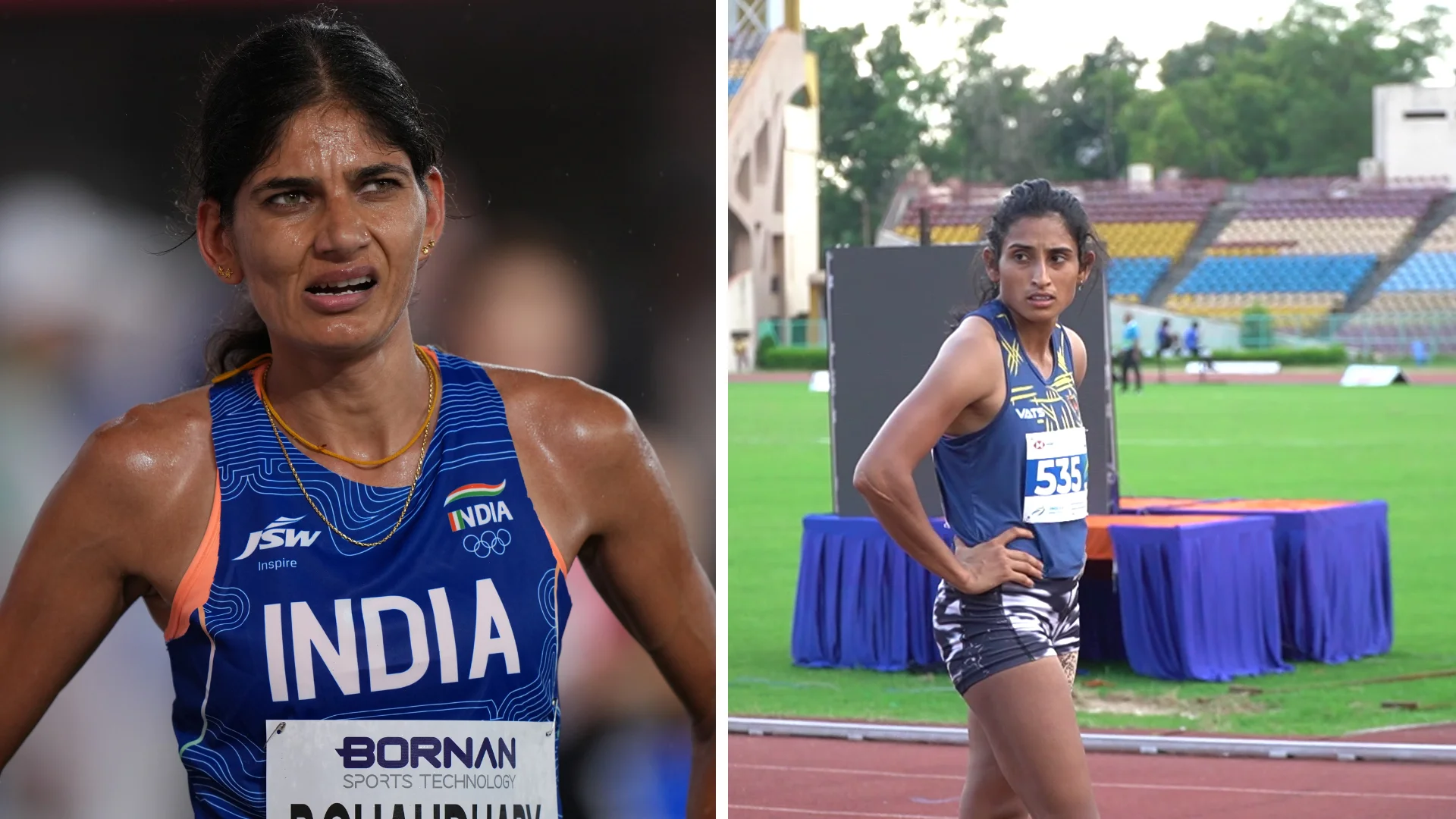
Indian distance runner Ankita Dhyani delivered a solid performance at the Drake Relays, clocking 9:34.39 in the women’s 3000m steeplechase at the World Athletics Continental Tour (Silver level) meet in Des Moines, Iowa.
Dhyani’s timing was around seven seconds shy of her personal best, which she had set just a week earlier at the Bryan Clay Invitational. Despite the slight dip, the performance reflects her growing consistency on the international circuit.
Competing against a strong field, Dhyani continues to build momentum this season, with back-to-back races showcasing her ability to maintain competitive timings.