




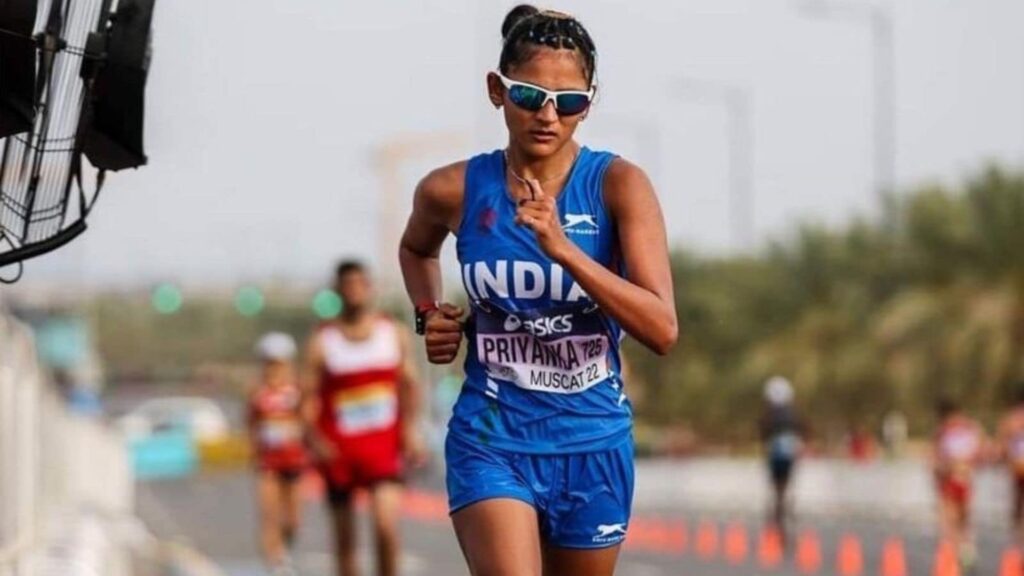
For elite athlete Priyanka, a cupboard full of shimmering medals – including a historic Commonwealth Games silver – is not merely a collection of trophies. It is the physical manifestation of a lifetime carved out of grit, sweat, and relentless perseverance. When the news of her selection for the prestigious Arjuna Award reached her, it triggered a wave of emotion. Sitting down for an exclusive interview, Priyanka reflected on what the honour truly represents.
“This is not an award for me,” she shared, her voice carrying the weight of past hardships. “This is the whole journey of my life in sports, in which I have seen ups and downs. I have struggled a lot in my life. So, I remember all that in a moment, that finally my perseverance has paid off, and I have got the award for that hard work today.”
Her ascent to national prominence is a testament to the famous line – It takes a village to raise a champion. While she acknowledges the invaluable foundation laid by her parents and family, she also points to the pivotal turning point of 2020. That was the year she began a specialized training regimen that culminated in 2021 when she shattered the national record and qualified for the Olympics with a stellar time of 1 hour 28 minutes and 5 seconds. Ask her how she plans to organize her accolades – placing her Commonwealth silver alongside state honours like the Rani Lakshmi Bhai Award – and she insists the CWG medal itself will always sit proudly at the very top, for it was the catalyst that changed her life forever.
Priyanka’s story, however, did not begin on an international track. It started locally in Meerut; a city steeped in a rich sports culture. In her early days, she competed in a modest 3-kilometer race, entirely unaware of what senior-level distances like 20 kilometres or marathons entailed. Her prize for that district-level race? A simple travelling bag. Today, she still keeps that first souvenir at home, a humble reminder of where it all started, long before she transitioned permanently into race walking and secured a Youth National silver medal just five months later.
Yet, stepping into elite international fields brought entirely new challenges. Training under legendary Olympic medallist Ronald Weigel transformed her technical approach, guiding her to strong finishes at World Championships in Tokyo and Brazil. Weigel also taught her a crucial mental skill: blocking out the volatile noise of social media and public criticism.
“In our country, it happens a lot. Athletes are promoted and eliminated very quickly,” Priyanka noted, drawing on observations from international peers like World Champion, Olympic medallist and Commonwealth gold medallist Evan Dunfee, who also experienced the ebbs and flows of athletic performance. Under Weigel’s guidance, she learned to look past the media cycles, manage pre-event pressure, and stay anchored entirely to her training.
That mental fortitude has been tested in gruelling conditions, from the extreme humidity and heat of Tokyo, where simply crossing the finish line felt like an act of survival amid a sea of struggling competitors, to her transition toward the demanding Marathon Race Walking circuit. Logging staggering off-season training loads of up to 180 kilometres per week, Priyanka is now setting her sights on future continental and global multi-sport games, preparing her body and mind to endure the punishing demands of long-distance pacing.
Reflecting on the broader landscape of Indian sports, Priyanka is candid about the structural hurdles. She believes strongly that youth athletics should be prioritized much earlier in schools, pointing out that foreign competitors often begin training a decade earlier than many Indian athletes. While government initiatives like Khelo India and district-level improvements under leaders like the Chief Minister of Uttar Pradesh are steadily transforming the ecosystem by offering better infrastructure, nutrition support, and job opportunities, she believes personal resilience remains the ultimate differentiator.
For the next generation looking at her journey, Priyanka offers a grounded, honest perspective. Race walking is not for the faint hearted; it demands immense physical and mental suffering. She does not sugarcoat the struggle, choosing instead to welcome those genuinely inspired by her path to step forward, lace up their shoes, and commit to the grind.
As she looks ahead to the podiums of upcoming international championships, Priyanka remains delightfully hungry for more. The medals may pile up, but for the girl who started with a simple district prize bag, the heartbeat of her journey remains unchanged: one step, one kilometre, and one relentless stride at a time.