




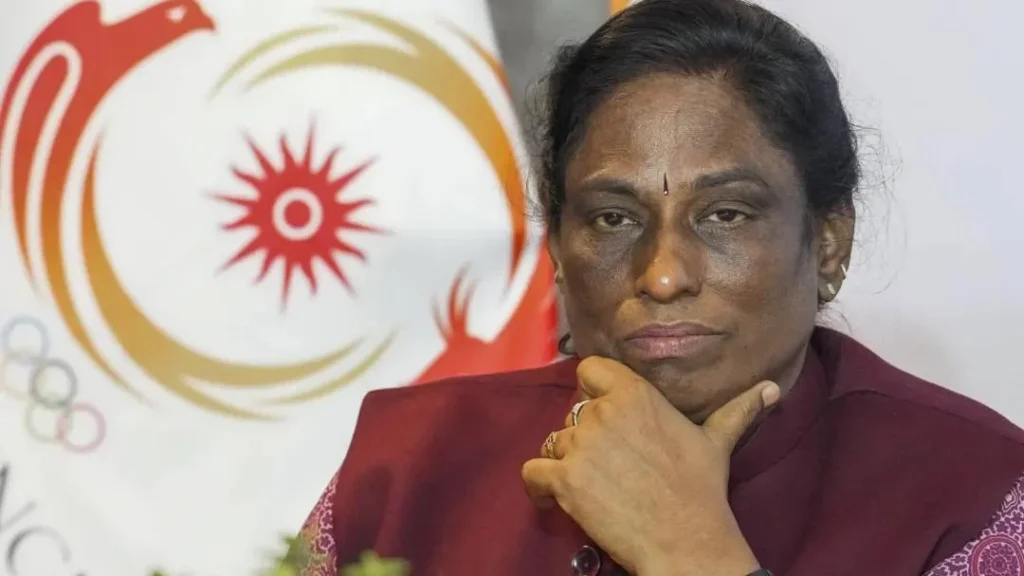
P.T. Usha’s defeat in the Sportspersons of Outstanding Merit (SOM) election appeared to slam the door on her chances of securing a second term as Indian Olympic Association president. But just days later, she found an alternative route into the IOA electoral college – through the Ice Hockey Association of India.
This sudden turn, call it sprinting in the opposite direction, has ignited a much larger debate across the sporting ecosystem. Is this a legitimate constitutional provision, or a calculated workaround to bypass an electoral defeat? Is Usha eligible to represent a sport she has never competed in? And why is a national sports body unrecognized by the Sports Ministry playing a pivotal role in Olympic elections?
Let’s break down the controversy layer by layer.
1. From SOM defeat to an alternative route
On November 9, the IOA conducted elections for eight Sportspersons of Outstanding Merit (four women, four men). In the women’s category, legendary long jumper Anju Bobby George led with 53 votes, followed by Rani Rampal (50), Dola Banerjee (45), and Saina Nehwal (43).
P.T. Usha finished fifth with 40 votes, missing out on a General Assembly seat through the SOM route.
However, the landscape shifted dramatically on November 12. The Ice Hockey Association of India (IHAI) nominated P.T. Usha as its female representative to the IOA General Assembly, pairing her with the association’s Secretary General, Harjinder Singh. Her name promptly appeared on the provisional electoral college published by the IOA Electoral Officer.
While she wasn’t directly nominated for the presidency by IHAI, securing a seat as an authorized federation representative gives her the vital gateway needed to contest executive posts. In short: she lost one route but pivoted to another; no empty track in the sprint, let’s do the marathon.
2. Why didn’t the Athletics Federation nominate her?
Naturally, observers ask why an icon of Indian track and field isn’t representing athletics.
The mechanics of the IOA electoral college restrict each eligible National Sports Federation to just two representatives – one male and one female. The Athletics Federation of India (AFI) had already filled its quota with Adille Sumariwalla and Jyotirmoyee Sikdar.
This forced Usha to look outward. But does a representative have to be an athlete of that specific sport?
Not under current rules. Article 10.4 of the IOA Constitution dictates only that representatives must be members of the concerned federation; it does not mandate competitive history in that discipline. Thus, Usha’s track background does not legally disqualify her from representing ice hockey.
However, a massive threshold question remains: Was P.T. Usha an active, legitimate member of the Ice Hockey Association of India at the time of her nomination? With the IHAI website failing to publish a public membership roll, verification rests entirely on paperwork.
3. P.T. Usha’s IOA Presidential Eligibility Under the Constitution
Evaluating her eligibility requires separating two distinct hurdles:
- Hurdle 1: General Assembly Entry. Under Article 10.4, she must be a verified member of IHAI, backed by a proper authorization form signed by the federation’s President or Secretary General. When NNIS Sports asked IHAI Secretary General Harjinder Singh if Usha was a member prior to nomination, he affirmed, “Yes, she is a member of IHAI.” Yet, when pressed on her exact internal position, he demurred: “Whatever has been asked by the IOA has been submitted by us.”
- Hurdle 2: Presidential Candidacy. Article 11.1.10 provides an alternative safety net for presidential or treasurer candidates: applicants must either be an SOM or have previously served at least one full term as an IOA Executive Council member, President, Secretary General, or Treasurer. Having served as IOA President during the 2022–26 term, Usha clears this hurdle on paper—subject to the Electoral Officer’s final interpretation.
In short: her past tenure may qualify her to run for president, but it does not automatically validate her ice hockey membership.
4. IOA vs Sports Ministry: Ice Hockey Federation Recognition
The controversy deepens when examining institutional recognition.
While the Ice Hockey Association of India is listed on the official IOA website as an affiliated member and appears on the 2026 electoral roll, its government standing is entirely different. In a Rajya Sabha reply on February 5, 2026, the Ministry of Youth Affairs and Sports listed 53 officially recognized National Sports Federations as of December 31, 2025, and IHAI was absent. PTI reports similarly confirmed that the Sports Ministry recognizes no national body for ice hockey.
While government non-recognition does not automatically invalidate an IOA affiliation (as sports bodies maintain autonomous bylaws), it raises a glaring governance question: How does the IOA determine who represents a sport when the national government recognizes no governing body for that discipline?
5. What Happens Next in the IOA Election Controversy?
Critics have alleged quid pro quo, suggesting that IHAI received recognition during Usha’s presidency and is now returning the favour.
However, the historical record refutes this specific timeline. Media reports from October 2012 document an IOA Special General Body Meeting held on October 18, 2012, where the IOA officially granted provisional affiliation with voting rights to the Ice Hockey Association of India, a full decade before Usha assumed the IOA presidency in December 2022.
6. Internal factional wars within IHAI
Complicating matters further, the Ice Hockey Association of India is embroiled in an internal leadership feud.
According to reports from Hindustan Times, IHAI Vice-President Ajit Kakkar wrote to the IOA on November 12, urging them to debar the association from the 2026 elections. Kakkar demanded verification of an August 2 internal election and requested recognition of a rival governing body headed by Kunzang Namgail.
If the August 2 election is legally challenged, the authority of the officials who signed Usha’s nomination form comes directly into question, threatening to invalidate the nomination at its core.
7. What happens next?
The electoral timeline leaves a narrow window for scrutiny. Following provisional roll publications, objections were slated for November 13, verification for November 14, and the final electoral roll release on November 15.
The big picture
P.T. Usha’s manoeuvre has laid bare the vulnerabilities of Indian sports governance. An incumbent president loses a direct sporting merit vote, pivots to an unrelated federation, and relies on a body facing internal factional disputes and a lack of government recognition all while constitutional loopholes protect her presidential eligibility.
Whether this represents a masterstroke in rulebook navigation or an institutional loophole exploited to retain power will be decided not by headlines, but by the Electoral Officer’s desk. With the IOA elections locked for December 5, this stands as one of the sternest tests of transparency in Indian Olympic administration history.