
Athletics age categories in India run from Under 14 to Under 23, followed by the open senior category. The Athletics Federation of India (AFI) places each young athlete by date of birth. Each category usually covers two birth years, so an Under 18 athlete is 16 or 17 on the cut-off date.
However, the cut-off date is not the same at every meet. That detail causes most of the confusion for athletes and parents. This guide therefore explains each category, how AFI calculates age, which national meets belong to which group, and what documents you need.
Athletics age categories in India: quick facts
- Under 14 and Under 16: the youngest groups, with their own national meet, NIDJAM
- Under 18: the youth category; National Youth Championships and Junior Nationals
- Under 20: the junior category; Junior Federation Cup and Junior Nationals
- Under 23: athletes aged 20 to 22; Indian Open U23 and the Asian U23 Championships
- Senior: open to all eligible athletes, with no upper age limit
- Proof of age: original birth certificate or Class 10 certificate, checked at the venue
Jump to: All categories How age is calculated Events by age National meets Age verification School categories
Athletics age categories in India at a glance
The table shows each category, the usual age on the cut-off date, and the 2026 birth window used at AFI meets. The windows come from the official AFI circulars for each meet.
| Category | Age on cut-off date | Main national meets | 2026 example (born between) |
|---|---|---|---|
| Under 14 | 12 or 13 | NIDJAM, Junior Nationals | 28 Oct 2012 and 27 Oct 2014 (Junior Nationals) |
| Under 16 | 14 or 15 | NIDJAM, Junior Nationals | 28 Oct 2010 and 27 Oct 2012 (Junior Nationals) |
| Under 18 | 16 or 17 | Youth Nationals, Junior Nationals | 28 Oct 2008 and 27 Oct 2010 (Junior Nationals) |
| Under 20 | 18 or 19 | Junior Federation Cup, Junior Nationals | 28 Oct 2006 and 27 Oct 2008 (Junior Nationals) |
| Under 23 | 20 to 22 | Indian Open U23 | 2004 to 2006 (Asian U23 selection) |
| Senior | No upper limit | Inter-State, Federation Cup, Open Nationals | Open |
How AFI calculates your age category
AFI uses two methods, and the method depends on the meet. Therefore, always read the circular for the specific competition.
Method 1: a two-year window tied to the meet
For domestic age-group meets, AFI sets a two-year birth window that ends close to the competition date. For example, the 2026 National Junior Championships in Chennai ended on 27 October. So the Under 18 window was 28 October 2008 to 27 October 2010. As a result, an athlete born on 15 March 2009 competed in Under 18.
Similarly, NIDJAM 2026 used windows ending on 16 November, its last day. A child born on 20 December 2012 was in Under 14. However, a child born on 1 November 2012 fell into Under 16. In addition, NIDJAM athletes had to be at least 12 years old on 16 November 2026.
Method 2: age on 31 December
For international selection, AFI follows World Athletics and Asian Athletics rules. Here, age is counted on 31 December of the competition year. For instance, Under 20 athletes are 18 or 19 on that date, and Under 18 athletes are 16 or 17. Likewise, the Asian U23 trials in 2026 were open to athletes aged 20 to 22 on 31 December 2026, born from 2004 to 2006.
The two methods can give different answers for the same athlete. The 2026 Junior Federation Cup in Tumkur accepted athletes born after 26 April 2006. Yet only athletes born from 2007 to 2010 were considered for India’s Asian and World U20 teams. So a late-2006 birth could compete there but not be selected.
Events in each of the athletics age categories in India
Younger categories have simpler events, so children learn basic skills before specialising. The rules below come from the 2026 AFI circulars.
| Category | Events and rules |
|---|---|
| Under 14 | No single events. Each athlete picks one triathlon (A: 60m, long jump, scissors high jump; B: 60m, long jump, back throw; C: 60m, long jump, 600m) and also takes part in the kids javelin. |
| Under 16 | Shorter, simpler events: scissors-style high jump, long jump from a 5m runway, standing shot put, javelin with a 10m approach, plus the pentathlon. |
| Under 18 | Full programme with youth implements. Entry standards apply, for example 1.80m (boys) and 1.45m (girls) in the high jump at the 2026 Junior Nationals. |
| Under 20 | Full junior programme, with mixed relays. For example, the 2026 Junior Nationals 100m standards were 10.90 (men) and 12.75 (women). |
| Under 23 | Senior equipment: 7.26kg shot and hammer, 2kg discus, 800g javelin and 1.067m hurdles for men. |
In addition, Under 16, Under 18 and Under 20 athletes may enter two individual events and one relay at the Junior Nationals. Meanwhile, results from these groups now feed the national record books. For example, Minakshi set a girls Under 16 javelin record of 54.40m in 2026.
Which national meets match which age category
| Meet | Age categories | 2026 edition |
|---|---|---|
| NIDJAM (National Inter District Junior Athletics Meet) | Under 14, Under 16 | Hyderabad, 14 to 16 November |
| National Youth Championships | Under 18 | Ludhiana, September |
| National Junior Championships | Under 14 to Under 20 | Chennai, 23 to 27 October |
| National Junior (U20) Federation Competition | Under 20 (Under 18 may enter) | Tumkur, 24 to 26 April |
| Indian Open U23 Athletics | Under 23 | Jaipur, 16 to 18 October |
| National Inter-State Senior Championships | Senior | Bhubaneswar, June |
Age verification and documents
Every athlete at an AFI junior meet must pass age verification at the venue. An AFI committee, which includes doctors, checks each athlete, and its decision is final. Without this check, an athlete cannot compete.
For athletes below 16, AFI accepts a birth certificate from a Birth and Death Registration Office or a Class 10 certificate. For older athletes, it accepts a Class 10 certificate or a birth certificate. Certificates in a regional language need an attested English or Hindi translation. You also need your AFI UID card in the call room.
Moreover, AFI circulars state that an athlete found overage at one meet must move to the next higher group. Age disputes still happen, as our report on the Under 18 eligibility row at the 2026 Junior Nationals shows. So families should keep original documents ready from the first district meet.
School categories differ from athletics age categories in India
School competitions often use different groups. For example, the Punjab Schools Inter District Championship in 2026 used Under 14 and Under 17. Therefore, a school Under 17 title does not map directly to an AFI category. Before entering an AFI meet, check the federation’s own windows. Our Under 14 athletics coverage lists recent results for the youngest group.
We will update this page when AFI publishes the 2027 circulars and age windows for each national meet.
According to the provided competition schedule, the 70th Punjab Schools Inter-District Athletics Championship 2025–26 will take place from October 15 to 18, 2026, at Guru Nanak Stadium in Ludhiana, Punjab. Over four days, the championship will feature Under-14 and Under-17 athletes competing across track and field events.
The programme includes sprint races, middle- and long-distance running, hurdles, race walking, relays, jumps and throwing events. Additionally, selected sprint events feature preliminary rounds and semi-finals before the finals.
Finally, the championship will conclude on October 18 with the Under-17 boys’ and girls’ 4x400m relay finals.
Event Details
- Event: 70th Punjab Schools Inter District Athletics Championship 2025–26
- Dates: October 15–18, 2026
- Venue: Guru Nanak Stadium, Ludhiana, Punjab
- Age categories: Under-14 and Under-17
- Disciplines: Track races, hurdles, race walking, relays, jumps and throws
Source: Competition schedule supplied for this report. Check the dates and programme against any revised notice from the organisers before publication.
Day 1: October 15 — Distance Races, Field Events and Relays
The opening day combines throwing events, distance running, jumps, hurdles and a relay final.
The programme begins at 11:00 AM with the Under-14 girls’ shot put, which uses a 3kg implement. Meanwhile, the Under-17 girls’ long jump starts at 11:10 AM, followed by the Under-17 boys’ discus throw at 11:30 AM.
On the track, the Under-17 boys’ 3,000m begins at 12:10 PM. Shortly afterward, the Under-17 girls’ race starts at 12:25 PM.
After the scheduled break, the Under-14 boys’ high jump begins at 2:10 PM. Next, the Under-17 boys’ 400m hurdles starts at 2:30 PM, followed by the girls’ race at 3:15 PM. Finally, the Under-14 girls’ 4x100m relay concludes the listed programme at 4:00 PM.
Key events on October 15
- 11:00 AM — Under-14 girls’ shot put
- 11:10 AM — Under-17 girls’ long jump
- 11:30 AM — Under-17 boys’ discus throw
- 12:10 PM — Under-17 boys’ 3,000m
- 12:25 PM — Under-17 girls’ 3,000m
- 2:10 PM — Under-14 boys’ high jump
- 2:30 PM — Under-17 boys’ 400m hurdles
- 3:15 PM — Under-17 girls’ 400m hurdles
- 4:00 PM — Under-14 girls’ 4x100m relay
The supplied schedule marks the hurdles and relay events as final/time-trial events. Meanwhile, the schedule lists all the other events mentioned above as finals.
Day 2: October 16 — Sprint Rounds and 400m Finals
The second day features race walking, sprint preliminaries, middle-distance finals and several field-event finals. In addition, it includes the 400m finals for all four age-category and gender groups.
The morning begins at 9:30 AM with the Under-17 boys’ 5,000m race walk and the Under-14 boys’ shot put. The Under-17 girls’ discus throw follows at 9:40 AM. Meanwhile, the Under-17 boys’ long jump starts at 9:45 AM.
Next, the 100m first round begins at 10:00 AM with the Under-17 boys. The Under-17 girls compete at 10:25 AM, followed by the Under-14 boys at 10:50 AM and the Under-14 girls at 11:15 AM.
Afterward, the 400m first round begins at 11:35 AM for the Under-17 boys. The Under-17 girls follow at noon, while the Under-14 boys and girls compete at 12:25 PM and 12:50 PM, respectively.
During the afternoon session, the Under-17 boys’ 1,500m final starts at 2:00 PM, followed by the girls’ final at 2:15 PM. Additionally, the session includes field-event finals and the 100m semi-finals.
The 400m finals begin at 3:15 PM with the Under-17 boys. The Under-17 girls follow at 3:30 PM, while the Under-14 boys compete at 3:45 PM and the girls at 4:00 PM. Finally, the Under-17 boys’ 4x100m relay rounds off the listed programme at 4:20 PM.
Key events on October 16
- 9:30 AM — Under-17 boys’ 5,000m race walk
- 10:00 AM — Under-17 boys’ 100m, Round 1
- 10:25 AM — Under-17 girls’ 100m, Round 1
- 10:50 AM — Under-14 boys’ 100m, Round 1
- 11:15 AM — Under-14 girls’ 100m, Round 1
- 11:35 AM — Under-17 boys’ 400m, Round 1
- 12:00 PM — Under-17 girls’ 400m, Round 1
- 2:00 PM — Under-17 boys’ 1,500m final
- 2:15 PM — Under-17 girls’ 1,500m final
- 2:30 PM onwards — 100m semi-finals
- 3:15 PM — Under-17 boys’ 400m final
- 3:30 PM — Under-17 girls’ 400m final
- 3:45 PM — Under-14 boys’ 400m final
- 4:00 PM — Under-14 girls’ 400m final
- 4:20 PM — Under-17 boys’ 4x100m relay
The four 400m finals make the afternoon a key part of the second day, while the sprint rounds will determine which athletes advance to the next stage.
Day 3: October 17 — 100m Finals, Hurdles and 800m Races
The third day begins at 9:30 AM with the Under-17 girls’ 3,000m race walk. Meanwhile, the morning field-event programme includes the Under-17 girls’ shot put, Under-14 girls’ discus throw, Under-14 boys’ long jump and Under-17 girls’ high jump.
The 100m finals then follow across both age groups. First, the Under-14 boys compete at 10:00 AM, followed by the Under-14 girls at 10:10 AM. Next, the Under-17 boys’ final starts at 10:20 AM, while the girls take the track at 10:30 AM.
The programme then moves to the Under-14 boys’ 80m hurdles at 11:00 AM and the girls’ event at 11:30 AM. After these races, the Under-17 boys’ 800m final begins at 11:50 AM, followed by the girls’ final at 12:10 PM.
In the afternoon, athletes contest the first round of the 200m across all four categories. The Under-17 boys start at 2:00 PM, followed by the girls at 2:25 PM. Meanwhile, the Under-14 boys compete at 2:50 PM, and the girls begin at 3:10 PM.
Field-event finals include the Under-17 girls’ javelin throw, triple jump and hammer throw. In addition, the Under-17 boys will contest the pole vault and hammer throw finals.
The relay programme features the Under-17 girls’ 4x100m relay at 3:35 PM. Finally, the Under-14 boys’ 4x100m relay follows at 4:00 PM.
Key events on October 17
- 9:30 AM — Under-17 girls’ 3,000m race walk
- 10:00 AM — Under-14 boys’ 100m final
- 10:10 AM — Under-14 girls’ 100m final
- 10:20 AM — Under-17 boys’ 100m final
- 10:30 AM — Under-17 girls’ 100m final
- 11:00 AM — Under-14 boys’ 80m hurdles
- 11:30 AM — Under-14 girls’ 80m hurdles
- 11:50 AM — Under-17 boys’ 800m final
- 12:10 PM — Under-17 girls’ 800m final
- 2:00 PM — Under-17 boys’ 200m, Round 1
- 2:25 PM — Under-17 girls’ 200m, Round 1
- 2:50 PM — Under-14 boys’ 200m, Round 1
- 3:10 PM — Under-14 girls’ 200m, Round 1
- 3:35 PM — Under-17 girls’ 4x100m relay
- 4:00 PM — Under-14 boys’ 4x100m relay
The 100m finals and 800m races headline the third day’s track programme. c
Day 4: October 18 — 200m Finals and Closing Relays
The final day features hurdles, the javelin throw, triple jump, pole vault, 200m finals, 600m races and the Under-17 4x400m relays.
The morning begins at 9:30 AM with the Under-17 girls’ 100m hurdles. Next, the Under-17 boys’ 110m hurdles starts at 10:00 AM. The Under-17 boys’ javelin throw follows at 10:10 AM, while the boys’ triple jump begins at 10:15 AM. Meanwhile, the Under-17 girls’ pole vault is scheduled for 10:20 AM.
The 200m finals then begin at 10:30 AM with the Under-17 boys. The Under-17 girls follow at 10:40 AM, while the Under-14 boys and girls compete at 10:50 AM and 11:10 AM, respectively.
Afterward, the Under-14 boys’ 600m final starts at 11:20 AM. The girls’ final follows at 11:40 AM.
Finally, the championship concludes with the Under-17 4x400m relay finals. The boys’ relay starts at noon, followed by the girls’ relay at 12:30 PM.
Key events on October 18
- 9:30 AM — Under-17 girls’ 100m hurdles
- 10:00 AM — Under-17 boys’ 110m hurdles
- 10:10 AM — Under-17 boys’ javelin throw
- 10:15 AM — Under-17 boys’ triple jump
- 10:20 AM — Under-17 girls’ pole vault
- 10:30 AM — Under-17 boys’ 200m final
- 10:40 AM — Under-17 girls’ 200m final
- 10:50 AM — Under-14 boys’ 200m final
- 11:10 AM — Under-14 girls’ 200m final
- 11:20 AM — Under-14 boys’ 600m final
- 11:40 AM — Under-14 girls’ 600m final
- 12:00 PM — Under-17 boys’ 4x400m relay
- 12:30 PM — Under-17 girls’ 4x400m relay
The two 4x400m relays close the four-day programme, according to the supplied schedule.
Events and Disciplines Across Four Days
The championship schedule covers a broad range of athletics events for Under-14 and Under-17 competitors.
Track events: 100m, 200m, 400m, 800m, 1,500m, 3,000m, 600m, 400m hurdles, 80m hurdles, 100m hurdles, 110m hurdles and relay races.
Race walking: 5,000m race walk for Under-17 boys and 3,000m race walk for Under-17 girls.
Jumping events: Long jump, high jump, triple jump and pole vault.
Throwing events: Shot put, discus throw, hammer throw and javelin throw.
The schedule also lists specific implement weights and hurdle heights for certain age groups and events. Therefore, athletes and team officials should review the complete competition document to confirm the relevant technical specifications.
Important Information for Athletes and Team Officials
The timetable lists scheduled start times and identifies each event as a final, preliminary round, semi-final or final/time-trial event. However, several track and field events may take place simultaneously, especially during morning sessions.
Therefore, athletes and team officials should review the complete timetable when planning their preparations. They should also check for revised schedules issued by the organisers.
The supplied document does not include a confirmed list of participating districts or athlete entries. For this reason, readers should consult the organisers’ latest notices for additional information.

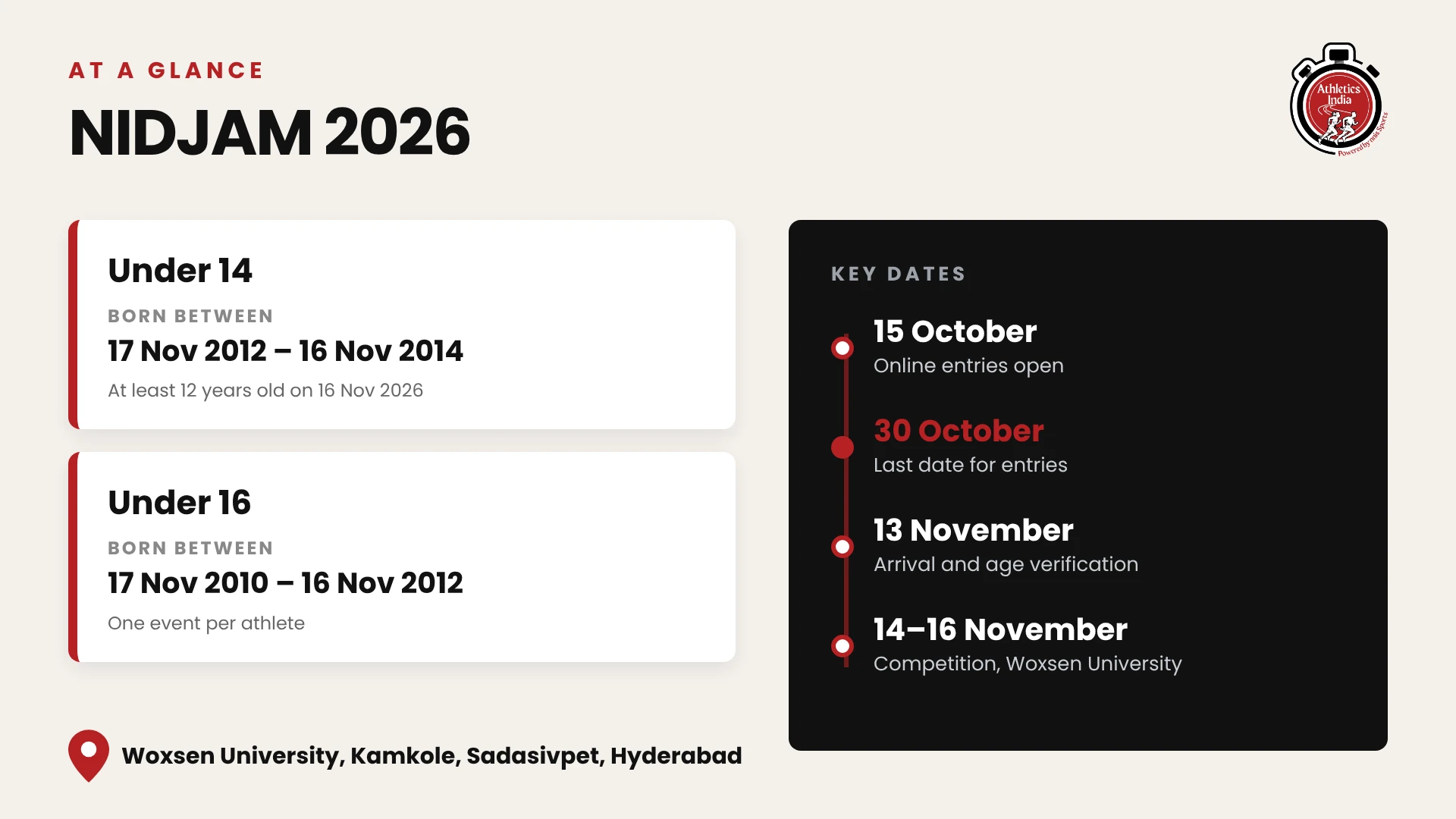
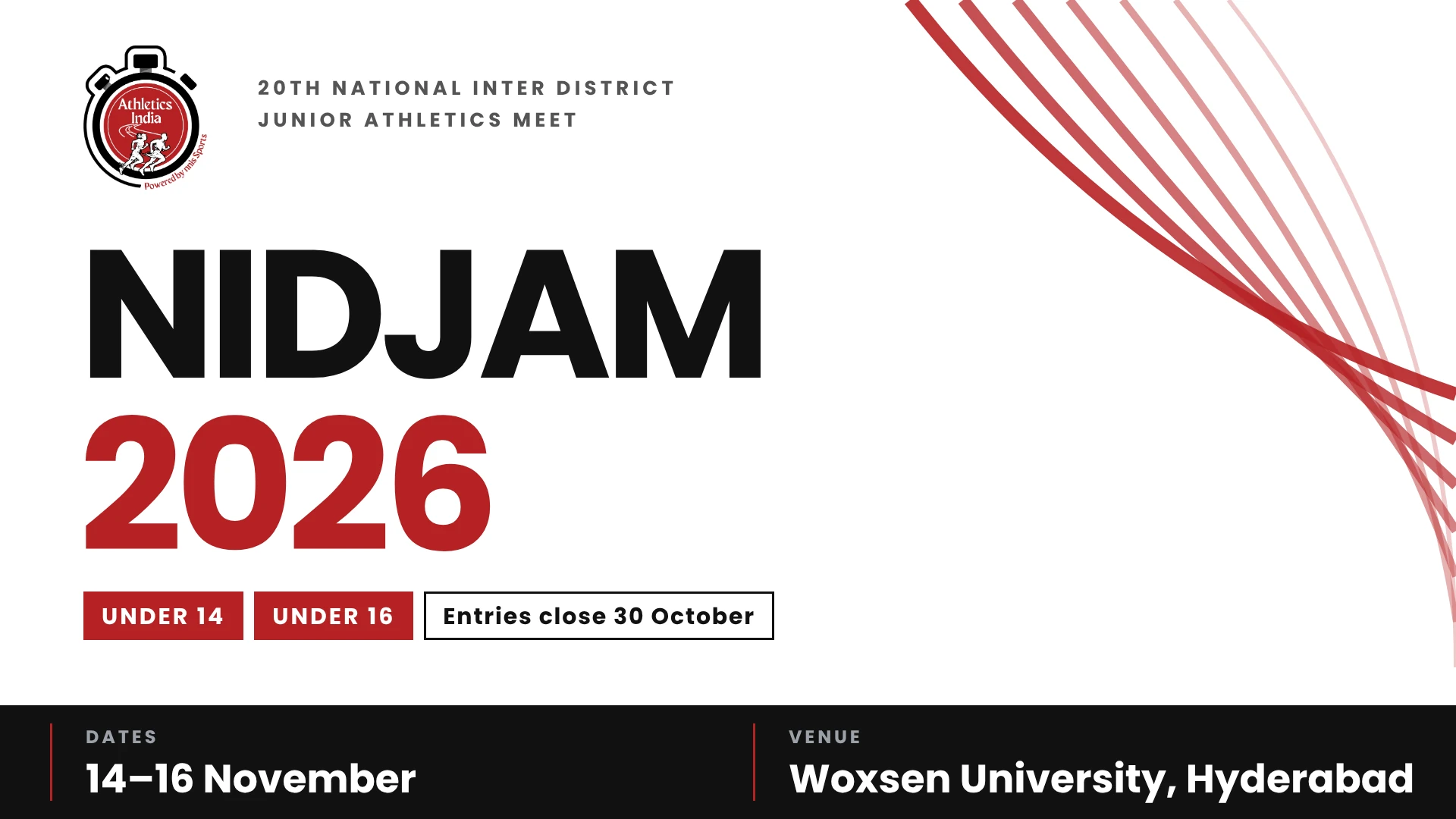
NIDJAM 2026, the 20th National Inter District Junior Athletics Meet, will take place at Woxsen University in Hyderabad from 14 to 16 November. It is the Athletics Federation of India’s biggest talent hunt for Under 14 and Under 16 athletes, and every entry comes through a district athletics association.
Online entries open on 15 October and close on 30 October. This guide therefore covers everything from the AFI circular: the age limits, the events, how many athletes a district can send, the entry steps and the documents to carry.
NIDJAM 2026 at a glance
- Full name: 20th National Inter District Junior Athletics Meet 2026
- Dates: 14 to 16 November 2026
- Venue: Woxsen University, Kamkole, Sadasivpet, Hyderabad, Telangana
- Organisers: Athletics Federation of India with the Government of Telangana
- Age groups: Under 14 and Under 16, boys and girls
- Entries: online only, through district units, 15 to 30 October 2026
- Age verification: 13 November 2026, at the venue
Jump to: What is NIDJAM Age groups Events District quota How to enter Documents Food and travel Last edition
What is NIDJAM?
NIDJAM is AFI’s national meet for district champions. AFI first launched it in 2003, and its aim is to find young talent early and give it a national stage.
The meet has grown with every edition. For example, the 2018 meet in Tirupati drew more than 4,500 athletes from over 420 districts. Then the 2023 edition in Patna had 5,482 athletes from 599 districts, according to The Bridge.
NIDJAM 2026 age groups: who is eligible
There are only two age groups, and the date of birth decides the group. In addition, an athlete must be at least 12 years old on 16 November 2026.
| Age group | Date of birth | Minimum age |
|---|---|---|
| Under 14 | 17 November 2012 to 16 November 2014 | 12 years on 16 November 2026 |
| Under 16 | 17 November 2010 to 16 November 2012 | – |
For example, a child born on 20 December 2012 is in the Under 14 group. However, a child born on 1 November 2012 falls in the Under 16 group.
NIDJAM 2026 events for Under 14 and Under 16
Under 14: triathlons and kids javelin
Under 14 athletes do not enter single events. Instead, each athlete chooses one triathlon group. Every Under 14 athlete must also take part in the kids javelin throw.
| Under 14 event | What it includes |
|---|---|
| Triathlon A | 60m, long jump (5m approach) and high jump (scissor) |
| Triathlon B | 60m, long jump (5m approach) and back throw (1kg shot) |
| Triathlon C | 60m, long jump (5m approach) and 600m |
| Kids javelin throw | Five-metre runway; compulsory for all Under 14 athletes |
Under 16: single events with lighter implements
The Under 16 events use shorter runways and lighter implements than senior athletics. For example, the shot put is a standing throw, and the high jump is scissor style only.
| Event | Boys | Girls |
|---|---|---|
| 60m | Yes | Yes |
| 80m hurdles | 0.838m hurdles | 0.762m hurdles |
| 600m | Yes | Yes |
| High jump | Scissor style only | Scissor style only |
| Long jump | 5m approach | 5m approach |
| Shot put (standing) | 4kg | 3kg |
| Javelin throw (10m approach) | 600g | 500g |
The circular also lists a pentathlon of 60m, 80m hurdles, long jump, standing shot put and 600m. However, its table does not make clear which group runs it, so check with your district unit before you enter.
How many athletes can a district send to NIDJAM 2026?
The quota is small, so district selection matters. Each district can send:
District quota for NIDJAM 2026
- Under 14: a maximum of four athletes, boys and girls together
- Under 16: one event per athlete, and a maximum of two athletes per event
- Free boarding and lodging: up to 13 athletes and 2 officials per district
Above all, only districts that have held a district meet under AFI guidelines can enter. The district association also has to send the district meet results, press cuttings and photographs with its entry, and it needs a valid PAN in its own name.
How to enter NIDJAM 2026
Athletes cannot enter on their own. Instead, the district athletics association enters them online. Here are the steps:
Important: AFI accepts online entries only. Entries sent by WhatsApp or email are not accepted.
NIDJAM 2026 age verification and documents
Age verification takes place on 13 November, at the venue, as soon as the teams arrive. An AFI committee, which includes doctors, checks every athlete, and managers or coaches have to present their athletes in person.
So bring the original proof of date of birth. AFI accepts either a birth certificate from the Birth and Death Registration Office (municipal corporation, nagar palika or district) or a Class 10 certificate. As a result, an athlete who does not clear verification cannot compete.
Food, stay and travel at NIDJAM 2026
AFI provides food from 13 to 17 November. It also gives free boarding and lodging to up to 13 athletes and 2 officials from each district.
In addition, AFI pays back the rail fare after the meet. It checks the original tickets and the athlete’s actual participation, and then it pays the money into the district association’s bank account. However, overage athletes get no travel allowance, food or accommodation.
Last edition: the 19th NIDJAM in Ahmedabad
The 19th NIDJAM took place at Gujarat University in Ahmedabad from 16 to 18 February 2024. You can see the 19th NIDJAM results (PDF) on our site.
Where else Under 14 and Under 16 athletes compete this season
The Under 14 and Under 16 groups also race at the National Junior Athletics Championships 2026 in Chennai from 23 to 27 October. Meanwhile, the zone results show the current level: see the Under 16 tables in our East Zone athletics 2026 results.
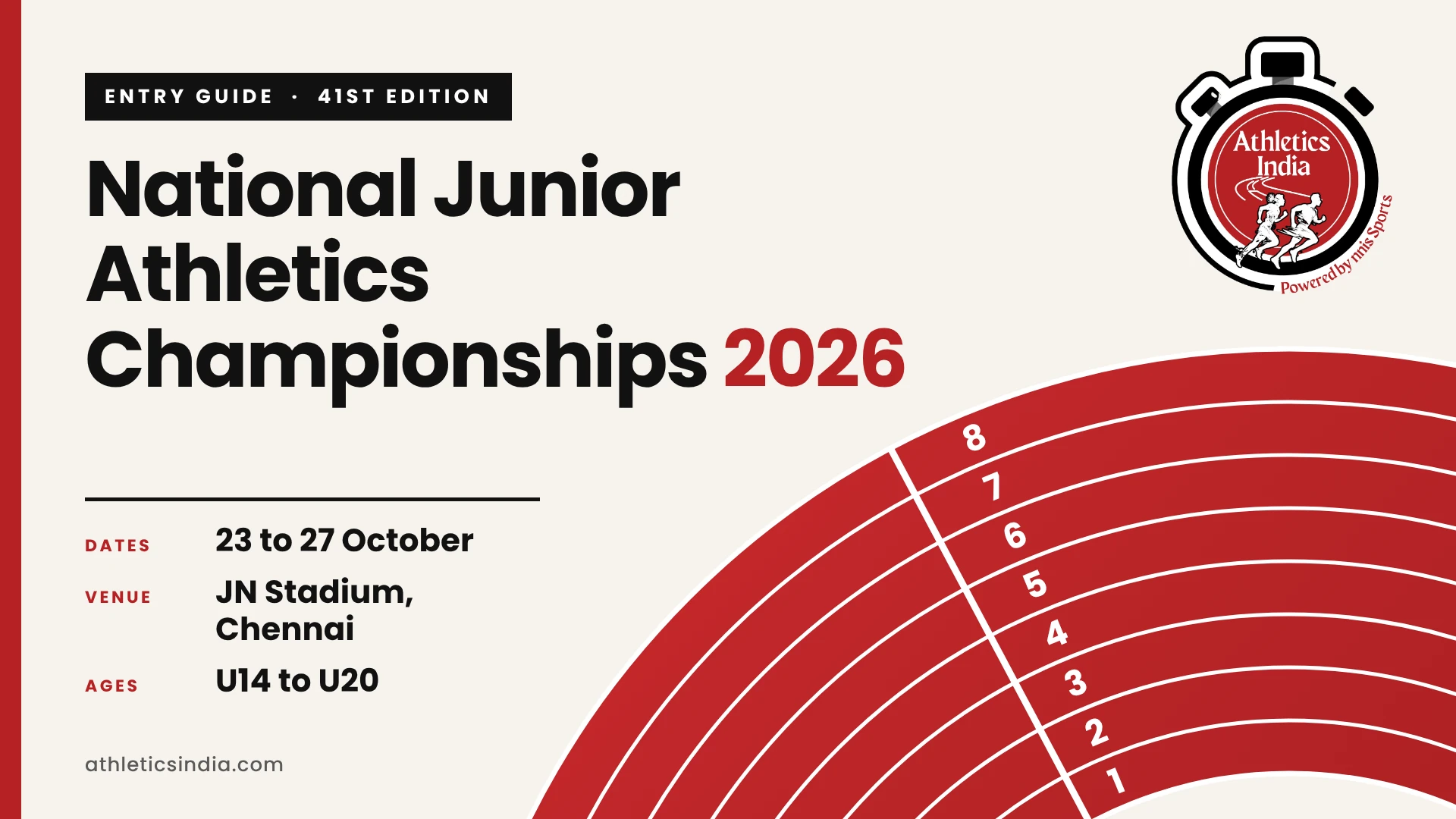
The 41st National Junior Athletics Championships 2026 will take place from 23 to 27 October at the JN Stadium in Chennai, and online entries close on Friday 9 October. The meet also covers four age groups, from Under 14 to Under 20.
This guide puts everything in one place for athletes, parents and coaches. You will find the entry standards for every age group, as well as the entry fee, the age rules and the documents you need for age verification. In addition, we explain how hard the standards really are, with results from this season.
National Junior Athletics Championships 2026 at a glance
- Dates: Friday 23 October to Tuesday 27 October 2026
- Venue: JN Stadium, Chennai, Tamil Nadu
- Organiser: Athletics Federation of India (AFI)
- Age groups: Under 14, Under 16, Under 18 and Under 20, for boys and girls
- Last date for entries: Friday 9 October 2026, online only, through your state association
- Entry fee: ₹250 per event, per athlete
- Age verification: from Wednesday 21 October at the stadium
Jump to: Key dates Age groups How to enter U20 standards U18 standards U16 standards Documents Schedule and results
National Junior Athletics Championships 2026: key dates
Four dates matter. Above all, do not miss the first one, because entries close that day.
Entries opened on 19 September, so only a few days remain. After that, the next step is age verification in Chennai.
Age groups: which category are you in?
Your date of birth decides your age group. For example, an athlete born on 15 March 2009 competes in the Under 18 group.
| Age group | Born between |
|---|---|
| Under 14 | 28 October 2012 and 27 October 2014 |
| Under 16 | 28 October 2010 and 27 October 2012 |
| Under 18 | 28 October 2008 and 27 October 2010 |
| Under 20 | 28 October 2006 and 27 October 2008 |
How to enter the National Junior Athletics Championships 2026
Athletes cannot enter on their own. Instead, the state or union territory association sends every entry online. So if you have the standard, contact your state association before 9 October.
| Rule | Under 20, Under 18 and Under 16 | Under 14 |
|---|---|---|
| Entries per state | Two athletes per event | One athlete per event |
| Events per athlete | Two individual events and one relay | One triathlon group, plus the kids javelin throw |
National Junior Athletics Championships 2026 entry standards: Under 20
These are the marks from the AFI circular. Times are in minutes and seconds, while field marks are in metres.
| Event | Men U20 | Women U20 |
|---|---|---|
| 100m | 10.90 | 12.75 |
| 200m | 23.00 | 26.50 |
| 400m | 50.00 | 58.50 |
| 800m | 1:55.00 | 2:20.00 |
| 1500m | 4:00.00 | 4:50.00 |
| 3000m | 9:14.00 | 11:40.00 |
| 5000m | 15:10.00 | 18:50.00 |
| 110m / 100m hurdles | 15.00 | 16.00 |
| 400m hurdles | 55.00 | 1:07.00 |
| 3000m steeplechase | 10:10.00 | 13:30.00 |
| 5000m race walk | 26:00.00 | 30:00.00 |
| High jump | 1.90m | 1.55m |
| Pole vault | 3.80m | 2.80m |
| Long jump | 6.80m | 5.30m |
| Triple jump | 14.50m | 11.60m |
| Shot put | 15.50m | 11.00m |
| Discus throw | 45.00m | 35.00m |
| Hammer throw | 60.00m | 39.00m |
| Javelin throw | 65.00m | 38.50m |
| Decathlon / Heptathlon | 5000 points | 3250 points |
| 4x100m relay | 44.00 | 52.00 |
| 4x400m relay | 3:24.00 | 4:05.00 |
The Under 20 programme also has 4x100m and 4x400m mixed relays. However, the circular does not list an entry standard for them.
Entry standards: Under 18
| Event | Boys U18 | Girls U18 |
|---|---|---|
| 100m | 11.50 | 13.00 |
| 200m | 23.60 | 27.00 |
| 400m | 51.70 | 1:03.00 |
| 1000m | 2:50.00 | 3:10.00 |
| 110m / 100m hurdles | 15.40 | 16.00 |
| High jump | 1.80m | 1.45m |
| Long jump | 6.50m | 5.00m |
| Shot put | 14.50m | 11.50m |
| Discus throw | 46.00m | 33.00m |
| Javelin throw | 58.00m | 35.00m |
| Heptathlon | 4000 points | 3000 points |
| Medley relay | 1:56.00 | 2:20.00 |
| 5000m race walk | 28:00.00 | Not listed |
Entry standards: Under 16 and Under 14
The Under 16 events are shorter and simpler. For example, the high jump is scissor style only, and the long jump uses a five-metre runway.
| Event | Boys U16 | Girls U16 |
|---|---|---|
| 60m | 8.00 | 9.50 |
| 600m | 1:30.00 | 1:45.00 |
| 80m hurdles | 12.00 | 13.50 |
| High jump (scissor) | 1.55m | 1.30m |
| Long jump (5m runway) | 4.20m | 3.50m |
| Shot put (standing throw) | 10.00m | 8.00m |
| Javelin throw (10m approach) | 38.00m | 30.00m |
| Pentathlon | 2800 points | 1800 points |
Under 14: no entry standards
However, the circular lists no entry standards for the Under 14 group. Instead, each athlete picks one triathlon group, and every Under 14 athlete also takes part in the kids javelin throw.
| Under 14 event | What it includes |
|---|---|
| Triathlon A | 60m, long jump (5m approach) and high jump (scissor) |
| Triathlon B | 60m, long jump (5m approach) and back throw (1kg shot) |
| Triathlon C | 60m, long jump (5m approach) and 600m |
| Kids javelin throw | Five-metre runway; compulsory for all Under 14 athletes |
How hard are the entry standards?
The standard is the minimum, not a medal mark. In order to show the gap, we compared the Under 20 standards with the winning marks at the North Zone Junior Championships in September.
| Event | Entry standard | North Zone 2026 winner | Winning mark |
|---|---|---|---|
| Men U20 100m | 10.90 | Sagar Baliyan (Uttar Pradesh) | 10.78 |
| Men U20 400m | 50.00 | Harmandeep Singh (Chandigarh) | 46.43 |
| Men U20 800m | 1:55.00 | Deepender (Haryana) | 1:52.68 |
| Men U20 1500m | 4:00.00 | Brijesh Kumar (Chandigarh) | 3:51.19 |
| Women U20 100m | 12.75 | Mannat (Haryana) | 12.62 |
| Women U20 400m | 58.50 | Harshil (Haryana) | 1:00.90 |
Most zone winners were well inside the standard. However, the last row tells a different story. Harshil won the North Zone Under 20 women’s 400m in 1:00.90, which is outside the 58.50 standard. So a zone gold does not guarantee the mark.
At the top end, however, the level is far higher. For example, Neil Samraj ran 10.46 in September to break the Under 18 100m national record, while the Under 18 entry standard is 11.50.
Similarly, Prem Raj of Bihar jumped 7.58m to win long jump gold at the National Youth Championships in Ludhiana. In comparison, the Under 18 entry standard for Chennai is 6.50m, so he cleared it by more than a metre.
Age verification: documents you must carry
The Age Verification Committee checks every athlete from 21 October at the stadium. No athlete can compete without this check, so carry the original documents.
Proof of age that AFI accepts
- Under 14 and Under 16: a certificate from the Birth and Death Registration Office, or the 10th standard certificate
- Above 16: the 10th standard certificate from a recognised board, or a birth certificate
- Athletes who did not attend school: a birth certificate
- School dropouts: a birth certificate and a school leaving certificate that shows the date of birth
- Certificates in a regional language: add an English or Hindi translation attested by a Gazetted Officer
Other rules at the venue
The National Anti-Doping Agency will conduct dope tests during the championships. In addition, AFI issues participation certificates online, and only to athletes who perform to the entry standard at the meet. Merit certificates also come online, after the dope test reports arrive.
Last year: Tamil Nadu won by two points
Bhubaneswar hosted the 40th edition at the Kalinga Stadium from 10 to 14 October 2025. Tamil Nadu won the overall trophy with 289 points, while Haryana finished second with 287, according to AFI.
Tamil Nadu therefore host the meet as defending champions. In addition, they have just won the overall title at the South Zone Junior Championships 2026.
National Junior Athletics Championships 2026 schedule and results
AFI has not published the day-wise schedule yet. We will add it here as soon as it is out, and then the results after every session from 23 October. Until then, results from every other meet this season are on our Indian athletics results page.