





The Athletics Federation of India, backed by private money and actual long-term planning, finally woke up. Foreign coaches were hired, not as tourists, but as planners, architects. Sports science, biomechanics, and video analysis replaced outdated guesswork. Kids were running and being engineered to win.
Then came Neeraj Chopra. When that farm boy from Khandra threw his javelin into the Tokyo sky and pulled down Olympic Gold, he didn’t just win a contest, he stirred a nation, demolishing a psychological complex.
Neeraj proved that an Indian could take on the world’s best in a technical field event and dominate them. He made throwing a spear cool. Overnight, India didn’t just get obsessed with javelin, but it started watching speed, release angles, and runway velocity.
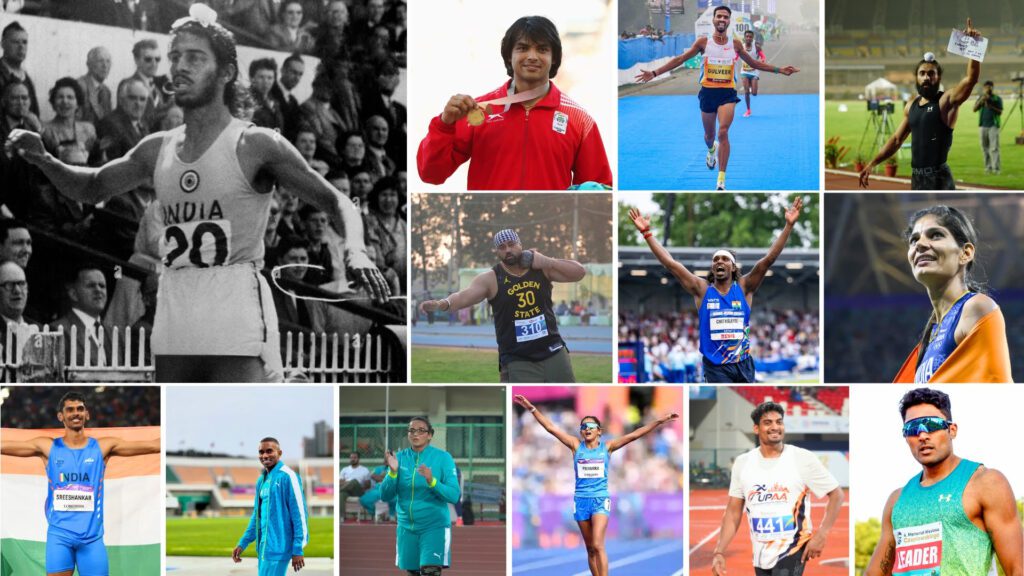
In Glasgow, India isn’t relying on a lone star to carry the flag. This squad has muscle across the board.
On a damp, overcast summer afternoon in 1958, deep inside Wales at the Cardiff Arms Park, Milkha Singh slowly crouched into his blocks. He wore a threadbare white vest, the tricolour hand-stitched over his chest.
When the gun went off, Milkha’s first step in so many ways defined India’s place in the world. It wasn’t just a simple one-lap race; Milkha ran for a young, wounded nation trying to find its place in the world. After 46.6sec, he crossed the line a hair’s breadth ahead of South Africa’s Malcolm Spence.
In that frantic, finish-line blur, India had its first Commonwealth Games athletics gold.
For nearly half a century, that solitary medal stood like a lighthouse. It was a glorious triumph, yes, but it constantly also reminded us of our sporting barrenness. For decades, Indian track and field remained a tragic romance -a series of heart-wrenching, heroic failures against overwhelming odds. We had got used to moral victories and fourth-place finishes.
Fast forward sixty-eight years. The circus moves back to Scotland for the 2026 Glasgow Commonwealth Games. But the story has changed.
The days of sending a handful of hopefuls armed with little more than jugaad, desi ghee, and blind faith are dead. India hasn’t just arrived in Glasgow; it walks through the front door with a confident 32-member athletics squad, filling every single slot in its quota across 18 events.
This isn’t just a story about collecting hardware. It’s the story of how an entire nation stopped praying for miracles and started owning excellence.
To truly understand what is happening today, you have to remember where we came from. For generations, Indian athletics was a heartbreak industry.
Milkha’s agonizing fourth-place finish at the 1960 Rome Olympics set a cruel, invisible ceiling. Twenty-four years later, PT Usha lost an Olympic bronze in Los Angeles by one-hundredth of a second, a fraction of a second that for years was a raw wound, a national trauma.
Every now and then, a titan would emerge: Gurbachan Singh Randhawa, Sriram Singh, TC Yohannan. They were kings in Asia, but unable to crack the podium open.
We lived in the shadow of ‘what if.’ We had world-class talent, but we were stuck in a bullock-cart system. Every medal was a triumph of sheer personal stubbornness.
Our athletes trained on mud tracks, ate haphazard diets, and used antiquated equipment. Field events like the javelin, triple jump, and shot put were treated like novelty acts. We were spectators masquerading as participants.
Then the tide turned. Not by accident but because of two shifts that happened.
What was once our weakest link is now our weapon. In the Men’s javelin, Neeraj Chopra leads a pack that includes Rohit Yadav and Yash Vir Singh. Having three guys from the same country consistently throwing past the 80-meter mark isn’t luck; it’s an assembly line. In shot put, veteran Tajinderpal Singh Toor provides the raw power and big-game experience.
If you told someone twenty years ago that India would be throwing down sub-10.20s times in short sprints, they would have laughed you out of the stadium. Today, sprinters like Gurindervir Singh and Animesh Kujur are running with explosive, world-class mechanics. More than hope, there is a genuine belief.
In the distance events, Indian runners aren’t playing it safe anymore.
Gulveer Singh is taking on the gruelling 5,000m–10,000m double.
Parul Chaudhary is tackling both the 5,000m and 3,000m steeplechase.
Avinash Sable, the man who broke Kenya’s decades-long iron grip on the steeplechase in Birmingham, returns with more tactical acumen.
Praveen Chithravel and Selva Prabhu lead the triple jump campaign after India had taken the top two spots at Birmingham 2022. Young vaulters like Dev Meena are clearing heights and, with a bit of experience, are expected to soar higher. Meanwhile, the 4x400m relay teams are no longer just happy to make the final; they want the podium.
Perhaps the most beautiful part of this shift is where these athletes are coming from.
There was a time when you could guess an athlete’s discipline by their address: Haryana gave us wrestlers, Punjab gave us throwers, Kerala gave us jumpers and middle-distance queens.
Look at the Glasgow roster now. It is a decentralized, sprawling map of India. Kids from the dustbowls of Uttar Pradesh, the coastal tracks of Odisha, Tamil Nadu, Karnataka, and Rajasthan are standing side by side with the boys from Punjab and Haryana.
Scouting networks and modern academies have reached the deepest corners of the country. If you have talent, ability, speed and fire, the system will find you.
When Milkha Singh won in 1958, India celebrated a miracle. It was a beautiful, lonely moment that stood like a time-capsule for half a century.
In Glasgow, if an Indian stands on top of the podium, no one will call it a miracle. It will be the start of business hour.
From a solitary runner in Wales to a 32-strong army in Scotland, Indian athletics has finally grown up. The romance of the near misses is over. India wants to begin its quest for the medals.