
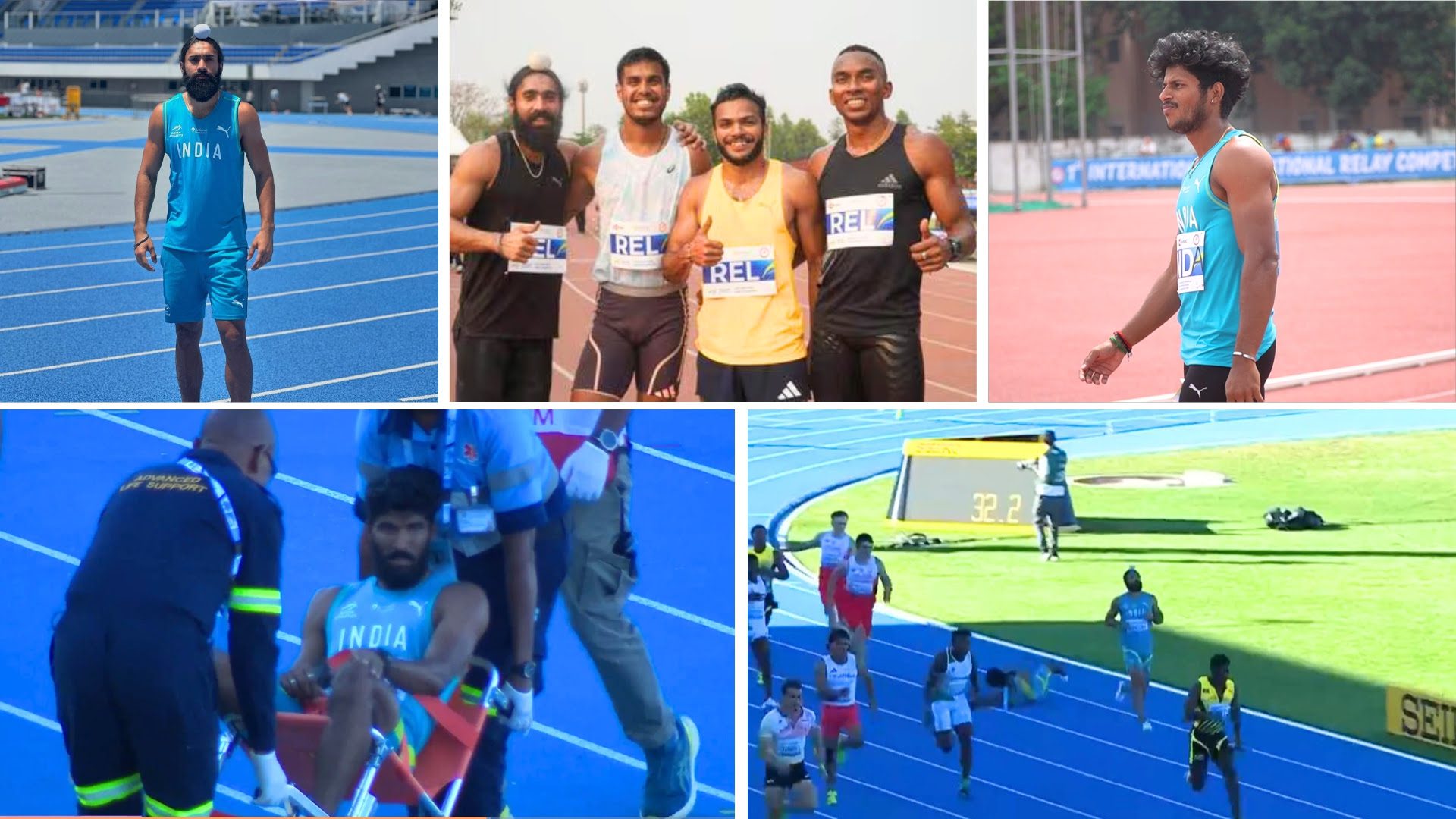
Indian sprinting is experiencing an unprecedented golden era, yet its men’s 4x100m relay dreams are collapsing under the weight of poor planning, technical failures, and internal friction.
The renaissance began in October 2023 when Army sprinter Manikanta Hoblidhar clocked 10.23s, shattering Amiya Mallick’s seven-year-old national record. By 2025, Indian sprinting reached a historic peak. Gurindervir Singh lowered the national record to 10.20s, only for Animesh Kujur to obliterate it three months later with a current national record of 10.18s. In 2025 alone, five Indian sprinters combined for a staggering nine sub-10.30s performances:
10.18s – Animesh Kujur
10.19s – Manikanta Hoblidhar
10.20s – Gurindervir Singh
10.22s – Tamilarasu
10.27s – Pranav Gurav
This explosive depth ignited hope for a competitive men’s 4x100m relay squad. In April 2025, that dream looked tangible when the Reliance-backed quartet of Animesh, Manikanta, Gurindervir, and Amlan Borgohain shattered a 15-year-old national record, clocking 38.69s. Suddenly, India was a genuine medal contender for the 2026 Asian Games.
Instead, what followed has been a story of squandered potential.
Despite a promising win at the Taiwan Athletics Open (38.75s) and promises of “special focus” from AFI spokesperson Adille Sumariwalla, the team has repeatedly found itself in the headlines for the wrong reasons.
In a single year, India was disqualified three separate times under World Athletics Technical Rule 24.7 for passing the baton outside the designated takeover zone:
1. The 2025 Asian Athletics Championships
2. The Open Invitational Relays in Chandigarh
3. Day 2 of the World Relays (following a lacklustre 39.07s run on Day 1)
The recurring technical failures point to a deeper problem. Speaking anonymously to NNIS Sports, a prominent sprint coach blamed the leadership: “The coaching is not up to the mark. That is evident in the way the athletes are exchanging the baton. Team planning has also been poor; there is no consistency in the relay combinations, too much shuffling of running legs, and no proper investment in junior athletes.”
The systemic issues became glaringly obvious during the lead-up to the World Relays. In August 2025, the AFI released a clear selection roadmap. The top six finishers from the 64th National Open Athletics Championships in Ranchi automatically qualified, alongside two wildcard selections based on seasonal merit.
The finalized eight-man squad comprised: Animesh Kujur, Gurindervir Singh, Manikanta Hoblidhar, Pranav Gurav, Harsh, Tamilarasu, Amlan Borgohain, and Ragul.
However, despite the roster being locked in by October 2025, the preparatory camp was inexplicably delayed by nearly five months, only assembling in late February 2026. This left the squad with barely a month of cohesive practice before competing globally.
Furthermore, the appointment of James Hillier, Athletics Director of Reliance Sports (one of the federation’s major sponsors), as the men’s relay coach has raised serious eyebrows regarding a conflict of interest.
“Problems arise when a private company coach is made the national relay coach,” the anonymous coach noted. “They often prioritize the company first, not the nation. This leads to internal conflicts, biased selections, and partiality. You can see the proof in the results.”
An anonymous national team sprinter echoed these concerns, stating that housing the camp at a private organization’s venue made several athletes feel “left out and cornered,” severely damaging team chemistry.
This lack of coordination spilled over into public view during major events. At the 2025 Asian Athletics Championships, a selection dispute erupted between Chief Coach Radhakrishnan Nair and Hillier regarding the heat’s lineup, specifically over whether to include Federation Cup champion Pranav Gurav.
Similar friction occurred at the Chandigarh Open Invitational. While the women’s team arrived early and repeatedly requested joint baton practice sessions, the men’s lineup was finalized so late that it derailed overall preparations.
“Right now, every athlete seems focused on outperforming each other individually,” the anonymous sprinter revealed. “In such an environment, how can they come together and run as one unit for the country? Why are the same athletes repeatedly being rotated between the men’s relay and mixed relay teams? Why not provide opportunities to younger athletes?”
The athlete urged the federation to transition to a long-term, accountable training camp system identical to India’s highly successful 4x400m program, overseen by an accountable Indian head coach.
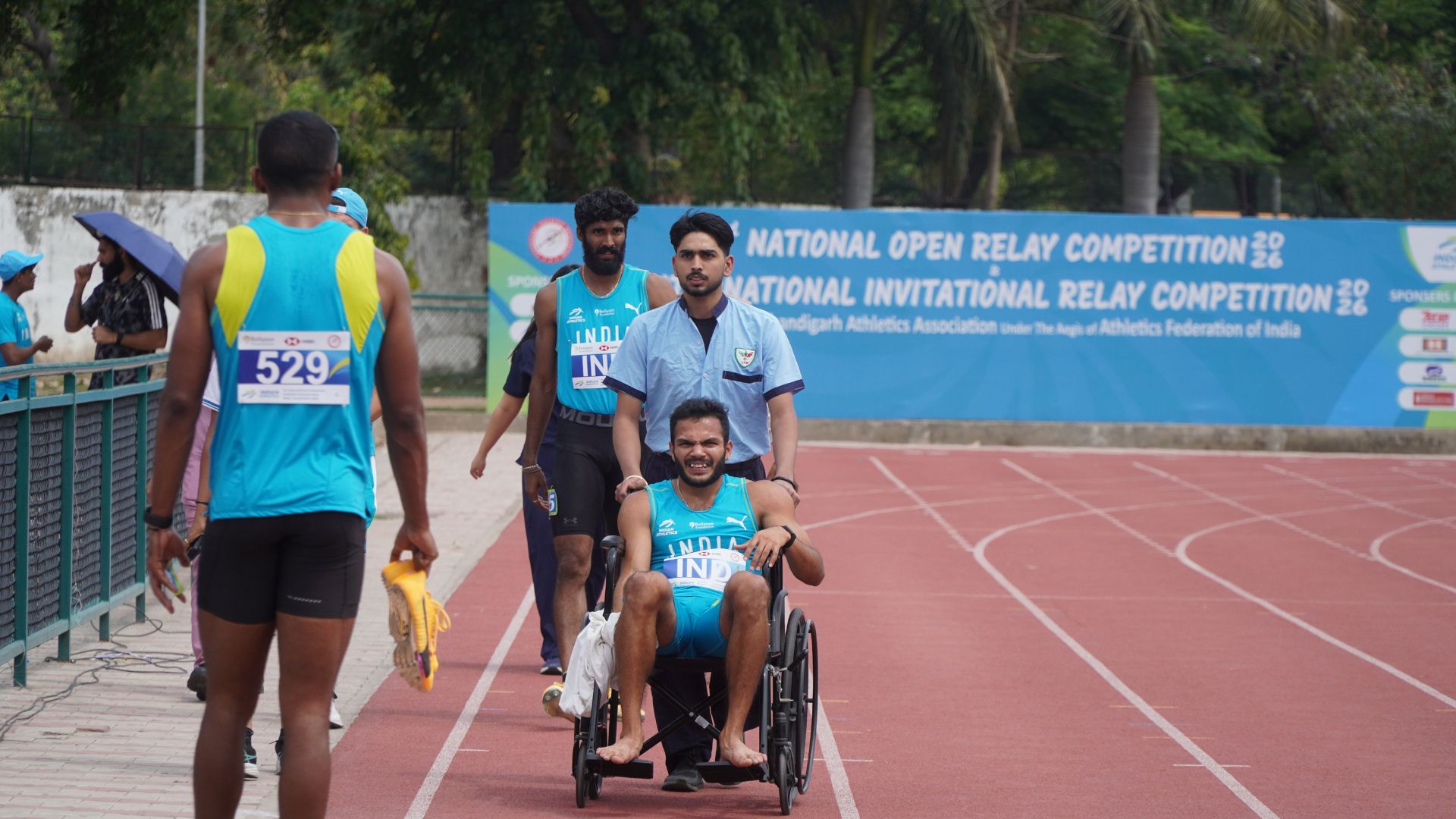
Compounding the administrative chaos is a sudden medical crisis. With less than four months until the 2026 Asian Games, the squad is decimated by injuries:
Amlan Borgohain: Yet to open his season due to injury.
Manikanta Hoblidhar: Recovering from his hamstring injury
Ragul: Left the track in a wheelchair after a heavy fall during a baton exchange.
Tamilarasu: Sidelined during World Relays due to knee pain.
Out of the original eight-man squad, only four athletes remain fully fit.
India possesses the raw, individual speed to match Asia’s best. But facing elite, highly disciplined legacy squads from Japan, China, and Thailand, the biggest question now is whether the AFI can repair its broken internal systems before the clock runs out.
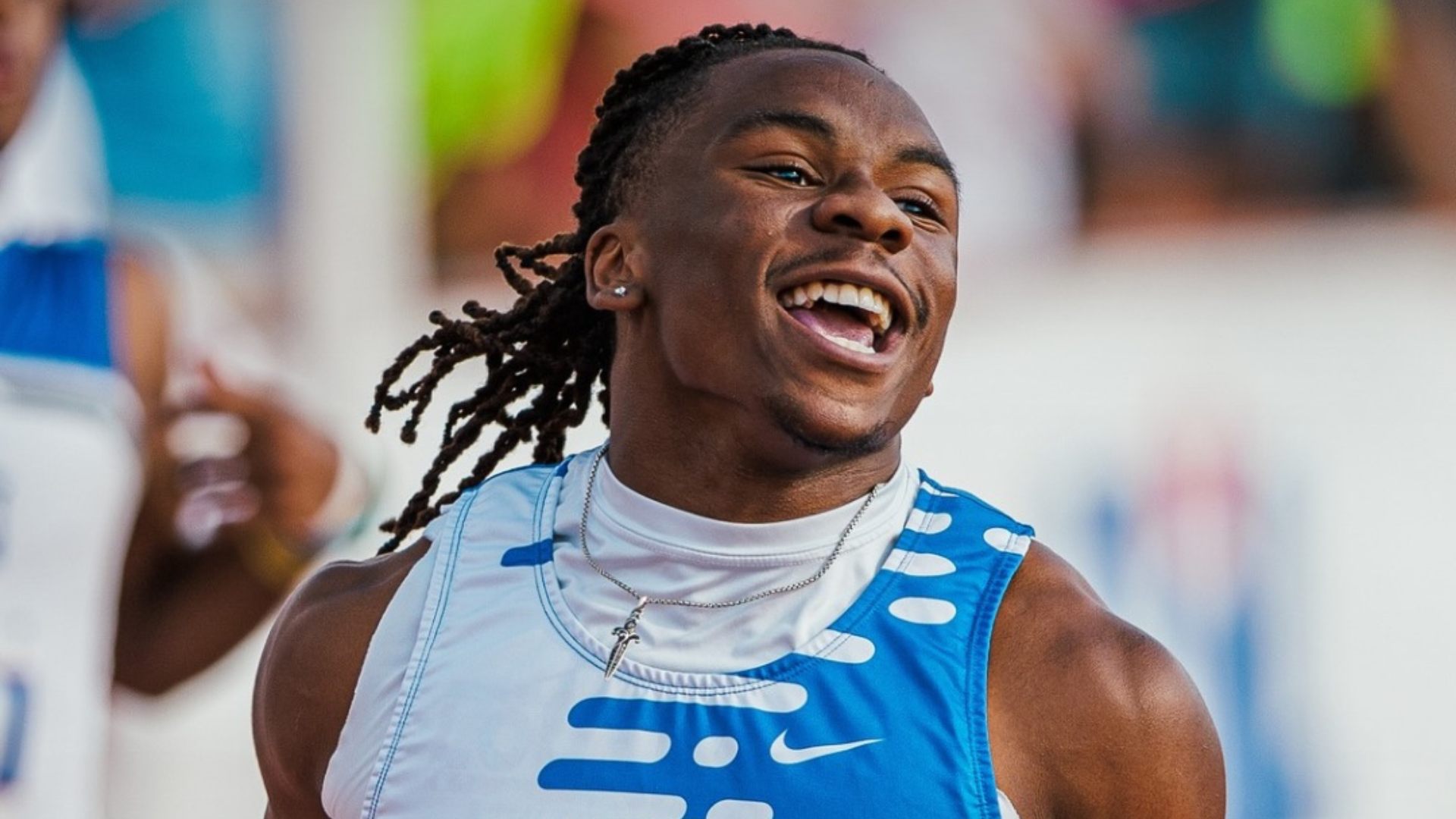
The track and field world is witnessing a historic anomaly. At just 16 years old, American high school sophomore Dillon Mitchell is rewriting what sports scientists thought possible for a teenage human engine.
The standard Under-18 (U18) world record stands at a legal $10.00\text{ seconds}$, established by Japan’s Sorato Shimizu in 2025. However, Mitchell’s 2026 outdoor campaign has thrown standard metrics out the window. Over the course of just a few months, the C.E. King High School sensation has blasted through three astonishing, all-conditions sub-10 performances: a blistering $9.88\text{ seconds } (+5.8\text{ m/s})$, a smooth $9.96\text{ seconds } (+2.8\text{ m/s})$, and most recently, a commanding $9.92\text{ seconds } (+4.0\text{ m/s})$ to capture the Texas UIL Class 6A state title.
While purists will point out that these times are technically wind-aided—exceeding the maximum legal limit of $+2.0\text{ m/s}$—dismissing them misses the broader strategic picture. Operating with that level of raw, baseline velocity at 16 is practically unprecedented. Earlier this year, Mitchell already claimed the official U18 world indoor best in the $60\text{m}$ dash with a stunning $6.59\text{ seconds}$, proving his explosive power out of the blocks is elite at any level. He also holds a wind-legal personal best of $10.10\text{ seconds}$.
The question is no longer if Mitchell can break the barrier, but when. If he can catch the perfect legal tailwind, he is mathematically positioned to become the first U18 athlete in human history to register an official, legal sub-10 second time. The clock is ticking, and history is chasing him.
Sprinter Manikanta Hoblidhar will miss the upcoming Federation Cup after suffering a hamstring injury during the Open Invitational Relay a few weeks ago, dealing another setback to what has already been a difficult 2026 season.
Manikanta, India’s all-time second-fastest man in the 100m, sustained the injury while running the third leg of the relay event. The timing of the setback is particularly significant as the Federation Cup also serves as the final qualification meet for the 2026 Commonwealth Games, making it one of the most important domestic competitions of the season.
The Karnataka sprinter has endured a frustrating campaign so far. Earlier this year, his season opener at the Asian Indoor Athletics Championships ended in disappointment after he was disqualified, preventing him from building momentum early in the season.
Injuries have troubled Manikanta in the past as well. Over the last couple of seasons, he has dealt with recurring fitness interruptions that affected both his training rhythm and competition schedule, despite showing immense promise as one of India’s leading sprint talents.
Manikanta shot into national prominence after clocking one of the fastest 100m times in Indian history, establishing himself as a major contender in Indian sprinting and an important member of the national relay setup.
Despite the latest setback, the sprinter has confirmed that he is already undergoing rehabilitation and remains hopeful of returning before the Interstate Championships later this season.
His recovery will be closely watched, especially with India’s sprint relay programme building towards major international competitions in the coming months.
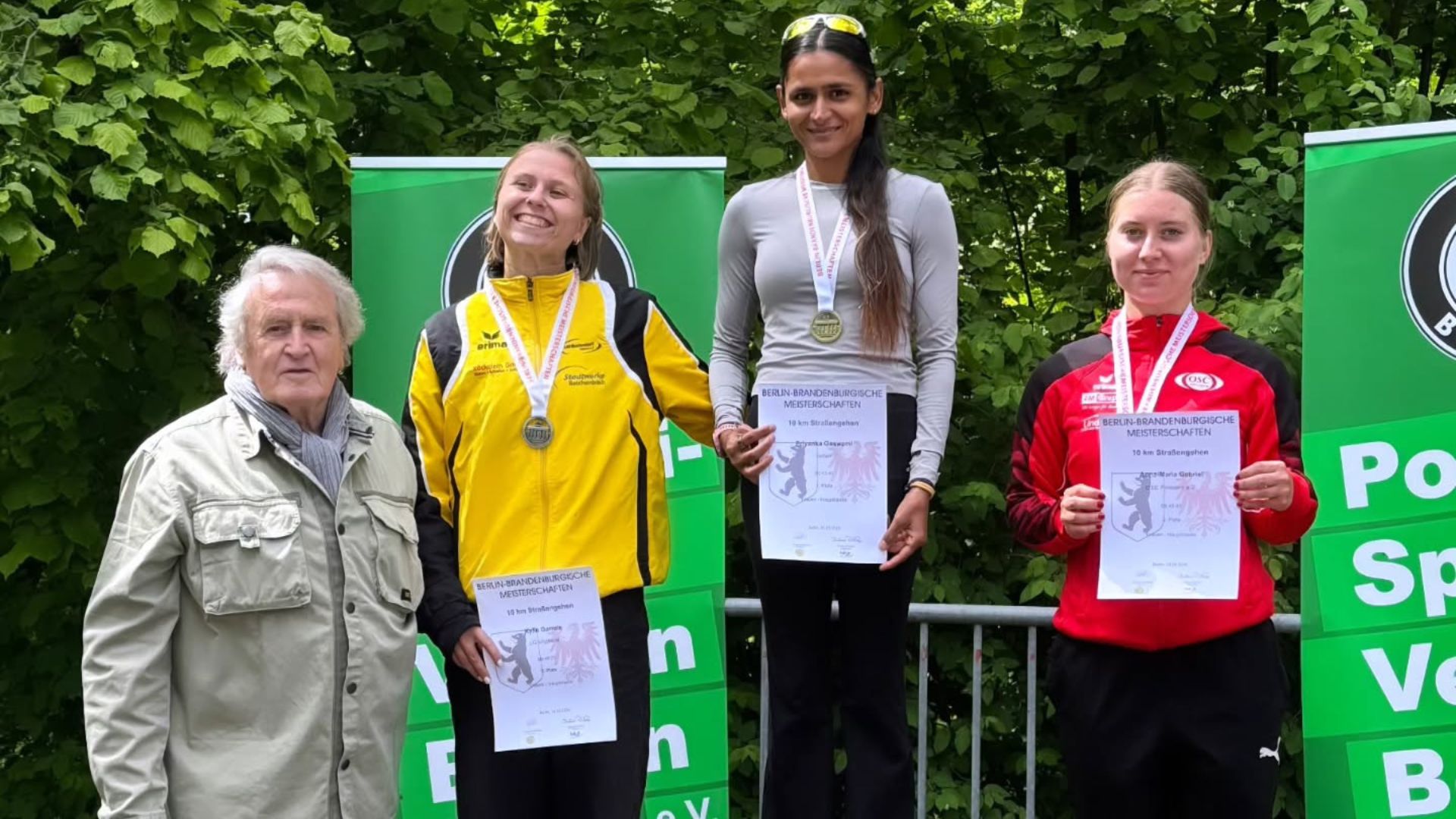
Priyanka Goswami won gold in the women’s 10,000m race walk at the Berlin-Brandenburg Race Walking Championships, registering India’s all-time 2nd fastest time of 43:49s.
The timing was very close to her personal best of 43:38.83, which also stands as India’s national record in the women’s 10,000m race walk.
Czech javelin star Jakub Vadlejch made an impressive start to his 2026 season by winning the men’s javelin title at the Golden Grand Prix in Tokyo with a best throw of 85.24m.
The mark is particularly significant as it is Vadlejch’s first throw beyond the 85m barrier in more than a year and a half. The last time the Czech athlete crossed that distance was during the 2024 Summer Olympics season, underlining the importance of the performance after a difficult 2025 campaign.
Vadlejch, one of the most experienced names in global javelin, endured an inconsistent last season despite moments of promise. His best mark in 2025 came during the qualification round of the World Championships, where he threw 84.11m. However, he struggled in the final and eventually finished 11th with a best effort of 78.71m.
The Tokyo result could therefore signal a timely return to form for the 34-year-old ahead of another crucial international season.
Over the years, Vadlejch has established himself as one of Europe’s leading javelin throwers. He won silver at the Tokyo Olympics in 2021, bronze at the World Championships in 2022 and has consistently been among the top contenders on the Diamond League circuit. Known for his technical consistency and strong competitive temperament, he has often been a regular rival to India’s Neeraj Chopra on the international stage.
With the 2026 season now underway, the 85.24m opener suggests Vadlejch could once again be a serious contender in the global javelin field.
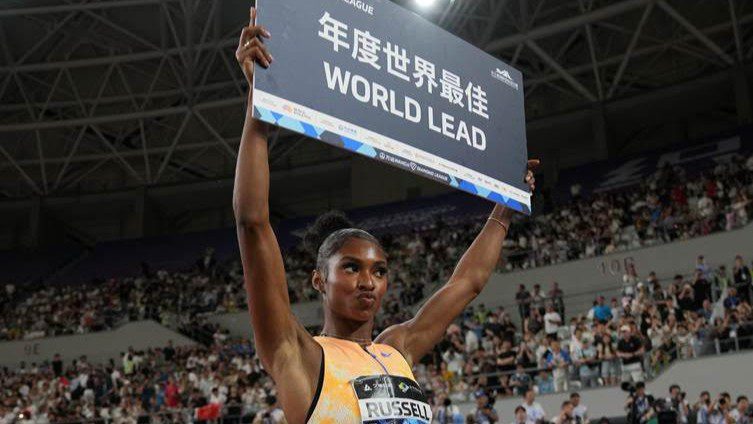
Masai Russell delivered a sensational performance at the Shanghai Diamond League, storming to victory in the women’s 100m hurdles with a world-leading time of 12.25 seconds. Competing with a slight 0.4 m/s tailwind, the American hurdler showcased exceptional speed and precision, recording one of the fastest times of the season and strengthening her status as a top contender on the global stage.
The race also featured a standout performance from Russell’s training partner, Devynne Charlton of the Bahamas, who finished second in 12.38 seconds. Charlton’s impressive run earned her a new national record, continuing her remarkable rise in international hurdling.
Nigeria’s Tobi Amusan secured third place in 12.41 seconds, an impressive effort considering she had claimed the African title less than three days earlier. The former world record holder once again demonstrated her consistency and competitive spirit against a world-class field.
The thrilling contest in Shanghai highlighted the incredible depth and fierce competition currently dominating women’s sprint hurdling.
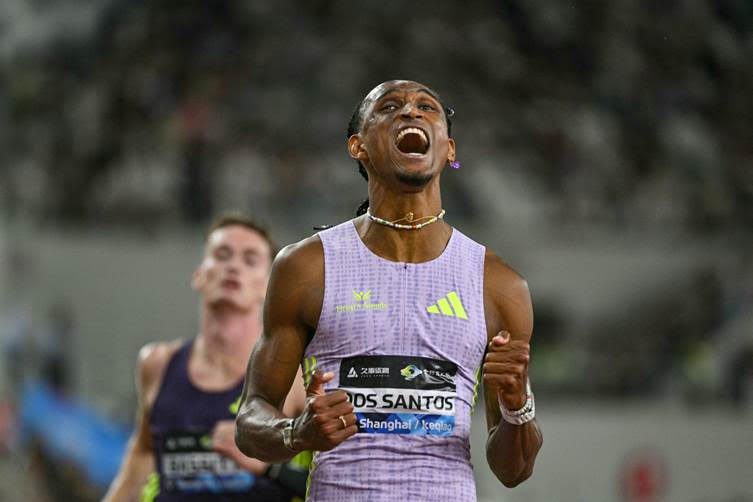
Brazil’s Alison dos Santos produced a spectacular performance at the Shanghai Diamond League, powering to victory in the men’s 300m hurdles with a world-leading time of 33.01 seconds. The world champion displayed remarkable speed and control throughout the race, delivering one of the standout performances of the meet.
Dos Santos faced intense pressure from Norway’s Karsten Warholm, who pushed him all the way to the finish line. Warholm crossed just behind in 33.05 seconds, making it one of the fastest and most exciting 300m hurdles races in recent memory. The fierce battle between two of the sport’s biggest stars captivated fans and highlighted the growing popularity of the event.
Brazil completed a strong showing as Matheus Lima secured third place with a solid run of 33.75 seconds.
The electrifying race in Shanghai once again demonstrated the exceptional level of competition in men’s hurdling, with dos Santos and Warholm continuing their thrilling rivalry on the international stage.
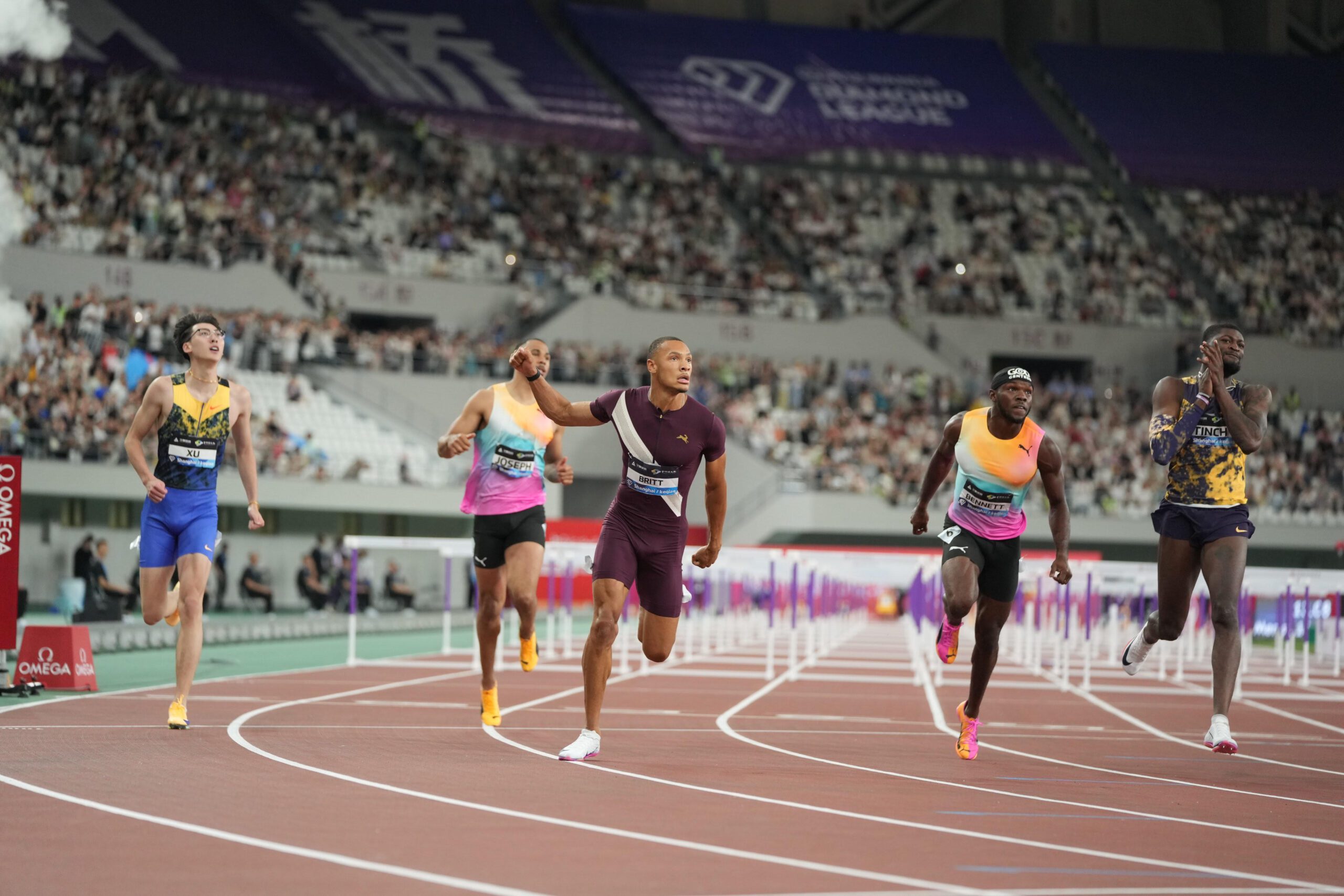
American hurdler Jamal Britt delivered an impressive performance at the Shanghai Diamond League, storming to victory in the men’s 110m hurdles with an equal personal best of 13.07 seconds.
Competing in near-perfect conditions with a legal wind of +0.1 m/s, Britt matched his lifetime best for the third time in his career, underlining his remarkable consistency at the highest level. He held off a strong challenge from fellow American Cordell Tinch, who finished second in 13.10s after a fast finish.
Japan’s Rachid Muratake secured third place with a solid 13.18s performance against a quality international field.
The race once again highlighted the depth in men’s sprint hurdling this season, with multiple athletes dipping close to the 13-second barrier in another high-quality Diamond League showdown in Shanghai.
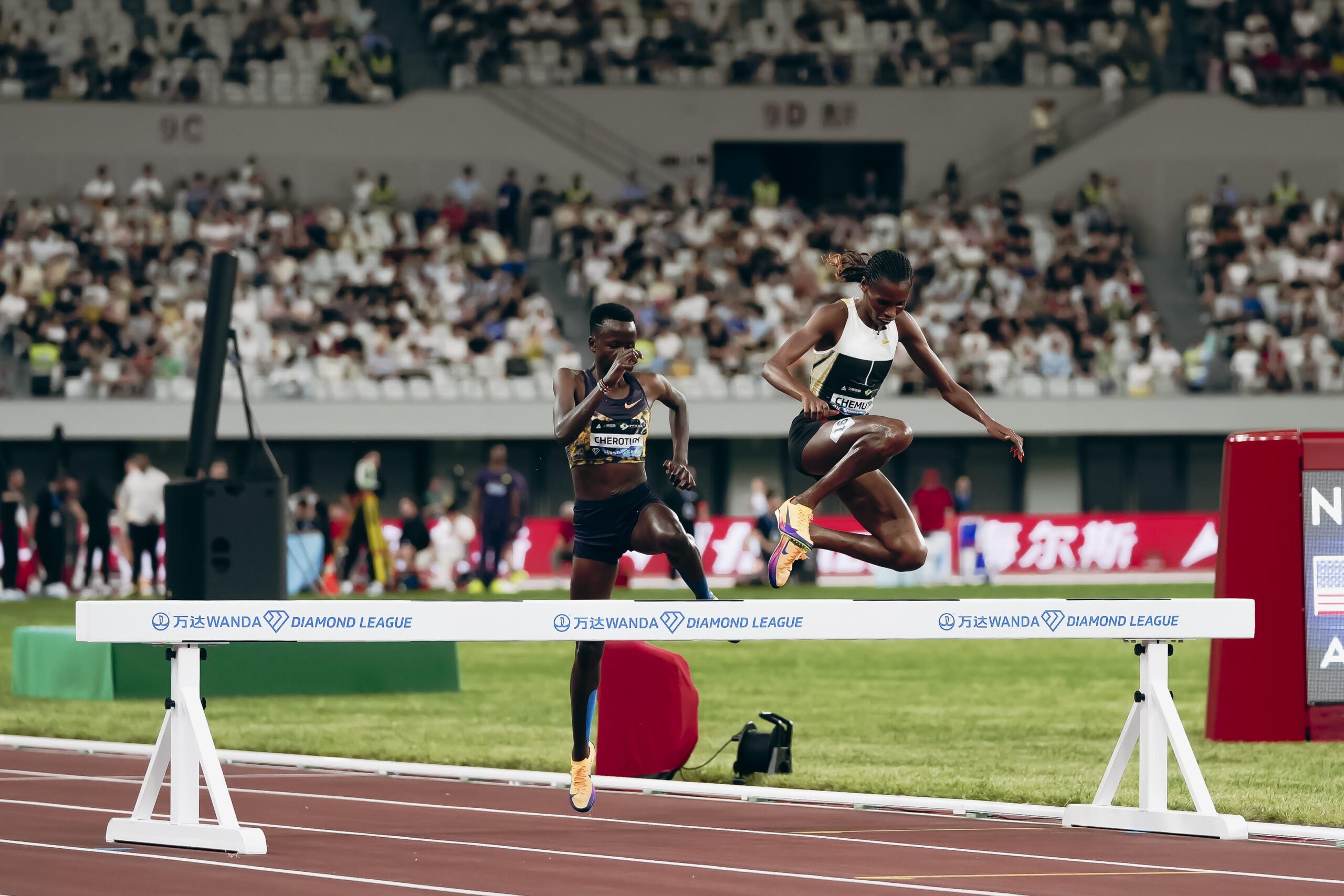
Ugandan star Peruth Chemutai produced a dramatic victory in the women’s 3000m steeplechase at the Shanghai Diamond League, clocking a world-leading and meet record time of 8:51.47.
In a breathtaking finish, Chemutai appeared to celebrate slightly early before narrowly holding off reigning world champion Faith Cherotich by just 0.01 seconds. Cherotich crossed the line in 8:51.48 after an incredible late charge in one of the closest finishes of the season.
Tunisia’s Marwa Bouzayani also delivered a historic performance, smashing the national record with a superb 8:58.09 to finish among the top contenders.
The race turned into an unforgettable showdown featuring world-class times, dramatic final moments, and multiple record-breaking performances, making it one of the highlights of the Shanghai Diamond League meeting.
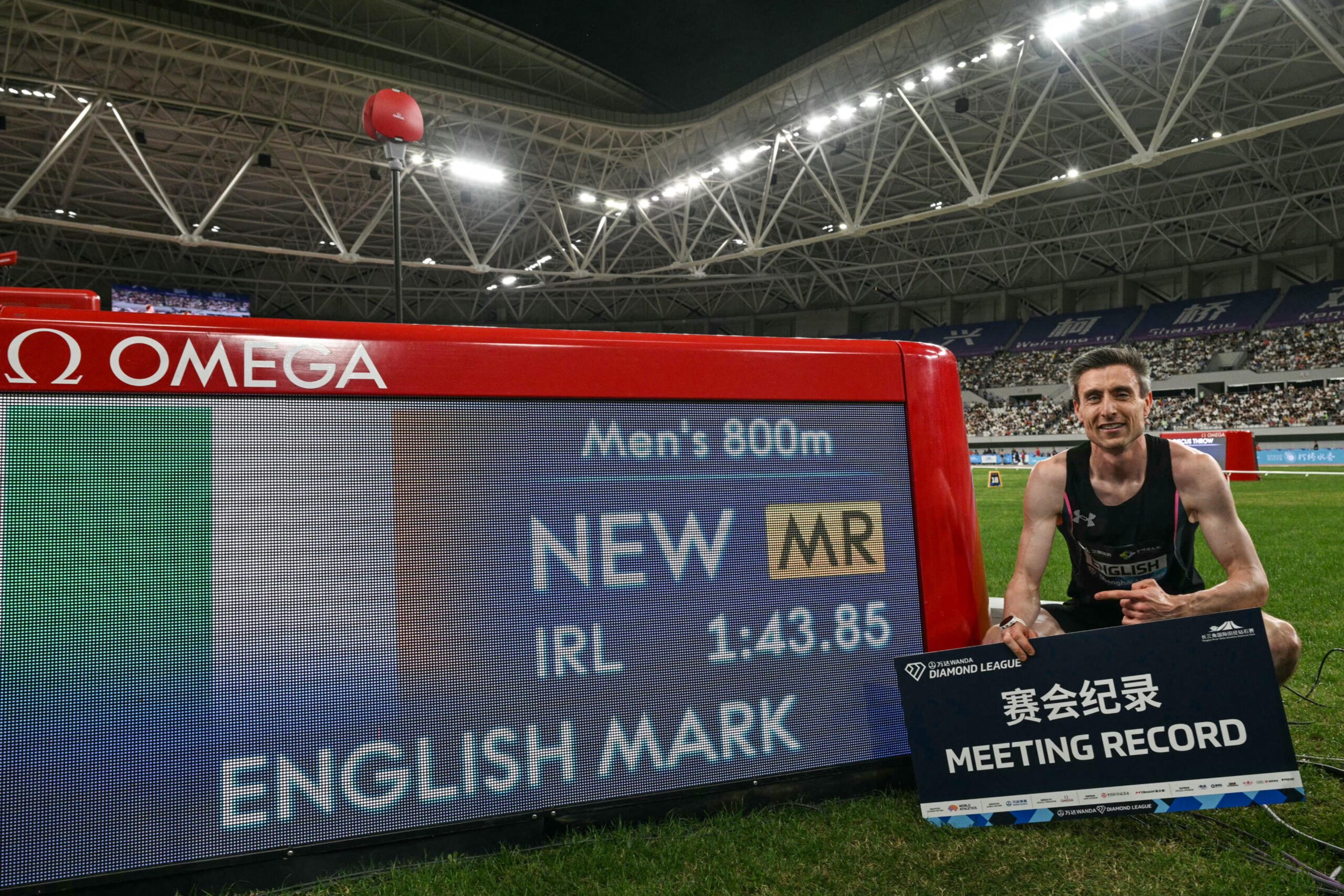
Irish middle-distance runner Mark English delivered one of the performances of the night at the Shanghai Diamond League, storming from sixth place to victory in the men’s 800m with a superb meet record time of 1:43.85.
English timed his finish to perfection, producing a powerful final surge in the closing metres to snatch victory in a thrilling race. His performance erased the previous meet record and marked one of the finest wins of his career on the Diamond League circuit.
Botswana’s Kethobogile Haingura pushed English all the way and finished a close second in 1:43.89, while American athlete Brandon Miller secured third place after clocking 1:44.00.
The race showcased the incredible depth currently present in men’s 800m running, with all three medallists producing world-class times in a dramatic finish in Shanghai.