





An Asian Games medal comes with the medal ceremony, the national recognition and, increasingly, a cash reward from the athlete’s state government.
But there is no single figure for what an Indian medallist earns.
Some states have announced rewards specifically for their athletes in Nagoya. Others already have Asian Games cash-award policies in place. The Centre has its own separate incentive scheme.
For Indian athletics, the differences are substantial.
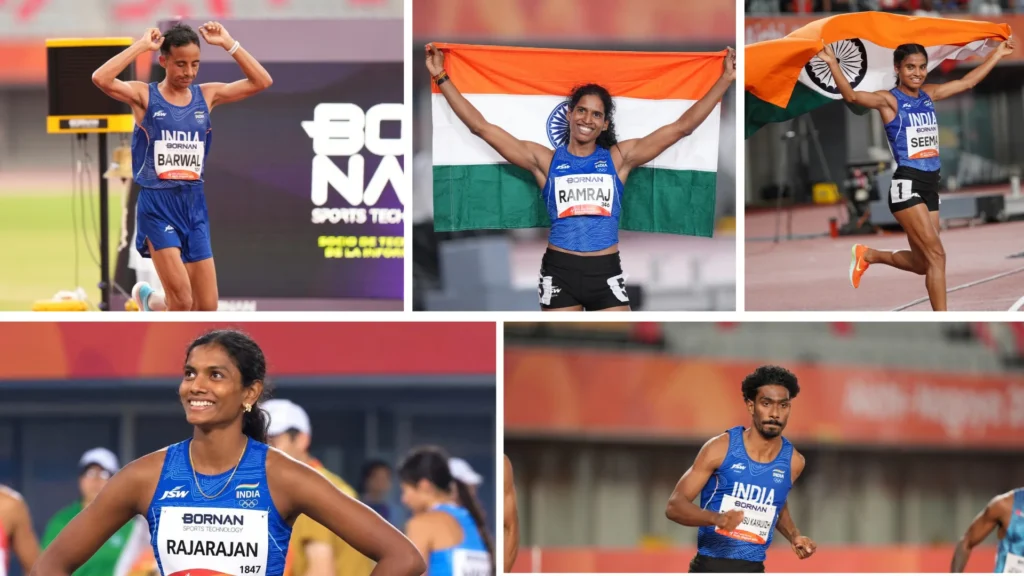
Sawan Barwal’s silver is worth ₹2.5 crore under Himachal Pradesh’s announcement. Vithya Ramraj’s three medals have produced ₹1.55 crore in Tamil Nadu announcements. Meanwhile, Uttar Pradesh’s existing policy provides ₹3 crore for an Asian Games gold medal.
These numbers should not be treated as identical forms of payment. Some are fresh announcements following medals at the 2026 Asian Games; others are existing policy provisions.
Sawan Barwal: ₹2.5 crore for a historic silver
The biggest confirmed state reward for an Indian athletics medallist so far has gone to Sawan Barwal.
Himachal Pradesh announced ₹2.5 crore for Barwal after his silver medal in the men’s marathon in Nagoya.
The reward follows one of India’s more significant athletics performances at these Games. Barwal ran 2:11:37, setting a national record and ending India’s 44-year wait for a men’s marathon medal at the Asian Games.
Himachal Pradesh also announced ₹1.5 crore for Seema Kumari, who won bronze in the women’s 10,000m.
The state’s women’s kabaddi gold-medal winners Pushpa Rana, Ritu Negi, Jyoti Thakur and Bhavana Thakur have been promised ₹33.33 lakh each.
The awards are being made under Himachal Pradesh’s sports cash-award rules.
For Barwal, however, the figure stands out. A silver medal has resulted in a state reward more than eight times the Central government’s standard individual-event silver incentive.
Vithya Ramraj reaches ₹1.55 crore
Tamil Nadu has taken a different approach, announcing rewards as athletes have won medals.
For Vithya Ramraj, three medals have resulted in three separate cash announcements.
She received ₹50 lakh after being part of India’s silver-medal-winning mixed 4x400m relay team.
Her individual bronze in the 400m hurdles brought another ₹30 lakh.
Then came gold in the women’s 4x400m relay, followed by an additional ₹75 lakh announcement.
That puts the total announced for Vithya at ₹1.55 crore.
It is important to describe this as the total of three separate medal rewards. It is not a single ₹1.55 crore Asian Games prize.
Tamil Nadu has also announced ₹50 lakh for Vishal T.K., another member of the mixed 4x400m silver-medal team.
Pole vaulter Baranica Elangovan has been promised ₹30 lakh for bronze, while Abinaya Rajarajan will receive ₹30 lakh for her mixed 4x100m relay bronze.
Tamil Nadu has made similar announcements for athletes from other sports. Squash silver medallist Abhay Singh, for example, has been promised ₹50 lakh.
Punjab: ₹50 lakh for Satnam Singh
Punjab has also made a specific post-medal announcement.
Rower Satnam Singh, who won bronze in the men’s double sculls, has been promised ₹50 lakh by Chief Minister Bhagwant Mann.
The reward is being made under Punjab’s sports policy.
At present, this is a confirmed announcement for an individual athlete rather than a blanket announcement covering every Punjab medallist at the Games.
Then there are the state policies
This is where the numbers become more complicated.
Some states do not need to announce a new reward every time an athlete wins a medal because their sports policies already specify the amount payable for Asian Games performances.
Uttar Pradesh
Uttar Pradesh has one of the larger existing Asian Games reward structures.
Its policy provides:
Gold — ₹3 crore
Silver — ₹1.5 crore
Bronze — ₹75 lakh
But these are existing policy provisions. They should not automatically be described as a fresh 2026 announcement until the state confirms the individual payments to its Nagoya medallists.
Madhya Pradesh
Madhya Pradesh’s existing policy provides:
Gold — ₹1 crore
Silver — ₹50 lakh
Bronze — ₹25 lakh
The state’s sports information specifically covers Asian Games and Para Asian Games medalists.
Again, this is different from a government announcing a new cash award after an athlete wins in Nagoya.
Kerala
Kerala announced its Asian Games reward structure before the athletes left for Nagoya.
Its slabs are:
Gold — ₹50 lakh
Silver — ₹30 lakh
Bronze — ₹20 lakh
The state also announced separate incentives for coaches.
Kerala therefore belongs in the existing/pre-announced policy category rather than the list of governments making new post-medal announcements.
The Centre has a separate scheme
The Union government also provides cash incentives for international sporting achievements.
For individual Asian Games medals, the reported Central government awards are:
Gold — ₹30 lakh
Silver — ₹20 lakh
Bronze — ₹10 lakh
These are separate from state-government rewards and are subject to the eligibility and conditions of the Central scheme.
That means an athlete can potentially receive both a Central government incentive and a state-government award, depending on the applicable rules.
Odisha and Maharashtra: no confirmed 2026 announcement yet
Two major sporting states worth watching are Odisha and Maharashtra.
I have not found a reliable announcement specifically awarding cash to their 2026 Asian Games medallists.
That does not mean their athletes will not eventually receive rewards. State governments often make such announcements when contingents return and official receptions are held.
It simply means there is currently no confirmed 2026 Asian Games-specific announcement that should be added to the list.
The numbers need context
The headline figures are impressive, but the distinction between an announcement, a policy entitlement and an actual payment matters.
So, as things stand, the clearest picture for Indian athletics is:
Sawan Barwal — ₹2.5 crore announced by Himachal Pradesh
Seema Kumari — ₹1.5 crore announced by Himachal Pradesh
Vithya Ramraj — ₹1.55 crore announced across three medals by Tamil Nadu
Vishal T.K. — ₹50 lakh announced by Tamil Nadu
Baranica Elangovan — ₹30 lakh announced by Tamil Nadu
Abinaya Rajarajan — ₹30 lakh announced by Tamil Nadu
Then there are the policy-based figures: UP’s ₹3 crore for gold, MP’s ₹1 crore and Kerala’s ₹50 lakh.
The medal is the same colour on the podium. The cash value attached to it, however, depends very much on where the athlete comes from.