




Sriram Singh, an Indian middle-distance runner, faced a career-threatening respiratory illness that nearly ended his athletic journey. Declared medically unfit, he was reassessed by a dedicated sports medicine team, which identified his condition as exercise-induced asthma.
“As joggers accelerate into runners, the siren of wheezing slowly grows louder. Within minutes, exercise-induced breathing difficulties can bring an aspiring runner to an abrupt halt.”
Almost half a century ago, three men stood together to see off an athlete flying to Bangkok to represent India at the 1978 Asian Games. No media entourage, no band, no garlands, and no cheering crowd. The athlete was Sriram Singh, one of India’s finest middle-distance runners, whose sporting career had come perilously close to ending after doctors declared him medically unfit to continue competing.
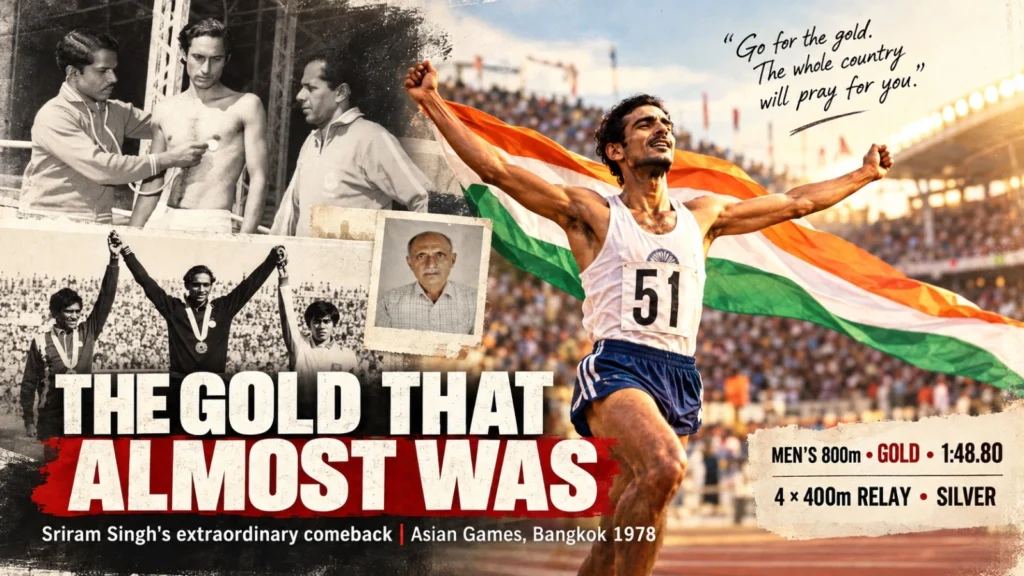
“Good luck, Sriram. Go for the gold. You can do it. The whole country will pray for you.”
Those were the words we offered him. The three of us were Dr.Gopi Kottoor, a sports physician from the Indian Navy; Illyas Babbar, his renowned personal coach; and me, his regimental medical officer.
We were seeing off an athlete whose career had been threatened by a respiratory illness that had not responded adequately to the treatment he had received. Our confidence was not based on wishful thinking. It came from clinical assessment, appropriate treatment, rehabilitation and a carefully monitored return to training.
On 15 December 1978, Sriram won the men’s 800-metre gold medal at the Bangkok Asian Games in 1 minute 48.80 seconds. He also contributed to India’s silver-medal performance in the 4 × 400-metre relay.
His victory was a triumph for Indian athletics. For those of us who worked with him, it also vindicated an emerging discipline still struggling to establish its place in Indian sport: sports medicine.
When An Olympian Was Declared Unfit
Sriram Singh Shekhawat belonged to the Rajputana Rifles Regiment of the Indian Army. His dedication to running had made him one of India’s outstanding middle-distance athletes during the 1970s.
He won the 800-metre silver medal at the 1970 Asian Games in Bangkok and the gold medal at the 1974 Asian Games in Tehran. At the 1976 Montreal Olympics, he reached the 800-metre final and finished seventh in 1 minute 45.77 seconds. That performance established an Indian national record that stood for 42 years, until Jinson Johnson broke it in 2018.
Sriram had demonstrated that an Indian runner could compete with the best in the world. Yet, after Montreal, his athletic future suddenly became uncertain.
In 1977, while training at the National Institute of Sports camp in Patiala, he developed a persistent cough, breathing difficulties and chest discomfort during running. Medical investigations were undertaken, and he received conventional treatment, including antibiotics, anti-allergic medication and corticosteroids. The diagnoses included pneumonitis and bronchial asthma, but his condition did not improve sufficiently for him to resume training.
Eventually, doctors declared him medically unfit for sport and sent him away from the national camp.
For an athlete who had reached an Olympic final, this was devastating. His career, painstakingly built through years of training, was suddenly threatened by an illness that appeared to defy treatment.
The predicament of an Olympic runner who could no longer run attracted attention. But there was another way of looking at the problem. Was Sriram necessarily unfit for sport, or was the precise nature of his illness still unknown? Newspaper headlines read: “India’s ace athlete Sriram Singh felled by a lung ailment which no Indian doctor knows how to treat.”
That distinction became the starting point of his rehabilitation.
A Fresh Assessment Changes The Course Of Events
A dejected Sriram returned to his Army base at the Rajputana Rifles Regimental Centre in Delhi Cantonment and reported to me, his authorised regimental medical officer.
That was my first personal introduction to him. It was February 1978, approximately ten months before the Asian Games in Bangkok.
Despite his achievements, he was an unassuming soldier, without airs or pretensions. He remained deeply attached to running and was reluctant to accept that his athletic career had ended.
Sports medicine was a relatively young discipline in India at the time. I was particularly interested in understanding the medical problems athletes face and finding ways to return them safely to training and competition. Sriram’s case presented precisely the kind of challenge that required this approach.
We established an immediate rapport. His coach, Illyas Babbar, was brought into the discussions, and the Commandant of the Regimental Centre agreed to release Sriram from his routine military duties so that his medical management and rehabilitation could receive the necessary attention.
I discussed the case with Dr.Gopi Kottoor, who was heading the newly established Sports Medicine Centre of the Armed Forces in Delhi Cantonment. Together, we decided that Sriram deserved a fresh assessment before anyone concluded that he could no longer compete.
We arranged further investigations, drawing on facilities available at the Army Hospital, Patel Chest Institute and the Defense Institute of Physiology and Allied Sciences (DIPAS) in Delhi.
The persistence of his symptoms, their relationship to running and his limited response to previous treatment led us to examine the possibility of exercise-induced asthma.
The critical clue was the pattern of his breathing difficulties. He could run reasonably well, but after about six to eight minutes of exercise, he developed breathlessness and chest discomfort. Running became laborious, and the symptoms could force him to stop.
Understanding this pattern required us to look beyond the symptoms in isolation. We needed to understand how his respiratory system responded to the specific demands of athletic exercise.
Recognising Exercise-Induced Asthma
Exercise-induced asthma, now more commonly discussed under the term exercise-induced broncho-constriction, involves narrowing of the airways during or after physical exertion. Symptoms can include coughing, wheezing, chest tightness and breathlessness.
For a middle-distance runner, these symptoms can be particularly disabling. The 800 metres demands considerable speed, endurance and sustained effort. A runner who cannot breathe comfortably during a race cannot realise his full potential, however strong his legs or determined his mind.
The challenge was to identify the mechanism behind Sriram’s symptoms and determine whether they could be controlled enough to allow high-level training.
We studied the available medical literature and sought expert guidance. Contemporary research on exercise-induced asthma, together with our clinical observations and investigations, helped us refine our understanding of the case. We also contacted Australian sports physician Kenneth Fitch, whose work included exercise-induced asthma. His views supported our assessment.
The case demonstrated the importance of combining clinical observation with appropriate investigations and specialist consultation. The objective was not to avoid medical tests, but to ensure that they answered the right questions.
An athlete’s symptoms must be interpreted in the context of the sport, training intensity, and the circumstances in which they appear.
This is where sports medicine has a distinctive role. The physician must understand both the patient’s medical condition and the physical demands of the activity the patient hopes to return to.
In Sriram’s case, identifying the exercise-related respiratory problem opened a path that had previously appeared closed.
Treatment, Training And Trust
Once the diagnosis had been established, the next challenge was treatment.
At the time, anti-doping regulations restricted athletes’ use of certain medicines prescribed for asthma. Treatment therefore required careful consideration of both medical needs and the rules in force.
We selected sodium cromoglycate, an inhaler-based medication used to manage asthma. Sriram tolerated it well, and his symptoms responded favourably.
With his breathing difficulties brought under control, we could begin the gradual process of restoring his training capacity. The medication became part of his medical management, not a substitute for training or physical conditioning.
The distinction is important. Treating an athlete’s illness is only one part of sports medicine. The other is determining how, when, and under what conditions the athlete can safely resume training.
Our guiding principle was simple: treat and train.
Sriram was fortunate to have Illyas Babbar as his coach. Babbar understood the demands of middle-distance running and the importance of maintaining an athlete’s confidence. The coach and the two doctors worked together, monitoring Sriram’s medical condition, training load, diet, and response to exercise.
Training was resumed progressively. They increased his workload based on his response rather than a rigid schedule. The medical team remained closely involved on the training ground, observing his symptoms and adjusting the program when necessary.
The rehabilitation required patience. An athlete who has been unable to train cannot simply be instructed to resume a previous workload. Fitness must be rebuilt, and confidence must return alongside physical capacity.
Over the following months, Sriram made steady progress. After about six months, he could tolerate a much more demanding training program without the breathing difficulties that had threatened his career.
Eventually, he returned to the national training camp at Patiala—the very place that had sent him away as medically unfit.
This time, he returned as a runner preparing to compete.
The transformation was not the result of a miracle cure. It came from identifying the problem, choosing appropriate treatment, respecting the athlete’s response, and combining medical supervision with his coach’s expertise.
Above all, it required a willingness to reconsider an earlier verdict.
Bangkok: The Answer On The Track
The 1978 Asian Games in Bangkok gave Sriram the chance to show what his rehabilitation had achieved. On 15 December 1978, Sriram won the men’s 800-metre gold medal at the Bangkok Asian Games in 1 minute 48.80 seconds. He also contributed to India’s silver-medal performance in the 4 × 400-metre relay.
The athlete who had struggled to breathe during training a year earlier was now preparing to race against Asia’s best. His doctors and coach could offer encouragement, but once the race began, the responsibility rested with him.
Sriram won the men’s 800 meters in 1 minute 48.80 seconds. He also contributed to India’s silver-medal performance in the 4 × 400-metre relay.
For Indian athletics, these achievements were significant. For our small team, the 800-metre gold carried a special meaning. It was the culmination of a journey from illness and uncertainty to diagnosis, treatment, rehabilitation and international success.
The medal belonged first and foremost to Sriram. His determination, discipline and willingness to work through a difficult period made the comeback possible. Babbar’s coaching was indispensable, and the medical intervention helped make his return to competition possible.
This was teamwork in its truest sense.
The story also illustrates why sports medicine’s value cannot be measured merely by counting injuries treated or consultations completed. Sometimes its greatest contribution is to prevent an athlete from being lost to sport unnecessarily.
A Medical Case Worth Remembering
Sriram’s case was subsequently documented in a scientific paper titled Case report: “An athlete runs through his asthma”, authored by P. S. M. Chandran and G. Kottoor, and published in the British Journal of Sports Medicine in March 1982.
The publication placed the case in the medical literature beyond the recollections of those who participated in it. It connected the athlete’s respiratory problem with the clinical assessment and management that enabled his return to high-level sport.
The case deserves to be remembered not simply because an Olympic athlete won another gold medal, but because it demonstrates an enduring principle: a medical condition does not automatically mean the end of an athletic career.
Exercise-induced asthma is one example. Athletes may also experience stress fractures, plantar fasciitis, anterior cruciate ligament injuries, exercise-related cardiac concerns, and many other conditions requiring specialised assessment.
The appropriate response is neither to dismiss the problem nor to rush the athlete back into competition. It is to establish the diagnosis, assess the risks, treat the condition and plan a safe return to sport.
Modern sports medicine has advanced considerably since the 1970s. Diagnostic methods, rehabilitation techniques, monitoring systems and knowledge of exercise physiology have all improved. Yet the sports physician’s fundamental responsibility remains unchanged: protect the athlete’s health while helping the athlete achieve the highest possible level of performance.
The doctor must know when to treat, when to investigate and when to refer. Equally, the doctor must recognise when a condition can be managed rather than assuming that participation in sport is no longer possible.
The Doctors Behind The Medals
Sriram’s story brings a larger issue into focus.
Sport is a public spectacle. Athletes who win medals rightly receive attention, as do their coaches and the sporting institutions they represent. But the contributions of physicians and other medical specialists who help athletes recover from career-threatening conditions often go unnoticed.
Consider a young athlete struggling to find a doctor with the right experience when facing a serious sports-related problem. Without appropriate guidance, valuable time may be lost, treatment may be delayed, and the athlete may be advised to abandon sport prematurely.
Sports medicine must therefore become more accessible and more visible. Athletes, parents, coaches and sporting administrators need to understand when specialist medical expertise is required.
The solution is not to create artificial divisions within an athlete’s support team. Physiotherapists, sports scientists, nutritionists, psychologists, coaches and physicians each have essential responsibilities. Their roles must complement one another, with clear professional boundaries and effective communication.
This is particularly important in anti-doping practice. Medicines routinely used to treat ordinary illnesses may be restricted under the anti-doping rules applicable to athletes. Sports physicians must understand the relevant prohibited list, therapeutic use exemption requirements and medication rules in force at the time of treatment. Protecting an athlete means protecting both health and eligibility to compete.
The larger purpose is athlete welfare, not administrative convenience.
A Welcome Change
There is reason to welcome the growing recognition of sports medicine and sports sciences in Indian sport. Including doctors, sports scientists, and recovery specialists in training camps and in Indian contingents competing at home and abroad is an encouraging development.
Equally important is giving these professionals the recognition, respect, and working conditions they need to fulfill their responsibilities.
For too long, members of the sports sciences fraternity were visible around athletes but were not always treated as integral members of the performance team. A change in that approach is welcome.
Sriram Singh’s story, from the uncertainty of 1977 to the triumph of Bangkok in 1978, reminds us why this recognition matters. Behind a successful athlete may be a coach who understands the sport, a physician who recognises the illness, a scientist who interprets the evidence, and a team willing to work together.
The athlete earns the medal. But a sporting system that values medical knowledge and respects the people who provide it gives more athletes the opportunity to reach the starting line—and sometimes to discover their careers aren’t over after all.
The Lesson For Indian Sport
Looking back, I believe Sriram Singh’s rehabilitation was an important early example of what sports medicine can do in India. It would be unwise to claim that it was definitively the first such case in the country without a comprehensive historical review. Nevertheless, it remains a particularly valuable, medically documented example of an elite athlete returning to success after a career-threatening illness.
Sriram went on to receive major national honours, including the Arjuna Award and the Padma Shri. His achievements rightly belong in India’s athletics history.
I remember the three of us standing together as Sriram prepared to leave for Bangkok. We had no way of guaranteeing a gold medal. We knew only that an athlete who had been written off had regained the ability to train and compete.
Our message to him was simple: “Go for the gold.”
He did.