




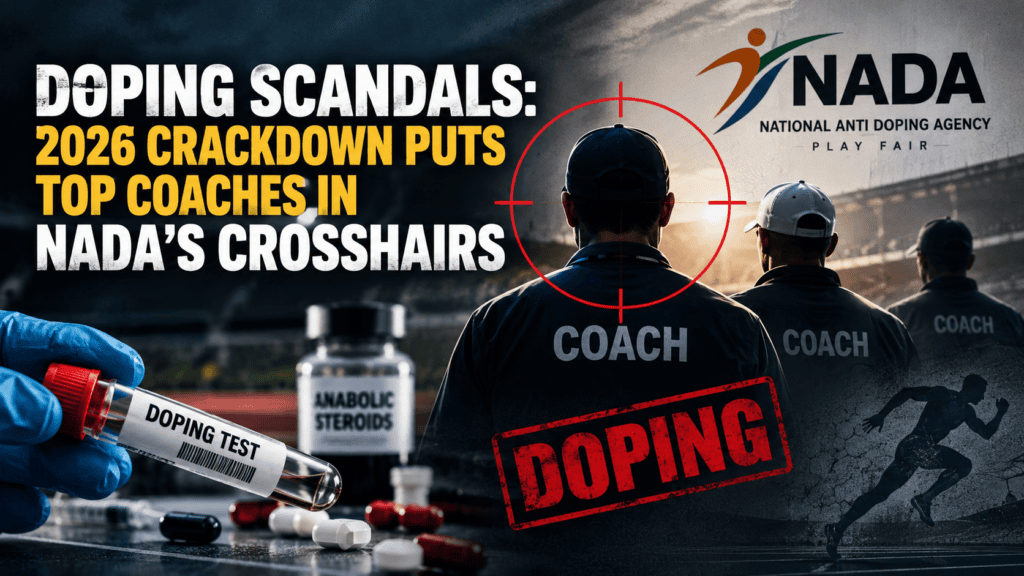
For years, athletes in India faced most of the consequences of doping scandals. However, 2026 has marked a turning point. The National Anti-Doping Agency (NADA) has shifted its focus toward structural accountability. As a result, prominent coaches and support staff now face scrutiny under strict anti-doping regulations.
The recent provisional suspension of Yunus Khan, a middle- and long-distance coach at the Army Sports Institute (ASI), has sent shockwaves through Indian athletics. Khan is a prominent name in distance coaching. He has trained elite runners, including Asian Games medallist Gulveer Singh, Kartik Kumar, and Sawan Barwal.
The Case Against Yunus Khan
Charges and Allegations
NADA provisionally suspended Yunus Khan under Article 2.9, which covers complicity in an anti-doping rule violation.
According to the allegations, Khan facilitated training access for Kartik Kumar, a distance runner serving an active NADA suspension. He allegedly provided reference letters or authorization that allowed Kumar to access official, federation-recognized training facilities.
Under anti-doping regulations, helping a suspended athlete bypass facility access restrictions may constitute complicity.
Legal Developments
The Anti-Doping Appeal Panel cleared the suspension, legally exonerating Nagapuri of the provisional charges brought against him. However, proceedings against N Ramesh remain ongoing before the Anti-Doping Disciplinary Panel.
2026 Crackdown: Prominent Coaches Facing Action
Yunus Khan is not an isolated case. In 2026, NADA’s official registry reflected a broader push to enforce accountability among coaches. The following cases involve four other prominent Indian athletics coaches who have faced action under Anti-Doping Rule Violations (ADRVs).
1. Rakesh Kumar
Sanction: NADA reportedly imposed a lifetime ban on Rakesh Kumar. This case represents one of the first instances in Indian athletics history of a coach receiving a permanent ban.
Background: Kumar is reportedly based in Bihar.
Charge: NADA sanctioned him under Article 2.8. This provision covers the administration or attempted administration of prohibited substances or methods. It also addresses aiding, abetting, or covering up an anti-doping rule violation.
Legal caveat: Public disclosures from NADA provide limited details about the specific evidence and documentation in this case.
2. Ramesh Nagapuri
Sanction: Nagapuri initially faced a provisional suspension. However, the Anti-Doping Appeal Panel (ADAP) subsequently lifted it.
Background: Nagapuri is a prominent figure in Indian sprinting. He coached Dutee Chand and served as a national junior athletics coach appointed by the Athletics Federation of India (AFI) at the time of the charge.
Allegation: NADA accused him under Article 2.9, which covers complicity. The allegation concerned an incident on December 2, 2024, at the GMC Balayogi Athletics Stadium in Hyderabad. He allegedly instructed athletes to leave the stadium to evade surprise doping control. He also allegedly failed to provide contact details for athletes under his care.
Legal caveat: The Anti-Doping Appeal Panel cleared the suspension, legally exonerating Nagapuri of the provisional charges brought against him.
3. Sandeep Maan
Sanction: As of April 1, 2026, NADA’s official list recorded Sandeep Maan under Article 2.7, which covers trafficking or attempted trafficking of prohibited substances.
Background: Maan is a national-level coach from Sonipat, Haryana.
Allegation: He allegedly supplied prohibited substances to track-and-field athletes.
Case context: The investigation stems from positive drug tests involving junior athlete Sanjana. She broke national records and won gold at the National Open and South Asian levels before testing positive for multiple banned substances.
4. Mickey Menezes
Sanction: The Anti-Doping Disciplinary Panel (ADDP) imposed a four-year ban and a ₹50,000 fine on Mickey Menezes.
Background: Menezes is a high-profile athletics coach based in Mumbai.
Charge: The panel found him guilty of violations under Articles 2.8 and 2.9. The case involved administering the prohibited anabolic steroid Drostanolone by injection to his trainee, Kirti Bhoite.
Defense: Menezes maintained that his supplier had misled him. According to his defense, the supplier claimed that the injection contained no banned ingredients.
Why the 2026 Crackdown Matters
These cases highlight the growing focus on accountability beyond athletes. Coaches and support staff play an important role in training, athlete welfare, and compliance with anti-doping rules.
Consequently, allegations involving prohibited substances, trafficking, or assistance to suspended athletes can have serious professional and legal consequences. However, each case must be assessed on its own evidence and procedural outcome. A provisional suspension or allegation does not automatically establish guilt.
As anti-doping enforcement continues to evolve, greater scrutiny of coaches may become an important part of protecting fair competition in Indian athletics.