





By Sundeep Misra
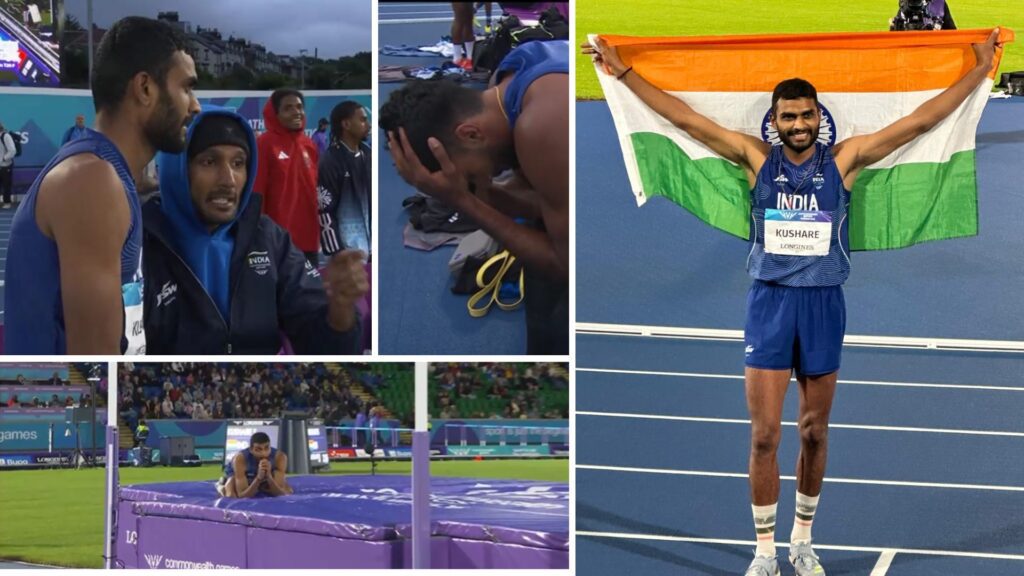
At 2.25 metres, two jumps binned, it seemed curtains for Sarvesh Kushare. Up to that point, every mark had been cleared in a single, fluid rush of air. Then came the third attempt. Kushare sailed, the bar trembled on its pegs, and the few diehard Indian fans suffocated on their own breath. Then, a collective exhale – the bar held. The bar moved to 2.28m.
Three men remained: a Brit, a Jamaican, and an Indian. Decades ago, long before the Commonwealth found its modern sporting identity, the podium hierarchy would have been pre-written. Not this time. England’s Kimani Jack faded after two misses, settling for bronze. Jamaica’s Romaine Beckford and Kushare both hit a wall at 2.28m, failing to clear.
Sarvesh had the final jump of the competition, but the gold slipped through his fingers. It came down to the painful arithmetic of countback: Beckford had cleared 2.25m on his first try, Sarvesh on his third. That single aberration, call it an error, cost him the top step. Silver, though, was a triumph and the story behind it ran deeper than the result sheet. Earlier in the evening, Tejaswin Shankar (TJ) had withdrawn from the event leaving open the tantalizing question of what a fully fit TJ might have achieved alongside him. But instead of retreating to the warm-up track or the quiet of the athlete’s lounge, TJ stayed.
He sat on the athlete’s bench at the edge of the apron, refusing to leave Kushare’s side. Between every run-up, as the stadium light flickered and the cold evening breeze swirled across the pit, the two exchanged tips. TJ wasn’t just offering empty encouragement; the former national record holder was watching and dissecting the jumps. Stride adjustments, angle of Sarvesh’s plant foot would have been scanned and corrections made. High jump is a solitary discipline; one athlete, a crossbar, and the sky.
TJ and Sarvesh made it a team event. Silver was secured not just on pure adrenaline but on a shared brotherhood forged under the floodlights.
For more visit Commonwealth Games 2026