




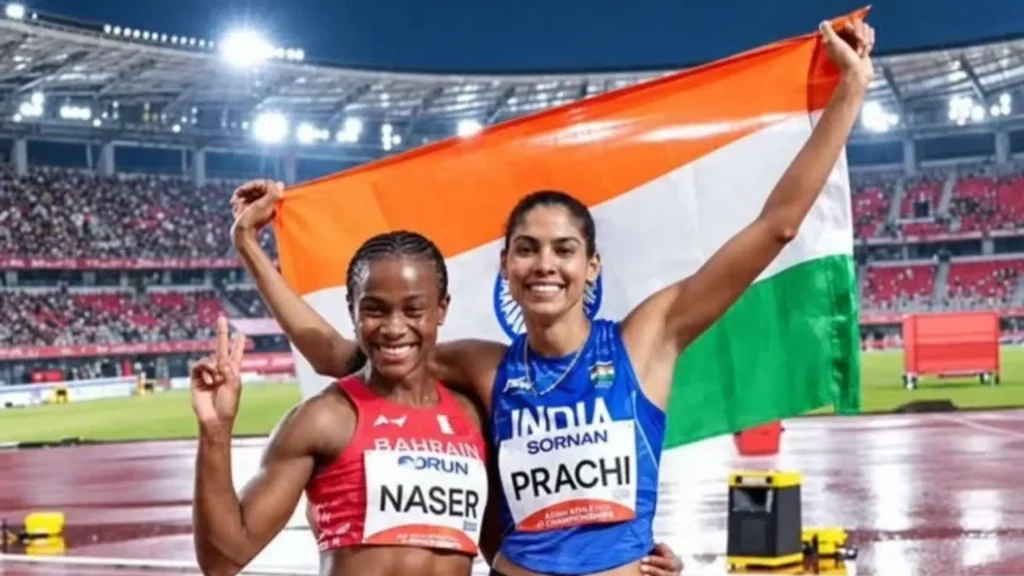
There was little doubt about the billing before the women’s 400m final at the Asian Games in Nagoya. Salwa Eid Naser was the star of the field. By the time she crossed the finish line, the Bahraini had made the statement the event demanded.
Naser won the women’s 400m gold at the Aichi-Nagoya Asian Games in a Games-record 49.20 seconds, finishing more than three seconds ahead of Iran’s Zahra Zarei Manoujan, who took silver in 52.38. India’s Prachi Choudhary ran a personal milestone race for bronze in 53.21, while Kiran Pahal finished fifth in 53.41.
The Nagoya gold was Naser’s second Asian Games 400m title. She had first won the event in Jakarta in 2018, when she set the previous Games record of 50.09. She had finished with silver at the Hangzhou Asian Games in 2023. In Nagoya, she took back the title and then some, lowering her own Games record by almost a full second.
And 49.20 seconds, particularly on a rain-soaked evening in Nagoya, was a reminder that the name Salwa Eid Naser belongs among the biggest names in the modern 400m.
But who exactly is Salwa Eid Naser?
From Nigeria to Bahrain
Naser was born on May 23, 1998, in Onitsha, Nigeria, to a Bahraini father and Nigerian mother. She moved to Bahrain at the age of 14 and began building the career that would eventually make her one of the most recognisable 400m runners in the world.
Her talent appeared early.
According to World Athletics, Naser was already beating children in street races as a youngster and won her first competitive race at the age of 11. The 400m, however, was not immediately love at first lap. She raced the distance as a child, found it painful and decided she never wanted to run it again.
Thankfully for Bahrain — and for the 400m — she changed her mind.
In 2014, she won the 200m and 400m at the Arab Junior Championships and then won silver in the 400m at the Youth Olympic Games in Nanjing, running 52.74 seconds. A year later came the first major international warning of what was coming: Naser won the 400m at the World Youth Championships in Cali in 51.50.
She was still a teenager.
And she was already running like an athlete in a hurry.
The making of a 400m star
Naser’s progression was remarkably quick.
At the 2016 Rio Olympics, still an under-20 athlete, she ran a national U20 record of 50.88 in the semi-finals. A year later, at the World Championships in London, she won silver in 50.06, becoming the youngest woman to win a World Championships medal in the 400m.
Then came 2018.
This was the season when Naser stopped looking like an exciting young prospect and started looking like a global force.
She won 10 of her 11 400m races that year. At the Diamond League meeting in Monaco, she ran 49.08 seconds — at the time an Asian record. She followed that with Asian Games gold in Jakarta, a Diamond League final victory and a Continental Cup title.
The Jakarta Asian Games were particularly revealing. Naser won the 400m title and set a Games record of 50.09.
Seven years later, in Nagoya, she would return to the same event and run 49.20.
The numbers tell part of the story. They do not tell all of it.
48.14 seconds: the race that changed everything
If 2018 established Naser as a major force, 2019 put her into the history books.
At the World Championships in Doha, she ran 48.14 seconds to win the 400m world title.
It was not merely a championship-winning performance. It was an Asian record and remains her personal best. World Athletics lists 48.14 as Naser’s lifetime best, recorded on October 3, 2019.
At the time, the performance was the third-fastest women’s 400m ever recorded.
Naser had gone from a promising teenager to world champion in a matter of years.She was also becoming one of the most formidable one-lap runners in the sport.
Naser’s ability to attack the race and still produce extraordinary speed late became one of her defining qualities.Her 2019 season ended with a world title, a 48.14 Asian record and another Diamond League final victory.
Then came one of the most difficult chapters of her career.
The suspension that interrupted her career
In 2020, the Athletics Integrity Unit charged Naser with anti-doping whereabouts violations based on four alleged failures. An independent World Athletics Disciplinary Tribunal initially dismissed the charges, determining that an anti-doping rule violation had not been established to its required standard.
World Athletics appealed that decision to the Court of Arbitration for Sport.
In 2021, CAS upheld the appeal and imposed a two-year period of ineligibility for whereabouts violations. The CAS ruling found three whereabouts failures; one alleged missed test was not upheld. Her results from November 25, 2019 until the notification of the award were also disqualified under the ruling.
The distinction matters.
The case concerned a breach of the anti-doping whereabouts rules. As the CAS decision made clear, the proceeding was about whether the rules had been breached and what sanction followed; it was not a determination that Naser had tested positive for a prohibited substance. The suspension kept her out of the Tokyo Olympics.
For an athlete who had been world champion less than two years earlier, it was a huge interruption. The question was no longer how fast Salwa Eid Naser could run. It was whether she could come back.
Naser returned to international competition and gradually rebuilt the form that had made her world champion. In 2023, she was back below 50 seconds, running 49.95 in Paris. The following year brought the Olympic stage she had missed in Tokyo. It was Naser’s Olympic debut.
In the women’s 400m final at the Stade de France, she ran 48.53 seconds to win silver behind the Dominican Republic’s Marileidy Paulino, who set an Olympic record of 48.17. Poland’s Natalia Kaczmarek took bronze in 48.98.
For Naser, the silver carried an obvious complexity. She had an Olympic medal at last, but she had narrowly missed the gold.
If Paris confirmed the comeback, 2025 confirmed that the comeback was not simply about getting back to the starting line. Naser produced a string of world-class performances during the 2025 season. She ran 48.67 in Kingston, 49.83 in Doha, 48.85 in Paris and 48.70 in Zurich.
Those numbers are important because they place Nagoya in context.
The 49.20 she ran at the Asian Games was not an isolated flash.
It was another performance from an athlete who has spent years living at the sharp end of the women’s 400m.
World Athletics currently lists Naser as the world No. 4-ranked woman in the 400m, with one world title, an Olympic silver medal and three Diamond League Final victories on her résumé.
More than a 400m runner
There is also another side to Naser’s public identity.
Her fashion, appearance and personality have been part of her public profile from the beginning of her rise. In 2019, the Olympic Channel featured Naser in a podcast titled Salwa Eid Naser: Making Statements on the Track and in Fashion.
That is perhaps fitting. Naser has always looked like an athlete comfortable with making a statement.
What makes Salwa Eid Naser significant?
Start with the timeline.
World Youth champion at 17.
World Championships silver medallist at 19.
Asian Games champion at 20.
Asian record-holder at 21.
World champion at 21.
Then a suspension and a forced absence from the Olympic Games.
Then a return.
Then Olympic silver.
And now another Asian Games gold — this time in a Games-record 49.20.
n the rain in Nagoya, Bahrain’s Salwa Eid Naser delivered exactly the performance expected of the star of the women’s 400m. She pulled clear of the field to win the Asian Games title, lowering the Games record she had set in Jakarta in 2018. India’s Prachi Choudhary took bronze in 53.21, while Kiran Pahal finished fifth in 53.41.
For Naser, 49.20 was not simply another championship victory. It added a second Asian Games 400m title to a career that already includes a world championship gold, an Olympic silver medal and an Asian record of 48.14. It also provided another marker in a career that has taken several turns since she emerged as one of the sport’s most promising young 400m runners.