





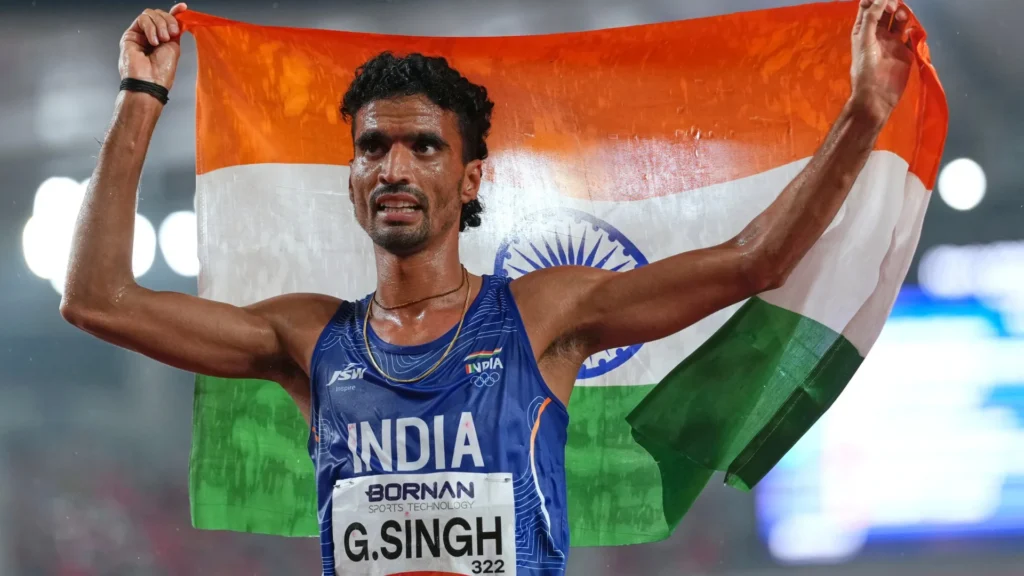
Gulveer Singh produced a remarkable performance at the Asian Games 2026 in Nagoya, winning three medals across the 10,000m, 1500m and 5000m.
The Indian distance runner reached the podium in every event he contested, earning two silver medals and one bronze.
His campaign showcased his endurance, versatility and ability to compete across different distances against Asia’s leading runners.
Silver in the Men’s 10,000m
Gulveer began his Asian Games campaign with a silver medal in the men’s 10,000m, clocking 28:29.38.
The performance established the foundation for what would become an extraordinary championship for the Indian runner.
However, his individual campaign did not end there. Gulveer went on to take on the very different challenge of the 1500m.
Gulveer Singh Wins 1500m Silver With Personal Best
Three days after his 10,000m silver, Gulveer returned to the track for the 1500m final.
The event demanded considerably more speed and tactical sharpness than the 10,000m. Nevertheless, he produced a personal best of 3:36.72 to secure another silver medal.
It was an unusual combination of endurance and speed. After competing in the 10,000m, Gulveer returned to the track and recorded the fastest 1500m time of his career.
Speaking to NNIS Sports after his second consecutive medal, Gulveer explained that his preparation mainly focuses on the 10,000m and 5000m.
As a result, his speed over 1500m is naturally different from that of athletes who specialise in the event.
However, his objective was straightforward.
He said his only thought going into the race was to win a medal.
And he achieved exactly that.
The silver highlighted his ability to transition between two events with very different demands while remaining competitive at the highest level of Asian athletics.
Bronze in the Men’s 5000m
Gulveer returned to the track for the 5000m final, completing another impressive chapter in his Asian Games campaign.
This time, he finished third in 13:32.75, adding a bronze medal to his two silvers.
Bahrain’s Birhanu Balew won gold in 13:30.79, while Japan’s Tomonori Yamaguchi claimed silver in 13:31.43.
Gulveer finished just over two seconds behind the winner.
With this result, he had now secured a medal in all three events he entered.
Gulveer Singh’s Asian Games Medal Summary
|
Event |
Medal |
Performance |
|---|---|---|
|
Men’s 10,000m |
Silver |
28:29.38 |
|
Men’s 1500m |
Silver |
3:36.72 (PB) |
|
Men’s 5000m |
Bronze |
13:32.75 |
A Remarkable Range Across Three Distances
What makes Gulveer’s campaign particularly striking is not just the number of medals but also the range of events involved.
The 10,000m tests endurance and pace over 25 laps. The 5000m combines endurance with speed, while the 1500m demands greater acceleration and finishing speed.
Gulveer competed across that spectrum and reached the podium in every event.
His 1500m performance was especially significant because he set a personal best. Rather than simply making the transition from longer-distance racing, he improved his own record and secured another medal.
The three-medal haul also places him among the standout performers of India’s athletics campaign in Nagoya.
For Indian distance running, his performances highlight the potential to compete across multiple disciplines. His ability to move between events has been rewarded with three medals.
An Inspiring Campaign for Indian Distance Running
Gulveer’s Asian Games campaign offers an example of how athletes can challenge themselves across different distances.
For young Indian runners watching Nagoya, his performances show that an athlete can develop in one event while also competing in others, provided the preparation and physical demands are managed.
Gulveer arrived in Nagoya as a serious distance-running contender.
He leaves with three Asian Games medals:
-
Silver in the 10,000m.
-
Silver and a personal best in the 1500m.
-
Bronze in the 5000m.
Across three races, he demonstrated endurance, adaptability and the ability to compete under pressure.
Three races. Three medals. Three different challenges.
Gulveer Singh has made his mark across the distance spectrum, producing one of the most memorable individual performances of India’s athletics campaign at the Asian Games.