

India’s men’s 4x100m relay team is set to return to international competition at the Saudi Athletics Grand Prix, scheduled for May 15-16, 2026, at Princess Nourah University in Riyadh, Saudi Arabia. The meet is part of the World Athletics Continental Tour Bronze circuit and is expected to attract a competitive field from across Asia and beyond.
The event will mark the Indian relay squad’s first appearance since the disappointing outing at the World Athletics Relays, where the team was disqualified under Technical Rule 24.7 after passing the baton outside the takeover zone. The error ended India’s campaign abruptly despite the team showing promising pace in the buildup to the competition.
The Riyadh meet now presents an important opportunity for the squad to regain rhythm and confidence ahead of a packed international season.
Among the athletes travelling to Saudi Arabia are Gurindervir Singh, Pranav Gurav and Harsh, all of whom will also line up in the men’s 100m individual event. The trio has been part of India’s emerging sprint setup and will be aiming to deliver strong performances against international opposition.
India’s fastest man, Animesh Kujur, is also set to compete and is entered in both the men’s 100m and 200m races.
The meet could prove significant for the Indian sprinters not only in terms of race exposure but also for valuable ranking points and relay preparation. With major continental and global events approaching later in the year, consistent international competition has become increasingly important for Indian athletics.
For the relay team especially, Riyadh offers a chance to move past the disappointment of the World Relays and focus on sharpening baton exchanges and race execution under competition conditions.
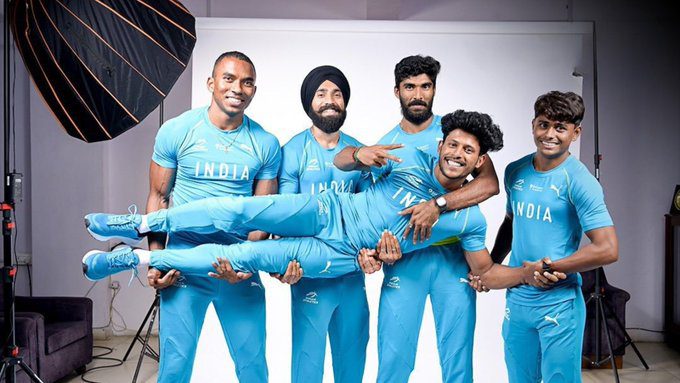
The lights were bright, the track in Gaborone was fast, and the expectations were sky-high. But as the dust settles on the 2026 World Relays, the story of India’s campaign isn’t one of triumph or narrow defeats. It is a story of a self-inflicted disaster—a dramatic collapse of coordination that left our athletes stranded and our fans heartbroken.
On paper, India arrived with the raw power to shake the world. On the track, they fell apart in a sequence of errors so basic they felt like a fever dream.
The Warning Signs
The nightmare began on Day 1. While the men’s 4x100m (39.07s) and the women’s 4x100m (43.97s) posted respectable times, the first crack in the armor appeared in the mixed 4x100m. A baton drop by Animesh Kujur on the third leg led to a DNF, a haunting omen of what was to come.
Day 2 offered a fleeting moment of brilliance—a National Record for the mixed relay team. But that single bright spot was quickly swallowed by a sea of technical failures.
The Anatomy of a Collapse
What followed wasn’t just losing; it was an organizational meltdown.
- The Women’s 4x100m: A catastrophic exchange between Tamanna and Nithya Gandhe saw the baton hit the dirt in the very first zone. They finished dead last in 53.90s—a time more suited for a school meet than a World Championship qualifier.
- The Men’s 4x100m: The most painful exit of all. A disqualification (DQ) after passing the baton outside the takeover zone between Ragul Kumar and Gurindervir Singh.
As 2010 CWG Gold medalist Abdul Najeeb Qureshi bluntly put it: “Gurindervir started far too early… and in Animesh’s case, it’s a basic rule: you cannot change hands during a 4x100m relay.”
The “Speed” Illusion
The tragedy here is that India was fast enough. We have the athletes; we just don’t have the “team.” While veteran Srabani Nanda tried to find the silver lining—praising Nithya Gandhe’s grit to finish the race—the reality remains: Relays are won in the exchange zone, and India was a ghost in that space.
Manjit Kaur, another 2010 legend, emphasized that relay success isn’t instinct; it’s grueling, repetitive drilling under pressure. That pressure clearly exposed a lack of “race-day” chemistry. Former national record holder Amiya Mallick hit the nail on the head: “The team needs to compete together in more races… we still see these mistakes during major events.”
The Verdict
The Botswana campaign can be summarized in a single, bitter sentence: The speed was world-class, but the coordination was amateur.
Baton drops. Zone violations. Disqualifications. These aren’t issues of fitness or heart; they are failures of execution and preparation. Until India moves away from “last-minute camps” and adopts a year-round, dedicated relay program—perhaps led by the very legends who once brought us Gold—we will continue to be the fastest team that never crosses the finish line.
In Botswana, India didn’t lose to the world. They lost to themselves.
What happened in Gaborone didn’t stay in Gaborone! It has shaped the global track and field landscape for the next two years.
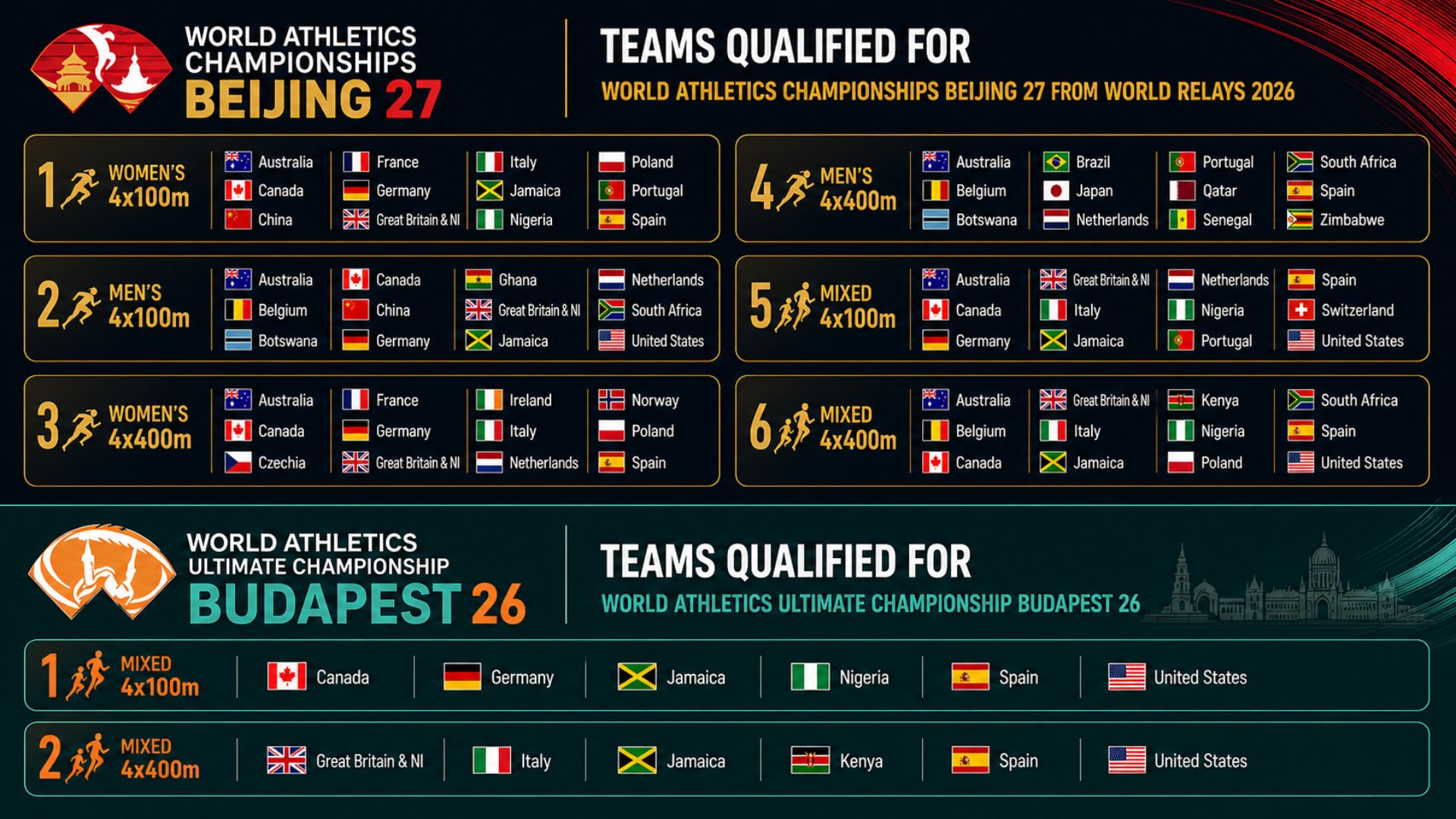
The world’s top relay squads competed for automatic entry into the World Athletics Championships Beijing 27 and the inaugural World Athletics Ultimate Championship Budapest 26.
Led by Jamaica’s sensational 39.62s World Record in the Mixed 4x100m, the first wave of qualifiers has been confirmed:
Beijing 27 Qualification: The top 12 finishers in each of the six relay disciplines (Men’s and Women’s 4x100m, 4x400m, and the Mixed 4x100m and 4x400m) secured automatic berths for the 2027 World Championships. These teams progressed through a rigorous two-round qualification format, ensuring that only the most consistent and elite squads earned their spots early.
Budapest 26 Tickets: In a more exclusive race for the 2026 season, the top six finishers in the Mixed Relay finals earned automatic qualification for the first-ever World Athletics Ultimate Championship. This new, fast-paced ‘best of the best’ event in Budapest will feature only the highest-ranked athletes and teams in the world.
The following lists detail the nations that have successfully secured their places on the world stage.
Highlights:
Australia is one of the few nations to qualify a team in every single event for Beijing 27.
Nations like Jamaica, the United States, and Spain proved their versatility by qualifying for the Ultimate Championship in Budapest across both mixed-gender formats.
Host nation Botswana and neighbouring South Africa leveraged the home-continent advantage to secure spots in the Men’s 4x400m, a discipline where they continue to be world-class contenders.
Teams qualified for the World Athletics Championships Beijing 27 from World Relays 2026
1) Women’s 4x100m: Australia, Canada, China, France, Germany, Great Britain & NI, Italy, Jamaica, Nigeria, Poland, Portugal, Spain
2) Men’s 4x100m: Australia, Belgium, Botswana, Canada, China, Germany, Ghana, Great Britain & NI, Jamaica, Netherlands, South Africa, United States
3) Women’s 4x400m: Australia, Canada, Czechia, France, Germany, Great Britain & NI, Ireland, Italy, Netherlands, Norway, Poland, Spain
4) Men’s 4x400m: Australia, Belgium, Botswana, Brazil, Japan, Netherlands, Portugal, Qatar, Senegal, South Africa, Spain, Zimbabwe
5) Mixed 4x100m: Australia, Canada, Germany, Great Britain & NI, Italy, Jamaica, Netherlands, Nigeria, Portugal, Spain, Switzerland, United States
6) Mixed 4x400m: Australia, Belgium, Canada, Great Britain & NI, Italy, Jamaica, Kenya, Nigeria, Poland, South Africa, Spain, United States
Teams qualified for the World Athletics Ultimate Championship Budapest 26
1) Mixed 4x100m: Canada, Germany, Jamaica, Nigeria, Spain, United States
2) Mixed 4x400m: Great Britain & NI, Italy, Jamaica, Kenya, Spain, United States

India’s mixed 4x100m relay team created history by breaking the national record at the World Athletics Relays 2026 on Sunday.
The team of Ragul Kumar, Nithya Gandhe, Animesh Kujur, and Sneha SS ran 41.35s, beating the old record of 42.30s. The previous mark was set earlier this year in Chandigarh by Lalu Prasad, Unnathi Aiyappa, Harita Bhadra, and Dondapati Jayaram.
However, despite setting a new national record, India could not qualify for the final or secure a place for the 2027 World Championships in Beijing.
The team finished sixth in their heat and 10th overall, missing out on qualification, as only the top two teams from each heat advanced.
In the mixed 4x400m relay, the Indian team of Theerthesh P. Shetty, Kumari Saloni, Nihal William, and Rashdeep Kaur finished fifth in their heat with a time of 3:19.40, placing 12th overall.
It turned out to be a tough day for India in other events as well.
In the men’s 4x400m relay, the team could not finish the race after Amoj Jacob (second leg) suffered an injury during his leg.
The women’s 4x100m team, consisting of Nithya Gandhe, Tamanna, Sudeshna Shivankar, and Sneh, finished last overall in the heats with a time of 53.90s.
Meanwhile, the men’s 4x100m team of Harsh Raut, Animesh Kujur, Ragul Kumar, and Gurindervir Singh was disqualified due to a failed baton exchange.
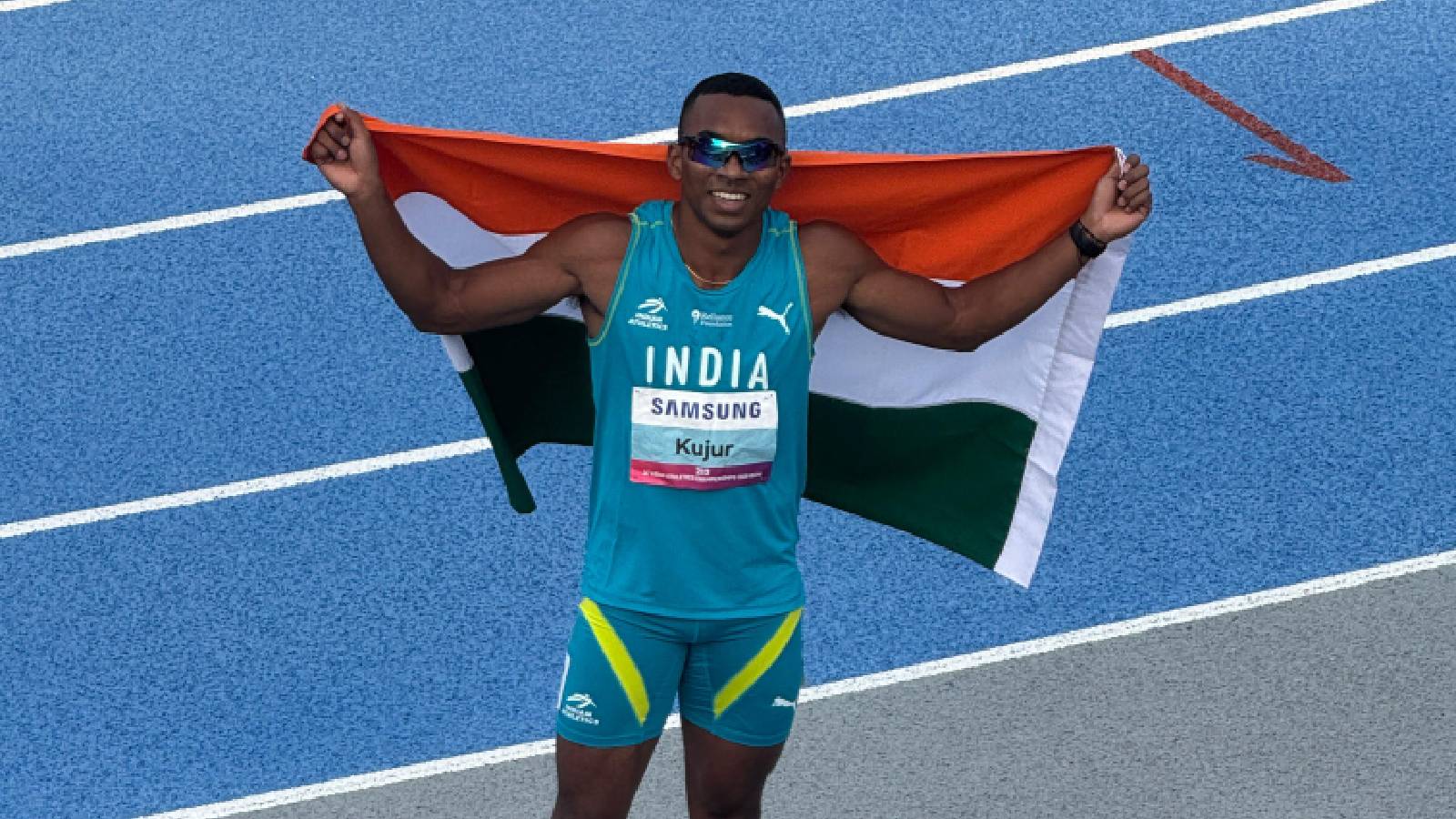
India’s relay teams had a tough start on Day 1 of the World Athletics Relays 2026 in Gaborone, Botswana, as none of the five teams could reach the finals on Saturday.
However, all teams will get another chance on Sunday. They will compete again for a few remaining spots to qualify for the 2027 World Athletics Championships.
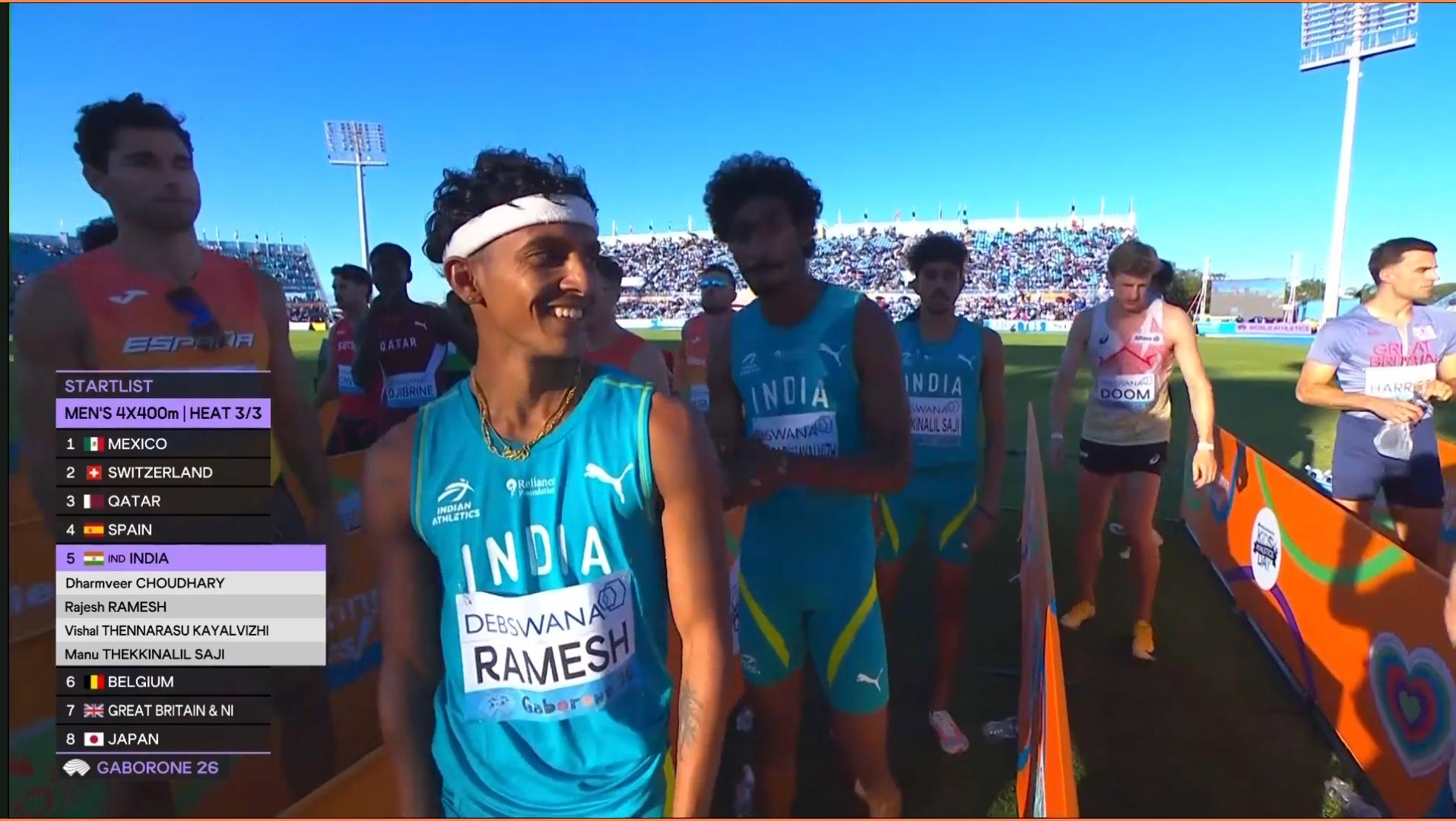
The men’s 4x400m team Dharmveer Choudhary, Rajesh Ramesh, Vishal TK, and Manu TS gave a strong performance. They finished fourth in their heat with a time of 3:00.32 (Season Best).
Rajesh Ramesh, who ran the second leg, even took the lead for a short time. Vishal TK, running the third leg, stayed close with the top teams. But in the end
Manu TS couldn’t maintain the pace, India finished behind Belgium, Qatar, and Spain, placing 12th overall and missing out on the final.
In this event, only the top teams from each heat and the next fastest teams move to the final and directly qualify for the 2027 World Championships.
The other teams, including India, will race again on Day 2. This time, only the top two teams from each heat will qualify.
Earlier, the mixed 4x100m relay team S. Tamilarasu, Nithya Gandhe, Animesh Kujur, and SS Sneha could not finish their race. The baton slipped from Kujur’s hand during the exchange.
The mixed 4x400m team Theerthesh Shetty, Ansa Babu, Amoj Jacob, and Rashdeep Kaur finished sixth in their heat with a time of 3:16.00.
In the women’s 4x100m relay, Tamanna, Nithya Gandhe, Sudeshna Shivankar, and SS Sneha finished fifth with a time of 43.97 seconds.
The men’s 4x100m team Harsh Raut, Ragul Kumar, Animesh Kujur, and Gurindervir Singh, finished last in their heat, clocking 39.07 seconds.
The 24th National Junior Athletics Federation Competition is set to be held from April 24 to 26, 2026, at the Mahatma Gandhi (MG) Stadium in Tumkur, Karnataka, with around 40 events lined up across men’s and women’s categories.
A 3-day event packed with action:
Day 1: Early finals – 5000m, Pole Vault, Discus, 100m finals, etc.
Day 2: Bulk of finals – field events, middle distance, hurdles
Day 3: Remaining finals – 800m, 200m, steeplechase, relays
What makes this event even more special is that it will also serve as a qualification meet for the 22nd Asian U20 Athletics Championships and, more importantly, the 2026 World Athletics U20 Championships, scheduled to take place in Eugene, Oregon, USA, from 5–9 August 2026.
In past editions, India has produced some of the best results at the U20 Worlds:
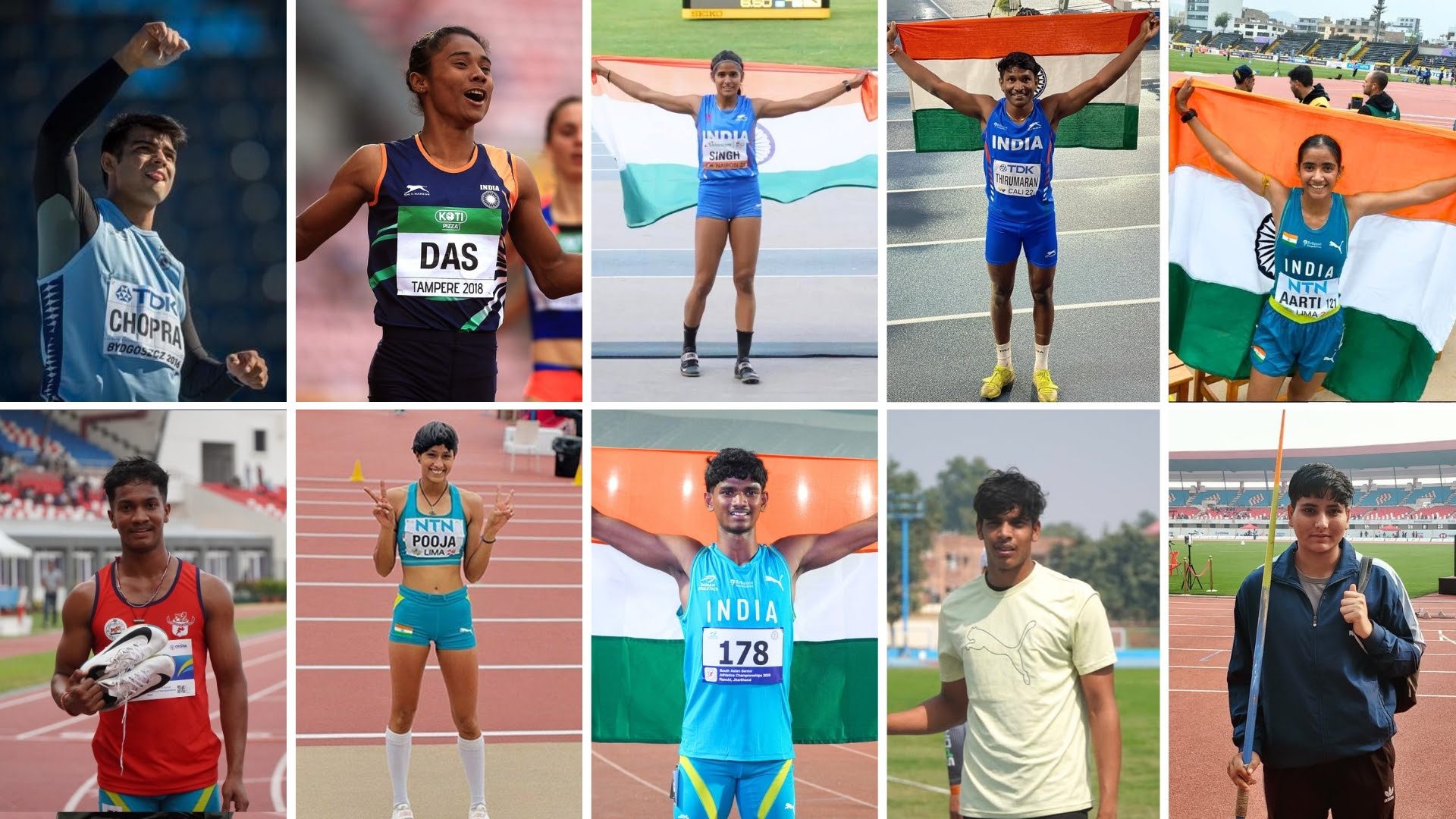
- Neeraj Chopra — 2016 (Javelin Throw):
In 2016, India’s wonder boy stepped onto Poland’s Zawisza Stadium with a spear in his right hand and made history. He won gold with a U20 world record throw of 86.48m, securing India’s first-ever U20 gold in javelin. This remains one of the greatest junior performances globally. - Hima Das — 2018 (400m):
In 2018, Hima Das created one of the most iconic moments in Indian sporting history, becoming the first Indian woman to win a track gold at a global event, clocking 51.46s. - Shaili Singh — 2021 (Long Jump):
Currently India’s all-time second-best jumper (6.76m), she won silver with a jump of 6.59m. It was a special moment for the girl from Jhansi, supported by her mother and trained at the Anju Bobby George Academy, breaking barriers along the way. - Selva Prabhu — 2022 (Triple Jump):
India’s U20 national record holder won silver at the 2022 U20 World Championships with a jump of 16.15m, which was his lifetime best at the time. - Aarti — 2024 (Racewalking):
Although the last edition did not go as planned for India, only one athlete reached the podium. Aarti delivered a standout performance, winning bronze and breaking India’s U20 national record in race walking with a time of 44:39.39.
This year promises to be just as exciting, with several athletes preparing to perform on the biggest U20 stage:
- Pratik Maharana (Sprints):
A young sprinter from Odisha, a region known for producing some of India’s fastest athletes. The state has seen names like Amiya Mallick (10.26s) and Dutee Chand (11.17s). Pratik, trained by coach Siba Mishra, has already breached the World Championships qualification mark by clocking 21.24s to win gold at the Junior Nationals. However, he will need to repeat that performance here to confirm his ticket to Eugene. - Mohammed Ashfaq (400m):
Kerala’s rising talent is one to watch. The 18-year-old impressed at the Senior South Asian Athletics Championships, winning silver in the 400m with a lifetime best of 46.56s. Competing against experienced athletes like Sri Lanka’s Kalinga Kumarage (46.21s), Ashfaq also secured three medals overall – gold in the mixed 4x400m and silvers in the individual 400m and men’s 4x400m. - Pooja Singh (High Jump): Pooja has been steadily raising the bar, literally. The 18-year-old recently cleared a lifetime best of 1.90m at the Indian Series–3. She had already made the final at the last U20 Worlds, where she broke the U20 national record with 1.83m. This time, she heads in as a Senior Asian outdoor champion and indoor silver medallist.
Along with these names, several others will be worth watching:
- Rishabh Giri (Men’s Javelin), Poonam (Women’s events), Sai Kiran (Shot Put), Parth Singh and Aarti (100m), along with others.
As per the latest Road to World Relays rankings, India’s 4x100m mixed relay team has dropped out of the qualification zone.
India had clocked 42.30s, breaking the national record at the Open Relays, initially placing them 19th in the standings.
However, six teams have since gone faster — Nigeria (41.44), Kenya (41.70), Poland (41.62), Ukraine (42.19), New Zealand (41.30), and USA (40.84). As a result, India has now been pushed to 25th, just outside the top 24 required for qualification.
 Current status:
• Men’s 4x400m looks set to qualify
• Mixed 4x400m and Women’s 4x100m remain inside the qualification zone, currently ranked 22nd and 23rd, respectively The final list is expected to be published tonight by World Athletics.
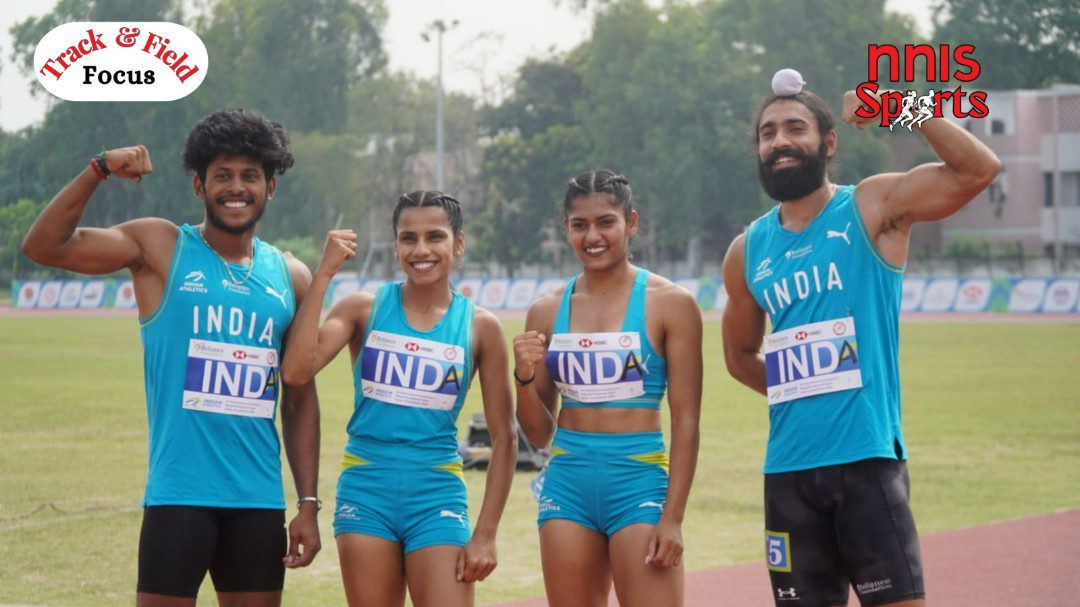
India’s 4x100m mixed relay team is facing a tense wait for World Relays qualification after slipping in the standings.
The team had initially secured a strong position, ranking 19th after clocking a national record time of 42.30 seconds at the Open Relays.
However, recent performances from other nations have changed the scenario. Nigeria, Kenya, Poland, and Ukraine have all recorded faster times, pushing India down to 23rd place — just inside the qualification cutoff of 24 teams.
With the qualification window still open until April 5, the situation remains uncertain. If two more teams post better timings, India risks dropping out of the top 24 and missing qualification for the World Relays in Gaborone.
The United States is also yet to register a qualifying time, which could further impact the final standings.
Sources indicate that India had targeted a sub-42 second run, but a baton exchange issue during the third leg cost valuable time in their record-setting race.
With qualification now hanging by a thread, all eyes are on upcoming races worldwide that could decide India’s fate.