



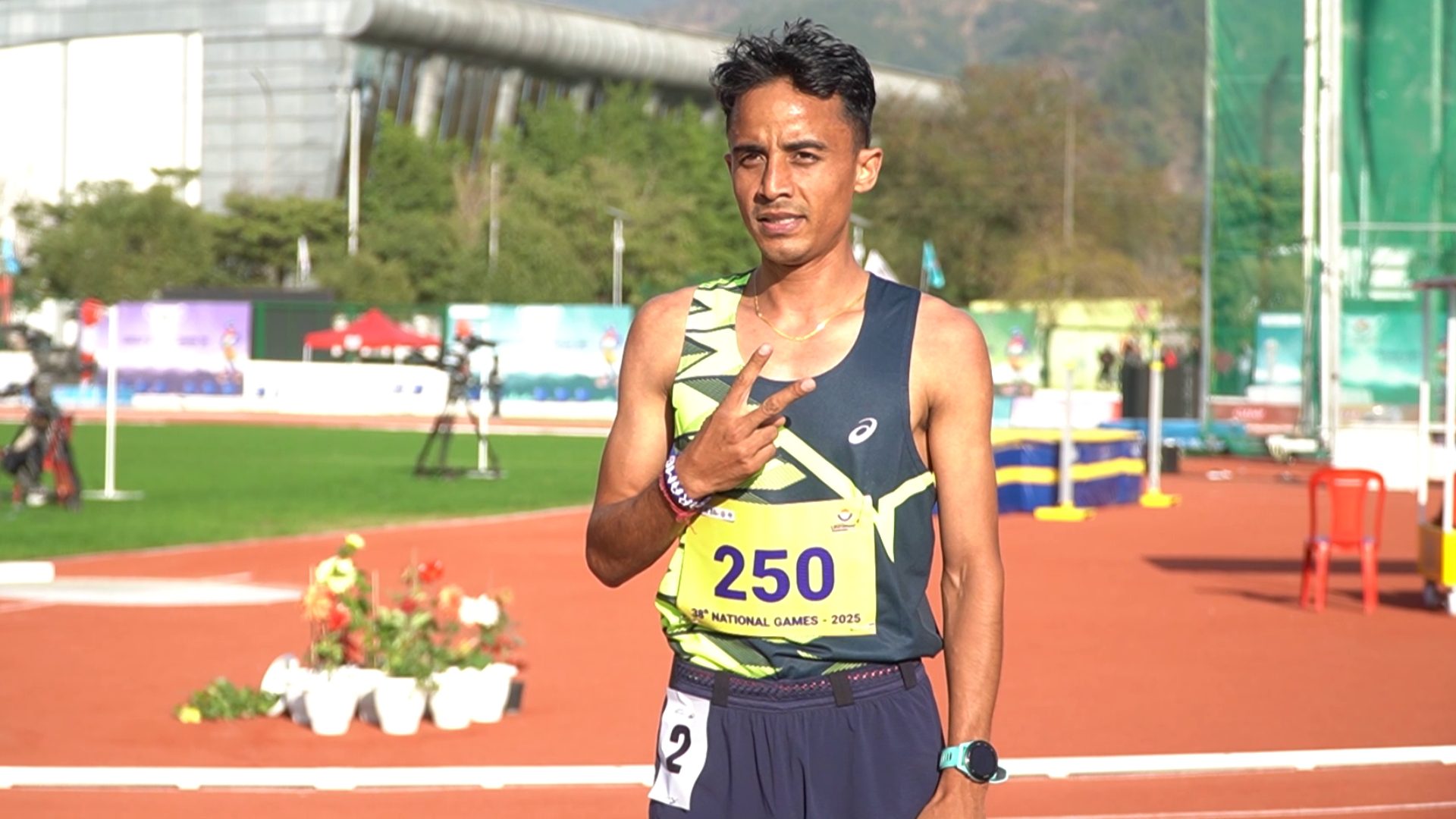
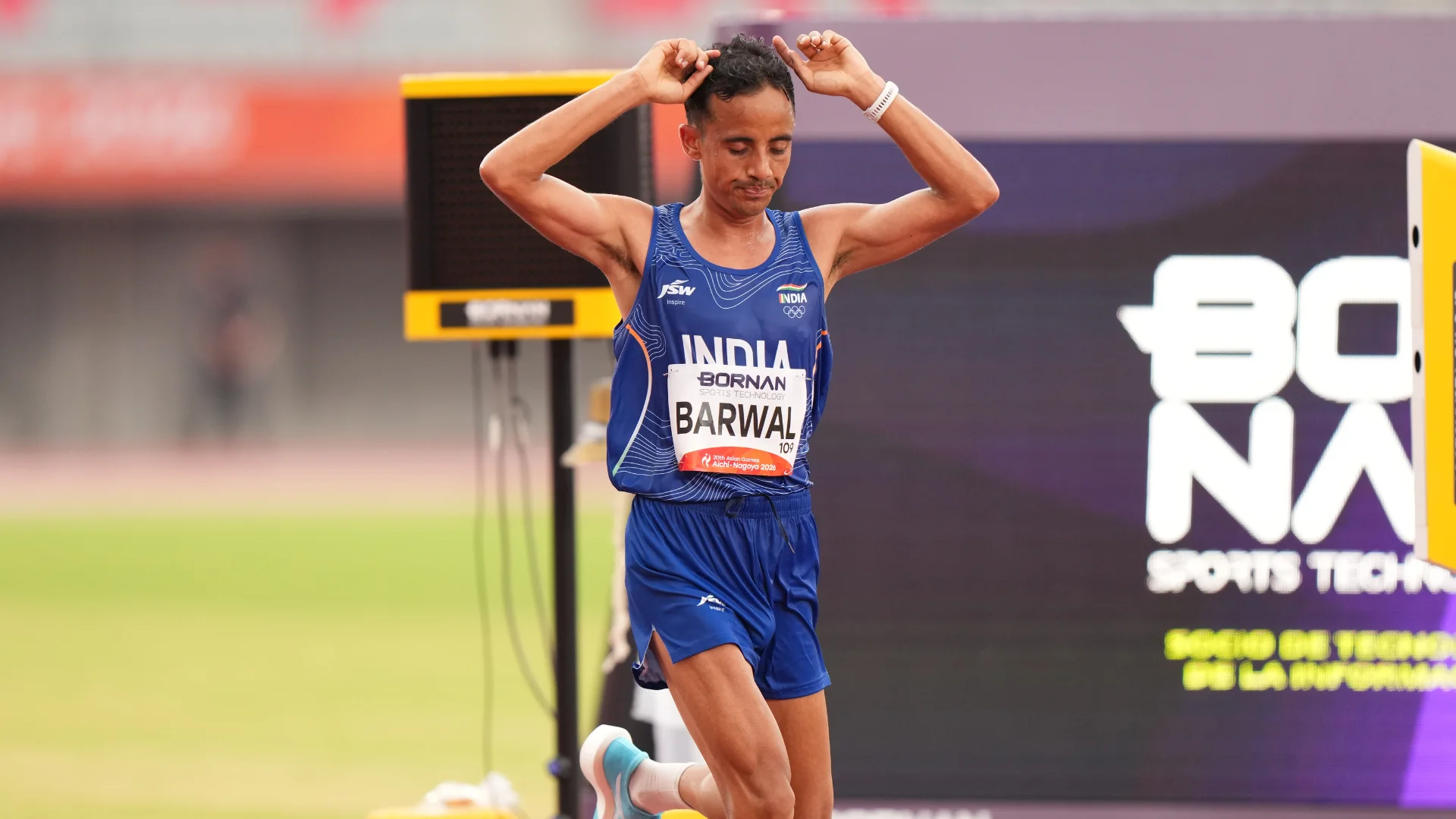
Who is Sawan Barwal? He is the 28-year-old Indian Army runner from Himachal Pradesh who won India’s first Asian Games marathon medal in 44 years. In Nagoya he took silver in a national record of 2:11:37. Five months earlier, Sawan Barwal broke India’s oldest national record on his marathon debut in Rotterdam.
Until 2026, he raced mainly on the track and in half marathons. This page therefore tells his whole story so far: his medals, his personal bests, his rise race by race, and the family that set him on the road.
Sawan Barwal at a glance
- Born: 18 February 1998
- Age: 28
- State: Himachal Pradesh (Joginder Nagar, Mandi district)
- Events: Marathon, half marathon, 10,000m and 5000m
- Personal best: Marathon 2:11:37, national record (Asian Games, September 2026)
- 2026 results: Asian Games silver and two marathon national records
- Job: Indian Army, which he joined in 2019 through the sports quota
- Off the track: the son of a driver and a homemaker, he followed his elder brother into running and into the Army
Jump to: Who is he Asian Games silver Rotterdam record Race by race Personal bests His story Beyond the track
Who is Sawan Barwal? The short answer
Sawan Barwal is an Indian distance runner from Joginder Nagar in the Mandi district of Himachal Pradesh. He was born on 18 February 1998, according to World Athletics, and he serves in the Indian Army.
His 2026 season was the breakout year of his career. He ran his first two marathons, set a national record in both, and won Asian Games silver in the second. Meanwhile, he built that speed over years in the 5000m, 10,000m and half marathon, much like fellow distance runner Gulveer Singh.
Asian Games 2026: marathon silver and a new national record
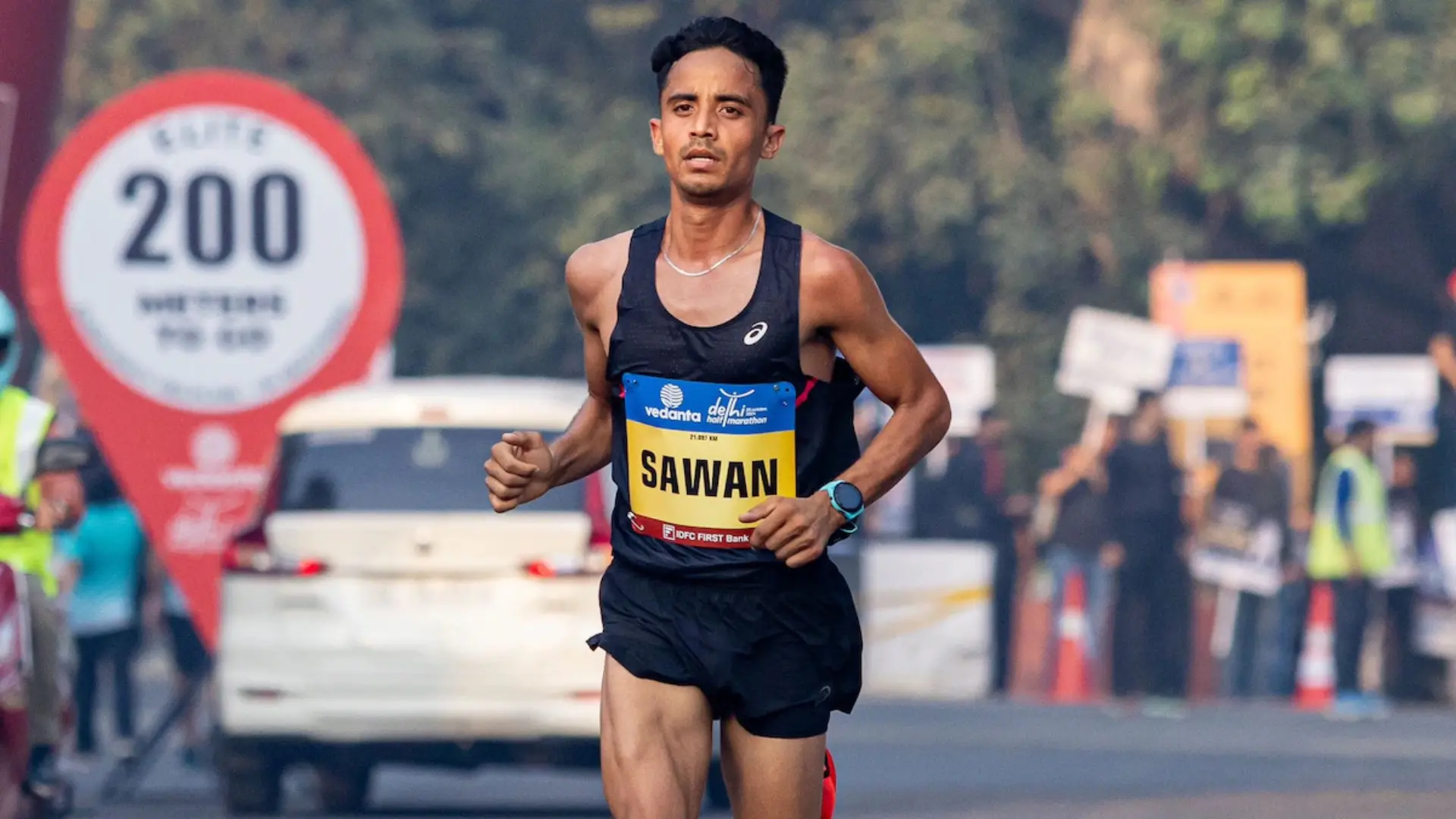
The men’s marathon took place in Nagoya on Saturday 26 September. Japan’s Ichitaka Yamashita pulled away in the closing stages to win gold in 2:10:49. Sawan, however, held on to second place and crossed the line in 2:11:37.
As a result, he took 21 seconds off the national record he had set in April. His teammate Kartik Karkera finished 17th in 2:22:41. Every Indian result from Nagoya is on our Asian Games 2026 hub.
| Place | Athlete | Country | Time |
|---|---|---|---|
| 1 | Ichitaka Yamashita | Japan | 2:10:49 |
| 2 | Sawan Barwal | India | 2:11:37 |
| 3 | Peiyou Feng | China | 2:12:13 |
| 17 | Kartik Karkera | India | 2:22:41 |
The medal also ended a long wait. Before Sawan, India’s last Asian Games marathon medal was Hosur Kukkappa Seetharan’s bronze in New Delhi in 1982. In addition, all three earlier Indian medals came at home Games in New Delhi.
Rotterdam 2026: a 48-year-old record falls on debut
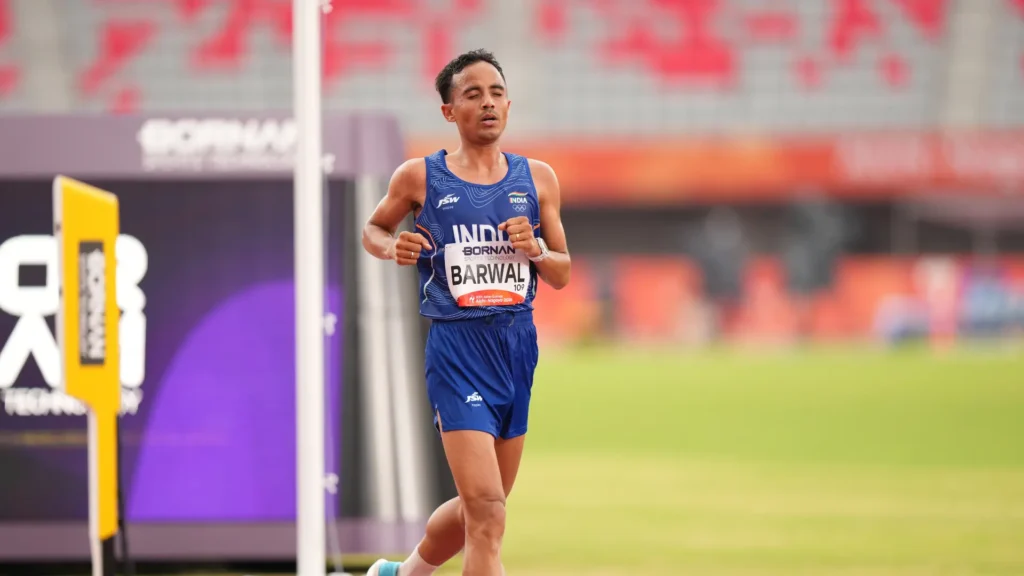
On 12 April, Sawan ran his first marathon at the NN Marathon Rotterdam. He passed halfway in 1:04:42 and then broke India’s oldest national record with 2:11:58. He finished 20th in the elite race.
However, it nearly went wrong. He was on target pace until about 38km, but wind hit hard in the last two kilometres, and he blacked out at the finish. Still, he beat the old mark by two seconds.
| When | Athlete | Time | Where |
|---|---|---|---|
| May 1978 | Shivnath Singh | 2:12:00, national record | Jalandhar |
| December 2025 | Gopi Thonakal | 2:12:23, near miss | Valencia |
| 12 April 2026 | Sawan Barwal | 2:11:58, national record | Rotterdam |
| 26 September 2026 | Sawan Barwal | 2:11:37, national record | Nagoya |
The 1978 mark was the oldest record in Indian athletics. In fact, Gopi Thonakal had missed it by just 23 seconds in Valencia only four months before Rotterdam, the AFI reported. Sawan explained the race himself in our post-record interview.
Sawan Barwal’s road to the marathon, race by race
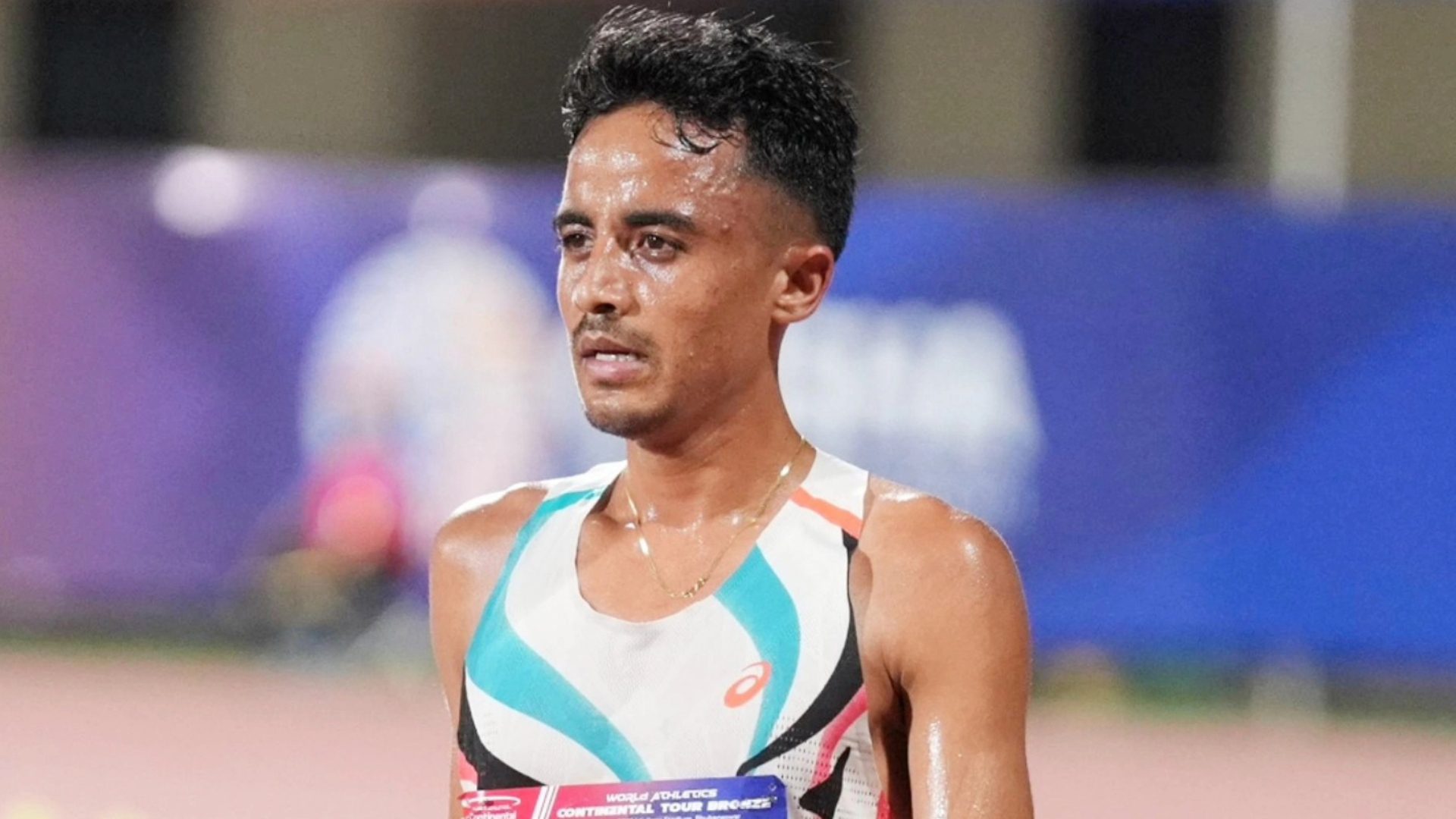
His rise came in steps. For example, he ran 13:39.26 for 5000m in 2024 and 1:02:46 for the half marathon later that year. Then, in 2025, he won national titles at 5000m and 10,000m before he moved up to the full distance in 2026.
| When | Meet | Event | Result |
|---|---|---|---|
| November 2023 | Asian Half Marathon Championships, Dubai | Half marathon | 1:04:30, bronze and team gold |
| 25 May 2024 | Meet in Brussels, Belgium | 5000m | 13:39.26, personal best |
| 20 October 2024 | Delhi Half Marathon, New Delhi | Half marathon | 1:02:46, personal best |
| 15 December 2024 | Road race, Kolkata | 25km road | 1:14:11, personal best |
| February 2025 | National Games, Dehradun | 10,000m | 28:49.93, gold, Games record |
| February 2025 | National Games, Dehradun | 5000m | 13:45.93, gold, Games record |
| April 2025 | National Federation Senior Championships, Kochi | 10,000m | 28:57.13, gold, meet record |
| 12 July 2025 | Meet in Joensuu, Finland | 3000m | 7:56.24, personal best |
| 12 April 2026 | NN Marathon Rotterdam | Marathon | 2:11:58, national record |
| 26 September 2026 | Asian Games, Nagoya | Marathon | 2:11:37, silver |
At the 2025 Federation Cup, his 28:57.13 also beat the 10,000m meet record from 2007 and earned him a place at the Asian Championships. However, after that he turned his focus to the roads. Results from India’s other distance runners are on our men’s marathon section.
Sawan Barwal personal bests
The marks below are from his World Athletics profile, except the 10,000m, which comes from National Games reports.
| Event | Time | Where | Date |
|---|---|---|---|
| Marathon | 2:11:37 (NR) | Asian Games, Municipal Mizuho Stadium, Nagoya | 26 September 2026 |
| 25km road | 1:14:11 | Kolkata | 15 December 2024 |
| Half marathon | 1:02:46 | New Delhi | 20 October 2024 |
| 10,000m | 28:49.93 | National Games, Dehradun | February 2025 |
| 5000m | 13:39.26 | Boudewijnstadion, Brussels | 25 May 2024 |
| 3000m | 7:56.24 | Keskusurheilukenttä, Joensuu (Finland) | 12 July 2025 |
His 2:11:37 is India’s men’s marathon national record. In addition, he is the only Indian man to run under 2:12, and he did it twice in five months. Meanwhile, his half marathon best of 1:02:46 came at the Delhi Half Marathon in 2024.
Who is Sawan Barwal’s coach? From Joginder Nagar to Nagoya
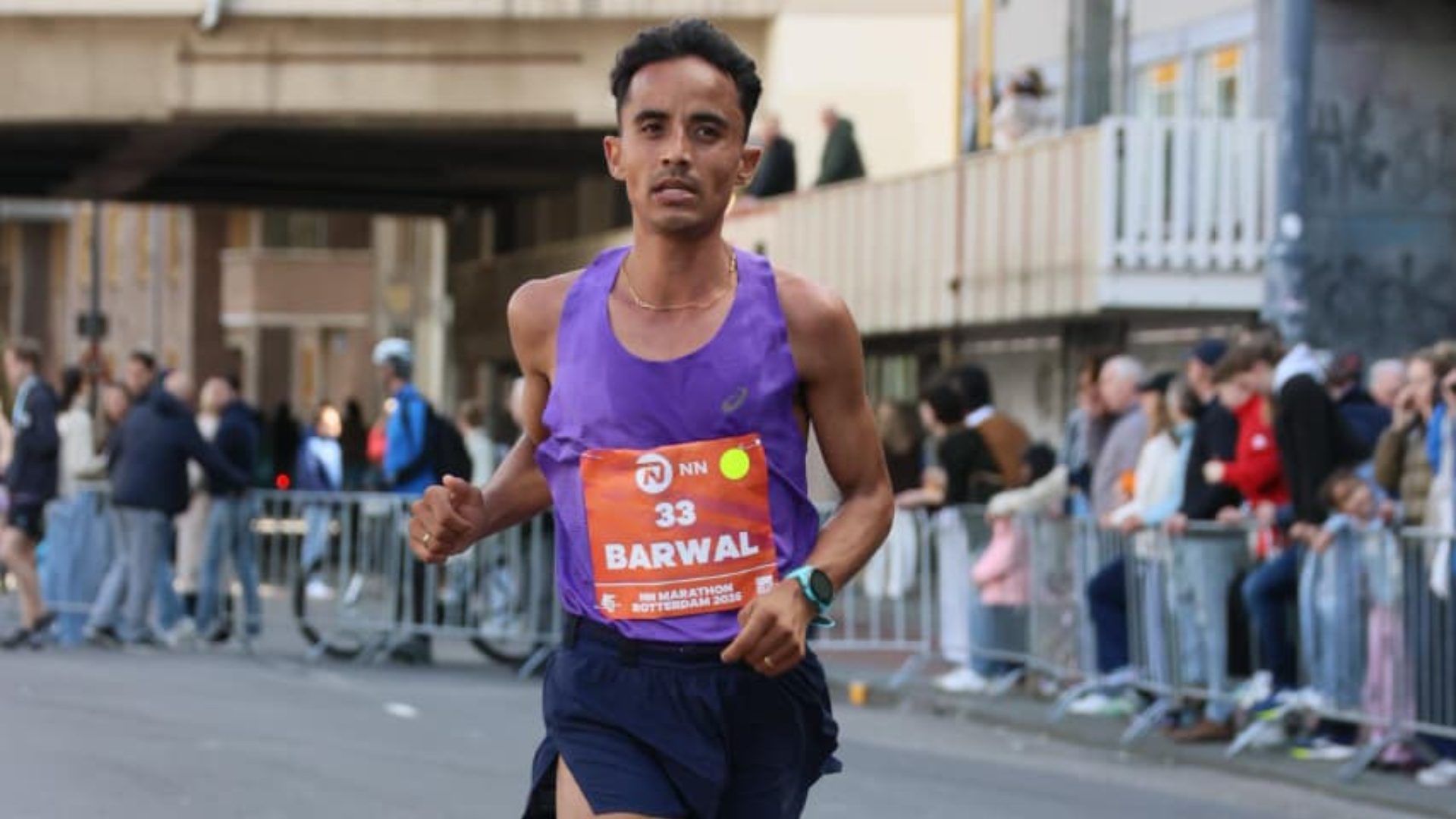
Sawan started running by chance after he visited a track near his home, where his elder brother trained with the school team. At 14, he began training for the 1500m. His first national event was the U18 3000m in 2015.
He joined the Army in 2019 and ran his first senior race, the 5000m, at the 2021 Federation Cup. Then, in November 2023, he won individual bronze at the Asian Half Marathon Championships in Dubai and helped India to men’s team gold.
However, the marathon was a late decision. AFI foreign coach Scott Simon suggested he try it, so he trained at 5000m and 10,000m speed with more mileage at altitude in Coonoor. Today, he is coached by Younis Khan at the Army Sports Institute in Pune and Ajith Markose of Reliance Foundation.
Who is Sawan Barwal beyond the track? Family, the Army and sacrifice
Sawan’s father, Kuldeep, worked as a driver in New Delhi, while his mother, Subhadra Devi, is a homemaker. He followed his elder brother both onto the track and into the Army, which he joined through the sports quota.
The road to Nagoya also took patience. A knee injury delayed his marathon debut, so he only returned to full training in January 2026. After Rotterdam, he trained at altitude in Ooty and then spent about two months in Colorado Springs before the Games.
Meanwhile, he is already looking ahead. After a one-month break, he wants to qualify for the 2027 World Championships, and his own target is a time of around 2:08 to 2:09.
Follow Sawan Barwal on Athletics India
His full stats and results are on Sawan Barwal’s athlete profile. In addition, India’s road races are on our marathon page, and the latest meets are on our Indian athletics results page.
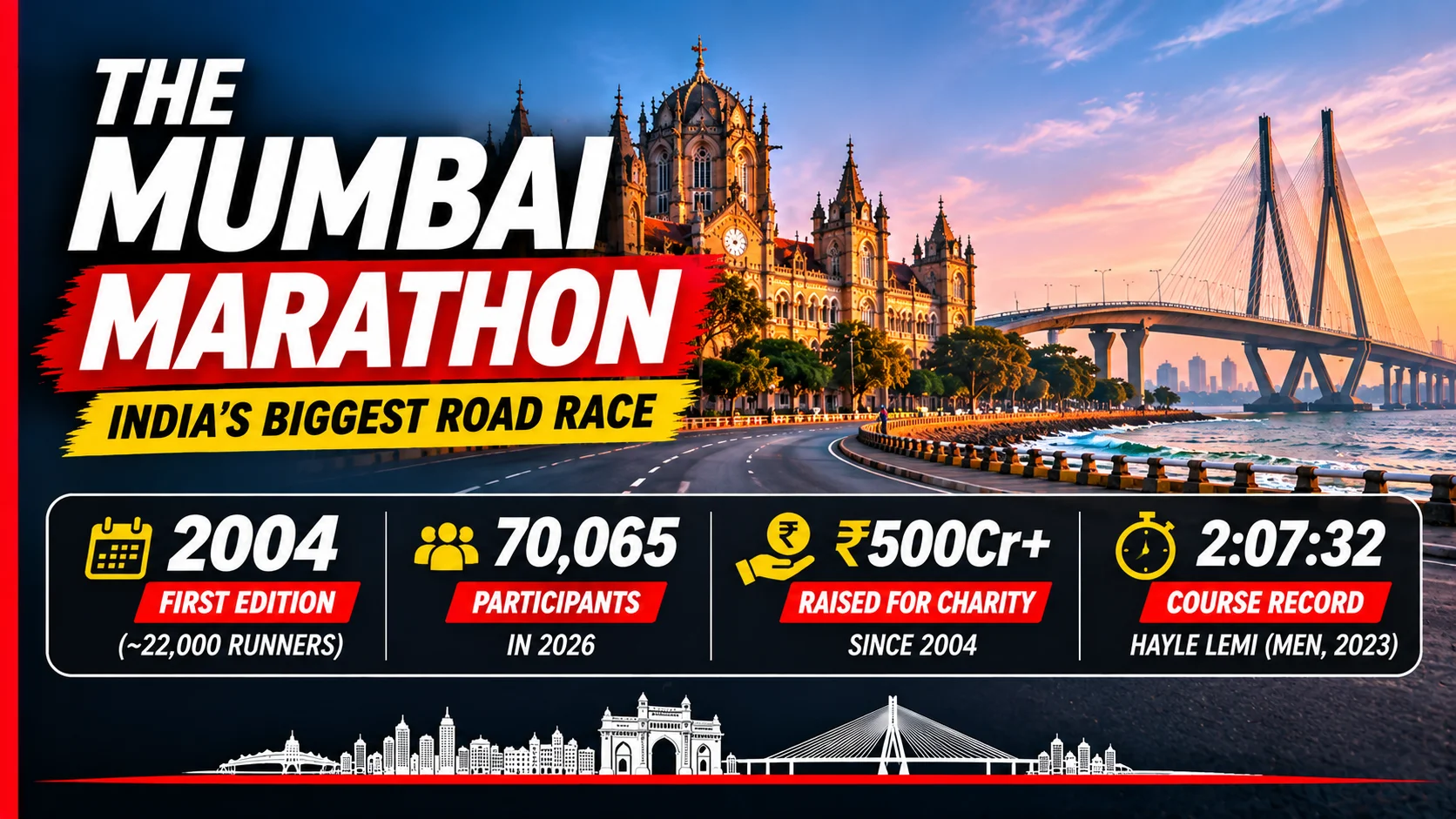
Every January, Mumbai gives its roads to runners. Tens of thousands of people set off from outside Chhatrapati Shivaji Maharaj Terminus, run along Marine Drive and across the Bandra–Worli Sea Link, and turn a working city into a running festival. Since 2004, the Mumbai Marathon has grown into India’s biggest road race and the event that started the country’s running boom.
This is the history of the Mumbai Marathon: how it began, how it grew from about 22,000 runners to more than 69,000, the champions and course records, the Indian runners who made their names on its streets, and its role as India’s biggest charity platform. Every fact has been checked against at least two sources where possible, and the fact-check table at the end shows the status of each claim.
Mumbai Marathon at a glance
- First held: 2004, as the Standard Chartered Mumbai Marathon
- Organiser: Procam International
- Title sponsor: Standard Chartered (2004 to 2017), Tata Group (since 2018)
- Status: World Athletics Gold Label road race
- Course records: Hayle Lemi, 2:07:32 (men); Anchialem Haymanot, 2:24:15 (women), both Ethiopia, 2023
- 2026 edition: 21st edition, 18 January 2026, about 70,000 participants
- Next edition: 22nd edition, 17 January 2027
Jump to: The beginning Timeline The course Course records All winners Indian runners Charity 2026 edition Fact check
How the Mumbai Marathon began
The Mumbai Marathon was created by Procam International, a Mumbai sports management company run by Anil and Vivek Singh. Inspired by the London Marathon, Procam believed Mumbai could support a big-city road race of the same kind. Its founding idea was simple: every great city in the world must have a marathon.
The first edition was held in 2004 as the Standard Chartered Mumbai Marathon, with about 22,000 participants. It raised around ₹1.44 crore for charity in its first year. South Africa’s Hendrick Ramaala won the first men’s race in 2:15:47, and Poland’s Wioletta Uryga won the women’s race in 2:47:53.
Mumbai Marathon timeline: the key moments
- 2004: The first Standard Chartered Mumbai Marathon, with about 22,000 participants.
- 2009 and 2010: The race earned an IAAF (now World Athletics) Silver Label in 2009 and a Gold Label in 2010.
- 2012: Ram Singh Yadav ran 2:16:59 in Mumbai to qualify for the London Olympics.
- 2013: The Gold Label was withdrawn. The same year, Kenya’s Valentine Kipketer ran 2:24:33, at the time the fastest women’s marathon ever run in India.
- 2017: Standard Chartered’s 14th and last year as title sponsor, with about 42,000 runners.
- 2018: The race became the Tata Mumbai Marathon under a 10-year sponsorship deal with Tata Group and Tata Consultancy Services. It regained a Silver Label.
- 2019: The race returned to Gold Label status.
- 2021 and 2022: No race was held, because of the COVID-19 pandemic.
- 2023: Ethiopia’s Hayle Lemi (2:07:32) and Anchialem Haymanot (2:24:15) set the current course records.
- 2024: A record ₹72 crore was raised for charity by 268 NGOs.
- 2026: The 21st edition drew about 70,000 participants, the biggest field in the race’s history.
- 2027: The 22nd edition is scheduled for 17 January 2027.
The Mumbai Marathon course
The marathon starts opposite Chhatrapati Shivaji Maharaj Terminus (CSMT), the UNESCO-listed railway station in south Mumbai. It runs past Flora Fountain, along Marine Drive and Chowpatty, past Haji Ali and Mahim Church, and over the Bandra–Worli Sea Link, before turning back into the city.
Runners say the hardest stretch is Peddar Road, a long climb late in the race. The humidity of a Mumbai morning also makes fast times hard to run. That is why the course records, while quick, are slower than those of the flat, cool marathons of Europe and Asia.
The event also includes a half marathon, a 10K, the Dream Run, a Senior Citizens’ Run and a race for Champions with Disability.
Mumbai Marathon course records
On a phone, swipe the table sideways to see every column.
| Category | Athlete | Time | Year |
|---|---|---|---|
| Men | Hayle Lemi (Ethiopia) | 2:07:32 | 2023 |
| Women | Anchialem Haymanot (Ethiopia) | 2:24:15 | 2023 |
Haymanot’s record broke Valentine Kipketer’s 2:24:33, which had stood since 2013. Hayle Lemi came back to win again in 2024 in 2:07:50, making him one of only two men to win the race twice, along with Kenya’s John Kelai (2007 and 2008).
Every Mumbai Marathon winner (2004 to 2026)
East Africa has dominated the elite races. Ethiopia leads with 23 titles (7 men’s and 16 women’s), and Kenya has 13 (10 men’s and 3 women’s). Ethiopia’s Mulu Seboka is the most successful runner in the race’s history, with three women’s titles.
On a phone, swipe the table sideways to see every column.
| Year | Men’s winner | Women’s winner |
|---|---|---|
| 2004 | Hendrick Ramaala (RSA), 2:15:47 | Wioletta Uryga (POL), 2:47:53 |
| 2005 | Julius Sugut (KEN), 2:13:20 | Mulu Seboka (ETH), 2:35:03 |
| 2006 | Daniel Rono (KEN), 2:12:03 | Mulu Seboka (ETH), 2:33:15 |
| 2007 | John Kelai (KEN), 2:12:27 | Yang Fengxia (CHN), 2:36:16 |
| 2008 | John Kelai (KEN), 2:12:23 | Mulu Seboka (ETH), 2:30:04 |
| 2009 | Kenneth Mugara (KEN), 2:11:51 | Kebebush Haile (ETH), 2:34:08 |
| 2010 | Denis Ndiso (KEN), 2:12:40 | Bizunesh Urgesa (ETH), 2:31:09 |
| 2011 | Girma Assefa (ETH), 2:09:54 | Koren Jelela (ETH), 2:26:56 |
| 2012 | Laban Moiben (KEN), 2:10:48 | Netsanet Achamo (ETH), 2:26:12 |
| 2013 | Jackson Kiprop (UGA), 2:09:32 | Valentine Kipketer (KEN), 2:24:33 |
| 2014 | Evans Rutto (KEN), 2:09:33 | Dinknesh Mekash (ETH), 2:28:08 |
| 2015 | Tesfaye Abera (ETH), 2:09:46 | Dinknesh Mekash (ETH), 2:30:00 |
| 2016 | Gideon Kipketer (KEN), 2:08:35 | Shuko Genemo (ETH), 2:27:50 |
| 2017 | Alphonce Simbu (TAN), 2:09:32 | Bornes Kitur (KEN), 2:29:02 |
| 2018 | Solomon Deksisa (ETH), 2:09:34 | Amane Gobena (ETH), 2:25:49 |
| 2019 | Cosmas Lagat (KEN), 2:09:15 | Worknesh Alemu (ETH), 2:25:45 |
| 2020 | Derara Hurisa (ETH), 2:08:09 | Amane Beriso (ETH), 2:24:51 |
| 2021 and 2022 | Not held (COVID-19) | |
| 2023 | Hayle Lemi (ETH), 2:07:32 (CR) | Anchialem Haymanot (ETH), 2:24:15 (CR) |
| 2024 | Hayle Lemi (ETH), 2:07:50 | Abersh Minsewo (ETH), 2:26:06 |
| 2025 | Berhane Tesfay (ERI), 2:11:44 | Joyce Chepkemoi (KEN), 2:24:56 |
| 2026 | Tadu Abate Deme (ETH), 2:09:55 | Yeshi Kalayu Chekole (ETH), 2:25:13 |
CR = course record. Country codes: ETH Ethiopia, KEN Kenya, RSA South Africa, POL Poland, CHN China, UGA Uganda, TAN Tanzania, ERI Eritrea.
Indian runners at the Mumbai Marathon
The race has a separate Indian elite category with its own prize money, which gives the country’s best distance runners a reason to race at home against a world-class field. In 2026, the top three Indian men and women won ₹5 lakh, ₹4 lakh and ₹3 lakh.
Mumbai has also been a launch pad for Indian Olympians. In 2012, Ram Singh Yadav ran 2:16:59 in Mumbai to qualify for the London Olympics.
The 2026 Indian elite titles went to two surprise winners. Kartik Karkera, an orthopaedic surgeon, won the men’s race in a personal best of 2:19:55, ahead of Anish Thapa (2:20:08) and Pradeep Chaudhary (2:20:49). Sanjivani Jadhav won the women’s race in 2:49:02, just ahead of Nirmaben Thakor (2:49:13) and Sonam (2:49:24).
India’s biggest charity platform
The Mumbai Marathon is not only a race. With United Way Mumbai as its philanthropy partner, it has become India’s largest platform for charity fundraising. Runners raise money for NGOs, and companies enter teams to support causes.
- 2004: about ₹1.44 crore raised in the first year.
- 2017: about ₹32.9 crore raised, with more than ₹190 crore raised across the race’s first 14 years.
- 2024: a record ₹72 crore raised by 268 NGOs.
- 2026: ₹60.68 crore raised for about 309 NGOs, with 13,580 runners fundraising and around 28,000 donors.
- Total: more than ₹500 crore since 2004.
The 2026 Mumbai Marathon: an Ethiopian double
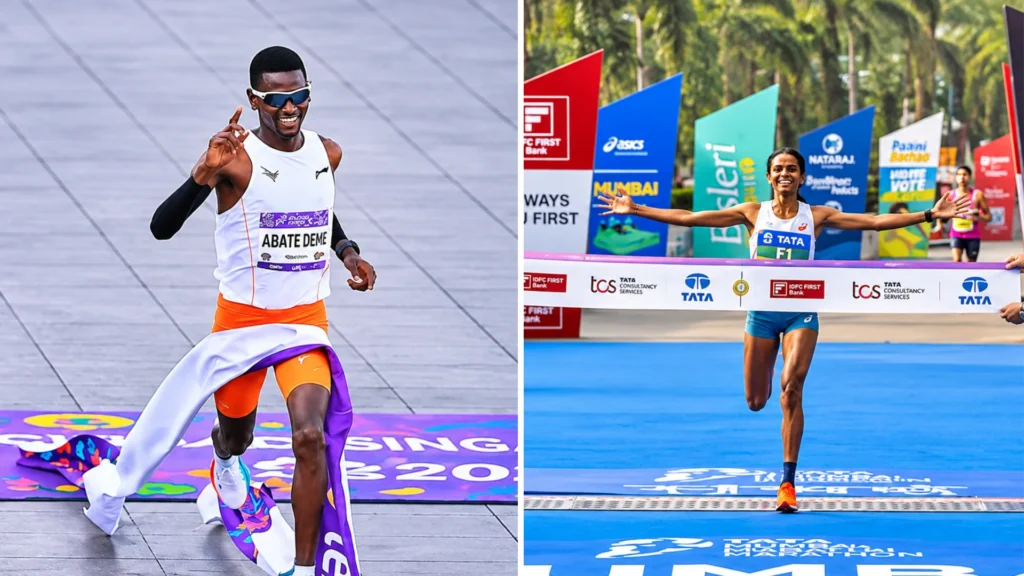 Ethiopia won both elite titles at the 2026 Tata Mumbai Marathon.
The 21st edition, on 18 January 2026, was the biggest yet, with 70,065 participants (65,424 running on the day and 4,641 online). Ethiopia won both elite races, the seventh time in the event’s history that one country has taken both titles.
- Men: Tadu Abate Deme (Ethiopia) won in 2:09:55, ahead of Leonard Kiprotich Langat (Kenya, 2:10:10) and Merhawi Kesete (Eritrea, 2:10:22).
- Women: Yeshi Kalayu Chekole (Ethiopia) won in 2:25:13, the fifth-fastest women’s winning time in the race’s history. Gojjam Tsegaye Enyew (Ethiopia) was third in 2:28:27.
The elite winners each took home $50,000 (about ₹45 lakh). The 22nd edition will be held on 17 January 2027, again starting from CSMT, with a total prize purse of $389,524.
Fact check: how we verified this history
On a phone, swipe the table sideways to see every column.
| Claim | Status | Sources |
|---|---|---|
| Started in 2004 by Procam; Standard Chartered until 2017; Tata from 2018 (10-year deal) | Verified | Wikipedia; Procam; BestMediaInfo; Devdiscourse |
| Course records (Lemi 2:07:32, Haymanot 2:24:15, 2023) | Verified | Wikipedia; Athletics Illustrated |
| 2026 winners, times and podiums | Verified | Watch Athletics; Marathons.com; Wikipedia; Free Press Journal |
| 2026 participants: 70,065 | Sources differ slightly | Marathons.com (70,065); Free Press Journal (“over 69,000”) |
| Charity totals (₹72 crore in 2024; ₹60.68 crore in 2026; ₹500 crore+ overall) | Verified | Procam; Free Press Journal |
| 2004 and 2017 participant and fundraising figures; label history | Single source | Wikipedia (current Gold Label status confirmed by Procam and Watch Athletics) |
| Full list of winners 2004 to 2025 | Single source | Wikipedia (2013, 2019, 2023 and 2024 results also in news reports) |
| Ram Singh Yadav’s 2012 Olympic qualifying run | Single source | Wikipedia |
| 2027 date (17 January) and prize purse | Verified | Devdiscourse; LatestLY (ANI) |
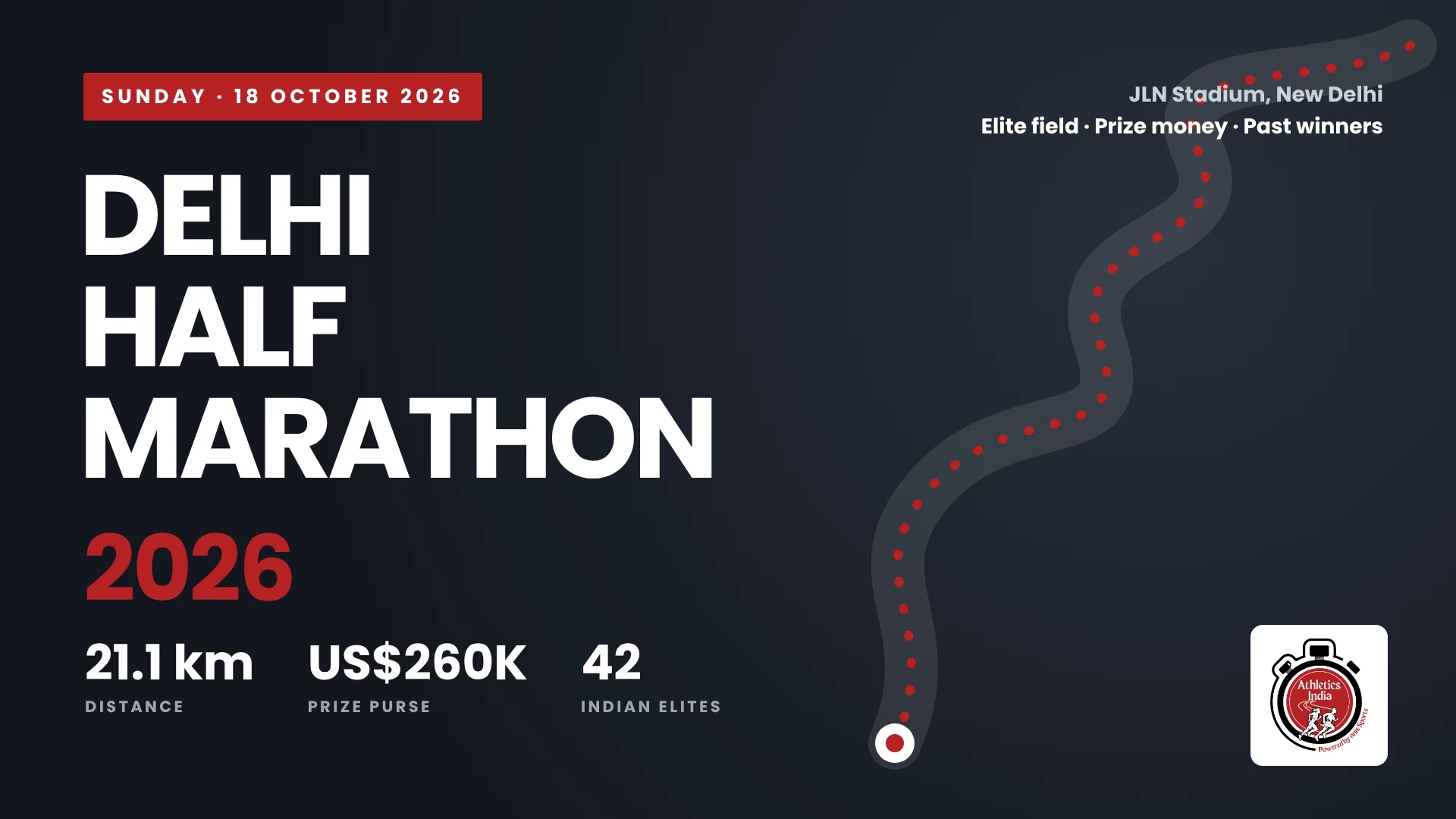
The Delhi Half Marathon 2026 takes place on Sunday, 18 October, with the start and finish at the Jawaharlal Nehru Stadium in New Delhi. It is the 21st edition of the Vedanta Delhi Half Marathon, a World Athletics Gold Label road race with a total prize purse of US$260,000.
Procam International, the race promoter, announced a 42-member Indian elite field on 8 October. Harmanjot Singh, the fastest Indian in the field, leads the men, while former champions Lili Das and Kavita Yadav lead the women. This guide therefore covers the date, the race categories, the Indian elite runners, the prize money, the records and every recent winner. In addition, we will add the results here on race day.
Delhi Half Marathon 2026 at a glance
- Date: Sunday, 18 October 2026
- Start and finish: Jawaharlal Nehru Stadium, New Delhi
- Edition: 21st Vedanta Delhi Half Marathon
- Status: World Athletics Gold Label road race
- Total prize purse: US$260,000
- Indian elite field: 42 runners (22 men, 20 women)
- Indian elite winner’s prize: Rs 3,50,000 (men and women)
- Promoter: Procam International
Jump to: Date and venue Race categories Indian elite field Prize money Records Past winners 2025 results Race-day results
Delhi Half Marathon 2026 date and venue
The race is on Sunday, 18 October 2026. As in recent editions, it starts and finishes at the Jawaharlal Nehru Stadium. Procam International organises the event, and the official race website carries the race-day information for registered runners.
The Delhi Half Marathon is one of India’s biggest running events. For example, the 2025 edition had 39,513 participants, including 9,709 women, according to Outlook. The elite race also carries World Athletics Gold Label status, so it draws Kenyan and Ethiopian runners every year.
Race categories at the Delhi Half Marathon 2026
Registrations opened on 23 July for six categories. However, each category had its own closing date or slot limit, so check the official website for any places left.
| Category | Note |
|---|---|
| Half Marathon | 21.097 km; elite and amateur runners aged 18 and above |
| Open 10K | 10 km |
| Great Delhi Run | Fun run |
| Senior Citizens’ Run | – |
| Champions with Disability Run | – |
| Virtual Run | Run from anywhere |
For the elite half marathon, runners must be at least 18, which means born on or before 17 October 2008. Moreover, all elite finishers receive a finisher medal, and confirmed elite runners get an official event T-shirt.
Delhi Half Marathon 2026 Indian elite field
The Indian elite field has 22 men and 20 women. Procam named the leading athletes in a press release on 8 October, reported by ANI. In short, the men’s race is a contest between a debutant with the best time and the runners who stood on the podium last year.
Indian elite men to watch
| Athlete | Why he matters |
|---|---|
| Harmanjot Singh | Fastest Indian in the field with a half marathon best of 1:01:46 (Alwar). Reigning TCS World 10K Bengaluru 2026 Indian elite champion and 2026 Asian Cross Country silver medallist. Making his Delhi debut. |
| Kiran Matre | Second among Indian elite men in Delhi in 2025, where he ran his best of 1:04:57. Indian elite winner at the TCS World 10K Bengaluru in 2024. |
| Kartik Karkera | Third among Indian elite men in Delhi in 2025. Indian elite men’s winner at the Tata Mumbai Marathon 2026. |
| Prince Kumar (Uttar Pradesh) | Back in the half marathon after a long break. Won the 5000m and 10,000m at the 2025 National Open and 5000m gold at the 2025 South Asian Championships. |
Harmanjot starts as the favourite on paper. His best is more than three minutes faster than Kiran Matre’s. Earlier this season, he also traded the lead with Gulveer Singh in the Inter-State 5000m final. Karkera, meanwhile, is in good form as well; he ran a 10,000m personal best on the track at the Indian Athletics Series in April.
Indian elite women to watch
| Athlete | Why she matters |
|---|---|
| Lili Das | Won the Indian elite women’s race in Delhi in 2024. |
| Kavita Yadav | Won the Indian elite women’s race in Delhi in 2023. |
| Ankita Dhyani | Olympic and World Championships steeplechaser. Finished fifth among Indian elite women on her half marathon debut in Delhi in 2025. |
| Priti Lamba | Bronze medallist in the 3000m steeplechase at the Asian Games 2023. |
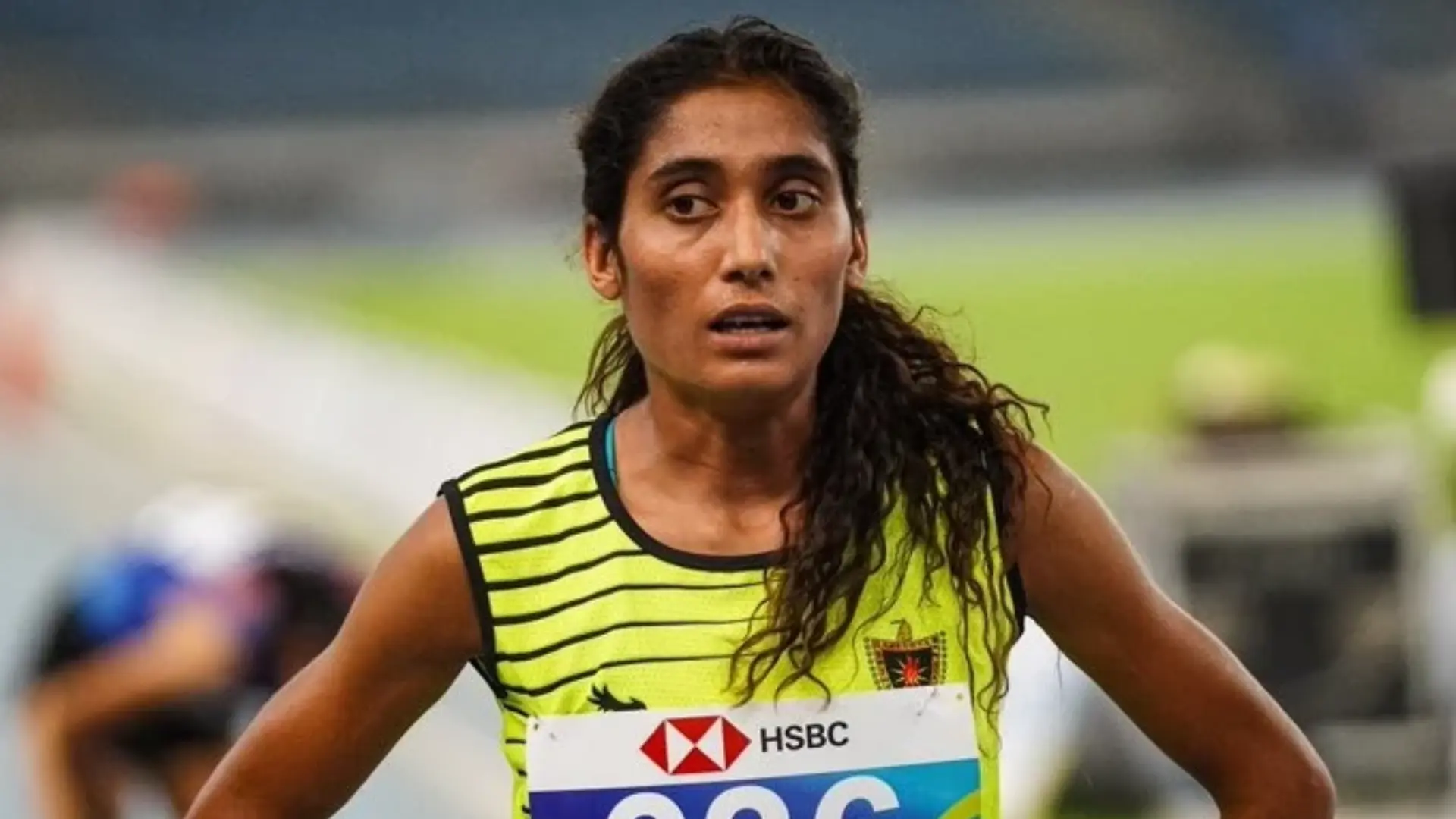
Two former champions, then, meet two steeplechasers who are still new to the distance. Ankita comes into the race in form, too: she won the 1500m at the National Open Athletics Championships in New Delhi this month.
Delhi Half Marathon 2026 prize money
The total prize purse is US$260,000. Most of it goes to the international elite race. For Indian runners, however, there is a separate Indian elite prize, and it is the same for men and women.
| Indian elite position | Men | Women |
|---|---|---|
| 1st | Rs 3,50,000 | Rs 3,50,000 |
| 2nd | Rs 2,50,000 | Rs 2,50,000 |
| 3rd | Rs 1,50,000 | Rs 1,50,000 |
| New Indian elite race record | Rs 1,00,000 bonus | Rs 1,00,000 bonus |
In addition, Procam has launched PRIDE (Procam Rewards for Indian Distance Elites) with this edition. It is a merit-based rewards scheme for verified Indian elite distance runners who enter any Procam event, according to Telangana Today.
Course records and Indian elite records
Both overall course records date from the 2020 race, which Ethiopian runners won in very fast times. The Indian elite records are older still.
| Record | Time | Athlete | Year |
|---|---|---|---|
| Course record, men | 58:53 | Amedework Walelegn (Ethiopia) | 2020 |
| Course record, women | 1:04:46 | Yalemzerf Yehualaw (Ethiopia) | 2020 |
| Indian elite record, men | 1:00:30 | Avinash Sable | 2020 |
| Indian elite record, women | 1:10:31 | L. Suriya | 2017 |
Can the Indian men’s record fall this year? It would take a big step from Harmanjot. His best of 1:01:46 is still 76 seconds slower than Sable’s mark. Even so, the Rs 1,00,000 bonus gives every Indian elite runner a reason to go for it.
Delhi Half Marathon winners since 2019
East African runners have won every international elite race in recent years. Notably, Olympic and world champion Joshua Cheptegei of Uganda won the men’s race in 2024.
| Year | Men’s winner | Time | Women’s winner | Time |
|---|---|---|---|---|
| 2025 | Alex Matata (Kenya) | 59:50 | Lilian Rengeruk (Kenya) | 1:07:20 |
| 2024 | Joshua Cheptegei (Uganda) | 59:46 | Alemaddis Eyayu (Ethiopia) | 1:08:17 |
| 2023 | Daniel Ebenyo (Kenya) | 59:27 | Almaz Ayana (Ethiopia) | 1:07:58 |
| 2022 | Chala Regasa (Ethiopia) | 1:00:30 | Irine Cheptai (Kenya) | 1:06:42 |
| 2020 | Amedework Walelegn (Ethiopia) | 58:53 | Yalemzerf Yehualaw (Ethiopia) | 1:04:46 |
| 2019 | Andamlak Belihu (Ethiopia) | 59:10 | Tsehay Gemechu (Ethiopia) | 1:06:00 |
Delhi Half Marathon 2025 results: a quick recap
Last year’s race took place on 12 October 2025. Kenya won both elite races, and that had happened only once before, in 2006. Alex Matata won the men’s race in 59:50, while Lilian Rengeruk beat Ethiopia’s Melal Siyoum Biratu by one second in the women’s race, as Outlook reported.
| Indian elite | 1st | 2nd | 3rd |
|---|---|---|---|
| Men | Abhishek Pal, 1:04:17 | Kiran Matre, 1:04:57 | Kartik Karkera, 1:05:16 |
| Women | Seema, 1:11:23 | Ujala, 1:15:41 | Sanjivani Jadhav, 1:15:52 |
Two of last year’s men’s podium finishers, Matre and Karkera, are back in 2026. As a result, Harmanjot’s debut gives the Indian race its most open look in years.
Shaunae Miller-Uibo is the event ambassador
Two-time Olympic 400m champion Shaunae Miller-Uibo of the Bahamas is the International Event Ambassador for the Delhi Half Marathon 2026, Procam announced on 24 September. She won Olympic gold in Rio 2016 and Tokyo 2020, and she became world 400m champion in 2022.
Delhi Half Marathon 2026 results on race day
Provisional results are due by 5 PM on race day, according to the official race page. Timing certificates follow on Sports Timing Solutions after 21 working days.
We will update this page on 18 October with the international and Indian elite results, the top ten in each race and any records. Procam had not named the international elite field when this page was published on 12 October; we will add it as soon as it is announced.
Meanwhile, Indian distance running is having a strong year. For example, Sawan Barwal set a national record of 2:11:37 to win marathon silver at the Asian Games in September. You can also find all of India’s medals in our Asian Games 2026 athletics results.
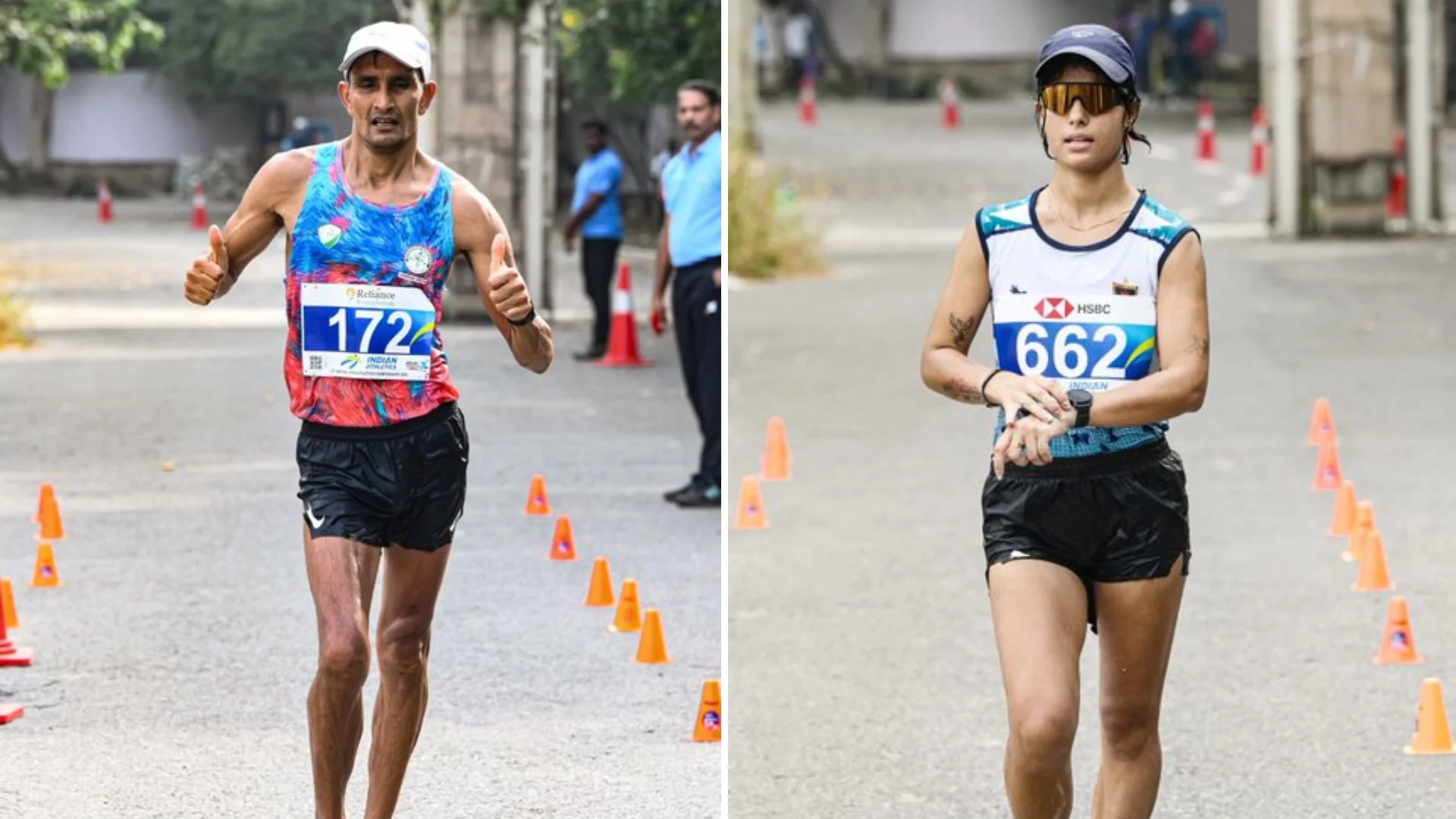
Sandeep Kumar of Haryana and Ramandeep Kaur of Railways won the men’s and women’s marathon race walk titles respectively at the 65th National Open Athletics Championships 2026, held at the Jawaharlal Nehru Stadium in New Delhi.
The marathon race walk events took place on the final day of the four-day championships, which ran from October 8 to 11, 2026.
Sandeep Kumar Wins Men’s Marathon Race Walk Gold
Sandeep Kumar claimed the men’s marathon race walk title after completing the 42.195km event in 3:19:52.00.
Vishvendra Singh of Madhya Pradesh finished second in 3:21:11.00 to secure the silver medal, while Resham Midhun of the Services Sports Control Board (SSCB) took bronze in 3:22:46.00.
Sandeep finished 1 minute and 19 seconds ahead of Vishvendra. The gap between the silver and bronze medallists was 1 minute and 35 seconds.
National record holder Ram Baboo did not finish the race, according to the results provided.
Men’s Marathon Race Walk Results
- Gold: Sandeep Kumar (Haryana) — 3:19:52.00
- Silver: Vishvendra Singh (Madhya Pradesh) — 3:21:11.00
- Bronze: Resham Midhun (SSCB) — 3:22:46.00
Ramandeep Kaur Takes Women’s Marathon Race Walk Title
Ramandeep Kaur won the women’s marathon race walk title with a reported time of 3:59:23.00.
Sonal Sukhwal of Rajasthan secured the silver medal in 4:16:06.00, while her state-mate Deepika Sharma finished third in 4:22:55.00 to claim bronze.
According to the results provided, five athletes entered the event, but only three completed the race, leaving all three finishers on the podium.
Ramandeep finished 16 minutes and 43 seconds ahead of Sukhwal. The difference between the silver and bronze medallists was 6 minutes and 49 seconds.
Women’s Marathon Race Walk Results
- Gold: Ramandeep Kaur (Railways, as reported) — 3:59:23.00
- Silver: Sonal Sukhwal (Rajasthan) — 4:16:06.00
- Bronze: Deepika Sharma (Rajasthan) — 4:22:55.00
Marathon Race Walk Concludes National Open Championships
The men’s and women’s marathon race walk competitions formed part of the final day’s programme at the 65th National Open Athletics Championships in New Delhi.
Sandeep Kumar and Ramandeep Kaur emerged as the respective winners, while Vishvendra Singh, Resham Midhun, Sonal Sukhwal and Deepika Sharma completed the medal podiums in their events.
Nagoya: Five months ago, Sawan Barwal achieved something Indian marathon runners had been chasing for 48 years.
On a cold April morning in Rotterdam, the Army runner from Himachal Pradesh broke Shivnath Singh’s long-standing national marathon record. He clocked 2:11:58, becoming the first Indian to run under 2 hours and 12 minutes in the marathon.
The performance finally erased a record that had stood since 1978.
On Saturday in Nagoya, Barwal went even faster. This time, he also secured an Asian Games medal.
Barwal won silver in the men’s marathon at the 2026 Asian Games, clocking 2:11:37 to improve his own national record by 21 seconds.
More importantly, he ended India’s 44-year wait for a medal in the Asian Games marathon.
For a runner competing in only his second marathon, the achievement marks a remarkable rise.
Speaking to NNIS Sports after the race, Barwal said the medal was important because he had won it for India. However, he was already looking ahead to his next challenge.
“I will try even harder next time.”
From a 48-Year-Old Record to a New National Mark
When Barwal arrived in Rotterdam in April, he faced a different kind of challenge.
Shivnath Singh’s national record of 2:12:00 had survived for 48 years. It had become a major benchmark in Indian athletics, resisting generations of marathon runners.
Barwal, however, had never competed in a marathon before.
Despite that, he finished in 2:11:58 and broke the record.
The closing kilometres made the achievement even more dramatic. Barwal struggled badly near the finish and briefly blacked out.
He fell but got back up and completed the race. His time of 2:11:58 was enough to finally replace Singh at the top of the Indian record list.
Five months later, Barwal has lowered that mark once again.
2:11:37.
This time, he also won an Asian Games silver medal.
A Marathon Career That Has Barely Begun
Barwal’s rapid rise is particularly remarkable because the marathon is a relatively new chapter in his career.
The Mandi-born Army athlete previously competed in shorter events, including the 5,000m, 10,000m and half marathon.
He then made the move to the marathon, covering the full distance of 42.195km.
His first marathon produced a national record. Now, his second has brought an Asian Games silver and another national record.
In Nagoya, Barwal stayed with the leading group deep into the race. He was second at the halfway point.
After the 35km mark, the contest had effectively narrowed to three runners.
Japan’s Ichitaka Yamashita eventually made the decisive move to win gold in 2:10:49. China’s Peiyou Feng took bronze in 2:12:13.
Barwal held on to finish second and secure silver.
Barwal Ends India’s 44-Year Wait for an Asian Games Marathon Medal
With his silver medal, Barwal became only the fourth Indian to win a men’s marathon medal at the Asian Games.
India’s previous medals in the event had all come in New Delhi.
At the inaugural Asian Games in 1951, Chhota Singh won gold, while Surat Singh Mathur claimed bronze.
Later, in 1982, Hosur Kukkappa Seetharan won another bronze medal.
Barwal has now added his name to that list. He is also the first Indian men’s marathon medallist at the Asian Games outside India.
His silver in Nagoya marks a significant moment for Indian distance running.
The Significance of Shivnath Singh’s Record
There is an important connection between Barwal’s two national-record performances.
When he broke Singh’s record in April, the achievement went beyond the numbers on the clock.
Shivnath Singh had run 2:12:00 in 1978. His outstanding career also included an 11th-place finish at the 1976 Montreal Olympics.
For almost half a century, Indian marathon runners had tried to break that mark.
Barwal finally did it in Rotterdam.
Former Olympian Nitendra Singh Rawat said after the race that breaking such a long-standing record could encourage other Indian marathoners to target the new benchmark.
He also stressed the need for Indian distance runners to compete more often on fast courses and against stronger international fields.
According to Rawat, these opportunities are important if Indian runners are to move towards the 2:09 range.
Now, Barwal has given them another national record to chase.
“I Will Try Even Harder Next Time”
For Barwal, the Asian Games silver is not the finish line.
Speaking to NNIS Sports after the race, he said the medal was important because he had won it for India. However, he also made it clear that he wants to achieve much more for the country.
“I will try even harder next time.”
After just two marathons, Barwal leaves Nagoya with an Asian Games silver and another national record.
His 2:11:37 performance has made him one of India’s leading distance runners and ended a 44-year wait for an Asian Games marathon medal.
April may not be peak marathon season in India, but the calendar remains active with a mix of full marathons, trail races and major road events. Here’s a clean look at key races to track this month, along with what it takes to get on the start line.
- Kaveri Trail Marathon (Coorg | April 11–12)
Distances: 42.2K, 21.1K, 10K
A scenic but demanding trail race along the Cauvery river. Open registration, but the full marathon is best suited for experienced runners due to terrain and humidity. No strict time qualification required. - Varanasi Marathon (Varanasi | April 12)
Distances: 42.2K, 21.1K, 10K, 5K
A traditional road race with broad participation. Open to all, though full marathon runners are typically expected to have prior long-distance experience. - Bhubaneswar City Marathon (Bhubaneswar | April 12)
Distances: 42.2K, 21.1K, 10K
One of the more structured city marathons in eastern India. Entry is open; some categories may recommend timing certificates for competitive slots. - Tawang Marathon (Arunachal Pradesh | April 5)
Distances: Marathon, Half Marathon
High-altitude race with limited field size. No formal qualification standards, but runners should be prepared for altitude and cold conditions. - Kutch Desert Trail Run (Kutch | April 4–5)
Distances: 10K to 50K ultra
A niche endurance event across desert terrain. Open entry, but longer distances are geared toward experienced ultra runners. - TCS World 10K Bengaluru (Bengaluru | April 26)
Distances: 10K
A World Athletics Gold Label race. Amateur categories are open, but faster runners may need to submit timing proof for seeded entries.
April’s schedule leans toward accessibility, but conditions — heat, terrain, altitude — make preparation the real qualifier.
