





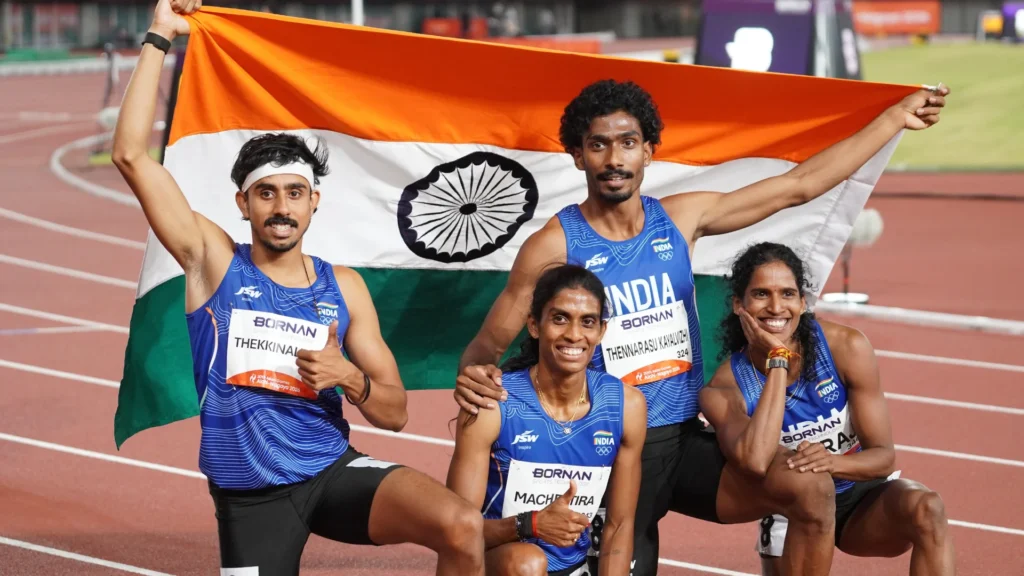
Relay success on the international stage demands far more than raw quarter-mile speed; it requires millisecond precision in exchange zone geometry, sharp break-line navigation, and supreme lactate tolerance under high-speed traffic. In the Mixed 4x400m Relay final at the 2026 Asian Games, the Indian quartet delivered a masterclass in relay execution, clocking a high-velocity 3:14.46 to capture the silver medal. Every single leg served a specific tactical purpose, combining raw individual speed with seamless baton handoffs.
Manu TS set the tone for Team India out of the starting blocks on leg one. Tasked with navigating the full-stagger opening lap, Manu drove aggressively over the first 200 meters to establish forward momentum before settling into a smooth stride frequency through the top turn. Clocking a solid 46.10s split, he brought the baton into the first exchange zone in clean air, giving India an immediate front-running position without wasting metabolic energy in mid-pack traffic.
Taking the first baton handoff, veteran campaigner MR Poovamma demonstrated why tactical experience is invaluable in mixed relay events. Operating on the second leg where athletes break for the inside rail, Poovamma absorbed aggressive mid-leg surges from rival runners representing Bahrain and China. By holding a firm, tight line along the inside rail during the backstretch, she forced opposing runners to cover extra distance on the outside of the curve. Poovamma delivered a 52.16s split, maintaining a relaxed torso and low arm carriage to manage lactate buildup into the second transition.
The defining surge of the race came on the third leg via Vishal TK. Unleashing a blistering flying split of 45.22s—the fastest overall split of the Indian quartet—Vishal obliterated the gap to the front. He tracked his targets through the backstretch, eating up track distance with massive stride length and smooth transition mechanics. His explosive lap ensured that India entered the final exchange in firm contention for the top podium spots.
Anchoring the performance was Vithya Ramraj, who produced a clutch performance when the pressure was highest. Taking the baton for the final 400 meters, Vithya launched into a brilliant sub-51s split (50.98s). Despite intense pressure from chasing athletes down the home stretch, Vithya maintained erect vertical posture, avoiding upper-body sway and shoulder tension over the agonizing final 50 meters. Her 50.98s anchor leg sealed the silver medal comfortably in 3:14.46. With flawless baton transfers inside the 30-meter exchange zones, India proved that technical precision amplifies pure sprinting power.