





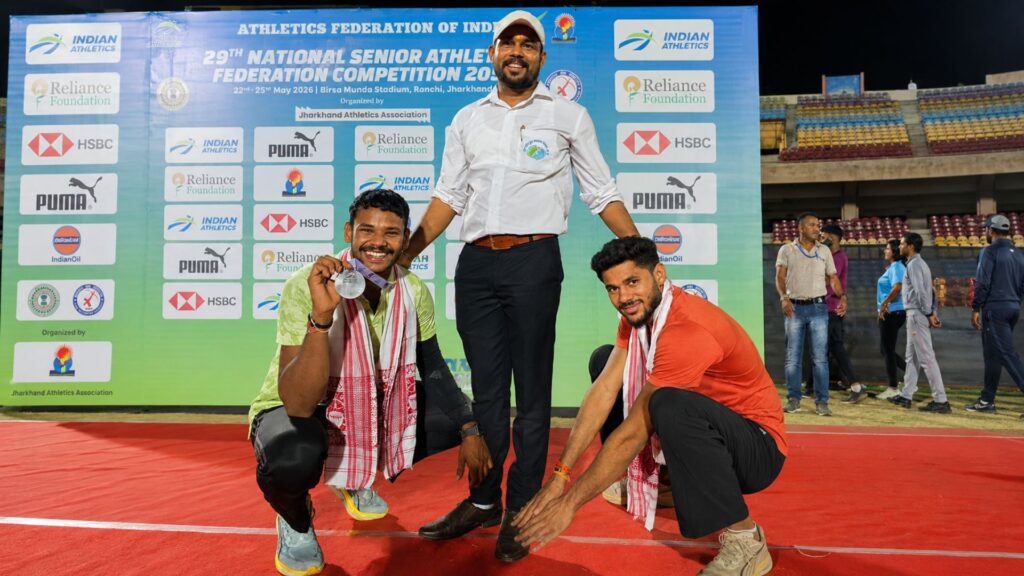
Indian athletics is officially entering its main character era. For the first time in history, two Indian athletes are pulling up to represent the country in the men’s pole vault at the Commonwealth Games. Dev Meena from Madhya Pradesh and Kuldeep Yadav from Uttar Pradesh have both secured their spots for CWG 2026, and honestly? They’re about to rewrite the history books.
What makes this lore even crazier is that they’re basically training twins. Both vaulters train under the same mastermind coach, Ghanshyam Yadav, at the state-sponsored DSWY academy at TT Nagar, Bhopal.
But let’s be real—their road to qualification was a whole survival arc. Until last year, India’s national record in men’s pole vault was capped at a modest 5.31m. Enter 20-year-old Dev Meena, who absolutely understood the assignment at the National Games 2025 by clearing 5.32m. He didn’t just break the record and call it a day, though. Dev went on an absolute rampage, breaking the national record five times in a row before flexing a 5.46m clearance—which is currently the top-tier flex for Indian athletics.
Meanwhile, Kuldeep Yadav’s arc was all about the ultimate comeback. He’d been fighting a long battle with injuries before linking up with Ghanshyam’s squad last year. The glow-up? Insane. Kuldeep came into 2026 with a former personal best of 5.15m, instantly upgraded to 5.25m, and then casually smashed the national record with a 5.41m vault. Not stopping there, he pushed it to 5.45m, easily surpassing the CWG qualification bar.
Unpacking the dynamic of his star pupils, Ghanshyam Yadav said, “They are both very good athletes, very hardworking, good training partners during practice, and great competitors against each other in competition.”
When asked how he keeps the peace between two elite athletes constantly trying to out-flex each other, Ghanshyam dropped his secret recipe with a smile: “I give them individual targets. I speak to both of them separately before competitions and tell each of them, ‘Today is your day. You have to break the national record.’ Neither athlete knows that I’ve given the same target to the other. If they ever find out, it might become a problem for me,” he said with a laugh.
Fun fact: Coach Ghanshyam is a former pole vaulter himself, so he knows the vibes inside out.
The duo will be jumping into action on July 30 for the men’s pole vault qualification round in Glasgow. If they clear the hype, they’ll be vaulting for actual CWG medals on August 1.
Dev and Kuldeep are bringing fresh personal bests of 5.46m and 5.45m to the table, but Glasgow is going to be a total boss fight. Looking at this season’s global stats, the Indian duo currently ranks fourth and fifth among qualified CWG athletes. Australia’s Kurtis Marschall is leading the pack with a massive 6.00m flex, followed by Great Britain’s Owen Heard (5.71m) and South Africa’s Kyle Rademeyer (5.60m).
Addressing the heavy competition, Ghanshyam isn’t sweating it: “Yes, the field is tough, but you have to understand that we are here to make a way, not follow one. Competing against stronger athletes will only make both of them better. They are regular 5.50m athletes, and I have full confidence they will give their best. I believe they are medal contenders, without a doubt.”
However, one major plot hole in India’s CWG setup is that no dedicated pole vault specialist or support staff was included in the official contingent traveling for the event.
Reacting to the gatekeeping, Ghanshyam said, “Yes, they haven’t included anyone specifically for pole vault. It will be tough because pole vault is a completely different event.”
He added, “I showed them the performances of the athletes they will be competing against, including the vaulter from Australia who has cleared 6.00m this season.”
Talking about the lack of high-level domestic meets to lock in practice, Ghanshyam noted, “Yes, they are struggling because there isn’t enough competition at the national level. After the Commonwealth Games and the Asian Games, our sole focus will shift towards the 2028 Olympics. I know the qualification mark of 5.83m is tough, but it’s not impossible. I’m planning to send both athletes to more competitions outside India. If they regularly compete against athletes clearing 5.70m or 5.80m, it will give them more confidence and will certainly help improve their performances.”
For more visit Commonwealth Games 2026