





By Johanna Worley
For nearly three decades, the men’s mile world record seemed untouchable.
Not impossible. Just untouchable.
Every generation produced athletes who looked capable. Every few years came another bold prediction that modern training, lighter spikes, faster tracks or superior pacing would finally bring down Hicham El Guerrouj’s astonishing 3:43.13, set in Rome in July 1999. Yet the record endured through the careers of Bernard Lagat, Asbel Kiprop, Matthew Centrowitz, Jakob Ingebrigtsen and Yared Nuguse.
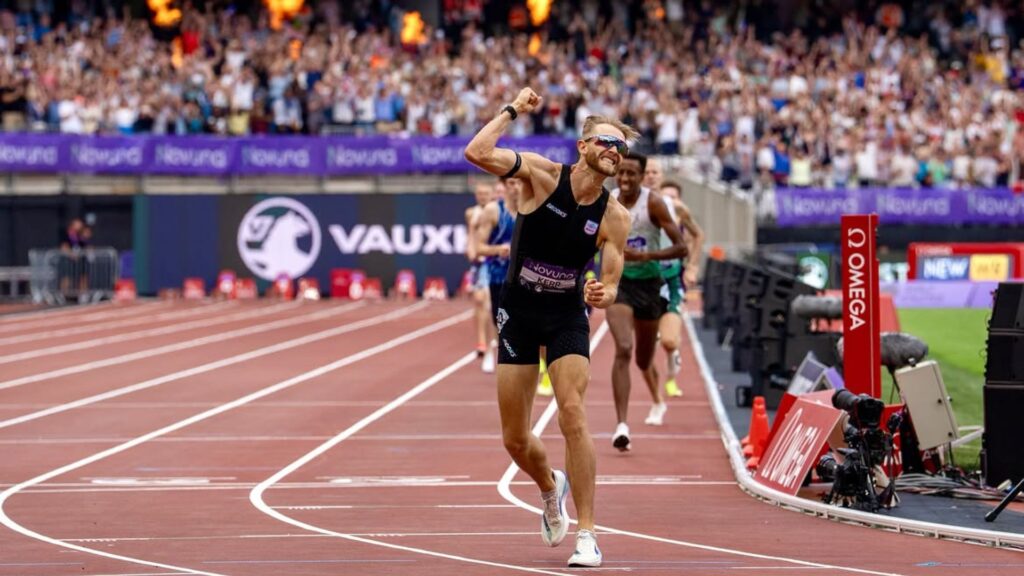
Then, on Saturday in London, Josh Kerr finally did it.
The Scot ran 3:42.66, becoming the first man in history to cover the mile in under 3 minutes 43 seconds and shaving 0.47 seconds off one of athletics’ most revered records. It wasn’t just another world record. It was the end of a 27-year wait.
That deserves far more attention than it has received.
The mile occupies a unique place in sporting history. Unlike the Olympic distances, it has always carried an almost mythical status. Roger Bannister’s first sub-four-minute mile in 1954 remains one of the defining moments in modern sport. Even after athletics officially embraced metric racing, the mile retained its romance.
Its world record has often represented the very frontier of human endurance and speed.
From the mid-1970s to the mid-1980s, that frontier kept moving.
Between 1975 and 1985, the world record was broken eight times by five different athletes in what remains perhaps the greatest era in middle-distance running.
Filbert Bayi of Tanzania opened the sequence with 3:51.0 in 1975.
John Walker of New Zealand responded the same year, becoming the first man under 3:50 with 3:49.4.
Then came the unforgettable British rivalry.
Sebastian Coe lowered the mark to 3:48.95 in 1979 before Steve Ovett reclaimed it with 3:48.40 in 1980. Just 48 days later, Coe answered with 3:47.33. Steve Cram then carried the record to 3:46.32 in 1985, completing a decade in which Britain dominated the event and the record changed hands with remarkable frequency.
After Cram’s mark, the progression slowed dramatically.
Nearly eight years passed before Algeria’s Noureddine Morceli produced 3:44.39 in Zurich in 1993. Six years later came what many considered the perfect mile.
On a warm evening in Rome, Hicham El Guerrouj ran 3:43.13. Remarkably, Kenya’s Noah Ngeny also finished inside the previous world record with 3:43.40, highlighting just how extraordinary that race was.
What followed was unprecedented stagnation.
The event evolved. Shoes became lighter. Tracks became faster. Sports science transformed training. Pacing lights, advanced physiology and precision race planning became standard. Yet the record refused to budge.
That wasn’t because nobody came close.
Jakob Ingebrigtsen ran 3:43.73. Yared Nuguse clocked 3:43.97. Both performances suggested El Guerrouj’s record was vulnerable, but neither quite found the final fraction of a second.
Josh Kerr believed he could.
Earlier this year he publicly announced “Project 222″—222 seconds, or exactly 3:42.99. It was an unusually bold declaration in an era when athletes often avoid discussing records until after they happen.
On Saturday, 18th July 2026, he delivered.
With perfectly judged pacemaking through 1200 metres, Kerr took over for the final lap before an extraordinary closing circuit carried him into history. His official time of 3:42.66 also included a 1500m split of 3:27.62—faster than his own British record over that distance.
The significance goes beyond one athlete.
World records usually fall in clusters. Once a psychological barrier disappears, others often follow. Bannister’s sub-four-minute mile is the classic example. El Guerrouj himself broke the previous world record by more than a second.
Could Kerr’s performance have the same effect?
It feels possible.
Nuguse remains capable of threatening the mark. Ingebrigtsen, when healthy, is still one of the greatest middle-distance talents of the era. And Kerr himself has already shifted his attention towards El Guerrouj’s equally legendary 1500m world record of 3:26.00.
Perhaps what is most surprising is how quietly this achievement has been received outside athletics circles.
Breaking a world record that survived for 27 years should have been front-page news. It should have dominated sporting conversations. Instead, it barely rippled beyond track and field’s dedicated followers.
History, however, has a way of correcting these oversights.
Years from now, when people trace the evolution of the mile—from Bannister to Coe, Ovett and Cram, from Morceli to El Guerrouj—they will find another name.
Josh Kerr.