





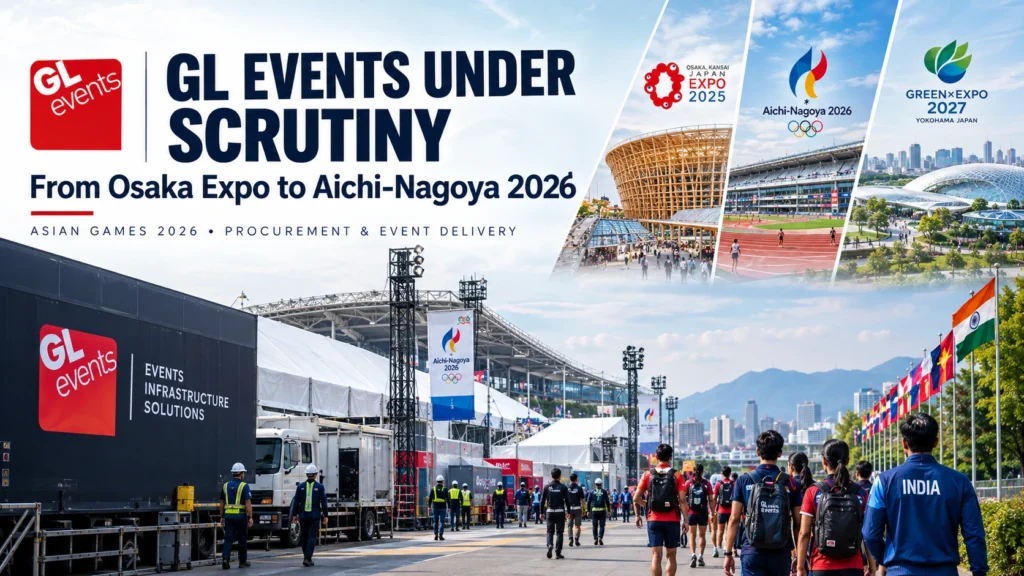
GL events Japan, the Japanese arm of French event-services giant GL events, was a contractor for several overseas pavilions at Expo 2025 Osaka-Kansai. Subcontractors subsequently complained of unpaid construction bills, with some taking legal action. Reports have described disputes involving multiple pavilions, while the Osaka authorities and Expo organisers have largely treated the payment disputes as matters between private parties.
And yet GL events did not disappear from Japan’s major-event ecosystem.
It became an official Prestige Partner of the Aichi-Nagoya 2026 Asian and Asian Para Games. More importantly, this is not merely a logo-on-the-wall sponsorship. GL events was selected as the Event Delivery Entity responsible for a huge part of the operational infrastructure of the Games.
Its responsibilities include temporary structures, power, lighting and sound, venue management, press operations, spectator services, medal ceremonies, food and beverage, cleaning, waste management and logistics.
The reported value of the Asian Games contract is ¥63 billion — roughly ₹3,700 crore at current exchange rates. Aichi prefectural officials themselves confirmed that the figure of ¥63 billion had been reported and described the required expenses as being around that level.
The remarkable part is that the Osaka Expo controversy was already known before the Asian Games contract was being implemented.
In July 2025, Aichi Governor Hideaki Omura was questioned about reports of more than ¥300 million in unpaid Expo construction costs involving GL events. He acknowledged that there had been payment-related disputes involving several pavilions and said the organisers were checking the facts.
By August, the governor said the Asian Games organising committee had received an explanation from GL events. He also acknowledged that GL would necessarily have to subcontract work to a large number of companies for the Games and said measures were being sought to ensure those companies could undertake the work with confidence.
There is an even more revealing detail in the selection process.
According to the Aichi Prefectural Assembly, GL events Japan was selected as a candidate for a negotiated contract because its parent company, GL events SA, was already a Prestige Partner of the two Games. The contract was subsequently approved by the organising committee’s board.
So this is not simply a case of the same company winning two unrelated jobs.
The company involved in a major unpaid-contractor controversy at Osaka was already positioned as a prestige partner of the Aichi-Nagoya Games — and its Japanese subsidiary subsequently received the enormous event-delivery assignment.
And the story does not end there.
GL events Japan has also been selected as one of the 10 certified GX House suppliers for GREEN×EXPO 2027, the international horticultural exposition in Yokohama. The official Expo association’s own material lists GL events Japan among those suppliers.
That means one company appears repeatedly in the infrastructure of three enormous Japanese public events:
OSAKA EXPO → AICHI-NAGOYA ASIAN GAMES → YOKOHAMA GREEN×EXPO.
That, by itself, does not prove corruption, improper influence or “vested interests”. There is no evidence established in the sources cited here that would justify making that accusation as fact.
But it absolutely raises a legitimate question:
How does a company facing unresolved disputes over unpaid subcontractor bills at one major Japanese event continue to secure prominent roles in two more?
And perhaps the bigger question is about the procurement system itself.
Was GL events selected because of its demonstrable international event-management experience? Was its existing status as a Prestige Partner a significant factor? What due diligence was conducted after the Osaka disputes emerged? What safeguards were imposed to protect Asian Games subcontractors? And why was the company subsequently acceptable as a supplier for Yokohama’s 2027 exposition?
Those are questions worth answering.
Because when billions of yen in public-event infrastructure are involved, “it is a private contractual dispute” becomes an increasingly unsatisfactory explanation for the public to simply accept.
The issue isn’t merely whether GL events can deliver an Asian Games.
It is whether Japan’s major-event procurement system is sufficiently transparent about who gets these contracts, why they get them, and what happens when things go wrong.