





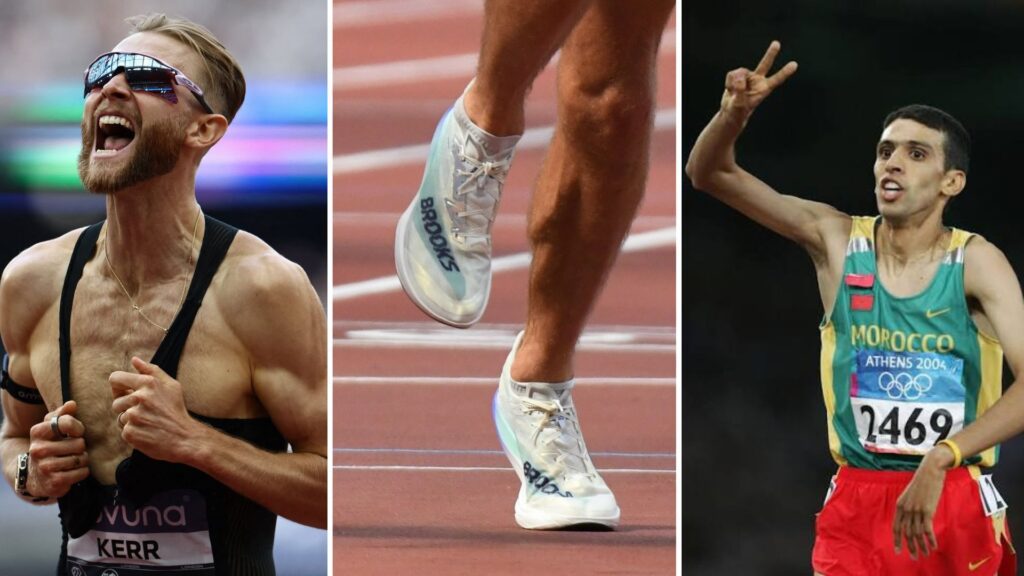
By Sundeep Misra
Josh Kerr has left me with mixed emotions.
As an athlete, he is not only world-class but possesses that rare skill set which makes an enduring legend of multiple record-breaking performances, Olympic medals, and World titles. So, when he crossed the line at the London Diamond League in 3:42.66, erasing Hicham El Guerrouj’s 27-year-old mile world record, the 60,000 inside the stadium, and the millions watching across the globe, were understandably ecstatic. Delirious, even.
Records do that to your senses. Especially when one has endured for nearly three decades, held by an athlete widely considered an all-time great.
As a kid reading about track and field, I was fascinated by Saïd Aouita, the 1984 Los Angeles 5,000m gold medallist and 1987 Rome World Champion. In Seoul ’88, while the world was consumed by the fallout of Ben Johnson’s 100m scandal, Aouita quietly picked up an 800m bronze.
Following Hicham El Guerrouj was a natural evolution. The Moroccan won four consecutive 1,500m World titles from 1997 to 2003. By the time he arrived in Sydney for the 2000 Olympics, his victory was considered a mere formality, all he had to do was show up on the track. Instead, in a shock result, Hicham finished second to Noah Ngeny, the talented Kenyan who, ironically, had been his pacemaker when El Guerrouj set the 1,500m world record in Rome two years earlier.
Still chasing Olympic gold, Hicham flew into Athens four years later. Just twenty days before the Olympic final, Bernard Lagat beat him at the Zürich meet. But on August 24, 2004, when another campaign threatened to end in heartbreak, Hicham fought back. He led down the home straight, lost the lead to Lagat, and then, a few agonizing strides from the finish, reclaimed it to finally seize his gold.
It remains one of those rare sporting moments that brought me to tears. I was covering a different event at those Games and had sprinted into the media centre barely ten minutes before the gun. Days later, Hicham won the 5,000m in 13:14.39, becoming the first man in 80 years since Paavo Nurmi in 1924 to complete the distance double.
Twenty-seven years ago, on July 7, 1999, El Guerrouj set his historic mile mark of 3:43.13 at Rome’s Stadio Olimpico. Understanding what Hicham represents to the soul of track and field is necessary to explain why Kerr’s heavily publicized record leaves such a lingering, complicated aftertaste.
There is no doubting the success of Project 222. Anyone who understands modern athletics knew Brooks would pull out all the stops, relying on Kerr to push his physical limits. Yet, it leaves you feeling that this wasn’t purely a triumph of lungs, heart, and grit that singular currency that drives runners across the line. It was also a victory of bespoke sports engineering.
This is no slight on Kerr – an Olympic medallist, a World Champion, and one of the fiercest competitors alive. No shoe breathes for an athlete. No speed-suit absorbs the lactic acid of a 55-second lap. Yet, to analyse this mark without examining the machinery beneath his feet is to tell only half the story.
For decades, the track was an ascetic sanctuary. The sole currency was endurance, tactical intellect, and raw talent. In India, stories of running barefoot on cinder or grass were legion. Later, all you needed was a pair of standard-issue spikes to feel ready to take on the world. Equipment was never the differentiator, at least not in our minds.
Project 222 questions that innocence.
Brooks didn’t pull a top-tier spike off a retail shelf in London for Kerr. The Hyperion 222 is a one-off prototype modelled on eight years of Kerr’s personal stride data, 3D foot scans, and a carbon plate customized to his heavy, high-force strike.
As Runner’s World put it: His Custom Shoes Were Designed to Be a ‘Weapon’.
Danny Orr, Brooks’ senior director of product development, openly admitted to Popular Science: “The notion of running slowly, or changing gears, is going to feel awful in this shoe. It’s not designed for that. It really is a weapon for him to run four laps at a sustained high speed and cadence.”
For an emerging Indian talent like Yoonus Shah, a shoe like the Hyperion 222 is useless, unless one is engineered specifically for him.
World Athletics regulations mandate that shoes worn in major championships must be widely available on the retail market. Yet, prototypes like Kerr’s exploit the “Development Shoe” loophole, which allows unreleased shoes a 12-month window in one-day international meets like the Diamond League. While the times are officially ratified, the reality is equipment asymmetry.
When El Guerrouj ran 3:43.13 in 1999, he wore standard EVA foam and thin metal spikes. He had no energy-return carbon plates, no custom uppers, no personalized aerodynamic suits. Neither did Steve Cram when he ran 3:46.32 in 1985.
In Formula 1, we never evaluate Lewis Hamilton’s lap times against Juan Manuel Fangio’s without discussing the car. Why do we insist on doing so in track and field?
Track is moving toward its own Constructors’ Championship. Brooks didn’t just sponsor Kerr; they won alongside him. The global media blitz that followed – worth an estimated $20M to $30M in direct advertising -instantly shattered Nike and Adidas’s monopoly on the “elite speed” narrative.
Kerr told the New York Times: “The mantra was that we’re not chasing world records, we’re creating the conditions where world records become inevitable.”
And there lies the dilemma.
Kerr’s 3:42.66 is an astounding physical achievement, built on brutal 70-mile training weeks and excruciating 4x800m workouts. But the fear among purists isn’t that technology is advancing – it is that technological capability will eventually eclipse human parity.
When records are engineered in a lab as much as they are forged on the track, we are no longer just watching a race. We are watching the future arrive. Whether that future still belongs entirely to the runner remains the open question.