




World Athletics has officially unveiled the qualification system for the 2027 World Championships in Beijing — and the message is loud and clear: qualifying is about to become much harder.
The governing body is continuing with its hybrid qualification model, where athletes can enter either through direct qualifying standards or via world rankings. But this time, rankings will matter more than ever before.
World Athletics says it wants roughly 40% of athletes to qualify through entry standards and 60% through rankings. That is a major shift from previous championships, where standards carried more weight.
For Indian athletes, this changes the entire approach to season planning.
The qualifying windows are already open for some events. Marathon qualification began in November 2025, while the 10,000m and race walks opened in February 2026. Most other events will have qualification periods running from August 2026 to August 2027.
But the real talking point is the standards themselves.
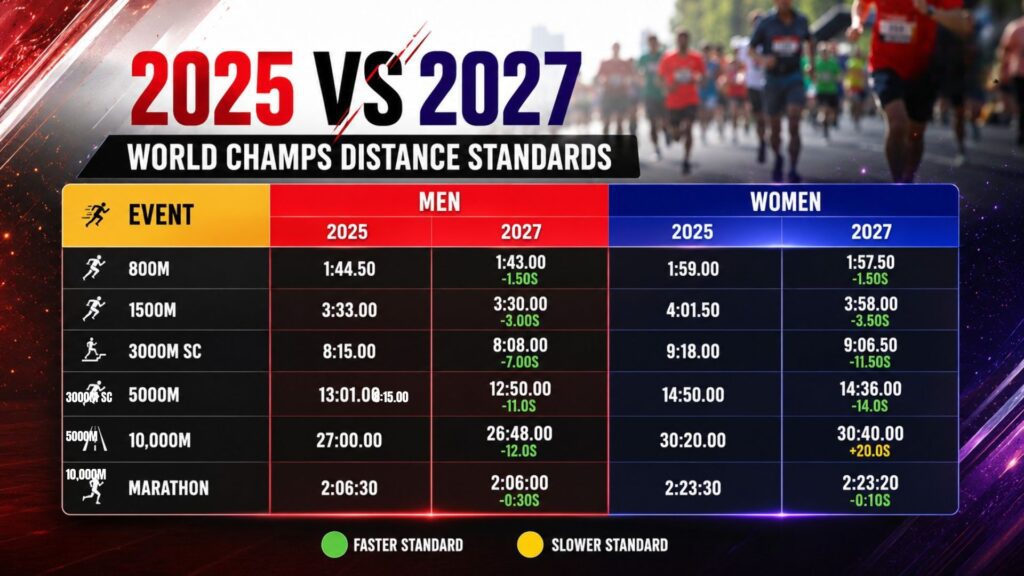
Several marks have become brutally difficult. The men’s 800m standard is now 1:43.00, while the men’s 1500m has been pushed to 3:30.00. Even the men’s 100m now effectively requires athletes to break the 10-second barrier.
The implication is obvious: World Athletics does not expect most athletes to qualify directly anymore.
Instead, the rankings system will decide the majority of places.
That means athletes will need to compete regularly at high-category international meets such as Diamond League events and Continental Tour competitions. Rankings are calculated using both performance marks and the quality of competition.
There is another major twist.
From now on, qualifying marks will only count if achieved at Category C meets or above. That effectively excludes many lower-level competitions and local meets from direct qualification consideration.
For Indian athletes, this could become a serious challenge.
Access to high-category international meets is often expensive and politically complicated. Entry into elite competitions frequently depends on agents, sponsorship relationships, and global rankings themselves. Athletes from stronger systems naturally gain an advantage.
Distance runners and throwers may feel the impact the most.
World Athletics has also cracked down on certain “favourable conditions” performances. Marks achieved at famous facilities such as Throw Town Ramona in discus or on Boston University’s indoor track will no longer count as qualifying standards, though they will still help rankings.
There are also wild-card routes available.
Defending world champions, winners of the new World Ultimate Championships, Diamond League champions, and certain tour winners can qualify automatically.
For Indian athletics, the system creates both opportunity and pressure.
Athletes like Gulveer Singh, Vishal TK, Gurindervir Singh, and Tejaswin Shankar are already competing at levels where rankings can become realistic qualification routes. But for emerging athletes without international exposure, the pathway now looks significantly tougher.
The days of producing one brilliant performance at a domestic meet and punching a World Championships ticket may slowly disappear.
Consistency, international competition, rankings management, and access to elite races may now matter as much as raw talent itself.