





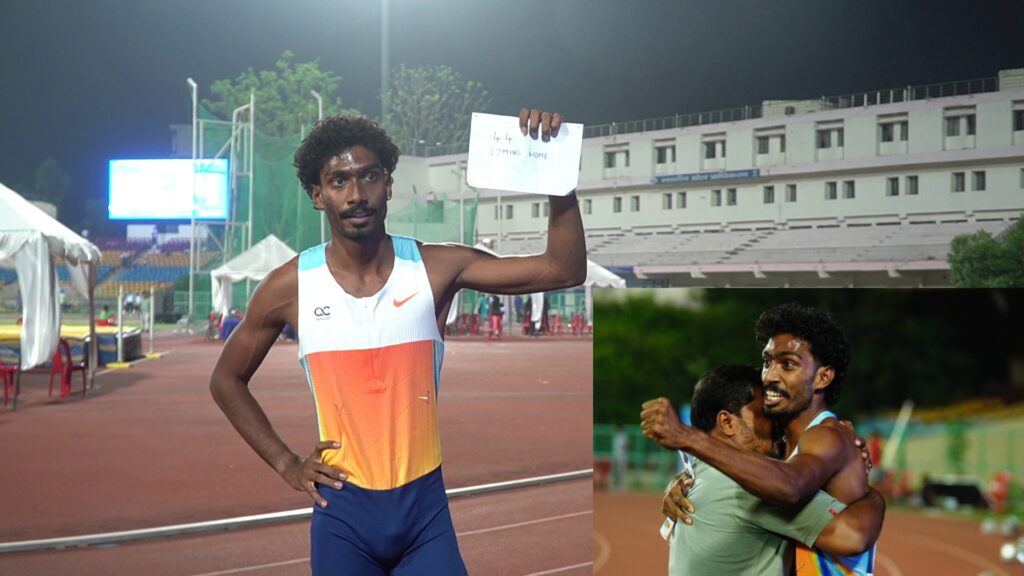
India’s quarter-miler Vishal TK shattered his own national record, clocking a historic 44.98s to become the first Indian ever to go sub-45 seconds in the men’s 400m.
With that run, the Tamil Nadu athlete did not merely break a record — he crossed a barrier Indian athletics had chased for generations.
For nearly 90 years, Indian quarter-milers have slowly pushed the national standard downward, one athlete at a time. From the era when breaking 50 seconds itself was considered extraordinary, Indian athletics has now finally entered the elite sub-45 club.
The journey began as far back as 1936, when GP Bhalla ran 50.0 seconds over 440 yards — roughly equivalent to 49.7 seconds for 400m. Two years later, F Gantzer lowered it further to 49.8 seconds.
Then came gradual progress through the decades.
Ivan Jacob clocked 49.6 seconds in 1954 before Joginder Singh dramatically cut the record to 48.0 seconds in 1955, signalling India’s growing sprint potential on the international stage.
But the true revolution arrived with one man.
Milkha Singh’s iconic 45.73s in 1960 transformed Indian athletics forever. The “Flying Sikh” carried Indian sprinting into world-class territory and his national record became one of the most celebrated marks in Indian sporting history.
For decades afterward, nobody could truly move beyond Milkha’s shadow.
It took 40 years before Paramjeet Singh lowered the mark to 45.56s in 2000. Then KM Binu clocked 45.48s in 2004, followed by Olympian Arokia Rajiv’s 45.47s in 2016.
Mohammed Anas Yahiya pushed it even lower with 45.21s in 2019.
And now comes Vishal TK.
At just 21 years of age, the Tamil Nadu sprinter has become the athlete who finally carried India beyond the mythical sub-45 barrier.
What makes the achievement even more remarkable is how rapidly Vishal’s career has evolved.
Until March 2024, Vishal primarily focused on sprint hurdles. But over the last year, he shifted his attention to the 400m — a decision that has completely transformed his career.
Speaking earlier this year, Vishal admitted the transition was not initially easy.
“There were good and bad days,” he had said after narrowly missing qualification for the World Relays during the Indian Open Relay competition in Chandigarh. “Personally, I made a slight technical error and had a lot of energy left after the race. The coach pointed out that I needed to push more as I did not feel tired after the race.”
The breakthrough came quickly afterward.