




Athletics age categories in India run from Under 14 to Under 23, followed by the open senior category. The Athletics Federation of India (AFI) places each young athlete by date of birth. Each category usually covers two birth years, so an Under 18 athlete is 16 or 17 on the cut-off date.
However, the cut-off date is not the same at every meet. That detail causes most of the confusion for athletes and parents. This guide therefore explains each category, how AFI calculates age, which national meets belong to which group, and what documents you need.
Athletics age categories in India: quick facts
- Under 14 and Under 16: the youngest groups, with their own national meet, NIDJAM
- Under 18: the youth category; National Youth Championships and Junior Nationals
- Under 20: the junior category; Junior Federation Cup and Junior Nationals
- Under 23: athletes aged 20 to 22; Indian Open U23 and the Asian U23 Championships
- Senior: open to all eligible athletes, with no upper age limit
- Proof of age: original birth certificate or Class 10 certificate, checked at the venue
Jump to: All categories How age is calculated Events by age National meets Age verification School categories
Athletics age categories in India at a glance
The table shows each category, the usual age on the cut-off date, and the 2026 birth window used at AFI meets. The windows come from the official AFI circulars for each meet.
| Category | Age on cut-off date | Main national meets | 2026 example (born between) |
|---|---|---|---|
| Under 14 | 12 or 13 | NIDJAM, Junior Nationals | 28 Oct 2012 and 27 Oct 2014 (Junior Nationals) |
| Under 16 | 14 or 15 | NIDJAM, Junior Nationals | 28 Oct 2010 and 27 Oct 2012 (Junior Nationals) |
| Under 18 | 16 or 17 | Youth Nationals, Junior Nationals | 28 Oct 2008 and 27 Oct 2010 (Junior Nationals) |
| Under 20 | 18 or 19 | Junior Federation Cup, Junior Nationals | 28 Oct 2006 and 27 Oct 2008 (Junior Nationals) |
| Under 23 | 20 to 22 | Indian Open U23 | 2004 to 2006 (Asian U23 selection) |
| Senior | No upper limit | Inter-State, Federation Cup, Open Nationals | Open |
How AFI calculates your age category
AFI uses two methods, and the method depends on the meet. Therefore, always read the circular for the specific competition.
Method 1: a two-year window tied to the meet
For domestic age-group meets, AFI sets a two-year birth window that ends close to the competition date. For example, the 2026 National Junior Championships in Chennai ended on 27 October. So the Under 18 window was 28 October 2008 to 27 October 2010. As a result, an athlete born on 15 March 2009 competed in Under 18.
Similarly, NIDJAM 2026 used windows ending on 16 November, its last day. A child born on 20 December 2012 was in Under 14. However, a child born on 1 November 2012 fell into Under 16. In addition, NIDJAM athletes had to be at least 12 years old on 16 November 2026.
Method 2: age on 31 December
For international selection, AFI follows World Athletics and Asian Athletics rules. Here, age is counted on 31 December of the competition year. For instance, Under 20 athletes are 18 or 19 on that date, and Under 18 athletes are 16 or 17. Likewise, the Asian U23 trials in 2026 were open to athletes aged 20 to 22 on 31 December 2026, born from 2004 to 2006.
The two methods can give different answers for the same athlete. The 2026 Junior Federation Cup in Tumkur accepted athletes born after 26 April 2006. Yet only athletes born from 2007 to 2010 were considered for India’s Asian and World U20 teams. So a late-2006 birth could compete there but not be selected.
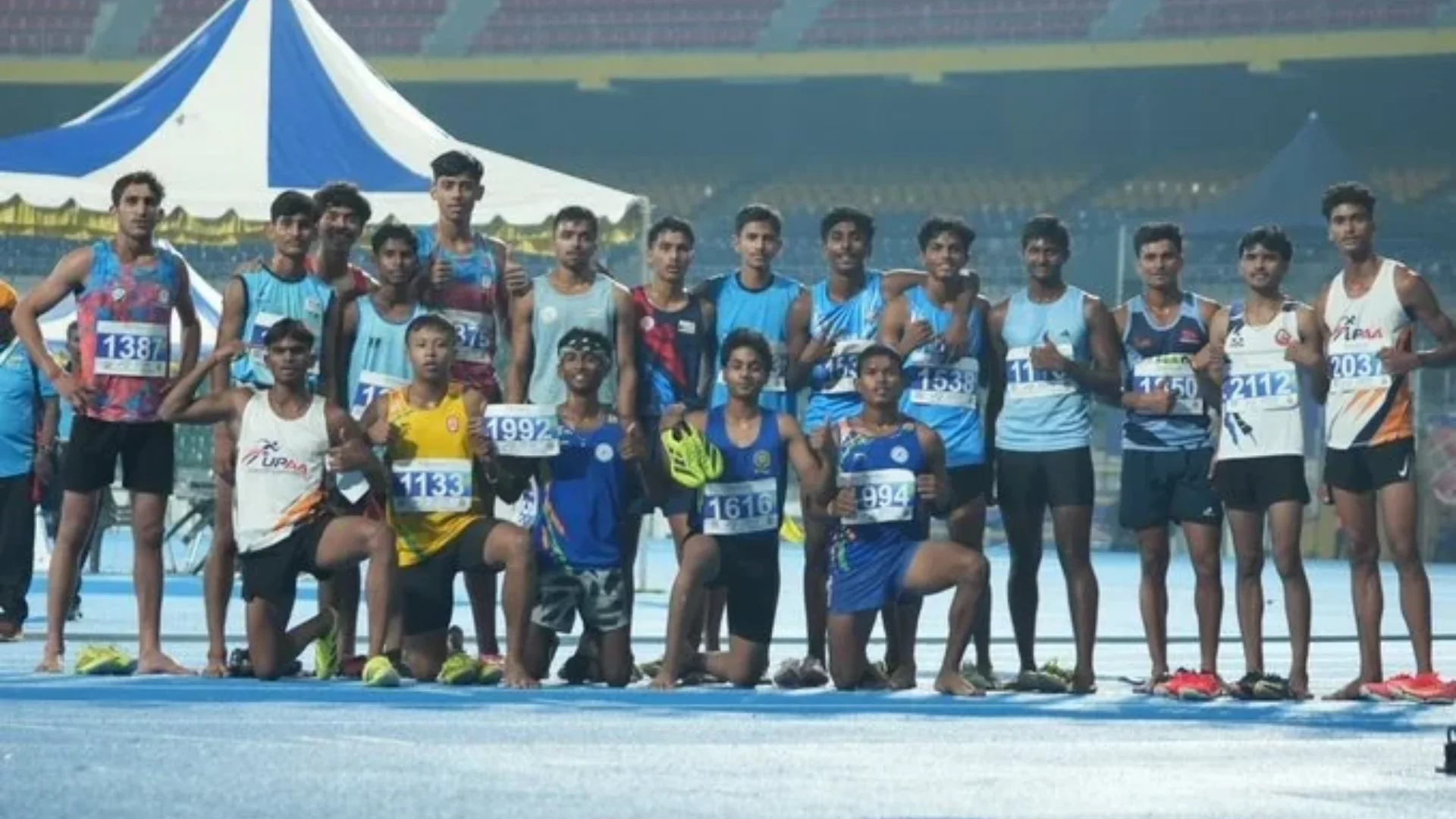
Events in each of the athletics age categories in India
Younger categories have simpler events, so children learn basic skills before specialising. The rules below come from the 2026 AFI circulars.
| Category | Events and rules |
|---|---|
| Under 14 | No single events. Each athlete picks one triathlon (A: 60m, long jump, scissors high jump; B: 60m, long jump, back throw; C: 60m, long jump, 600m) and also takes part in the kids javelin. |
| Under 16 | Shorter, simpler events: scissors-style high jump, long jump from a 5m runway, standing shot put, javelin with a 10m approach, plus the pentathlon. |
| Under 18 | Full programme with youth implements. Entry standards apply, for example 1.80m (boys) and 1.45m (girls) in the high jump at the 2026 Junior Nationals. |
| Under 20 | Full junior programme, with mixed relays. For example, the 2026 Junior Nationals 100m standards were 10.90 (men) and 12.75 (women). |
| Under 23 | Senior equipment: 7.26kg shot and hammer, 2kg discus, 800g javelin and 1.067m hurdles for men. |
In addition, Under 16, Under 18 and Under 20 athletes may enter two individual events and one relay at the Junior Nationals. Meanwhile, results from these groups now feed the national record books. For example, Minakshi set a girls Under 16 javelin record of 54.40m in 2026.
Which national meets match which age category
| Meet | Age categories | 2026 edition |
|---|---|---|
| NIDJAM (National Inter District Junior Athletics Meet) | Under 14, Under 16 | Hyderabad, 14 to 16 November |
| National Youth Championships | Under 18 | Ludhiana, September |
| National Junior Championships | Under 14 to Under 20 | Chennai, 23 to 27 October |
| National Junior (U20) Federation Competition | Under 20 (Under 18 may enter) | Tumkur, 24 to 26 April |
| Indian Open U23 Athletics | Under 23 | Jaipur, 16 to 18 October |
| National Inter-State Senior Championships | Senior | Bhubaneswar, June |
Age verification and documents
Every athlete at an AFI junior meet must pass age verification at the venue. An AFI committee, which includes doctors, checks each athlete, and its decision is final. Without this check, an athlete cannot compete.
For athletes below 16, AFI accepts a birth certificate from a Birth and Death Registration Office or a Class 10 certificate. For older athletes, it accepts a Class 10 certificate or a birth certificate. Certificates in a regional language need an attested English or Hindi translation. You also need your AFI UID card in the call room.
Moreover, AFI circulars state that an athlete found overage at one meet must move to the next higher group. Age disputes still happen, as our report on the Under 18 eligibility row at the 2026 Junior Nationals shows. So families should keep original documents ready from the first district meet.
School categories differ from athletics age categories in India
School competitions often use different groups. For example, the Punjab Schools Inter District Championship in 2026 used Under 14 and Under 17. Therefore, a school Under 17 title does not map directly to an AFI category. Before entering an AFI meet, check the federation’s own windows. Our Under 14 athletics coverage lists recent results for the youngest group.
We will update this page when AFI publishes the 2027 circulars and age windows for each national meet.