





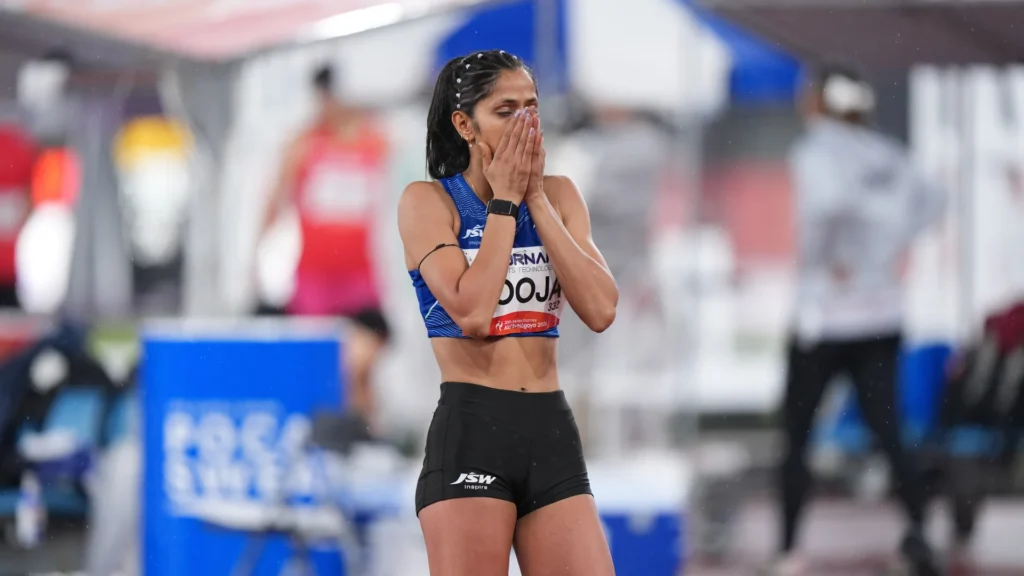
At 19, India’s national record holder has already outgrown one training environment, recovered from a serious injury and moved into a new management setup. Her journey raises a larger question: who gets to shape the careers of India’s most promising athletes?
Pooja Singh has cleared 1.93 metres in the high jump, won an Asian senior title and collected an Asian Games medal. She is still only 19. Yet the story of her rapid rise is not just about how high she can jump. It is also about the changing relationships between athletes, coaches, academies, sponsors and the management companies increasingly eager to represent India’s emerging stars.
Her recent move to VEL Sports Management, founded by Olympic champion Neeraj Chopra, is part of that story. But the signing itself is no longer the news. What matters is what it represents.
Across Indian athletics, exceptional young athletes are beginning to move beyond the people and institutions that first nurtured them. As their performances improve, so do their requirements. A coach who can take an athlete to a national junior title may not have the facilities, technical resources or international connections needed to prepare the same athlete for a World Championships final.
For the athlete, changing coaches or training bases can become a necessary step forward. For a management agency, securing the signature of a young national record holder is an opportunity to invest in a career that could become commercially valuable.
Both sides have something to gain. The question is whether the athlete’s development remains the organising principle of the relationship.
Pooja’s journey offers an unusually clear illustration of how this process works.
She began her career under Balwan Singh Parta, the coach who guided her from promising youngster to national champion and eventually an Asian gold medallist. Their partnership produced a remarkable sequence of results.
In 2022, Pooja won the national under-16 high jump title with a clearance of 1.76m. The following year, she won gold at the Asian U18 Championships with 1.77m and silver at the Asian U20 Championships with 1.82m, crossing the 1.80m barrier for the first time.
Her development was not confined to the high jump. In 2024, she competed in the under-18 heptathlon and bettered the national record. At the Junior Nationals at Bhubaneswar’s Kalinga Stadium, she also cleared a then-personal best of 1.84m in the high jump while competing in the combined event, improving the national under-20 high jump mark within the heptathlon.
By the beginning of 2025, she had become one of Indian athletics’ most intriguing young prospects.
She cleared 1.84m at the National Games, improved to 1.85m at the Indian Open and then travelled to Gumi, South Korea, for the Asian Athletics Championships.
There, she cleared 1.89m to win gold.
In three years, Pooja had progressed from 1.76m to 1.89m. She had become a continental champion while still a teenager. And she had done it all under Balwan Singh.
That last detail is important.
Much of India’s athletics talent continues to emerge through coaches working far from the country’s best-funded training centres. They identify athletes early, teach them the fundamentals and spend years developing their abilities. By the time an athlete becomes attractive to sponsors or management companies, much of the difficult work has already been done.
The role of the first coach is sometimes lost in the excitement surrounding the athlete’s next professional move.
Yet that move may also be entirely justified.
Pooja’s 2025 season ended prematurely after she suffered a Grade 2 ligament tear following the Asian Championships. The injury forced her to withdraw from the World University Games, interrupting what had been the most successful period of her career.
During her rehabilitation, Olympic Gold Quest, which was supporting her, brought in Serega Biran to work with her. She shifted her training base to the Anju Bobby George Academy in Bengaluru.
It was a significant change, arriving at a moment when Pooja needed more than a conventional training programme. Recovering from injury while preparing to compete at a higher international level required careful management of her physical condition and technical development.
The results that followed were encouraging.
She returned at the Khelo India University Games, winning gold with 1.77m. At the All India Inter-University Championships, she improved her own meet record to 1.85m and collected another gold.
Then came silver at the Asian Indoor Championships with 1.87m, her second-best performance at the time.
At Indian Series 3 at the Jawaharlal Nehru Stadium, she cleared 1.90m for the first time.
Her next major breakthrough came at the Asian U20 Championships, where she soared over 1.93m to win gold and establish a new Indian senior national record.
She subsequently added bronze at the 2026 Asian Games in Aichi-Nagoya with 1.84m.
The progression is striking. But it would be too convenient to attribute it simply to a change of coach.
Pooja was already an Asian champion before she arrived in Bengaluru. Balwan had built the technical and physical foundations that made her subsequent achievements possible. Her own maturity, rehabilitation, exposure to stronger competition and new training environment have all contributed to what followed.
That is how athlete development usually works. It is cumulative, not a story of one coach replacing another and suddenly discovering the missing ingredient.
Nevertheless, the change reflects a reality that Indian sport has often been reluctant to confront.
As athletes reach higher levels, their requirements become increasingly specialised. The training methods and facilities that produce a junior champion may not be sufficient for someone attempting to compete against the world’s best.
A high jumper approaching 1.95m or 2.00m needs access to advanced technical coaching, appropriate strength and conditioning, injury-management expertise, quality facilities and regular competition against stronger international fields.
No single coach or institution necessarily possesses all those resources.
The difficulty lies in making the transition without disregarding the contribution of the people who developed the athlete in the first place.
Ideally, the move should be determined by sporting requirements, with clear responsibilities and continuity of support. In practice, such changes can also involve disagreements over control, loyalty and competing interests.
Pooja’s subsequent move into VEL Sports adds another dimension.
Founded by Neeraj Chopra, the management company has a compelling proposition for an athlete whose profile is rising. Representation can bring commercial opportunities, professional contract negotiations, media exposure and assistance with the logistical demands of an international sporting career.
For Pooja, those services could become increasingly valuable as she moves from junior success towards the senior global circuit.
But the attraction runs both ways.
From VEL’s perspective, Pooja is a highly marketable prospect. She is a teenage national record holder, a senior Asian champion and an Asian Games medallist. Her performances have improved substantially over a relatively short period, and she has yet to reach what would ordinarily be considered her athletic prime.
A management company signing an athlete at this stage is not merely responding to existing success. It is making a judgment about future sporting performance and commercial potential.
That is becoming a more recognisable feature of India’s emerging sports business.
Agencies have traditionally gravitated towards established stars, particularly those whose Olympic or international achievements have already made them household names. Increasingly, however, there is an incentive to identify exceptional performers earlier, build their profiles and develop commercial partnerships before the wider market catches up.
For young athletes, that attention can be transformative. Sponsorship income, access to better training environments, assistance with travel and the ability to concentrate on sport can remove obstacles that previously limited their careers.
But representation also introduces another set of interests.
A coach is primarily concerned with sporting performance. A sponsor wants visibility and association with success. A management company wants to develop the athlete’s commercial value. An academy must manage its facilities and coaching resources.
These interests can reinforce one another. They do not always align automatically.
An athlete might need six weeks of uninterrupted training while a sponsor wants appearances. A coach might prefer a carefully selected competition schedule while a management agency sees value in international exposure. Commercial commitments can provide financial security but may also compete for time and attention.
There is no suggestion that such conflicts are occurring in Pooja’s case. The point is that they become more important as an athlete’s sporting and commercial profile develops.
Reports indicate that Biran is continuing with Pooja under the new arrangement. If so, the coaching continuity could prove valuable. She would be entering a different management structure without having to begin another technical transition.
It also means that VEL’s contribution will be judged less by whether it can find her a new coach and more by what it can provide around the existing coaching relationship.
The next challenge is already visible.
Pooja’s national record stands at 1.93m. The automatic qualification standard for the women’s high jump at the 2027 World Athletics Championships in Beijing is 1.96m.
Three centimetres separate the two marks.
At this level, three centimetres can represent months of technical refinement, physical conditioning and carefully managed competition. It is a small distance on a measuring tape but a substantial challenge in elite high jumping.
She also has the 2027 Asian Athletics Championships ahead of her, where she will return as the defending champion after winning the 2025 title with 1.89m.
Competing more frequently outside India could help her gain experience against stronger opposition and accumulate world-ranking points, offering another possible route into the World Championships if she does not achieve the automatic standard.
This is where a management company with the right network could make a difference. Identifying suitable international meetings, helping with travel arrangements and coordinating commercial support around the athlete’s competition schedule are practical services that can contribute to performance.
But none of them guarantees a higher clearance.
Pooja still has to jump the height herself.
Her career also raises an uncomfortable question about the structure of Indian athletics.
Why does the progression of an exceptional athlete so often depend on assembling a sequence of separate support systems?
First comes the coach who identifies the talent. Then, perhaps, a sponsor or organisation capable of funding better facilities. A specialist coach follows. A better-equipped academy becomes available. Eventually, a management company enters to handle commercial interests and professional opportunities.
In Pooja’s case, those stages have produced impressive results. But they have also depended on individual relationships and timely interventions.
For every outstanding athlete who successfully navigates such changes, there may be others without the profile, connections or financial backing to make the same journey.
That is the wider issue.
Indian athletics needs not just talented coaches at the grassroots and sophisticated support systems at the elite level, but a more reliable pathway connecting the two.
Coaching transitions should not have to become personal ruptures. Access to advanced facilities should not depend entirely on attracting a sponsor. And professional representation should support sporting development rather than simply turn an athlete’s achievements into a commercial product.
Pooja’s move to VEL is therefore interesting not because a famous athlete’s company has signed another rising star, but because it illustrates how the business of developing and representing Indian athletes is changing.
The original coach develops the talent. Specialist expertise helps it progress. Institutions provide resources. Management companies recognise its market potential and seek to build a business around it.
There is room for everyone in that arrangement, provided their interests remain aligned.
At 19, Pooja is still at the beginning of her senior international career. Her progress from 1.76m to 1.93m has been exceptional, and her ambition now extends towards the world’s biggest championships.
Whether her latest move proves successful will not be measured by the announcement of another sponsorship deal or the visibility generated by her association with Neeraj Chopra.
It will be measured by what happens on the high jump apron.