





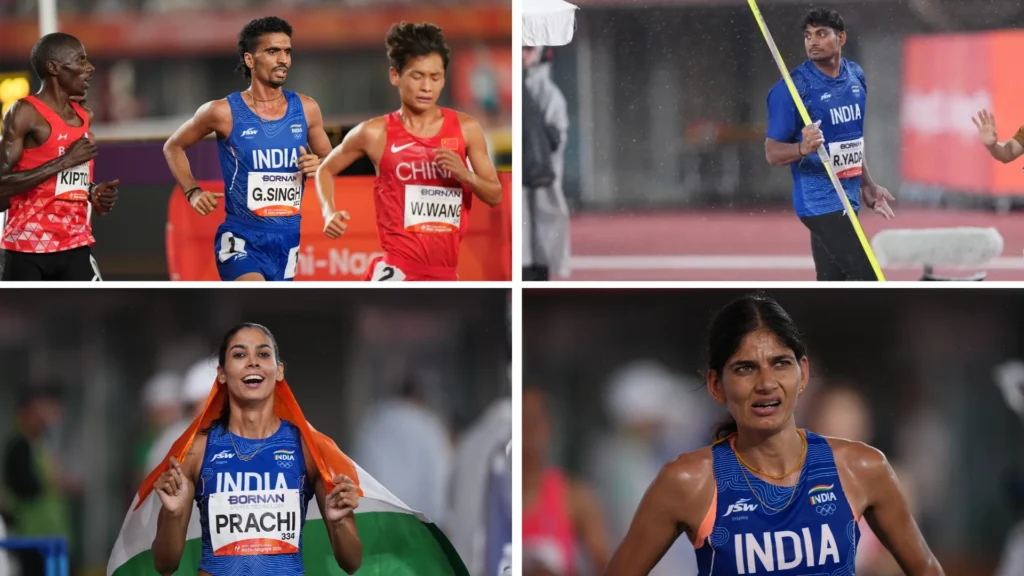
While the dip in gold medals and the reliance on multi-event athletes present valid areas for a deeper inquest, a purely critical lens misses the broader, highly competitive context of modern continental athletics. To achieve a truly balanced view, we must weigh structural vulnerabilities against the continent’s athletics progression.
The “Gold Drought”
Dropping from 6 golds in 2023 to just 1 gold in 2026 suggests India is losing its edge at the apex.
Continental competition in Asia, particularly driven by West Asian nations (naturalized athletes) and East Asian powerhouses (China, Japan), has accelerated dramatically. Winning a gold medal at the Asian Games increasingly requires world-leading or Olympic-qualifying standards. Securing 24 total medals indicates that India’s overall competitive floor remains high; athletes are not falling off the map, they are simply running into a rapidly rising global standard across Asia. Furthermore, managing 14 bronze medals shows that a wider swath of Indian athletes are successfully cracking international finals and landing on podiums, a feat that was rare a decade ago.
Balancing the “Multi-Event Reliance”
Over-relying on athletes like Gulveer Singh and Vithya Ramraj across multiple gruelling events creates a dangerous single-point-of-failure risk.
Doubling up on events is standard global practice for elite endurance and track athletes (frequently seen in the Olympics and World Championships). It reflects elite conditioning and tactical versatility rather than just a shortage of talent. While depth is still being built, having world-class athletes capable of executing multiple competitive races within a tight tournament schedule is a pointer to the enhanced physical conditioning and sports science support now available to Indian campers.
Balancing the State Disparity
Vast populous states lagging behind while a few states dominate highlights a fragmented domestic grassroots structure.
The rise of Uttar Pradesh alongside traditional strongholds like Tamil Nadu, Kerala, Haryana, and Punjab actually signals a decentralization of sports culture, rather than stagnation. It proves that sports policies are beginning to bear fruit outside of traditional pockets. The emergence of new regional hubs shows that domestic talent acquisition is expanding, setting the stage for a more geographically diverse national pipeline over the next Olympic cycle.
Moving Forward
The 2026 data should not be viewed as a regression, but as a consolidation phase. India has proven it can consistently capture a high volume of medals in track and field. The next frontier is less about panic over gold conversion and more about targeted, high-performance interventions, such as specialized sports science, biomechanical analysis, and mental conditioning, to help silver and bronze contenders bridge those final hundredths of a second or centimetres to reach the top step.
State-Wise Medal Tally — 2026 Asian Games
| Rank | State / UT | Gold | Silver | Bronze | Total |
|---|---|---|---|---|---|
| 1 | Uttar Pradesh | 1 | 3 | 6 | 10 |
| 2 | Tamil Nadu | 1 | 2 | 5 | 8 |
| 3 | Kerala | 0 | 3 | 1 | 4 |
| 4 | Haryana | 1 | 1 | 1 | 3 |
| 4 | Karnataka | 1 | 1 | 1 | 3 |
| 4 | Maharashtra | 0 | 1 | 2 | 3 |
| 4 | Punjab | 0 | 1 | 2 | 3 |
| 8 | Himachal Pradesh | 0 | 1 | 1 | 2 |
| 8 | Rajasthan | 0 | 1 | 1 | 2 |
| 10 | Delhi | 0 | 0 | 1 | 1 |
| 10 | Odisha | 0 | 0 | 1 | 1 |
| GRAND TOTAL | 4 | 14 | 22 | 40 | |