





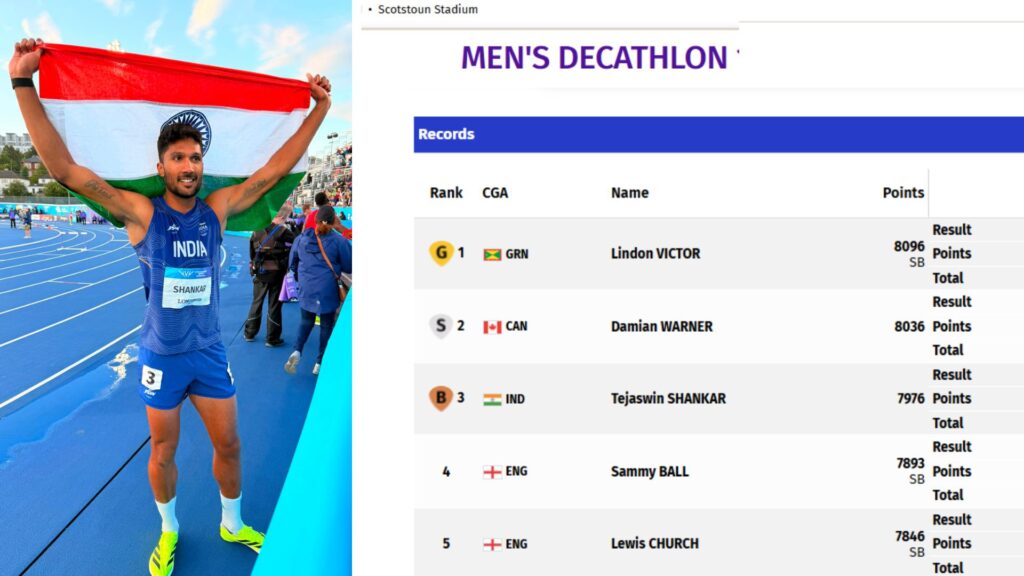
While the spotlight in Glasgow’s Scotstoun Stadium fixated on the high-octane battle between Lindon Victor and Damian Warner, the most compelling storyline of the Commonwealth Games decathlon belonged to India’s Tejaswin Shankar.
Entering the two-day multi-event grind carrying a painful patellar tendon injury which had earlier forced him to withdraw from his marquee high jump event, Shankar showed classic resilience to secure a bronze medal against the odds with 7976 points.
Overcoming the Odds on Day One
Shankar’s campaign opened in ominous fashion when a cautious 10.96s in the 100m sprint saw him finish last in the opening heat. However, the Indian national record holder refused to let physical discomfort dictate his tournament. Rallying behind extensive physical therapy between events, he responded with a personal-best 7.82m leap in the long jump, snagging a crucial 1,015 points.
He then relied on his core technical mastery in the high jump clearing 2.15m to comfortably top the discipline and managed his effort in the 400m (49.51s) to finish Day 1 in an astonishing second place overall, trailing Olympic champion Damian Warner by a mere 14 points.
Holding the Line to Lock Up the Podium
Day 2 tested the outer limits of Shankar’s physical endurance on an already compromised knee. Yet, his technical composure held firm when it mattered most. In the discus throw, an event historically considered one of his weaker technical disciplines, Shankar registered another personal best with a 40.44m effort, briefly pushing him ahead of Victor in the overall standings.
As Victor’s massive javelin throw reshuffled the podium order and put gold out of reach, Shankar stayed laser-focused on preserving his top-three position against a charging English contingent. Balancing risk in the pole vault and javelin, he entered the final 1500m needing only to manage his pace relative to the chasing pack. He crossed the line exhausted, leaving everything on the track to seal the bronze.
For an athlete who began the week in tears wondering if he could even take the line, Shankar’s second consecutive Commonwealth Games medal and his first in the decathlon was a triumph of grit, and tactical discipline.