





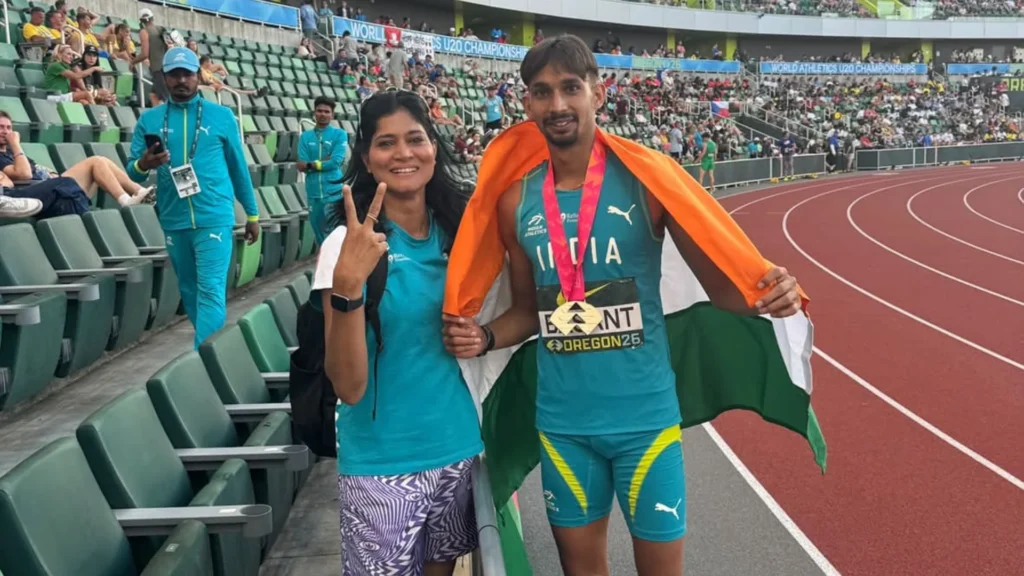
For two decades, Indian athletics had a quiet titan in the high jump pit. Sahana Kumari carved her name into national lore through an arduous journey that culminated in a historic qualification for the 2012 London Olympics and a national record of 1.92 meters, a benchmark that stood resilient for 14 years. Today, Sahana is no longer just a name in the record books; she is the master architect behind a seismic shift in Indian high jumping, coaching the nation’s brightest young talents to soar higher than ever before.
Sahana’s path to the upper echelons of global athletics was paved with immense isolation. Reflecting on her own formative years, she recalls a landscape devoid of specialized technical coaching or modern sports science support. When she touched down in London for the 2012 Olympics, battling both the brutal morning chill and the psychological toll of competing without a personal coach, she realized the stark gap in India’s sporting ecosystem.
Rather than letting those hardships fade, Sahana channelled them into her calling. “I struggled a lot when I was doing high jump and there was no coach for high jump, especially technically,” she shares. Earning her international diplomas and spending 20 years mastering the craft, she made a firm commitment: to ensure that the next generation of Indian athletes would never have to ask if there was a high jump coach available.
That commitment is already bearing historic fruit. Under her tutelage, young athletes from humble backgrounds are rewriting India’s track and field narrative.
Take 19-year-old Basant Kumar Meghwal, a boy from a modest family in Rajasthan whose father worked as a driver and agricultural labourer. Through relentless dedication and strict training consistency under Sahana, Basant shocked the world by winning a silver medal at the World U-20 Championships in Eugene, clearing an impressive 2.21 meters. Sahana points to his discipline, listening skills, and ability to block out distractions as the traits that separate world-class contenders from the rest.
Then there is Pooja Singh, the young phenom who finally shattered Sahana’s 14-year-old national record by clearing 1.93 meters. Watching your own record fall can be bittersweet for any athlete, but for Sahana, it was a moment of pure, overwhelming validation. “When she made that 1.93, I was so happy, and I couldn’t stop my tears,” Sahana says. “It felt that someone broke my record, and high jump is improving in front of me and with my guidance.”
High jump is an unforgiving discipline. Unlike sports where raw power can mask minor errors, high jumping is a game of calculated inches. Sahana emphasizes that an athlete’s run-up consists of strictly calculated strides -usually eight steps where every single foot placement dictates whether the jumper successfully blocks and elevates or crashes into the bar.
When an athlete begins to falter under pressure, breathing heavily and losing rhythm on the runway, Sahana’s sideline intervention is rooted in psychological grounding. Drawing from her own Olympic experience, she mandates meditation and chanting, specifically techniques like Brahmari, to keep her pupils centred.
When a jumper misses consecutive attempts, her 30-second advice is straight out of sports psychology: she instructs them to trick their minds, visualize the towering bar lowered to eye-level, and treat it as a routine 2.10-meter jump. “Feel that this high jump bar is only 25, feel that it’s hardly 2.10,” she notes. “Then they come to know, okay, this is nothing. I can clear this easily.”
Sahana is also quick to dismiss common myths that plague Indian athletics, particularly the obsession with an athlete’s physical height. While critics often argued that Indian jumpers lacked the towering stature of their European counterparts, Sahana counters that mindset is everything. Citing successful Asian powerhouses in China, Japan, and Thailand who clear heights near the 2-meter mark despite comparable statures, she stresses that explosive speed, physical coordination, and mental hunger matter far more than inches on a measuring tape.
However, she remains candid about systemic hurdles. While infrastructure and sports science support from bodies like the Sports Authority of India (SAI) and the Athletics Federation of India (AFI) have vastly improved, Sahana advocates for deeper structural initiatives – such as dedicated 30-to-48-day national camps – to accurately scout grassroots talent and build seamless recovery and nutrition protocols for athletes transitioning into senior ranks.
Sahana Kumari’s transition from an isolated pioneer to a mentor represents the exact evolutionary leap Indian sports desperately needed. By combining technical precision with empathy, she has transformed the high jump pit from a lonely pit into a breeding ground for global champions. As Basant, Pooja, and the next wave of jumpers look toward future Asian Games and Olympic cycles, they do so with a coach who has walked the exact path before them – and is holding the door wide open for them to fly higher.