




By Sports Desk
You can spend four grueling years perfecting your block start, fine-tuning your javelin release angle, or timing your final kick to the millisecond.
But when you step off the plane in Japan for the 2026 Asian Games in Aichi-Nagoya, there are a few non-track skills worth mastering.
Think of the subtle bow, taking off your shoes without hesitation, and resisting the urge to celebrate a personal best at full volume on a commuter train.
For the 79-member Indian athletics squad heading to the Paloma Mizuho Stadium in Nagoya, understanding Japanese etiquette is more than a cultural formality. The athletics team is the largest single sports contingent representing India at these Games.
Knowing how to navigate everyday life outside the Athletes’ Village can be just as important as preparing for competition.
And remember: while gold medals will be awarded for the 3000m steeplechase and 4x400m relay, there is no podium for the deepest bow.
When in Japan, Bow
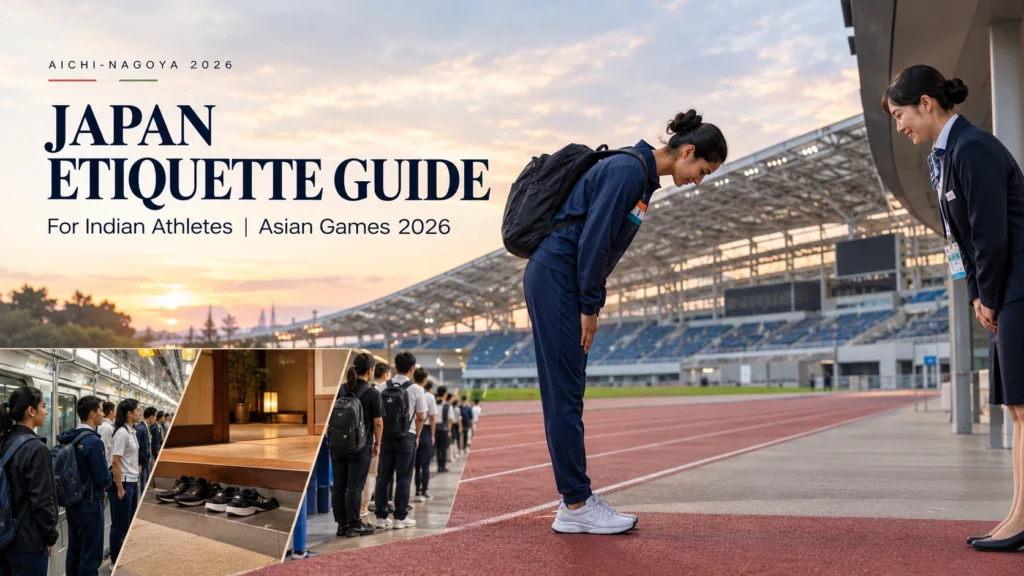
Bowing, or ojigi, is one of the most recognizable aspects of daily life in Japan.
Athletes will encounter it everywhere. That includes greeting team liaisons, thanking bus drivers, and acknowledging race marshals.
For visitors, a simple and respectful bend from the waist at about a 15-to-30-degree angle is standard practice. Keep your back straight.
Men can keep their hands naturally at their sides, while women can fold them lightly in front.
There is no need to overcomplicate it or turn a simple greeting into an Olympic gymnastics routine. A warm, quiet nod with a polite bow goes a long way.
Shoes Off Means Shoes Off
One of the easiest mistakes for international athletes is walking into a venue or traditional space with their footwear on when custom requires otherwise.
In Japan, some indoor spaces require visitors to remove street shoes. These include traditional ryokan accommodations and dining spaces, along with certain changing areas, training facilities, and medical pods.
These areas are usually marked by a raised floor at the entryway, known as a genkan. Guest slippers are often available there.
The golden rule for every sprinter, thrower, and jumper in the Indian contingent is simple: look down first.
If you see a raised step or a rack of alternative footwear, your shoes come off.
Your spikes belong strictly on the synthetic track of the Mizuho Stadium—not on tatami mats or indoor wooden floors.
Keep It Down: The Art of Public Quiet
Public spaces in Japan, particularly public transit systems such as Nagoya’s Meijo Subway line, follow a collective standard of quiet.
Loud phone calls, blasting music through unsealed headphones, or shouting across train cars can cause discomfort to fellow passengers.
For an athlete who has just shattered a national record or secured a spot in the finals, an outburst of emotion is understandable.
However, doing so at full volume inside a packed subway train alongside local commuters can disturb those around you.
Save the roar for the home straight. Keep team discussions subdued until you return to the hotel or squad quarters.
Queue. And Wait Your Turn.
Whether you are lining up at the dining hall, waiting for transport shuttles, or grabbing a pre-race coffee, orderly queuing, or narabu, is deeply embedded in Japanese society.
Lines are straight. Gaps are respected. Cutting in is virtually non-existent.
Athletes should expect to wait their turn patiently. Avoid pushing, crowding the doors, or attempting creative interpretations of line-forming.
Standing in line quietly is regarded as a sign of respect for those around you.
Forget the Tip
In India and many Western nations, tipping service staff is standard.
In Japan, it is unnecessary and can cause confusion.
Good, attentive service is viewed as a basic standard of professional duty rather than something requiring extra financial compensation.
If a hotel staff member, shuttle driver, or restaurant server goes above and beyond, trying to leave extra cash can create an awkward situation.
A polite “Arigatou gozaimasu” (Thank you very much) with a slight bow is all the appreciation needed.
The Ambassador’s Responsibility
The Asian Games are about elite athletic competition, chasing podium finishes, and breaking records.
But an international sporting spectacle of this scale is also a major exercise in cultural diplomacy.
When Indian athletes step out of the call room, they walk through airports, ride trains, eat in communal spaces, and interact with thousands of local volunteers and fans.
In those moments, every member of the squad serves as an ambassador for Indian sport.
The essential etiquette checklist is simple:
- Bow politely when greeted.
- Take off your shoes when stepping onto raised indoor entrances.
- Keep public transit conversations quiet.
- Queue patiently in single file.
- Leave the tip behind.
When in doubt, take a second, look around, and mirror the local custom.
Winning an Asian Games medal takes years of dedication and relentless training. Avoiding an unnecessary cultural misstep takes only a moment of awareness.