





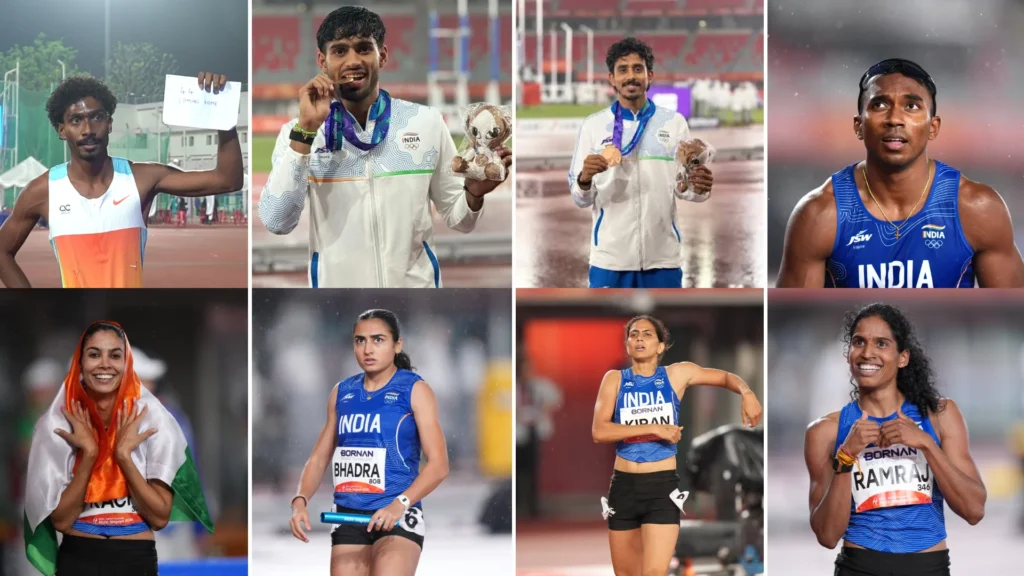
If the 100m dash in 2026 was defined by incremental hundredths of a second, India’s 200m, 400m, and relay campaigns delivered both a historic barrier-breaker and a familiar continental paradox.
The run that created the headline belonged to 22-year-old Vishal Thennarasu Kayalvizhi, who finally dragged Indian men’s quarter mile into the sub-45-second era. Coupled with a four-medal relay haul at the Aichi-Nagoya Asian Games, highlighted by a women’s 4x400m gold, the surface numbers do suggest a strong long-sprint health. Yet, if you go past the timings and baton exchanges, the questions that emerge are: why do Indian quarter-milers struggle to convert relay teamwork into individual international finals, and why did women’s 400m timings regress sharply in 2026 despite Kiran Pahal coming within 0.13 seconds of the national record just two years ago?
Men’s 400m: Vishal TK enters the sub-45 club, international conversion lags
On May 23 in Ranchi, the very same night Gurindervir Singh rewrote the 100m record, Vishal TK delivered one of the defining runs of the Indian season at the 29th National Senior Athletics Federation Competition. Clocking a blistering 44.98 seconds, the Tamil Nadu sprinter eclipsed his own previous mark of 45.12s to become the first Indian man in history to dip below 45 seconds.
Behind him, domestic depth looked promising, with six Indian quarter-milers dipping under 46 seconds at the Indian Athletics Final Series in New Delhi in September:
- Vishal TK: 44.98s (NR)
- Jay Kumar: 45.50s
- Manu TS: 45.68s
However, just like the 100m, the gaps between domestic timing and foreign execution resurfaced. When tested against high-pressure international fields at the 2026 Commonwealth Games, Vishal’s individual campaign ended in the semifinals. While breaking 45 seconds is a watershed moment for Indian athletics, global medal contenders routinely operate in the low-44s and sub-44 range proving that India’s new ceiling is merely an entry ticket to competition overseas.
Women’s 400m & the 200m: Relay gold masks individual stagnation
In the women’s 400m, India’s individual times in 2026 told a story of regression rather than progress. Aishwarya Mishra topped the late-season charts with 52.51s at the New Delhi Final Series, ahead of Prachi (52.75s) and veteran Poovamma Raju (52.76s). Meanwhile, national record holder Hima Das’s comeback after a two-year absence yielded a sluggish 57.94s.
With no Indian woman even threatening the 51-second mark in 2026, let alone Hima’s 2018 national record of 50.79s, it is fair to ask what happened to India’s individual quarter-mile pipeline. Fortunately, collective resolve saved the year at the Asian Games in Aichi-Nagoya, where Kiran Pahal, Poovamma, Prachi, and Vithya Ramraj combined to win a dramatic women’s 4x400m gold, alongside silver in the mixed 4x400m and bronze in the men’s 4x400m.
Over the half-lap 200m, Animesh Kujur remained India’s undisputed standard-bearer (clocking 20.59s in New Delhi, just shy of his 20.32s national record), while Harita Bhadra carried her 100m form into the 200m to claim a gritty Asian Games bronze in Nagoya. Still, with Thailand’s Puripol Boonson blazing 19.88s in Nagoya and world-leading men’s and women’s marks sitting at 19.52s and 21.47s respectively, Indian 200m running remains heavily reliant on one or two outliers rather than a structured sprint factory.
200M & 400M: INDIA VS. THE WORLD IN 2026
| Event | India 2026 Best | 2026 World Lead | The Gap |
|---|---|---|---|
| Men’s 200m | 20.59s (Animesh Kujur) | 19.52s (Kenneth Bednarek) | +1.07s |
| Men’s 400m | 44.98s (Vishal TK – NR) | ~43.7s (Samuel Ogazi) | ~+1.60s |
| Women’s 400m | 52.51s (Aishwarya Mishra) | ~48.48s (Marileidy Paulino) | ~+4.03s |
The accountability question: Why do we only shine in relays?
India’s 2026 relay medals – four podiums out of five relay events at the Asian Games, including a new mixed 4x100m national record of 41.35s – deserve applause. Yet they also expose a structural dependency. For decades, the AFI and national camps have relied on bundling four 52-second women or 45.5-second men into relay quartets to mask individual mediocrity on the global stage.
When athletes train in insular national camps year-round without regular, cutthroat individual exposure against sub-44 and sub-50 runners abroad, relays become a comfort zone. Until high-performance managers and coaches are judged on producing individual Olympic and World Championship finalists, rather than recycling the same camp rosters to salvage relay medals every four years, the Indian quarter mile will remain a ‘reaching there’ story.
Read more
- Federation Cup 2026: Vishal TK creates history with record-breaking 44.98s in men’s 400m
- Vishal TK’s historic run reshapes South Asian 400m sprinting legacy
- Asian Games: India bags first athletics gold, wins women’s 4x400m relay
- Meet India’s golden girls of the women’s 4x400m relay at Asian Games 2026
- Indian quartet smash national record to claim bronze in mixed 4x100m relay
- Asian Games 2026: Harita Bhadra sprints to women’s 200m bronze
- Hima Das enters her name in the 400m at Indian Athletics Series 3
- Thai sprinter Puripol wins Asian Games 200m gold in record 19.88s