





by Sundeep Misra
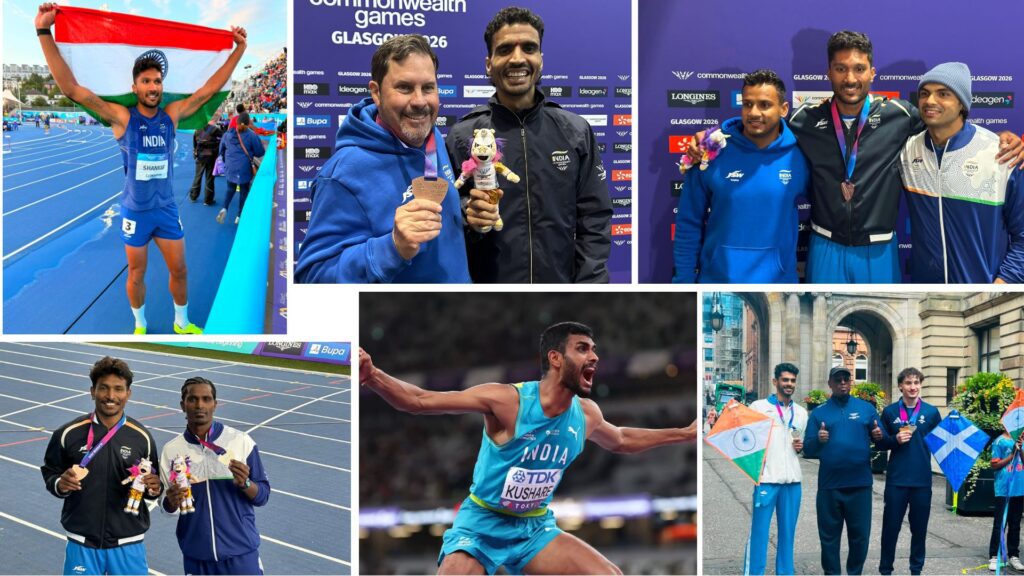
As the dust settled on Scotstoun Stadium at the Glasgow 2026 Commonwealth Games, India’s track and field contingent left an indelible mark on international athletics. Accumulating an impressive 16 medals -comprising 3 gold, 7 silver, and 6 bronze – the nation confirmed its expanding footprint across multiple disciplines, cementing its reputation as an emerging powerhouse on the global stage. While the numbers alone tell a story of sheer volume, the deeper narrative of Glasgow 2026 belongs to a paradigm shift in depth, tactical maturity, and, above all, the arrival of Indian distance running as a force to be reckoned with worldwide.
For years, India’s track and field success was compartmentalized, often relying on isolated bursts of brilliance in specific field events or throws. Glasgow shattered that ceiling. Though the team’s able-bodied athletes experienced a competitive squeeze that left them searching for that elusive top step on the podium – finishing with 5 silver and 5 bronze medals alongside 3 golds from a stellar para-athletics squad – the qualitative leap in performance was staggering. Compared to Birmingham 2022’s eight medals, India doubled its overall haul, proving that its athletes are no longer just competing; they are consistently contending across a broader spectrum of global disciplines.
At the absolute heart of this transformation is Gulveer Singh, whose historic exploits have sent a resounding message across the international athletics community. Competing against elite world-class fields, the Army distance runner delivered what is arguably the most significant individual track performance in Indian history. In the men’s 10,000m final, Gulveer clocked a scintillating 27:49.78 to claim a historic silver, securing India’s first-ever CWG medal in the gruelling event. Not content with rewriting history once, he returned to the track for the men’s 5,000m final, executing a masterful tactical kick over the final 400m to secure bronze with a time of 13:24.95.
Gulveer’s double-medal breakthrough is more than just a personal triumph; it is a cultural and structural watershed. For too long, the global narrative has dismissed India’s capacity for elite endurance running on the world stage. By executing dual sub-28:00 (10,000m) and sub-13:30 (5,000m) efforts, Gulveer has forced the global running community to take notice. The world is finally watching India step out of its traditional comfort zones and stake a legitimate claim in distance running, signalling that the nation’s athletic ambitions extend far beyond the field and into the heart of the track.
Beyond the distance tracks, Glasgow showcased a masterclass in technical depth and multi-event versatility. India achieved rare double-podium finishes in premier field disciplines. In the men’s javelin throw, former Olympic champion Neeraj Chopra demonstrated elite resilience under challenging, cold Scottish evening conditions to secure silver with an 85.83m throw, while teammate Yashvir Singh captured bronze with a personal-best 85.41m. Similarly, the men’s triple jump saw Praveen Chithravel (16.58m) and Selva Prabhu Thirumaran (16.52m) lock down silver and bronze in a commanding display of horizontal jumping pedigree.
This versatility was further underlined by Murali Sreeshankar, who backed up his previous successes with an 8.09m silver in the men’s long jump, and Sarvesh Anil Kushare, who cleared 2.25m on his first attempt to claim silver in the high jump. Meanwhile, Tejaswin Shankar etched his name in the record books by capturing India’s first-ever CWG decathlon medal with a phenomenal 7,976-point haul – highlighted by a 7.82m personal best in the long jump and a 2.15m clearance in the high jump. Complementing these exploits, Seema Kaliramna added a bronze in the women’s discus throw (58.65m), while India’s para-athletics contingent lit up the stadium with gold-medal blitzes from Dilip Mahadu Gavit (Men’s 100m T47), Soman Rana (men’s Shot put F57), and Sharmila Dhankar (women’s shot put F57).
Yet, as the delegation returns home, a clear strategic challenge remains: the gold conversion challenge. While the total medal count doubled, the absence of an able-bodied individual gold highlights the razor-thin margins separating global podium consistency from ultimate supremacy. In events like the javelin, where external weather conditions and peak-release mechanics dictate the final centimetre, and across tactical track races, coaches and athletes recognize that closing the gap to first place is the final frontier.
Glasgow 2026 will ultimately be remembered as the turning point where Indian athletics proved its systemic depth. By expanding into multi-events, dominating technical jumps, and – most importantly – shattering historical glass ceilings on the distance track through trailblazers like Gulveer Singh, India has signalled a definitive shift. The global athletics hub is no longer a closed circle. With the world now taking notice of India’s growing prominence, the roadmap toward the upcoming Asian and World Championships is crystal clear: take the silver-standard consistency, refine the tactical edges, and turn global respect into golden dominance.