





A forgotten hurdle. A solo re-run. And ultimately, a missed opportunity.
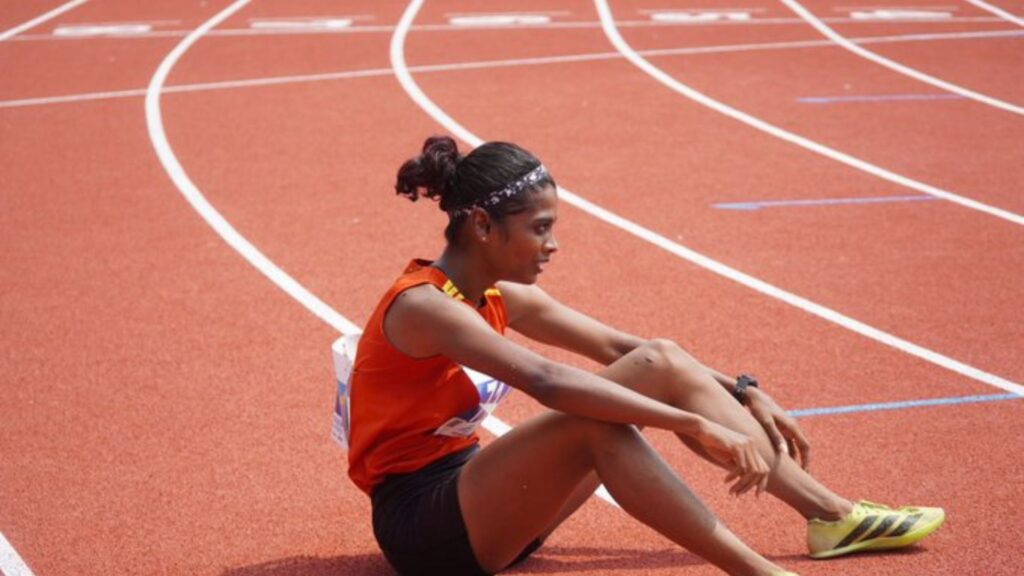
One of the most unfortunate incidents of the 65th National Inter-State Senior Athletics Championships unfolded in the women’s 400m hurdles, where 20-year-old Harshitha was left paying the price for an officiating error that has raised serious questions about athlete welfare and competition management.
Harshitha had initially appeared to have done everything right.
Competing in Heat 1 on Friday evening, she clocked 1:01.03, finishing fourth and seemingly earning a place in the final.
But celebrations were short-lived.
Officials later discovered that one hurdle had not been placed in her lane, meaning she had cleared only nine hurdles instead of the mandatory ten. The error rendered the race invalid for her, despite the mistake being entirely beyond her control.
Following the discovery, officials invoked World Athletics Competition Rule (CR) 18.7, which allows the referee to order a re-run or advancement when an athlete has been adversely affected by circumstances during the competition.
As a result, Harshitha was asked to contest the race again.
This time, she had to run alone.
A Race Against the Clock
The solo re-run was scheduled for 9:30 am on Saturday, just hours before the final.
Unlike her competitors, who advanced through the normal heats, Harshitha faced the unusual task of running without anyone alongside her—a significant disadvantage in an event where pacing and competition often influence performance.
To qualify for the final, she needed to clock under 1:02.00.
She stopped the clock at 1:02.54, missing qualification by 0.54 seconds.
Her Inter-State Championships ended there.
“Everyone Is Running Two Races. I Am Running Three.”
Speaking to the media after the re-run, an emotional Harshitha questioned the fairness of the situation.
“Everyone is running two races, while I am running three.”
She also revealed another troubling aspect of the episode.
“The officials said it was my fault too, as I cleared the adjacent lane’s hurdle yesterday.”
The remark has only intensified the debate surrounding the handling of the incident.
Bigger Questions for Indian Athletics
While the decision to order a re-run was in accordance with World Athletics rules, the episode has highlighted the difficult balance between following regulations and ensuring fairness to athletes.
A 400m hurdles race is built around rhythm, stride pattern and race dynamics. Running alone, without direct competition, presents a very different challenge from racing in a full field.
The incident becomes even more significant because the Inter-State Championships are not just a national competition. They also serve as the final domestic qualifying event for selection to the 2026 Asian Games.
For Harshitha, an officiating lapse meant running an additional race and ultimately missing the final.
The regulations may have been followed.
But the larger question remains: Should an athlete bear the consequences of an officiating error at a championship of this importance?