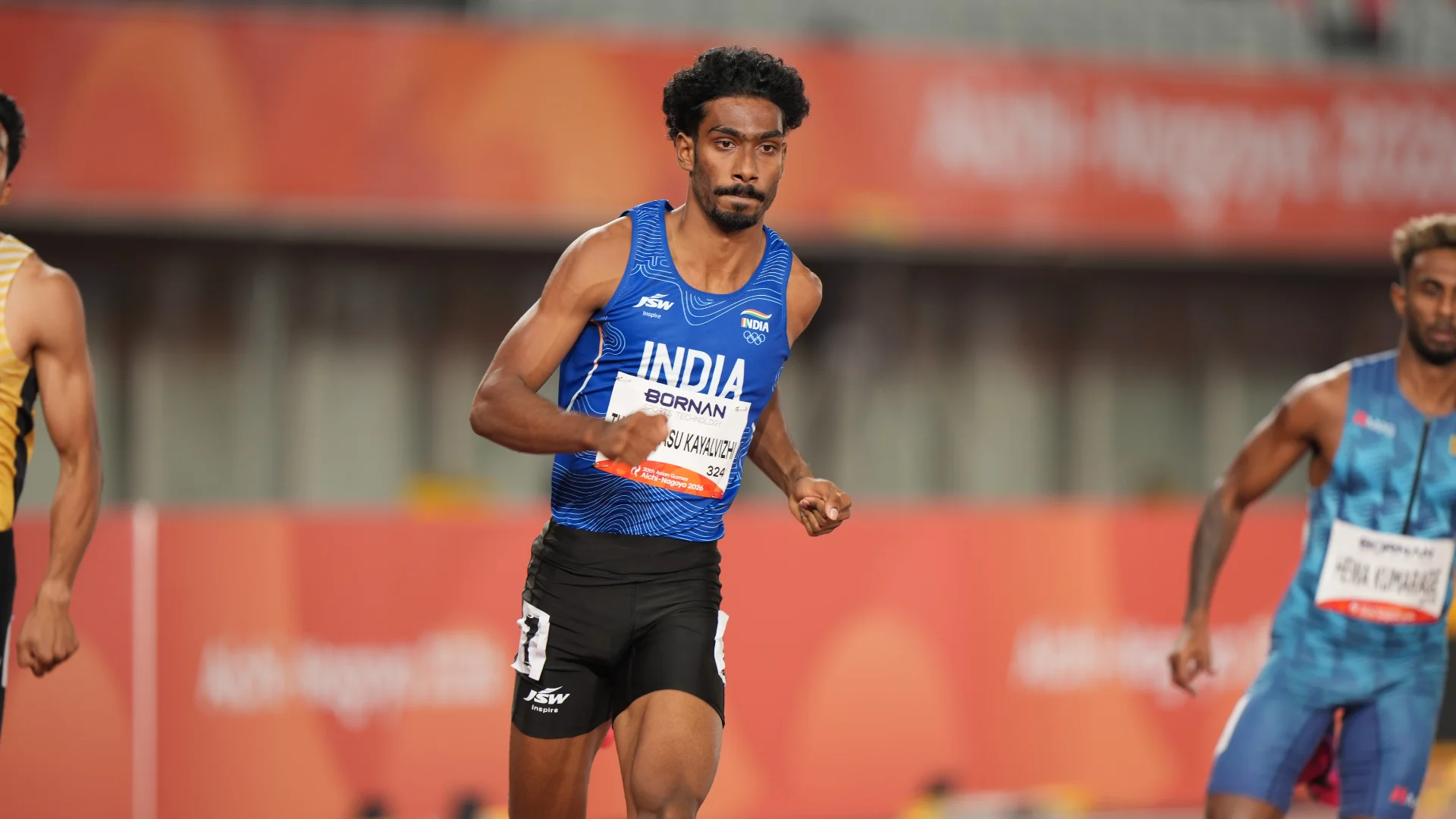
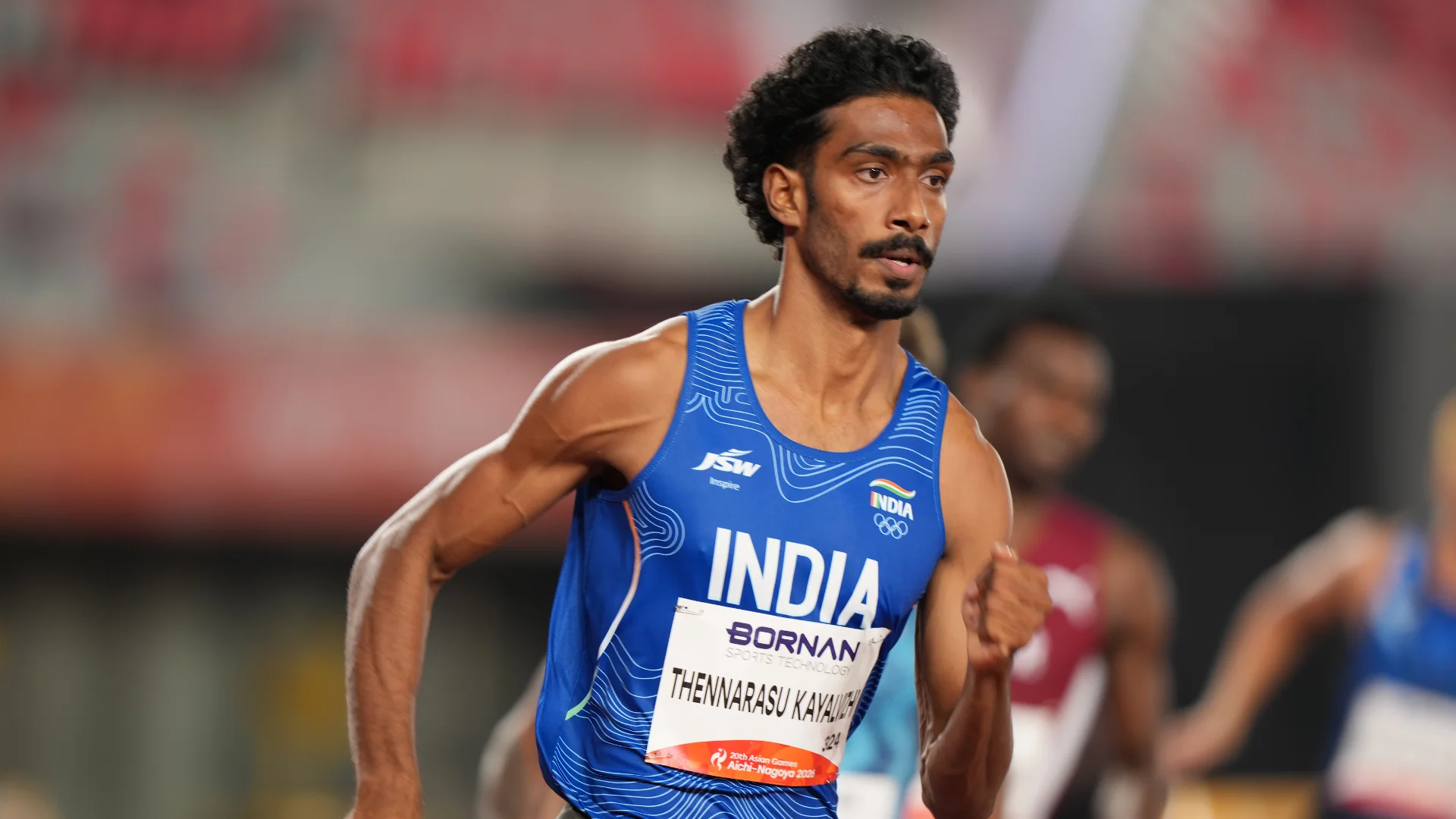
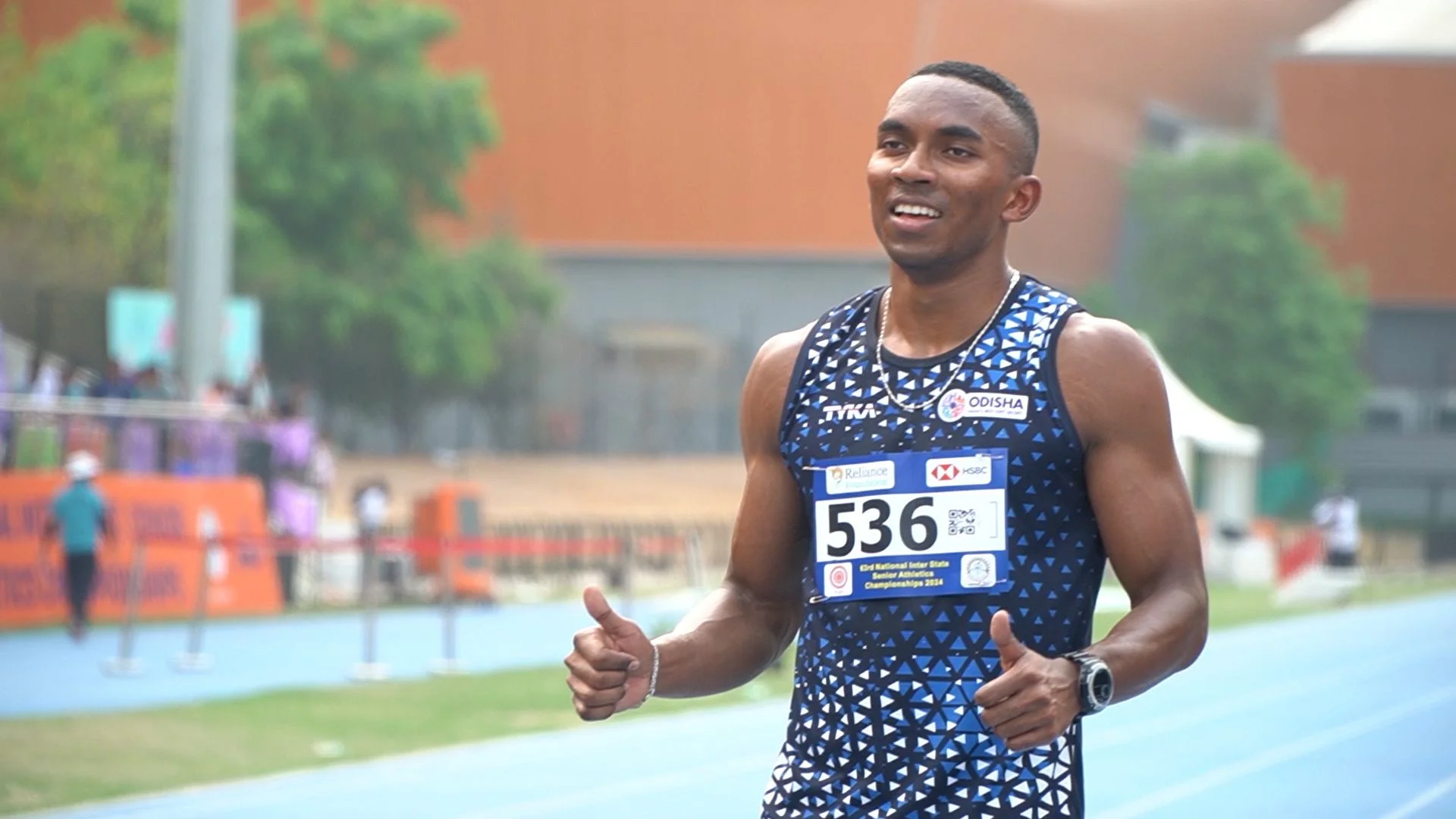
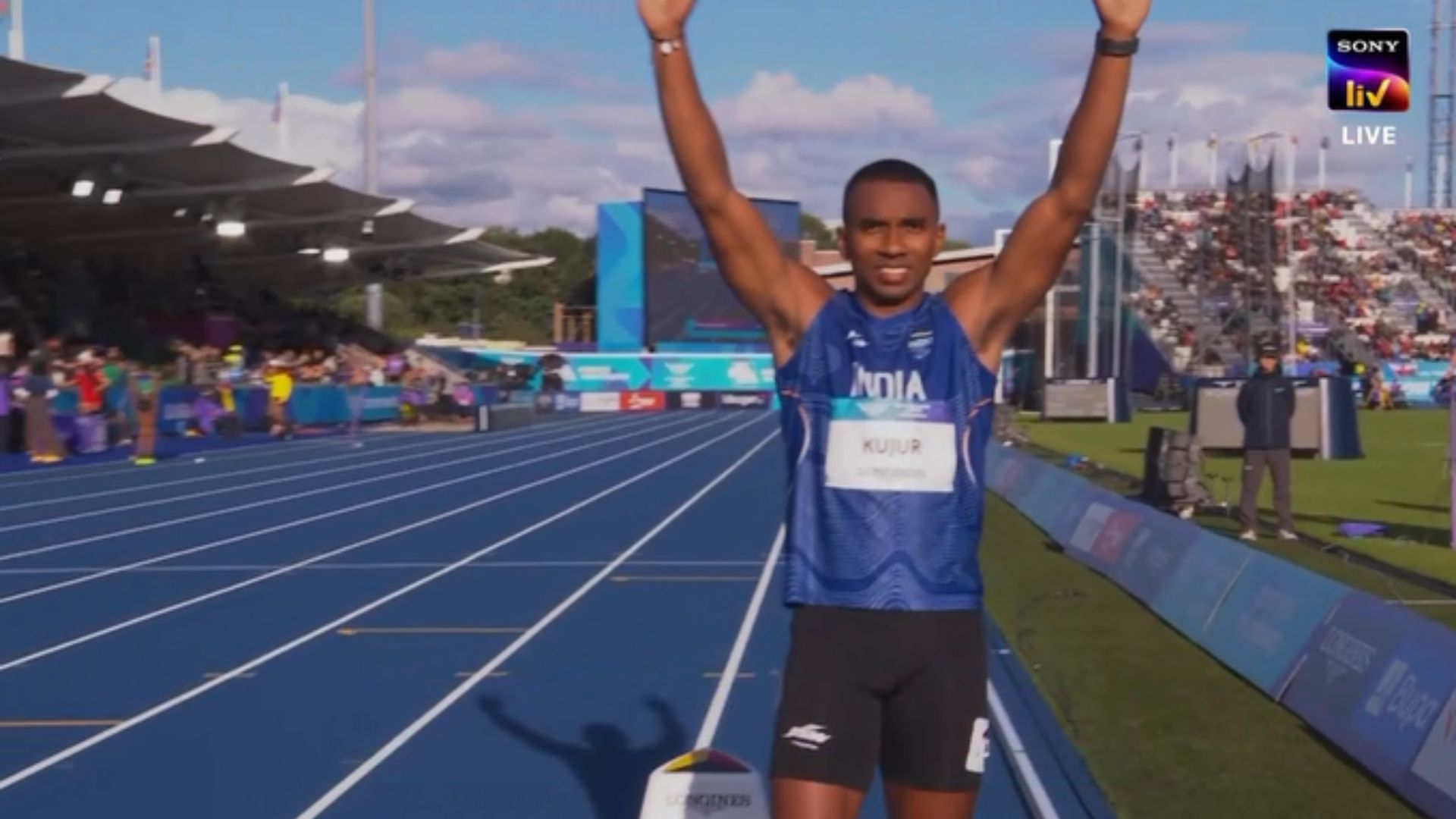
India’s sprinting star Animesh Kujur qualified for the men’s 200m final at the 2026 Asian Games. He finished second in his heat with a time of 20.81 seconds.
Kujur delivered a composed performance to secure automatic qualification. His result keeps India’s hopes alive for a medal in the event.
Animesh Kujur Secures Automatic Qualification
Kujur entered the race with a clear objective: secure a place in the final without wasting unnecessary energy.
He maintained his composure through the bend and accelerated down the home straight. His time of 20.81 seconds earned him second place and an automatic qualification spot.
Ali Haji finished closely behind in 20.91 seconds. However, Kujur held his position and secured his place in the medal showdown.
The Indian national record holder will now prepare for the final. He will look to build on his performance and challenge the leading sprinters.
Puripol Boonson Sets Games Record
Thailand’s Puripol Boonson emerged as the standout performer in the heats. The Thai sprinter delivered a remarkable run to win his race in 20.10 seconds.
His performance also established a new Asian Games record in the men’s 200m. Boonson raised the standard for the upcoming final with his explosive acceleration and top-end speed.
The record-breaking run placed him among the leading contenders for the title. His performance has added another layer of anticipation to the final.
Men’s 200m Final: A High-Stakes Showdown
With the heats complete, attention now turns to the men’s 200m final. Kujur has secured his place, while Boonson has set a new benchmark.
Kujur will need another strong performance to challenge the leading sprinters. Meanwhile, Boonson will look to carry his record-breaking form into the final.
The final promises a competitive contest as the athletes battle for the Asian Games podium.

The anticipation surrounding India’s premier quarter-miler,
Vishal TK, heading into the men’s
400m final at the
2026 Asian Games was immense. Having rewritten history earlier in the year as the first Indian to ever break the elusive 45-second barrier with a national record of
44.98 seconds in Ranchi, the young Tamil Nadu sprinter carried the heavy hopes of a continent-watching nation on his shoulders.
However, track and field can be unforgiving. On a night when expectations soared high, Vishal simply could not find his usual explosive rhythm out of the blocks. Struggling to accelerate and match the blistering pace set by the continent’s elite, he crossed the finish line in 5th place with a time of 45.48 seconds. While respectable by international standards, it fell short of the podium heroics many had envisioned for India’s new sprinting icon.
A Star-Studded and Tactical Affair
The race itself proved to be a fierce battle of endurance and speed, in which pre-race favourites were also tested. Thailand’s Joshua Atkinson delivered a masterclass performance, blazing to the gold medal with a phenomenal time of 44.90 seconds. Close behind him, the United Arab Emirates’ Suleiman Abdulrahman dug deep to clinch a well-deserved silver with a time of 44.99 seconds.
Much like Vishal, other high-profile contenders in the stacked field struggled to fully deliver their absolute peak forms under the intense pressure of the global-stage final, making it a night where tactical positioning and momentary lapses dictated the podium places.
Bouncing Back for India
For Vishal TK, born in Jolarpettai and nurtured at the Inspire Institute of Sport under coach Jason Dawson, this fifth-place finish marks a crucial learning curve. Having already established himself as an Asian champion and a proven relay medalist, the young star’s career trajectory has been defined by rapid meteoric growth.

Nagoya: Vishal T.K. continued his impressive Asian Games campaign on Friday. He won his men’s 400m heat in 45.27 seconds to qualify for the final.
The Indian national record holder had already helped India win silver in the mixed 4x400m relay on Thursday. Now, he has secured a place in Saturday’s individual final.
Vishal held off Qatar’s Ammar Ibrahim in the home straight. As a result, he won his heat and advanced to the next round.
For the 22-year-old, it is another strong performance at the Games. His campaign has already brought a major medal and another important milestone in his career.
Vishal Helps India Win Mixed 4x400m Relay Silver
On Thursday, Vishal was part of India’s mixed 4x400m relay team that won silver.
He ran the third leg alongside M.R. Poovamma, Vithya Ramraj and Manu T.S. Together, the quartet clocked 3:14.46 to finish second behind Bahrain.
India also edged Vietnam by 0.08 seconds to secure the silver medal.
Vishal took over the third leg with India still in medal contention. He produced a strong run to keep the team in the race.
His effort put the team in a good position for Vithya Ramraj’s decisive anchor leg. The following day, he returned to the track for his individual event.
Wins 400m Heat in 45.27 Seconds
Vishal clocked 45.27 seconds to win his heat and qualify directly for the men’s 400m final.
He held off Qatar’s Ammar Ibrahim in the final stretch. Consequently, he secured his place in Saturday’s race.
Although the time was slower than his season’s best, it was enough to achieve his immediate goal.
With a relay silver already secured, Vishal now has another opportunity to compete for a medal at the Asian Games.
National Record Holder After Historic 44.98-Second Run
Vishal’s performances in Nagoya come during a breakthrough season for the Tamil Nadu athlete.
Born in Jolarpettai, Tirupattur district, he initially competed in the 100m and 200m. However, he switched to the 400m in 2024.
That change quickly transformed his career.
Earlier this year, Vishal clocked 44.98 seconds, marking the biggest breakthrough of his career. He became the first Indian man to break the 45-second barrier in the 400m.
The performance also established a new national record. It marked a major milestone for Indian men’s 400m running.
His rapid rise is particularly notable because he had only recently moved up to the quarter-mile event.
From Short Sprints to the National Record
Vishal was introduced to athletics as a child in Jolarpettai. He later moved into the sports hostel system.
His father, Thennarasu, had played football. He also supported his son’s sporting ambitions from an early age.
Vishal began his athletics career in shorter sprints before switching to the 400m. Within a relatively short period, he progressed to become India’s fastest man over the distance.
His national-record run of 44.98 seconds established him as the first Indian to go under 45 seconds. This remains a significant benchmark in Indian men’s 400m running.
Previous Success at the Asian Athletics Championships
Vishal has already enjoyed success at the continental level.
At the 2025 Asian Athletics Championships, he helped India win gold in the mixed 4x400m relay. He also helped the country secure silver in the men’s 4x400m relay.
His performances at the 2026 Asian Games have added another relay medal to his growing list of international achievements.
Now, he has an individual Asian Games final to look forward to.
Vishal T.K. Eyes Individual Medal in 400m Final
Vishal’s 45.27-second performance in Nagoya was not his fastest run of the season. Nevertheless, it was enough to secure his place in the final.
After contributing to India’s relay silver, he will return to the track with an individual Asian Games medal within reach.
The final will test his ability to recover quickly after a demanding schedule. However, his performances so far have given him another opportunity to compete for a podium finish.
On Thursday, he helped India win relay silver.
On Friday, he won his 400m heat.
On Saturday, Vishal T.K. will line up in the Asian Games men’s 400m final, looking to add an individual medal to an already memorable campaign.
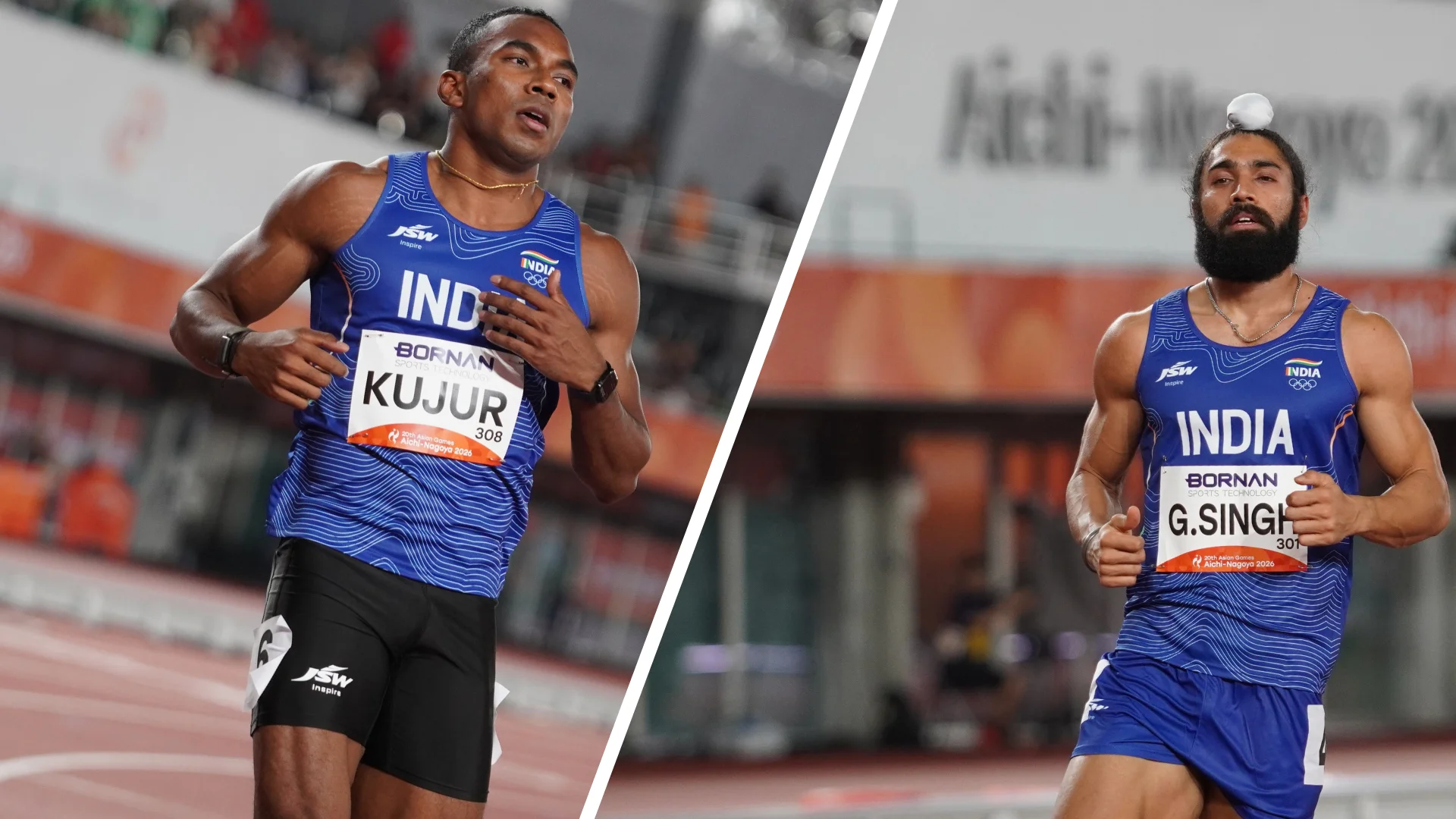
Aichi-Nagoya: India’s much-anticipated men’s 100m campaign ended in disappointment on Friday as Gurindervir Singh and Animesh Kujur crashed out in the semifinals, failing to match the performances that had raised expectations earlier this season.
Gurindervir, India’s national record holder and the country’s fastest-ever man over 100m, finished fifth in his semifinal with a time of 10.32 seconds. Animesh Kujur, the second-fastest Indian in history, finished seventh in his race in 10.38 seconds.
Neither sprinter could reproduce the form that had made them two of the most closely watched Indian athletes heading into the Asian Games.
Gurindervir Singh Finishes Fifth in 10.32 Seconds
Gurindervir finished fifth in his semifinal, missing out on a place in the final.
Oman’s Ali Al Balushi won the race in 10.01 seconds, followed by China’s Xie Zhenye in 10.18 seconds and Daniel Biwesa in 10.22 seconds.
Gurindervir’s 10.32-second finish was not enough to secure qualification for the final.
Animesh Kujur Finishes Seventh in His Semifinal
Kujur also failed to advance, finishing seventh in his semifinal with a time of 10.38 seconds.
South Korea’s Joeljin Nwamadi won the race in 10.17 seconds, while Malaysia’s Mohd Muhammad clocked 10.25 seconds and Japan’s Yuki Koike finished in 10.31 seconds.
Kujur’s performance ended his hopes of reaching the final.
A Disappointing End to a Remarkable Season
The semifinal exits were particularly disappointing given the performances both sprinters had delivered earlier this season.
Gurindervir arrived in Aichi-Nagoya as the national record holder with a personal best of 10.09 seconds. He became the first Indian to break the 10.10-second barrier when he clocked that time in Ranchi in May.
His record-breaking performance had raised expectations for the Asian Games, with the sprinter openly targeting a breakthrough on the continental stage.
Kujur, meanwhile, had established himself as one of the biggest stories in Indian sprinting. The 200m national record holder clocked 10.14 seconds, setting the fastest 100m time by an Indian on foreign soil and the second-fastest mark by an Indian overall, behind Gurindervir’s 10.09 seconds.
Gurindervir-Kujur Rivalry Raised Expectations
The rivalry between the two sprinters had been one of the most intriguing developments in Indian athletics this year.
In May, the national record changed hands twice within minutes. Gurindervir first clocked 10.17 seconds before Kujur lowered the mark to 10.15 seconds.
Gurindervir reclaimed the record the following day with his historic 10.09-second performance.
That remarkable sequence made Friday’s semifinal results particularly difficult to digest.
Both Sprinters Had Advanced Safely Through the Heats
Gurindervir and Kujur had progressed to the semifinals after successfully negotiating their heats on Thursday.
Kujur finished third in 10.36 seconds, while Gurindervir placed second in 10.38 seconds. Both secured automatic qualification for the next round.
Their performances in the heats had raised hopes for a strong showing in the semifinals.
Gurindervir had said he would run faster in the later rounds, while Kujur, speaking exclusively to NNIS Sports, described his heat as an easy race and set himself a target of 10.01 seconds for the semifinal.
However, neither sprinter managed to improve on his heat performance.
Both Indians Fall Short of Their Personal Bests
Gurindervir finished 0.23 seconds slower than his national-record time of 10.09 seconds, while Kujur was 0.24 seconds outside his personal best of 10.14 seconds.
At the semifinal stage of a 100m race at this level, those margins can make a significant difference.
India had entered the Games with two sprinters capable of competing at the sharp end of the Asian field. Neither could reproduce that level when a place in the final was at stake.
For Gurindervir, the fifth-place finish marks a missed opportunity after a season in which his 10.09-second performance had changed perceptions of Indian sprinting.
For Kujur, seventh place is equally frustrating after a year in which his rivalry with Gurindervir had repeatedly pushed both athletes to new heights.
No Indian in the Men’s 100m Final
There will be no Indian representation in the men’s 100m final at Aichi-Nagoya.
The Asian Games had offered Gurindervir and Kujur an opportunity to turn a remarkable domestic season into a major international breakthrough. Instead, both sprinters saw their campaigns end in the semifinals.
Their talent and performances earlier in the season had raised expectations, but neither could deliver the same level on the biggest day of the competition.
On Friday, both fell short of the performance needed to reach the final.
India’s sprint campaign at the Aichi-Nagoya Asian Games got off to a strong start on Thursday as
Animesh Kujur and Gurindervir Singh both booked their places in the men’s 100m semifinals.
Kujur clocked 10.36 seconds to finish third in Heat 1, while Gurindervir stopped the clock at 10.38 seconds to finish second in Heat 4. Both advanced to the semifinals, keeping India’s hopes alive in one of the most eagerly anticipated athletics events of the Games.
For Kujur, the heat was less about chasing a spectacular time and more about getting the job done.
Speaking exclusively to NNIS Sports, the 200m national record holder described the qualifying race as easy and immediately shifted his focus to the next round.
His target is clear: 10.01 seconds in the semifinal.
That ambition reflects the confidence Kujur has carried through a season in which he has repeatedly established himself among India’s fastest sprinters. He clocked 10.14 seconds earlier this year, the fastest 100m time by an Indian on foreign soil, while also continuing to hold the national record in the 200m.
The semifinal, however, will demand considerably more. Thailand’s Puripol Boonson produced a stunning 9.95 seconds to win Kujur’s heat, with China’s Zeng Keli finishing second in 10.22.
Kujur has repeatedly spoken about enjoying the increased competition in the 100m this season, particularly his battles with Gurindervir. After winning both the 100m and 200m at the Indian Athletics Final Series in New Delhi earlier this month, he said the repeated competition had made him enjoy the 100m even more.
Gurindervir, meanwhile, looked equally comfortable in his opening-round assignment.
The Punjab sprinter finished second in Heat 4 in 10.38 seconds, behind Oman’s Malham Al Balushi, who ran 10.29.
For Gurindervir, the opening round was an opportunity to settle into the atmosphere of his first Asian Games 100m campaign after a demanding season.
“I was enjoying myself,” Gurindervir said after qualifying, making it clear that he was embracing the occasion rather than allowing the pressure of the Asian Games to overwhelm him.
The national record holder has been preparing for this moment for a long time. Earlier this year, he became the first Indian to break 10.10 seconds in the 100m, clocking a national-record 10.09 seconds at the Federation Cup in Ranchi.
That mark has placed him firmly among Asia’s leading sprinters, but the Asian Games field is loaded with quality. Japan’s Yuki Koike has a 9.98-second personal best, Shuhei Tada has run 10.01, while Thailand’s Boonson has already gone below 10 seconds this season.
Gurindervir, however, has insisted that the Indian pair belong in the conversation.
The focus now shifts to the semifinals, where the intensity will rise sharply and every hundredth of a second could matter.
For Kujur, the target is already set: 10.01.
For Gurindervir, it is about enjoying the moment while finally showing what months of preparation can produce on the biggest Asian stage.
Two Indians. One semifinal. And a serious shot at making the 100m final.
The men’s 100m is set for a fiercely contested Round 1 at the Asian Games in Aichi-Nagoya, with India’s Animesh Kujur facing a strong field in Heat 1.
Kujur enters the opening round with a 10.14-second season best, placing him second-fastest in his heat behind Thailand’s Puripol Boonson, who owns a 9.99-second best.
With the top three from each heat qualifying automatically for the next round, along with six fastest non-automatic qualifiers, every hundredth of a second could prove important.
Asian Games 2026 Men’s 100m: Heat 1 Line-up
| Athlete |
Country/Territory |
Personal/Season Best |
| Puripol Boonson |
Thailand |
9.99s |
| Animesh Kujur |
India |
10.14s |
| Keli Zeng |
China |
10.18s |
| Mouzinho Belo |
Timor-Leste |
10.44s |
| Muhammad Subri |
Malaysia |
10.44s |
| Kum Ryom Jo |
North Korea |
10.44s |
| Ibadulla Adam |
Maldives |
11.12s |
Puripol Boonson Leads the Field
Thailand’s Puripol Boonson is the standout name in Heat 1 after breaking the 10-second barrier with a 9.99-second personal best.
That mark gives Boonson a clear advantage on paper and puts him among the leading contenders in the Asian Games 100m.
For the remaining automatic qualifying places, attention will turn to the battle between Kujur and China’s Keli Zeng, who has a 10.18-second personal best.
Kujur Faces Key Battle With Keli Zeng
Kujur’s 10.14s makes him the second-fastest athlete in the heat on the listed marks.
However, the gap to Zeng is only 0.04 seconds, leaving little room for error in the opening round.
Behind them, Mouzinho Belo, Muhammad Subri and Kum Ryom Jo all arrive with 10.44-second marks. The trio will be looking to take advantage of any mistakes from the athletes ahead of them.
In a 100m race, a slow start can quickly change the qualifying picture. Kujur will therefore need a clean start and a strong finish to secure one of the automatic qualifying positions.
India’s Sprint Challenge
Kujur’s appearance adds another important chapter to India’s growing presence in the men’s 100m at the continental level.
India will also have national record holder Gurindervir Singh competing in another heat, giving the country two strong entries in the blue-riband sprint.
For Kujur, the immediate target is straightforward: finish inside the top three and avoid relying on one of the six fastest-loser places.
With Boonson, Zeng and a tightly packed chasing group all in the same heat, Heat 1 promises an intense start to the Asian Games men’s 100m competition.
Vishal T K won the men’s 400m title at the Indian Series Final with a strong 45.36-second performance.
The final produced a remarkable display of depth, with six of the eight finalists breaking 46 seconds.
Vishal T K Leads a Fast 400m Final
Vishal topped the field in 45.36s, narrowly finishing ahead of Jay Kumar, who clocked 45.50s. Manu T S took third in 45.68s.
The top six finishers were:
| Position |
Athlete |
Time |
| 1 |
Vishal T K |
45.36s |
| 2 |
Jay Kumar |
45.50s |
| 3 |
Manu T S |
45.68s |
| 4 |
Vikrant Panchal |
45.75s |
| 5 |
Rajesh Ramesh |
45.80s |
| 6 |
Dharamveer Choudhary |
45.83s |
The six sub-46 performances made the men’s 400m final one of the standout races of the Indian Series Final.
Vishal T K Sets Sights on Nagoya
For Vishal, the victory is another step toward bigger ambitions.
The 400m champion has set his sights on winning a medal and breaking the National Record at Nagoya. That gives him an even bigger target to chase in the upcoming competition.
With six athletes going under 46 seconds in the same final, Indian men’s 400m is entering an increasingly competitive phase.
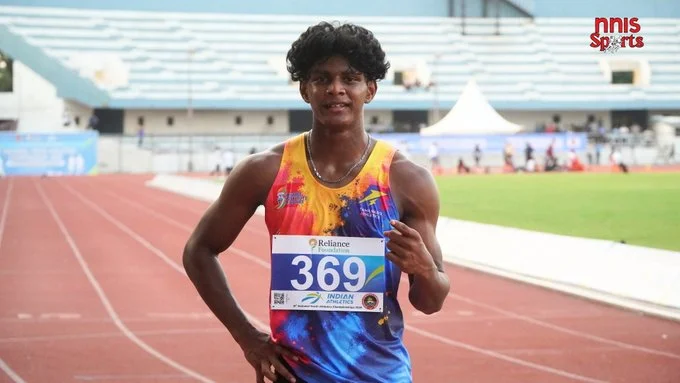
Tamil Nadu’s Neil Samraj produced a sensational performance at the 21st National Youth Athletics Championships 2026 in Ludhiana.
He won the men’s 100m gold and broke India’s U18 national record twice on the same day.
Samraj Breaks Record in Semifinal
Samraj first set a new mark in the semifinals.
He clocked 10.53s.
But he was not done yet.
In the final, the Tamil Nadu sprinter raised the bar even higher.
He stormed to victory in 10.46s and broke the U18 national record for the second time in a matter of hours.
The 10.46s performance also makes Samraj the fastest Indian youth over 100m.
The result underlines his emergence as one of the country’s most exciting young sprint prospects.
Samraj Wanted More
Samraj’s reaction after the race made the performance even more interesting.
Despite winning the national title and setting another record, the youngster was not completely satisfied with his time.
His target was to break the 10.40-second barrier.
Samraj also made it clear that he believes he can achieve that mark later this season.
His confidence adds another layer to what was already a remarkable day in Ludhiana.
He improved from 10.53s in the semifinal to 10.46s in the final.
Samraj also showed his ability to deliver when it mattered most.
A Remarkable Day in Ludhiana
The performance could prove to be an important milestone in his development.
Indian athletics continues to build depth in the sprint events.
For now, Neil Samraj leaves the Youth Nationals with gold, two U18 national records in one day, and the fastest 100m time ever recorded by an Indian youth.
And if his own words are anything to go by, 10.40s may only be the next target.
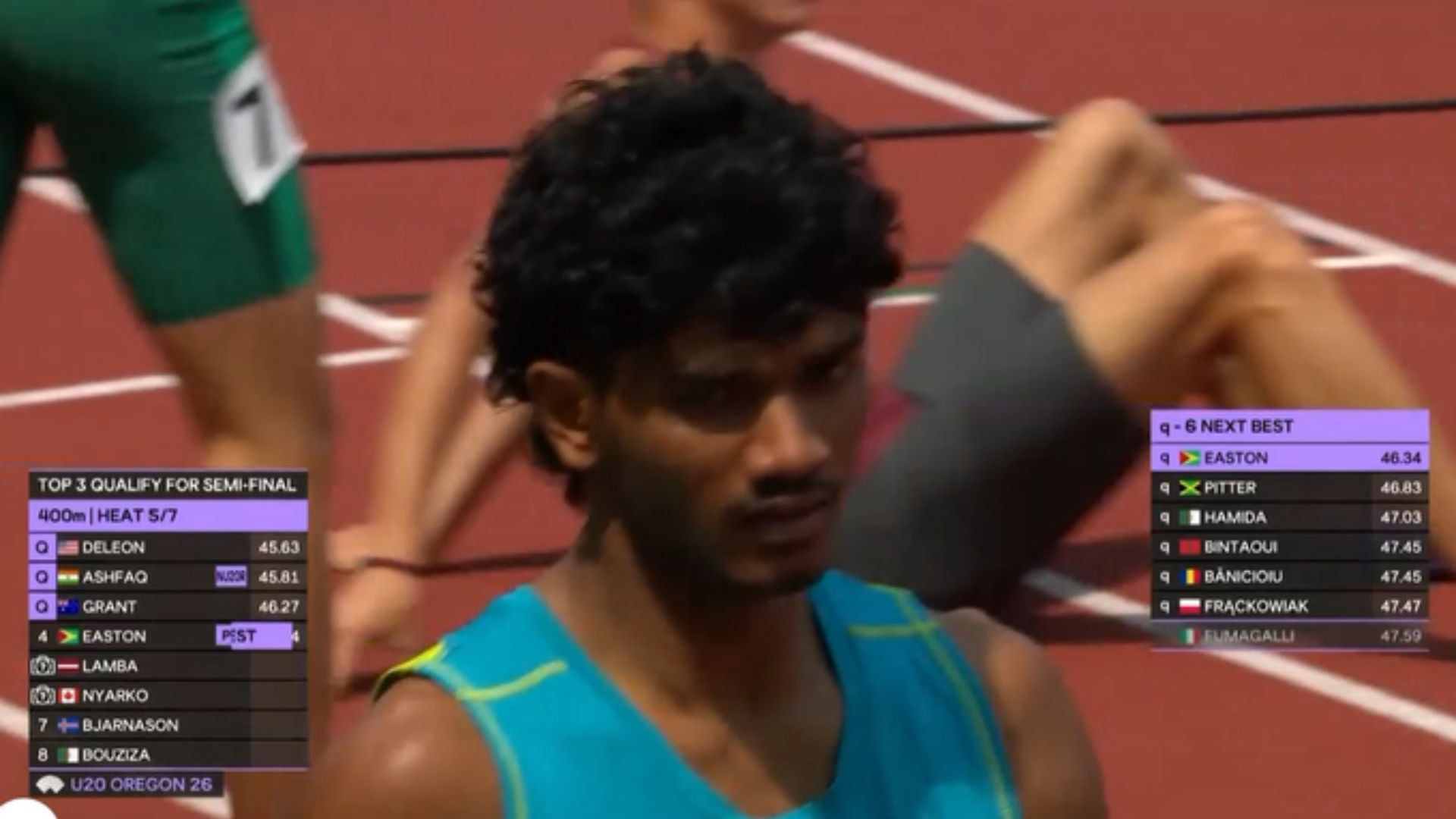
India’s Mohammed Ashfaq shatters the Indian U20 national record in the men’s 400m and qualifying for the final of the World Athletics U20 Championships 2026.
The young Indian quarter-miler produced a sensational performance in the heats, finishing second in his race with a lifetime best of 45.81s, breaking his own previous Indian U20 record of 46.05s set earlier this season. The heat was won by USA’s Jayden DeLeon in 45.63s, with Ashfaq finishing just behind him in a world-class race.
His 45.81s not only secured a semifinal berth but also ranked him fourth overall among all semifinal qualifiers, putting him firmly among the leading contenders heading into the next round.
Back-to-Back Sub-PB Performances
Ashfaq returned for the semifinals and once again produced a time faster than the personal best he had brought into the championships. Running alongside Olympic champion Quincy Wilson of the United States, the Indian athlete clocked 46.00s, finishing third in his semifinal and ninth overall to secure a place in the world final.
Wilson dominated the race and recorded the fastest time across all semifinals with 45.02s, but Ashfaq showed tremendous composure under pressure to book his place in the championship decider.
Championship Progression
• PB before championships: 46.05s
• Heats: 45.81s (New Indian U20 National Record)
• Semifinal: 46.00s
Both races in Eugene were faster than the personal best Ashfaq carried into the championships, underlining the extraordinary form he has found on the global stage.
Men’s 400m Final Line-up – World Athletics U20 Championships 2026
Lane-wise line-up (Season Bests)
1. Zion Davis (BAH) – 45.64s
2. Mohammed Ashfaq (IND) – 45.81s
3. Godfred Opoku (GHA) – 45.38s
4. Malachi Austin (GUY) – 44.87s
5. Quincy Wilson (USA) – 44.84s
6. Leendert Koekemoer (RSA) – 44.94s
7. Jayden DeLeon (USA) – 44.52s
8. Kryn Romijn (NED) – 45.79s
9. Milann Klemenic (SLO) – 45.83s
Ashfaq will now line up against some of the world’s fastest junior quarter-milers, including Quincy Wilson, Jayden DeLeon, Leendert Koekemoer, and Malachi Austin, in what promises to be one of the strongest U20 400m finals in recent years.
By
Sundeep Misra
Running out of the notoriously tight inside lane, Animesh Kujur’s campaign in the men’s 200m came to a halt with a sixth-place finish in his semi-final.
Clocking 20.65 seconds, the 23-year-old national record holder fell short of the electric 20.46s he delivered in the heats where he famously edged out newly crowned 100m champion Emmanuel Eseme and ended up 10th overall across both semi-final lineups.
While the stopwatch showed a slight regression from his opening heat, the semi-final itself offered an experience that no domestic circuit can replicate.
Drawing the inside lane in a 200m sprint is arguably the toughest assignment in track athletics. The tight radius subjects sprinters to centrifugal forces through the curve, forcing tall, powerful athletes like Kujur to balance drive with precise foot placement to avoid stepping on the line.
Facing experienced curve-runners who exploded off the blocks, Kujur was forced into a high-intensity chase phase earlier than ideal.
Yet, this experience is precisely the crucible the Odisha sprinter needs to reach the next tier of international sprinting.
Consistently lining up against the world’s best desensitizes a sprinter to the occasion, allowing them to stop reacting to the field and start executing their own race plan.
For Indian sprinting, sub-20.50 capability is no longer a distant peak; it is the baseline. Kujur leaves this championship not diminished, but equipped with a clear map of what it takes to transition from a national record holder into a habitual global finalist.