
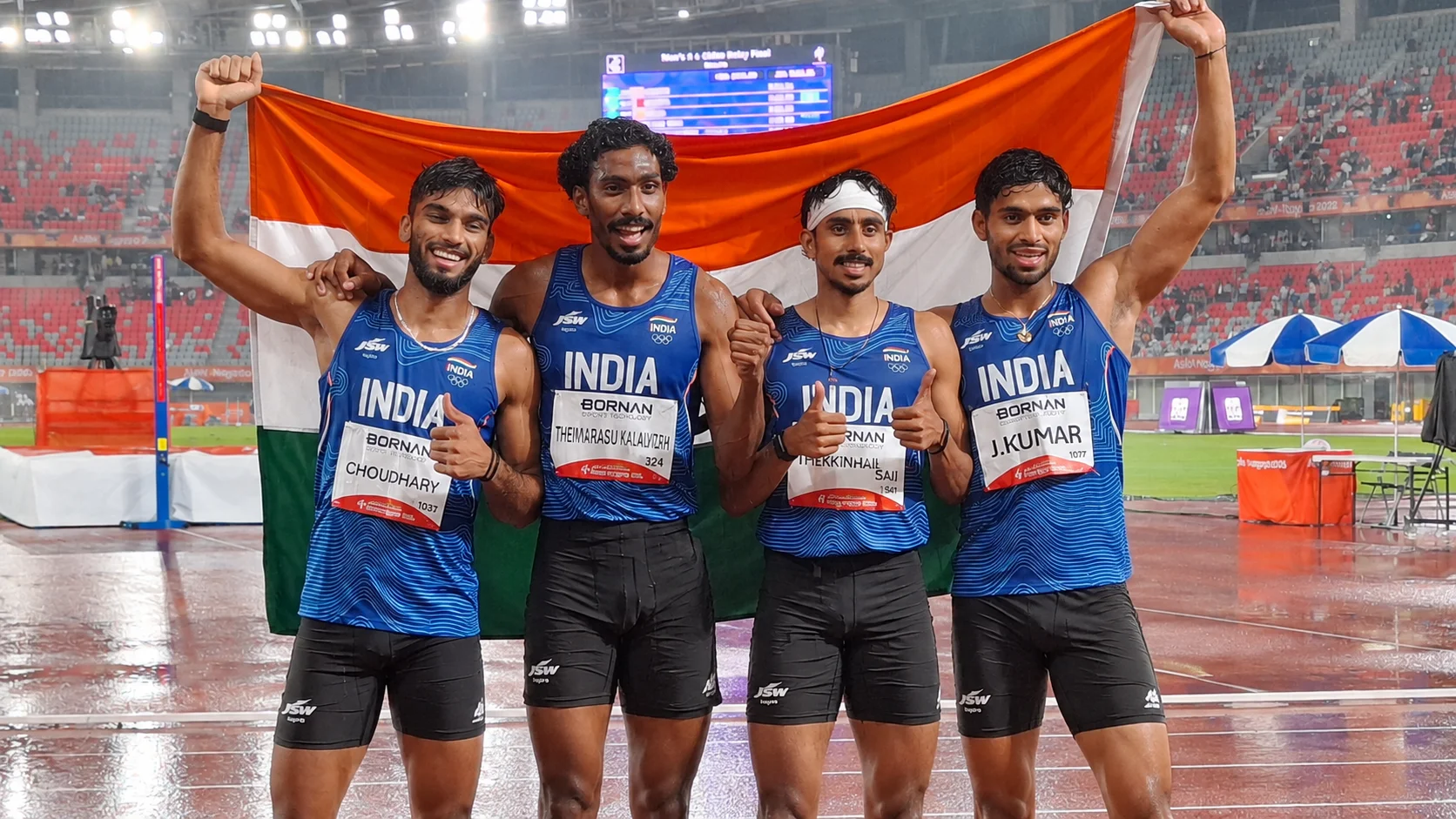
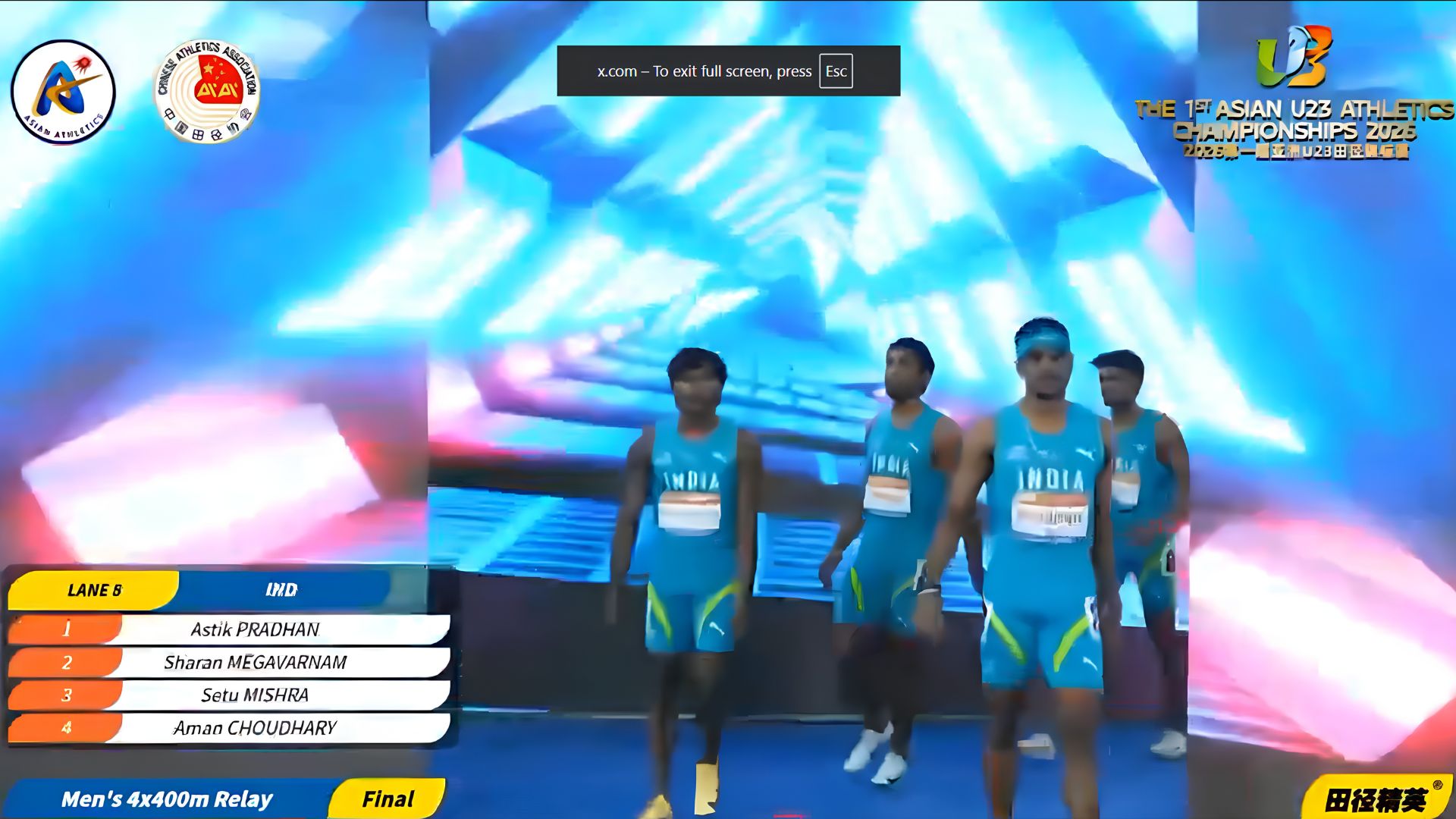
India’s men’s 4x400m relay team delivered a strong performance to secure the silver medal at the 2026 Asian U23 Athletics Championships, finishing in 3:04.24.
The Indian quartet of Astik Pradhan, Megavarnam Sharan, Setu Mishra, and Aman Choudhary fought hard throughout the race but finished behind China, which claimed the gold medal in 3:03.46. Qatar took the bronze medal with a time of 3:06.19.
Astik Pradhan provided India with an excellent start, handing over in the lead after a brilliant opening leg. Megavarnam Sharan maintained the advantage with another composed run before China moved ahead during Setu Mishra’s third leg. On the anchor leg, Aman Choudhary mounted a determined chase but was unable to bridge the gap, ensuring India finished with a well-earned silver medal.
The podium finish adds another medal to India’s impressive campaign at the Asian U23 Athletics Championships, reflecting the country’s growing depth in the 4x400m relay.
Indian sprinting is experiencing an unprecedented golden era, yet its men’s 4x100m relay dreams are collapsing under the weight of poor planning, technical failures, and internal friction.
The renaissance began in October 2023 when Army sprinter Manikanta Hoblidhar clocked 10.23s, shattering Amiya Mallick’s seven-year-old national record. By 2025, Indian sprinting reached a historic peak. Gurindervir Singh lowered the national record to 10.20s, only for Animesh Kujur to obliterate it three months later with a current national record of 10.18s. In 2025 alone, five Indian sprinters combined for a staggering nine sub-10.30s performances:
10.18s – Animesh Kujur
10.19s – Manikanta Hoblidhar
10.20s – Gurindervir Singh
10.22s – Tamilarasu
10.27s – Pranav Gurav
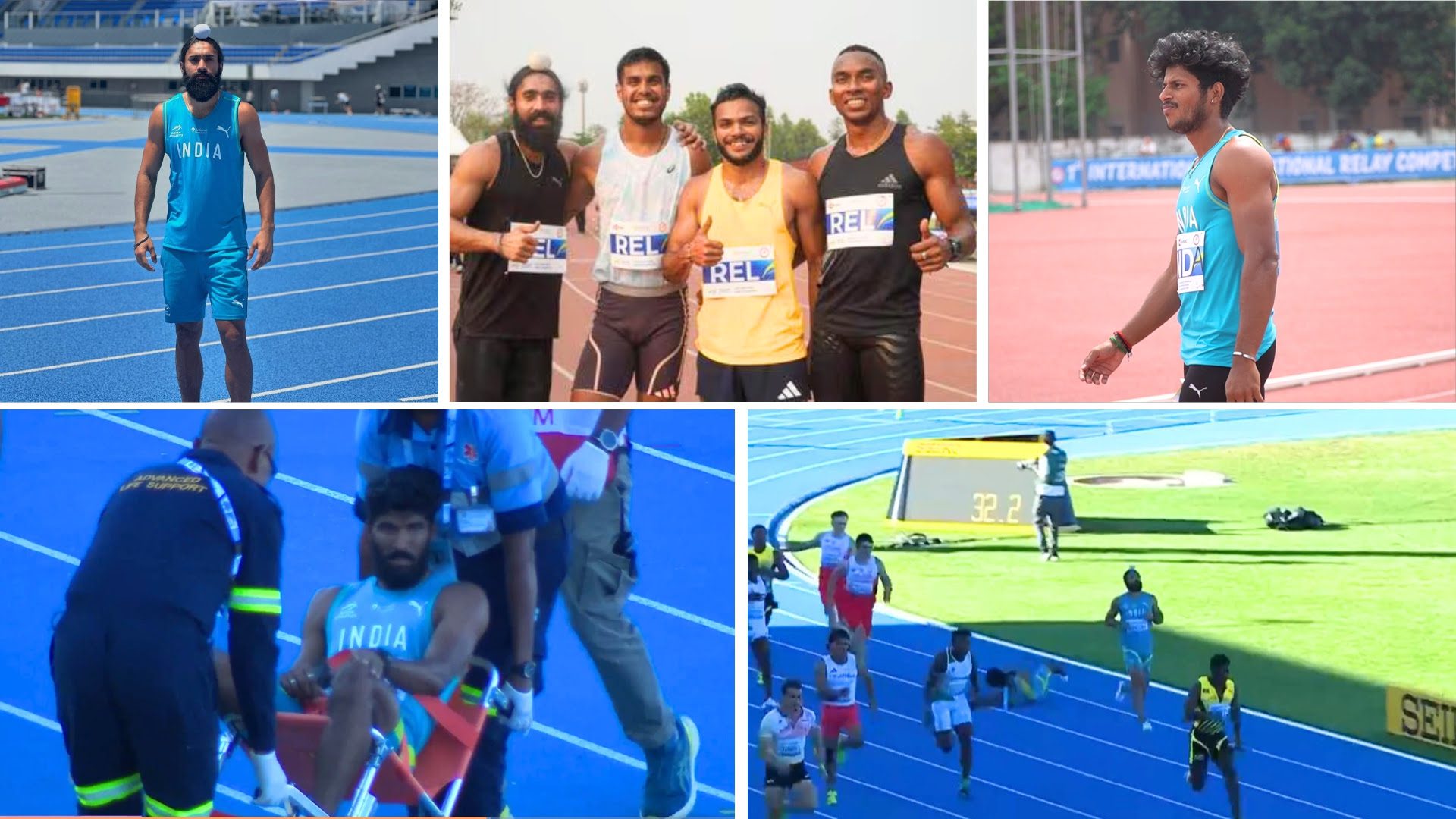
This explosive depth ignited hope for a competitive men’s 4x100m relay squad. In April 2025, that dream looked tangible when the Reliance-backed quartet of Animesh, Manikanta, Gurindervir, and Amlan Borgohain shattered a 15-year-old national record, clocking 38.69s. Suddenly, India was a genuine medal contender for the 2026 Asian Games.
Instead, what followed has been a story of squandered potential.
Despite a promising win at the Taiwan Athletics Open (38.75s) and promises of “special focus” from AFI spokesperson Adille Sumariwalla, the team has repeatedly found itself in the headlines for the wrong reasons.
In a single year, India was disqualified three separate times under World Athletics Technical Rule 24.7 for passing the baton outside the designated takeover zone:
1. The 2025 Asian Athletics Championships
2. The Open Invitational Relays in Chandigarh
3. Day 2 of the World Relays (following a lacklustre 39.07s run on Day 1)
The recurring technical failures point to a deeper problem. Speaking anonymously to NNIS Sports, a prominent sprint coach blamed the leadership: “The coaching is not up to the mark. That is evident in the way the athletes are exchanging the baton. Team planning has also been poor; there is no consistency in the relay combinations, too much shuffling of running legs, and no proper investment in junior athletes.”
The systemic issues became glaringly obvious during the lead-up to the World Relays. In August 2025, the AFI released a clear selection roadmap. The top six finishers from the 64th National Open Athletics Championships in Ranchi automatically qualified, alongside two wildcard selections based on seasonal merit.
The finalized eight-man squad comprised: Animesh Kujur, Gurindervir Singh, Manikanta Hoblidhar, Pranav Gurav, Harsh, Tamilarasu, Amlan Borgohain, and Ragul.
However, despite the roster being locked in by October 2025, the preparatory camp was inexplicably delayed by nearly five months, only assembling in late February 2026. This left the squad with barely a month of cohesive practice before competing globally.
Furthermore, the appointment of James Hillier, Athletics Director of Reliance Sports (one of the federation’s major sponsors), as the men’s relay coach has raised serious eyebrows regarding a conflict of interest.
“Problems arise when a private company coach is made the national relay coach,” the anonymous coach noted. “They often prioritize the company first, not the nation. This leads to internal conflicts, biased selections, and partiality. You can see the proof in the results.”
An anonymous national team sprinter echoed these concerns, stating that housing the camp at a private organization’s venue made several athletes feel “left out and cornered,” severely damaging team chemistry.
This lack of coordination spilled over into public view during major events. At the 2025 Asian Athletics Championships, a selection dispute erupted between Chief Coach Radhakrishnan Nair and Hillier regarding the heat’s lineup, specifically over whether to include Federation Cup champion Pranav Gurav.
Similar friction occurred at the Chandigarh Open Invitational. While the women’s team arrived early and repeatedly requested joint baton practice sessions, the men’s lineup was finalized so late that it derailed overall preparations.
“Right now, every athlete seems focused on outperforming each other individually,” the anonymous sprinter revealed. “In such an environment, how can they come together and run as one unit for the country? Why are the same athletes repeatedly being rotated between the men’s relay and mixed relay teams? Why not provide opportunities to younger athletes?”
The athlete urged the federation to transition to a long-term, accountable training camp system identical to India’s highly successful 4x400m program, overseen by an accountable Indian head coach.
Compounding the administrative chaos is a sudden medical crisis. With less than four months until the 2026 Asian Games, the squad is decimated by injuries:
Amlan Borgohain: Yet to open his season due to injury.
Manikanta Hoblidhar: Recovering from his hamstring injury
Ragul: Left the track in a wheelchair after a heavy fall during a baton exchange.
Tamilarasu: Sidelined during World Relays due to knee pain.
Out of the original eight-man squad, only four athletes remain fully fit.
India possesses the raw, individual speed to match Asia’s best. But facing elite, highly disciplined legacy squads from Japan, China, and Thailand, the biggest question now is whether the AFI can repair its broken internal systems before the clock runs out.
India’s men’s 4x100m relay team is set to return to international competition at the Saudi Athletics Grand Prix, scheduled for May 15-16, 2026, at Princess Nourah University in Riyadh, Saudi Arabia. The meet is part of the World Athletics Continental Tour Bronze circuit and is expected to attract a competitive field from across Asia and beyond.
The event will mark the Indian relay squad’s first appearance since the disappointing outing at the World Athletics Relays, where the team was disqualified under Technical Rule 24.7 after passing the baton outside the takeover zone. The error ended India’s campaign abruptly despite the team showing promising pace in the buildup to the competition.
The Riyadh meet now presents an important opportunity for the squad to regain rhythm and confidence ahead of a packed international season.
Among the athletes travelling to Saudi Arabia are Gurindervir Singh, Pranav Gurav and Harsh, all of whom will also line up in the men’s 100m individual event. The trio has been part of India’s emerging sprint setup and will be aiming to deliver strong performances against international opposition.
India’s fastest man, Animesh Kujur, is also set to compete and is entered in both the men’s 100m and 200m races.
The meet could prove significant for the Indian sprinters not only in terms of race exposure but also for valuable ranking points and relay preparation. With major continental and global events approaching later in the year, consistent international competition has become increasingly important for Indian athletics.
For the relay team especially, Riyadh offers a chance to move past the disappointment of the World Relays and focus on sharpening baton exchanges and race execution under competition conditions.
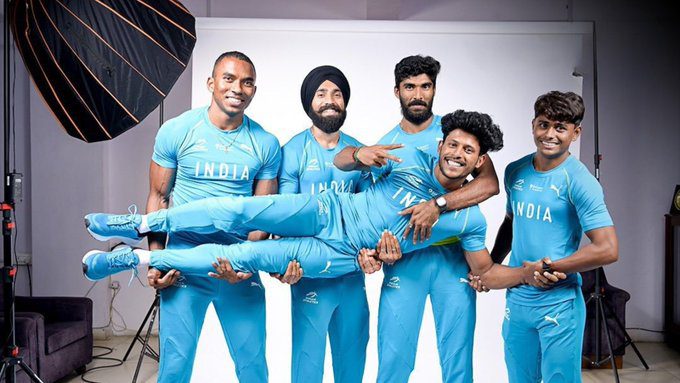
India’s mixed 4x100m relay team created history by breaking the national record at the World Athletics Relays 2026 on Sunday.
The team of Ragul Kumar, Nithya Gandhe, Animesh Kujur, and Sneha SS ran 41.35s, beating the old record of 42.30s. The previous mark was set earlier this year in Chandigarh by Lalu Prasad, Unnathi Aiyappa, Harita Bhadra, and Dondapati Jayaram.
However, despite setting a new national record, India could not qualify for the final or secure a place for the 2027 World Championships in Beijing.
The team finished sixth in their heat and 10th overall, missing out on qualification, as only the top two teams from each heat advanced.
In the mixed 4x400m relay, the Indian team of Theerthesh P. Shetty, Kumari Saloni, Nihal William, and Rashdeep Kaur finished fifth in their heat with a time of 3:19.40, placing 12th overall.
It turned out to be a tough day for India in other events as well.
In the men’s 4x400m relay, the team could not finish the race after Amoj Jacob (second leg) suffered an injury during his leg.
The women’s 4x100m team, consisting of Nithya Gandhe, Tamanna, Sudeshna Shivankar, and Sneh, finished last overall in the heats with a time of 53.90s.
Meanwhile, the men’s 4x100m team of Harsh Raut, Animesh Kujur, Ragul Kumar, and Gurindervir Singh was disqualified due to a failed baton exchange.
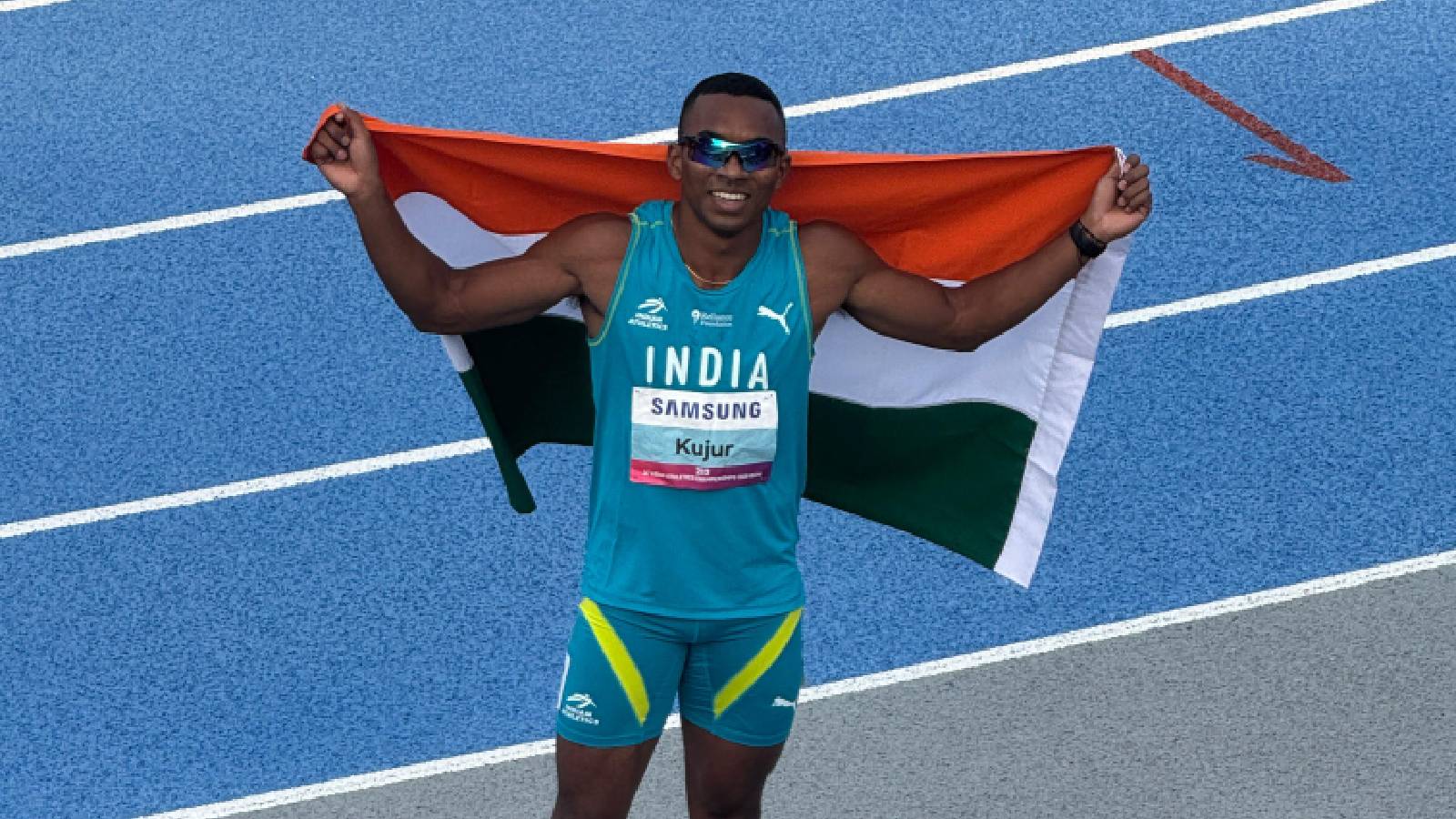
India’s relay teams had a tough start on Day 1 of the World Athletics Relays 2026 in Gaborone, Botswana, as none of the five teams could reach the finals on Saturday.
However, all teams will get another chance on Sunday. They will compete again for a few remaining spots to qualify for the 2027 World Athletics Championships.
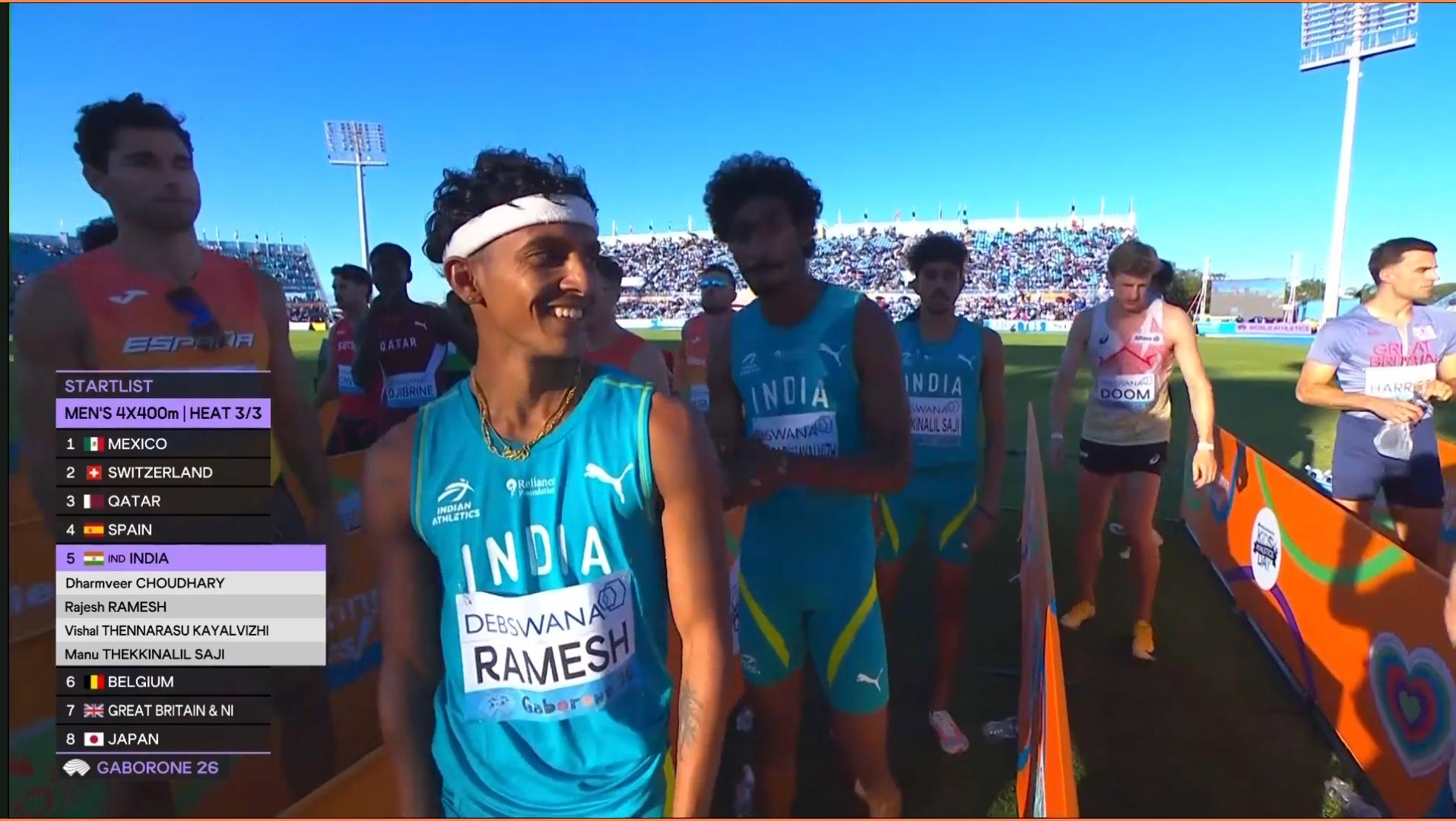
The men’s 4x400m team Dharmveer Choudhary, Rajesh Ramesh, Vishal TK, and Manu TS gave a strong performance. They finished fourth in their heat with a time of 3:00.32 (Season Best).
Rajesh Ramesh, who ran the second leg, even took the lead for a short time. Vishal TK, running the third leg, stayed close with the top teams. But in the end
Manu TS couldn’t maintain the pace, India finished behind Belgium, Qatar, and Spain, placing 12th overall and missing out on the final.
In this event, only the top teams from each heat and the next fastest teams move to the final and directly qualify for the 2027 World Championships.
The other teams, including India, will race again on Day 2. This time, only the top two teams from each heat will qualify.
Earlier, the mixed 4x100m relay team S. Tamilarasu, Nithya Gandhe, Animesh Kujur, and SS Sneha could not finish their race. The baton slipped from Kujur’s hand during the exchange.
The mixed 4x400m team Theerthesh Shetty, Ansa Babu, Amoj Jacob, and Rashdeep Kaur finished sixth in their heat with a time of 3:16.00.
In the women’s 4x100m relay, Tamanna, Nithya Gandhe, Sudeshna Shivankar, and SS Sneha finished fifth with a time of 43.97 seconds.
The men’s 4x100m team Harsh Raut, Ragul Kumar, Animesh Kujur, and Gurindervir Singh, finished last in their heat, clocking 39.07 seconds.