





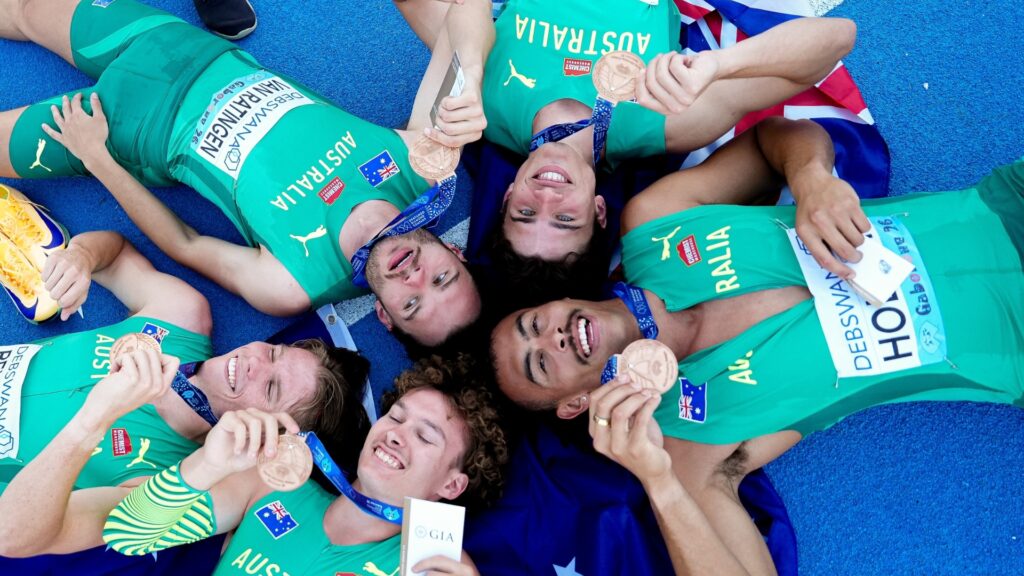
In the space of just a few seasons, Australia has engineered one of the most dramatic relay transformations in global athletics — culminating in a historic showing at the World Relays, where they became the *only nation to qualify all six relay teams* for the 2027 World Championships in Beijing. What makes the achievement even more striking is the speed of the rise: from a fringe relay nation to a record-breaking powerhouse in barely an Olympic cycle.
The campaign was defined by four national records, each underpinned by a new generation of athletes hitting peak form together. The men’s 4x100m team equalled the national record at 37.87, driven by the explosive speed of Rohan Browning, whose Olympic semifinal run in Tokyo marked him as a global contender. Alongside him, Australia’s sprint depth — featuring athletes like Oli Hoare and rising domestic talents — has turned the relay into a genuine medal prospect rather than an outside hope.
The biggest statement, however, came in the longer relays. The men’s 4x400m squad shattered the national record with 2:55.20, powered by a deep pool of sub-45-second runners. Athletes such as Lachlan Kennedy and Alex Beck have anchored a unit that blends raw pace with tactical composure — crucial in an event where positioning and splits often decide outcomes.
Australia’s women have been equally central to this surge. Ellie Beer, a World U20 medallist, has emerged as a cornerstone of both the women’s and mixed 4x400m teams, combining strength over the final leg with remarkable consistency. In the sprint relays, Bree Rizzo brings elite-level experience from global finals, helping stabilise baton exchanges in high-pressure situations.
The mixed relays — often the most unpredictable — showcased Australia’s depth and adaptability. The 4x400m mixed team clocked a national record 3:10.57, while the mixed 4x100m posted 40.78, both results reflecting a system where athletes are comfortable switching roles and maintaining performance across formats.
Crucially, this success is not accidental. Australia has invested heavily in relay-specific preparation — from dedicated baton camps to data-driven exchange optimisation — ensuring that individual talent translates into collective performance. That cohesion was evident in every race.
To qualify all six relay teams is rare; to do so while rewriting national records signals something bigger. And with Beijing on the horizon, this rapidly assembled generation now carries not just momentum, but genuine medal expectations.