





By Sundeep Misra
It was one of those evenings, June 24th, that came full of surprises, records, underlined by courage, speed, strength, the very idea that to venture out, throwing a line deep into the beyond like a hopeful angler, would not only bring a catch but reward you for sheer persistence and grit.
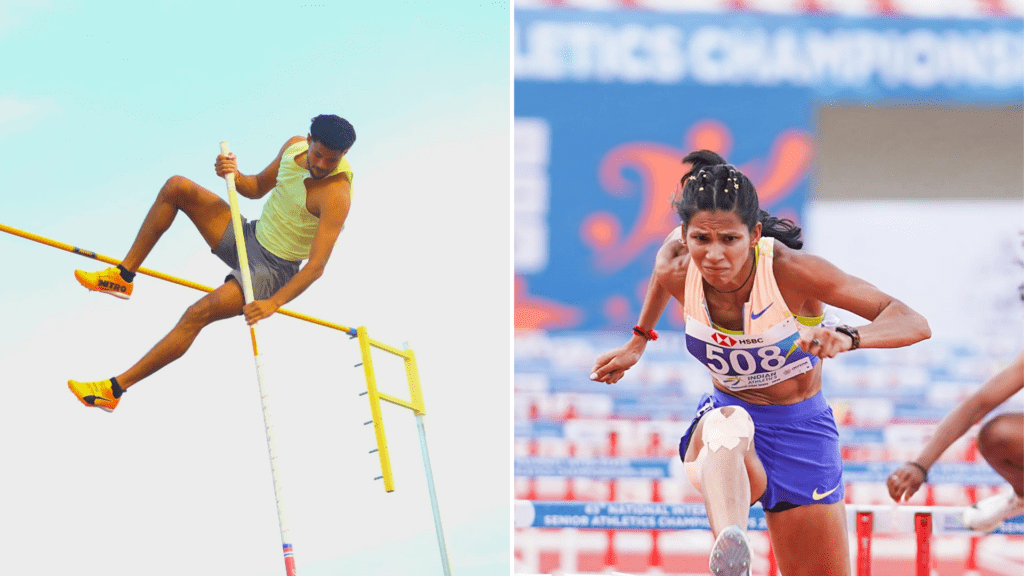
Otherwise, how would Dev Meena vault 5.46m for a new national record? If you were standing by the pit, watching the fiberglass pole bend against the floodlit sky, you would mutter to yourself, “You don’t coach that final clearance. That is defying gravity.” For pole vaulters around the globe, it’s always about trusting the runway, the grip, and the thousands of hours you spent, watching your surroundings while falling down from across the bar.
How else would Jyothi Yarraji, coming back from the uncertainty of injury, dominate and qualify for the 100m hurdles, possibly finding a fierce new competitive spirit in fellow hurdler Nandhini? In reality, the track doesn’t care about your previous records or even your injuries. It demands rhythm. Stopping the clock at 12.99sec, picking up the Inter-State gold, pocketing the Asian Games spot, along with Nandhini, Yarraji, kept the dream going.
Then came the absolute stunner from the cage. An 18-year-old girl from Uttar Pradesh, Anushka Yadav, stepped onto the concrete ring and completely shattered the quiet of the nondescript hammer throw community with a massive national record of 67.02m, booking her flight to Nagoya. “They call us nondescript because no one sees us training in the dust of UP,” her father and coach Sushil Yadav remarked, his voice barely a murmur but thick with raw emotion. Anushka’s throw did more than create a record; when that iron sphere cut through the heavy, humid air, it carried with it the dream of every village academy in the country.
There is nothing quite like track and field with its battle with a clock, trying to hold the sprinting seconds, minutes, and hours in your grasp, the throw filling the humid air ensuring metres stretch themselves out. It is the triumph of not the athlete alone; it is the victory of a Ghanshyam Yadav, an Angel Garcia, of a Sushil Yadav, of a James Hillier – of countless such coaches under the radar or in the spotlight, weaving and creating dreams for their athletes.
In the bargain, they are inching a nation towards track and field domination, fulfilling a promise every country makes to itself: those rust-coloured tracks, white-lined, don’t just look good. They take you to lands beyond, creating self-belief, gifting you a world that only perseverance and a ton of grit could fetch.
In the humid air of Bhubaneswar, known in ancient times as Ekamra (Sacred Earth), when people then ran for fun, or just ran, it is these athletes in the world today, who instil hope in us. On a synthetic track, in a throwing circle, on a sand pit, the Inter-State is not simply just another athletic meet or an Asian Games trial, but a deeper search for identity, hope, and excellence.
It was an evening that gave wings to hope that India could dream and believe that Olympic success might be more than just the trajectory of a single javelin.