




By Sundeep Misra
It remains one of the most striking paradoxes of modern Indian sporting culture: how an aerodynamic shaft of cased aluminium, weighing precisely 800 grams, shot into the air, in a complex alignment of biomechanical forces, becomes an object of national aspiration.
Yet, we shouldn’t mistake a national obsession, if it’s an obsession, for a mass phenomenon. One thing is sure – the javelin will never be a recreational pastime in India, just as it never became one in Jan Zelezny’s Czech Republic. In Prague or Ostrava, the collective obsession, pulse of the nation belongs to football; Czechoslovakia stops, breathes, and suffers along with the national team’s journeys, especially during the World Cup.
Similarly, the average American teenager, will never pick up a 7.26kg iron ball in their backyard or try and understand its rotational physics and the personalities of Ryan Crouser or Joe Kovacs. In the United States, American football and basketball dominate the grassroots. Yet, when Crouser steps into the circle on a global stage, Olympics or the World Championships, pride sweeps the country.
Leaving aside tennis to a large extent, a cultural movement in non-team sports will never have millions trying to replicate the act; most Olympic sport is stadium-bound, requiring technical expertise and hours of coach-managed sessions. You can’t just walk into a park and start throwing a discus, shotput, javelin or a hammer. Mass participation is never the key, it’s always projection.
It’s important to understand how different societies adopt their solitary icons. Consider Morocco, a nation intoxicated by football, where children grow up worshiping Achraf Hakimi. Yet, Soufiane El Bakkali and Hicham El Guerrouj and Saïd Aouita before him occupy a distinct but different sacred tier of iconography. Moroccan parents or even their sports administrators do not expect the youth to walk away from the football pitch for the lung-burners of the middle, long distance and the 3000m steeplechase. But Bakkali is revered, a massive figure in the Moroccan sports firmament as the man, athlete, warrior who dismantled East African distance running dominance on his own terms; that back-of-the-pack running, chewing up each athlete as he slices his way up to the front of the pack and top of the podium.
The same mechanism works in the global cycling landscape. In Slovenia, football and basketball pull the largest grassroots numbers. Yet, Tadej Pogačar’s historic, yellow-jersey-clad conquests across the alpine peaks of France have turned a gruelling, elite endurance sport into a cornerstone of Slovenian national and cultural identity. Not every Slovenian citizen needs to burst his arteries and climb the mountain passes to claim ownership of Pogačar’s triumph.
Closer home, in the sugarcane belts of western Uttar Pradesh, the suburbs of Meerut, households don’t send their daughters to run barefoot to master the steeplechase water jump. The technicalities of tracking Parul Chaudhary’s training splits are left to the purists. But when she snatched an Asian Games gold in the 5000m in Hangzhou and a silver in the 3000m steeplechase, the region celebrated, pride filling the bylanes of Meerut. Parul’s achievements will not trigger every girl to run on to the synthetic tracks, but it does alter the social imaginary of what a girl from Meerut can achieve.
Olympic sport, especially in India, relies on a rarefied tier of global success. An Olympic gold counts, a World Championship title cements it, and consistent podium finishes across the globe finally make an Indian feel proud that something apart from the swing of a willow bat is making international headlines.
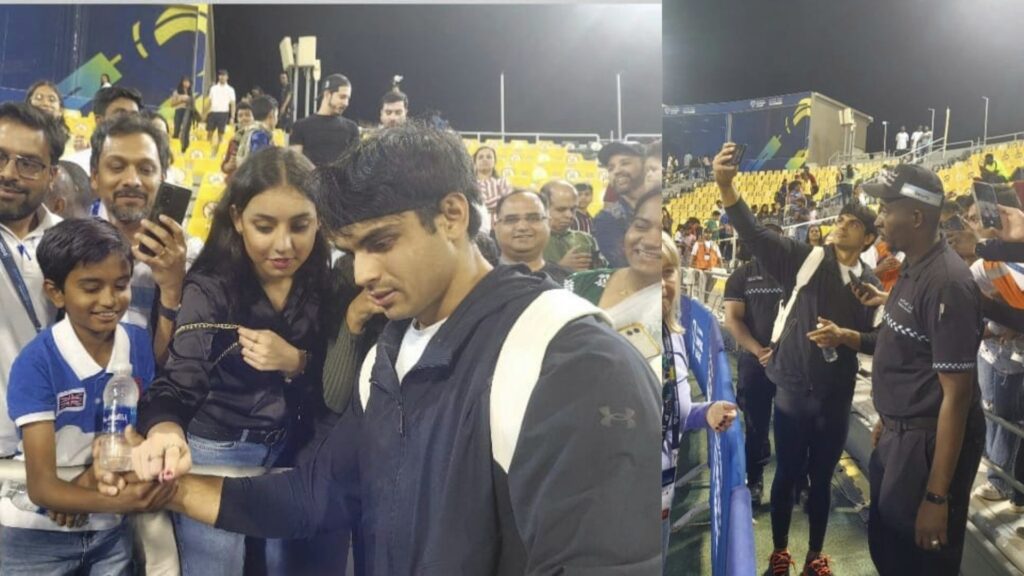
But what truly illustrates it is Neeraj Chopra’s subversion of the typical Indian sporting celebrity archetype. In a landscape where self-glorification is often treated as a sport in itself, be it the athlete, administrator or even the media, Chopra’s deliberate “invisibility”, his aversion to constant validation makes him a fascinating subject. His instinct to “slink back into the shadows” after a monumental effort creates a cultural scarcity. By refusing to feed the beast of public attention, he, knowingly or unknowingly heightens our hunger to watch him compete or understand him inside or outside of his athletic domain.
We don’t know what he will do now, following his fourth-place finish in his recent comeback and successfully securing his Commonwealth Games qualification. Having cleared the selection benchmark with a stable 85.69m throw, the pressure is off. The ‘predictable’ Chopra could easily retreat to his isolated European training base to protect his recovering back and fine-tune his rhythm away from the domestic circus.
Unless, of course, he decides to walk out onto the runway at the upcoming Inter-State Athletics Championships at the Kalinga Stadium in Bhubaneswar. Should he choose to compete at The Kalinga, it will transform a domestic selection trial into a jamboree.
The stadium will not fill up with people who want to pick up a javelin. It will fill up with people who are simply grateful that an athlete of his stature belongs to them. The aluminium spear will always be an elite, solitary, technical, intriguing piece of Olympic equipment. But the pride around it will be collective proving that the javelin outside of the stadium is now an unshakeable piece of our national conversation.