




By Sushant Singh
The Indian Athletics Series–9, which was announced as another opportunity for athletes to qualify for the Commonwealth Games 2026 and, in some events, the U20 World Athletics Championships 2026, concluded at the Guru Nanak Stadium in Ludhiana, Punjab.
It was already known to be a hectic, single-day event and was expected to attract heavy participation because of the qualification significance it carried. Athletes arrived prepared to deliver world-class performances, as that is what is expected of them to qualify for some of the world’s premier competitions. But the organisers appeared to fail to understand that significance or perhaps someone failed to convey the importance of the meet to them.
As per the schedule, the competition was expected to begin at 5:30 a.m. with the 10,000m race walk and end with the discus.
The mismanagement, however, had begun a day earlier.
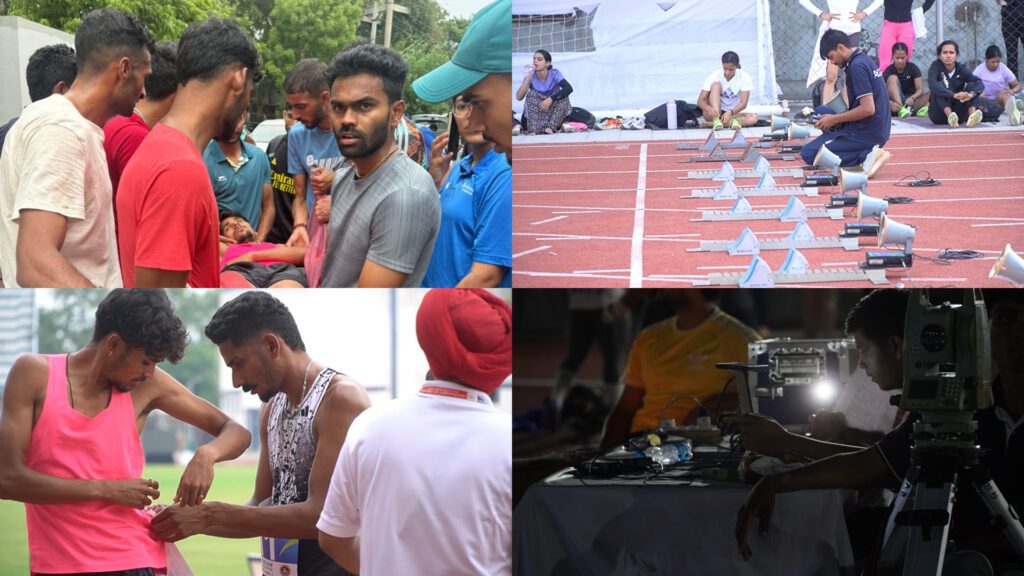
Usually, athletes collect their bibs (chest numbers) a day before competition to avoid unnecessary hassle on the day of the event. This time, they were instructed to collect them on the morning of the competition itself. Even then, the process could have been smooth had it been properly managed. Instead, it became a nightmare, according to athletes who spoke to us.
A support staff member who travelled with some of the athletes said in a subdued voice, clearly disappointed:
“It was a mess. National record holders and elite athletes were made to wait for long hours just to collect their bibs. Rather than finding a solution as time passed, the bib distributors — some inexperienced volunteers — threw all the bibs onto the ground, and athletes had to search for their own in a mountain of bibs.”
He further added:
“It was a scene hard to watch. Once the numbers got mixed up, it became very difficult for athletes to find their own.”
He spoke with disappointment, thanking God he had not brought some more elite athletes who were initially supposed to compete.
An elite coach spoke candidly:
“For viewers, organisers or volunteers, it’s just a bib — a piece of paper with a number written on it, used to identify athletes. But for an athlete, it is a feeling of competition. It is his identity. A bib always holds a special place in an athlete’s heart.”
The bib does hold a special place. In recent years, it has become common to see athletes posing with their bibs after victories, often writing messages on them after winning medals or breaking national records. It may seem insignificant to outsiders, but for athletes, it represents belief before competition and memories after it.
The chaos was evident even on the track. Our cameras captured an 800m athlete wearing two different bibs with similar numbers on the front and back.
The men’s 800m final began, and 2018 Asian U20 champion Anu R started strongly before collapsing in the final 100 metres. What came as a shock was that no immediate medical support arrived, as the medical team and ambulance were allegedly late. Athletes themselves rushed to help him after he collapsed on the track, reportedly suffering severe pain caused by a kidney stone. Later, fellow athletes carried him to the hospital.
A coach, who was watching the livestream from elsewhere, also called and said:
“Athletes travel to different states, paying hefty entry fees just to complete the federation’s mandatory competitions. If something had happened to him, who would be responsible? Everyone carries these worries in their hearts, but who do they talk to?”
Several athletes later came up and said, “These things should be reported. Whose fault is this? Athletes pay entry fees, but in return, they get nothing. Basic facilities like drinking water and clean toilets are sometimes missing from these national meets.”
AFI has already posted a circular on its website stating that if anything happens to athletes during competition, the federation is not responsible.
But the question remains: WHO IS RESPONSIBLE?
The 100m events, which featured more than ten finals and the highest participation numbers of the meet, were delayed due to technical faults not by a few minutes, but by nearly an hour.
Athletes who had already completed their warm-ups were left sitting beside the start line, continuing their exercises simply to keep their bodies warm ahead of the races they had travelled from across the country to compete in.
One athlete joked:
“Agar hum ek minute late ho jayein toh entry nahi milti. Yahan itna late ho raha hai inki wajah se, uska kuch nahi kar sakte.”
In the U20 men’s 3000m steeplechase, a qualifying event for the U20 World Championships, one athlete’s rhythm was broken when a women’s javelin thrower reportedly came into his path during the race.
One former athlete, whose younger brother was competing, messaged us:
“Sir, aap athlete ki awaaz ho. Sir, AFI athletes ke saath bahut galat kar rahi hai. Bas AFI ko paise se matlab hai, sir.”
Even the limited media personnel present at the stadium since morning had no charging ports available to them.
Then came one of the performances of the day.
Tejas Shirse broke the national record, clocking an outstanding 13.27 seconds to breach the Commonwealth Games qualification mark. After the race, he called fellow athletes over. Joined by India’s leading hurdlers, including Krishik M and Madhvendra, they collectively raised concerns with technical officials about the conditions and urged for better organisation at national-level competitions.
They pointed out that no hurdles had been made available for warm-ups. When they moved to the main field to warm up, they were disturbed by trespassers, with no officials present to stop them.
Tejas said, “Sir, this is a Commonwealth Games 2026 qualifier. We have come to Punjab. It is a request to provide these facilities.”
The chaos did not end there.
The shot put and discus events, which were scheduled to begin around 7 p.m., continued without adequate floodlights. Discus throwers could not properly see where their implements were landing after release. Volunteers responsible for measurements raised concerns, saying they were unable to spot the discus in the darkness.
The situation escalated further when officials struggled to conduct measurements accurately. The discus competition was halted after three rounds, with the top eight finalists instructed to return the following day to complete the event.
Another group of discus throwers, who had already begun warming up for their competition, were later informed that their event too had been postponed until the next day.
The athletes from this second group approached us while leaving the premises, frustration evident, but hope still in their eyes. They questioned how they were expected to recover, sleep and return to perform at their best after already consuming caffeine and completing their carefully planned pre-competition warm-up routines.
As per AFI’s website, the federation has an Athletes’ Commission comprising nine members, including Avinash Sable, Neeraj Chopra, Anju Bobby George and Sunita Rani. But who is listening to and finding solutions for athletes who continue to suffer at national competitions?
Ludhiana was supposed to be a stage where athletes chased Commonwealth Games dreams and U20 World Championship berths.
Indian athletics often asks its athletes to perform like professionals on the international stage. The least they can expect in return is an environment that treats them like professionals at home.
If national qualification meets cannot guarantee basic dignity, safety and organisation, the question is no longer whether athletes are resilient enough to overcome adversity.